Instinct Coder 355: On-Prem AI Coding, 85 Devs Per Node
AMD, Dell Technologies and Spectro Cloud announced AMD Instinct Coder 355 on November 10, 2026 at KubeCon + CloudNativeCon North America 2026. It is a turnkey AI coding platform that an enterprise installs inside its own facility, and one node supports up to 85 developers, with 50 concurrent users. The node is a Dell PowerEdge XE9785 server with eight AMD Instinct MI355X GPUs and 3 TB of system memory, running GLM-5.3 locally by default.
The product is the larger sibling of Instinct Coder 325, which arrived in August 2026 for smaller teams. Three months later the same formula returns at a bigger team size, which tells the reader how AMD now frames the category. The unit of purchase is no longer a GPU server plus a separate inference stack. It is a complete coding appliance: server, accelerators, a local model, routing software and governance, sold as one orderable system through Spectro Cloud, resellers and distribution partners.
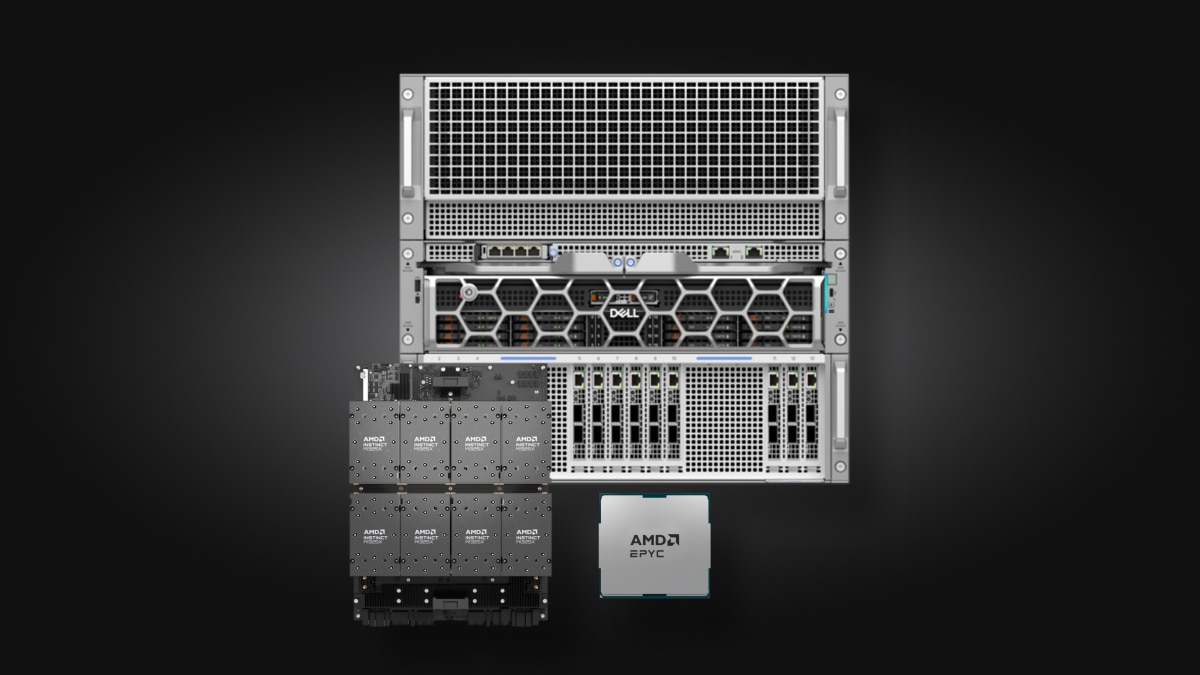
Hardware in One Dell PowerEdge Node
| Component | Specification |
|---|---|
| Server | Dell PowerEdge XE9785 |
| CPU | 2x AMD EPYC 9575F, 64 cores, 3.3 GHz |
| GPU | 8x AMD Instinct MI355X, 288 GB HBM3E and up to 8 TB/s bandwidth per GPU |
| System memory | 24x 128 GB DDR5 RDIMM, 3 TB total |
| Storage | 8x 7.68 TB PCIe Gen5 SSD |
| Local model | GLM-5.3 |
| Software | Spectro Cloud PaletteAI Inference Launchpad |
The memory figures explain the capacity claim. Eight GPUs at 288 GB each give the node a large pool for model weights and KV cache, and the 3 TB of host memory sits behind it for the surrounding platform. Capacity in a shared coding appliance is rarely limited by raw compute alone. Concurrent interactive sessions compete for cache and memory bandwidth, so a vendor that publishes a concurrent user number is making a statement about the whole memory system, not only about the accelerators.
Node Capacity and the 85 Developer Figure
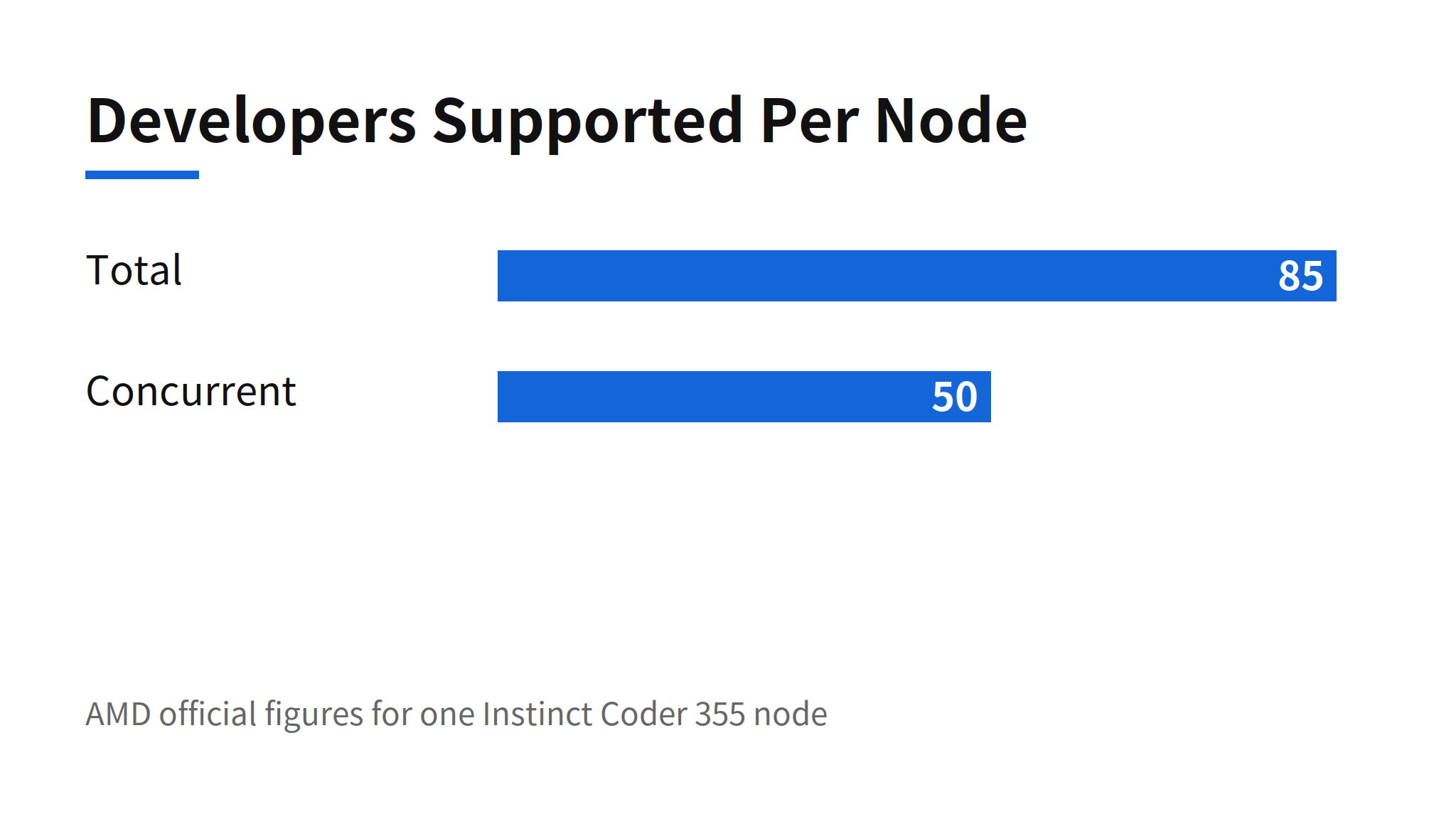
AMD rates one node at 85 developers in total and 50 concurrent developers. That distinction matters for budgeting. A team of 85 does not generate 85 simultaneous inference streams, and the gap between the two numbers is the vendor estimate of realistic overlap. For the first time in this product line, a buyer can do simple division: team size against nodes required, and appliance cost, once pricing appears, against per developer API spending.
The comparison only holds if the local model does enough of the daily work. Routine completion, search and small edits are the volume of enterprise coding traffic, and those are exactly the tasks a local model can absorb. The expensive frontier calls remain for the harder minority, which is why the routing layer, rather than the GPU count, decides whether the capacity figure turns into real savings.
Local-First Routing With Frontier Escalation
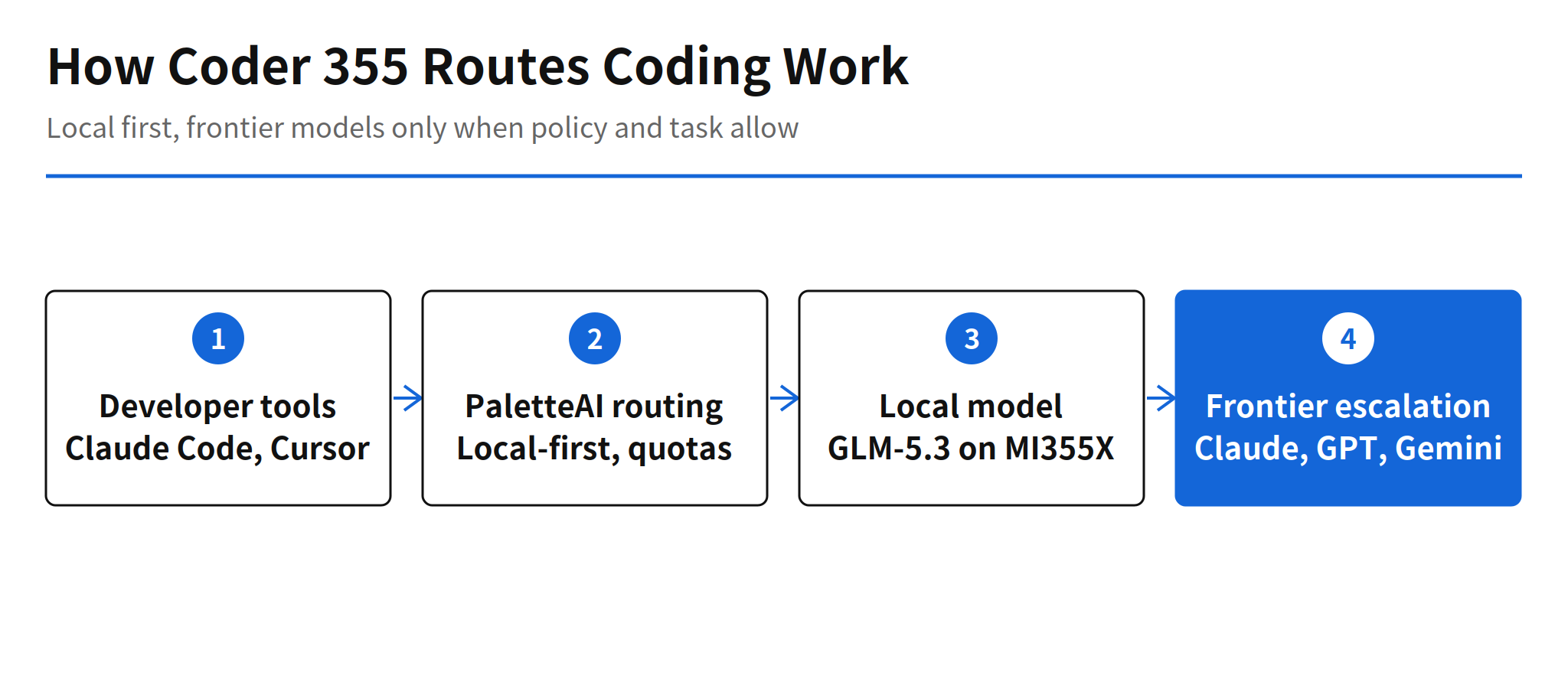
Spectro Cloud PaletteAI Inference Launchpad handles local-first routing, usage metering and quotas, KV cache optimization and governance. Developers keep working in Claude Code, Cursor and Visual Studio Code. The local default model is GLM-5.3, and when a task requires it and company policy allows it, requests can go to Anthropic Claude, OpenAI GPT or Google Gemini.
The appliance does not remove frontier models from the workflow. It changes their position from the default destination for every token to an escalation path for selected work.
That position change is the economic core of the product. Frontier APIs charge per token and require source code to leave the building, which creates both a cost line and a policy problem. A local-first design attacks both at once, but it also creates a new design task for the buyer: the routing policy. Which repositories, task types and users stay local, and which may escalate, is now an engineering decision with direct cost and quality consequences.
Performance and Cost Claims in Context
AMD claims up to 98% of frontier model benchmark performance and up to 75% lower total cost of ownership than cloud frontier models. Both numbers carry the qualifier that defines them: they are vendor claims under AMD footnote conditions, and the public material does not detail the comparison conditions or the measured workloads. A 98% figure without a named workload mix cannot tell a buyer how GLM-5.3 will perform on their own codebase.
The TCO claim has the same limit, compounded by the missing price. A percentage saving against cloud spending is calculable only when the appliance price, its utilization and the escalation rate to paid frontier APIs are all known. None of the three is public today. The honest reading is directional: AMD is confident enough to attach large numbers to the local-first model, and independent measurement is still missing.
Limits and Open Questions
- Pricing is undisclosed. Without an appliance price, no payback period can be calculated and the 75% TCO claim cannot be tested by a buyer.
- Benchmark conditions are undisclosed. The 98% performance claim rests on AMD footnote conditions, and the comparison workloads are not described in the announcement material.
- Local model quality varies by workload. GLM-5.3 coding quality differs across task types, so the share of work that can stay local depends on routing policy design rather than on a single benchmark score.
- Utilization decides the economics. An appliance sized for 85 developers only pays back if a real team keeps it busy. Smaller or bursty teams may still be cheaper on per token APIs.
Related Reading
Coder 355 sits in a wider AMD push to package its stack for agent workloads. See the report on AMD PrimusClaw and its open agent runtime for the software side of that push, and the report on the Cloudflare Codex harness on Durable Objects for a contrasting approach that moves agent infrastructure into a cloud platform instead of an on-premises appliance.
FAQ
What is AMD Instinct Coder 355?
Instinct Coder 355 is a turnkey on-premises AI coding platform from AMD, Dell Technologies and Spectro Cloud, announced on November 10, 2026 at KubeCon + CloudNativeCon North America 2026. It combines a Dell PowerEdge XE9785 server, eight AMD Instinct MI355X GPUs, the GLM-5.3 local model and Spectro Cloud PaletteAI software in one appliance.
How many developers does one Coder 355 node support?
AMD says one node supports up to 85 developers in total and up to 50 developers concurrently. Each MI355X GPU provides 288 GB of HBM3E memory and up to 8 TB/s of memory bandwidth, and the node carries 3 TB of system memory in total.
Which models and tools does Coder 355 work with?
The local default model is GLM-5.3. When task requirements and company policy allow, work can also be routed to Anthropic Claude, OpenAI GPT or Google Gemini. Developers connect through Claude Code, Cursor and Visual Studio Code.
What does Instinct Coder 355 cost?
Pricing has not been disclosed, so the appliance price and any payback period cannot be calculated from public information yet. AMD claims up to 98 percent of frontier model benchmark performance and up to 75 percent lower total cost of ownership than cloud frontier models, and both figures are vendor claims under AMD footnote conditions.