AMD PrimusClaw Release: Open-Source Managed Agent Runtime
AMD open-sourced PrimusClaw on November 6, 2026: a managed agent runtime that runs inside the user's own Kubernetes cluster, next to AMD Instinct GPUs. Managed agent services from Anthropic, AWS, Google, Microsoft and OpenAI all run in the vendor's cloud. An organization that already owns a GPU cluster had no equivalent way to run the harness and the session logs inside its own infrastructure, and PrimusClaw is AMD's answer to that gap.
The license is MIT, with one exception. The sandbox control plane is Apache-2.0 code forked from agent-sandbox, a Kubernetes SIG Apps project. AMD also says the system is not a fresh prototype: it has run in internal production since April 2026, and the published numbers come from two real deployments.
Three Parts in One Repository
PrimusClaw combines three components in a single repository. A session store keeps the state of each run, an agent harness executes the agent loop, and a per-session sandbox isolates the work each session performs. The split matters because the three parts fail in different ways: sessions need durable records, harnesses need to be replaceable, and sandboxes need to be disposable.
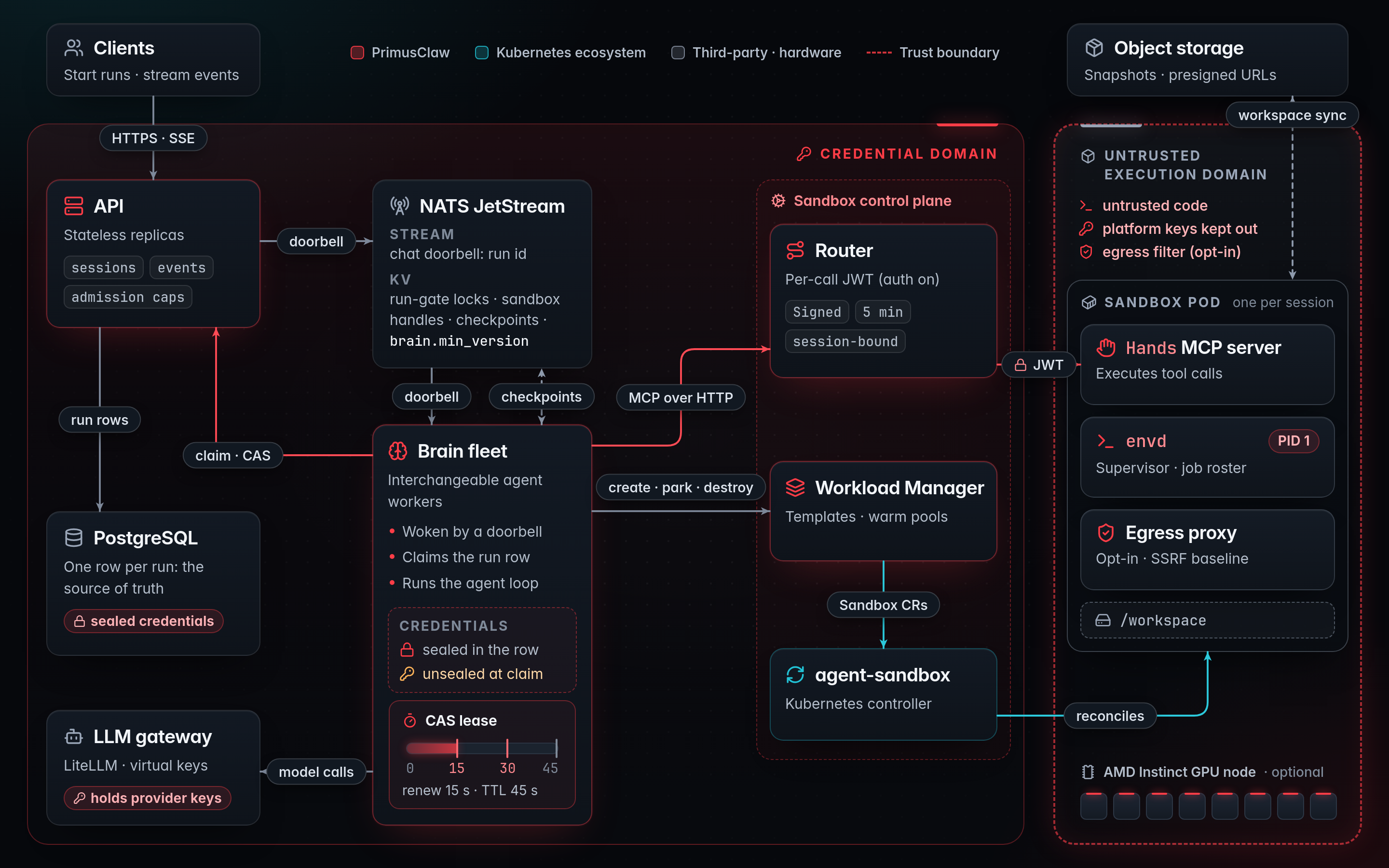
The architecture diagram from AMD's announcement shows how the pieces connect. Stateless API replicas write one database row per run, a fleet of interchangeable harness workers claims those rows, and a sandbox control plane manages one pod per session inside a separate untrusted execution domain. Platform credentials stay on the trusted side of that boundary, and model calls leave through an LLM gateway.
Production Numbers From Two Internal Deployments
AMD reports more than 40,000 sessions for more than 70 users across the two deployments, along with more than 100,000 hours of agent execution, more than 4 million tool calls and more than 500 billion prompt tokens. The median run on the main deployment lasted 3.4 hours, and at the June 2026 peak more than 800 runs executed at the same time.
Those figures describe a workload shape, not just a scale. A median run of 3.4 hours means the typical session outlives deploys, node maintenance and individual worker failures, so the runtime has to treat interruption as routine rather than exceptional. AMD collected the numbers from the deployments' databases and runtime metrics between April 20 and October 13, 2026. Every figure is AMD's own accounting, and no independent verification exists.
Leases and Checkpoints Instead of Sticky Workers
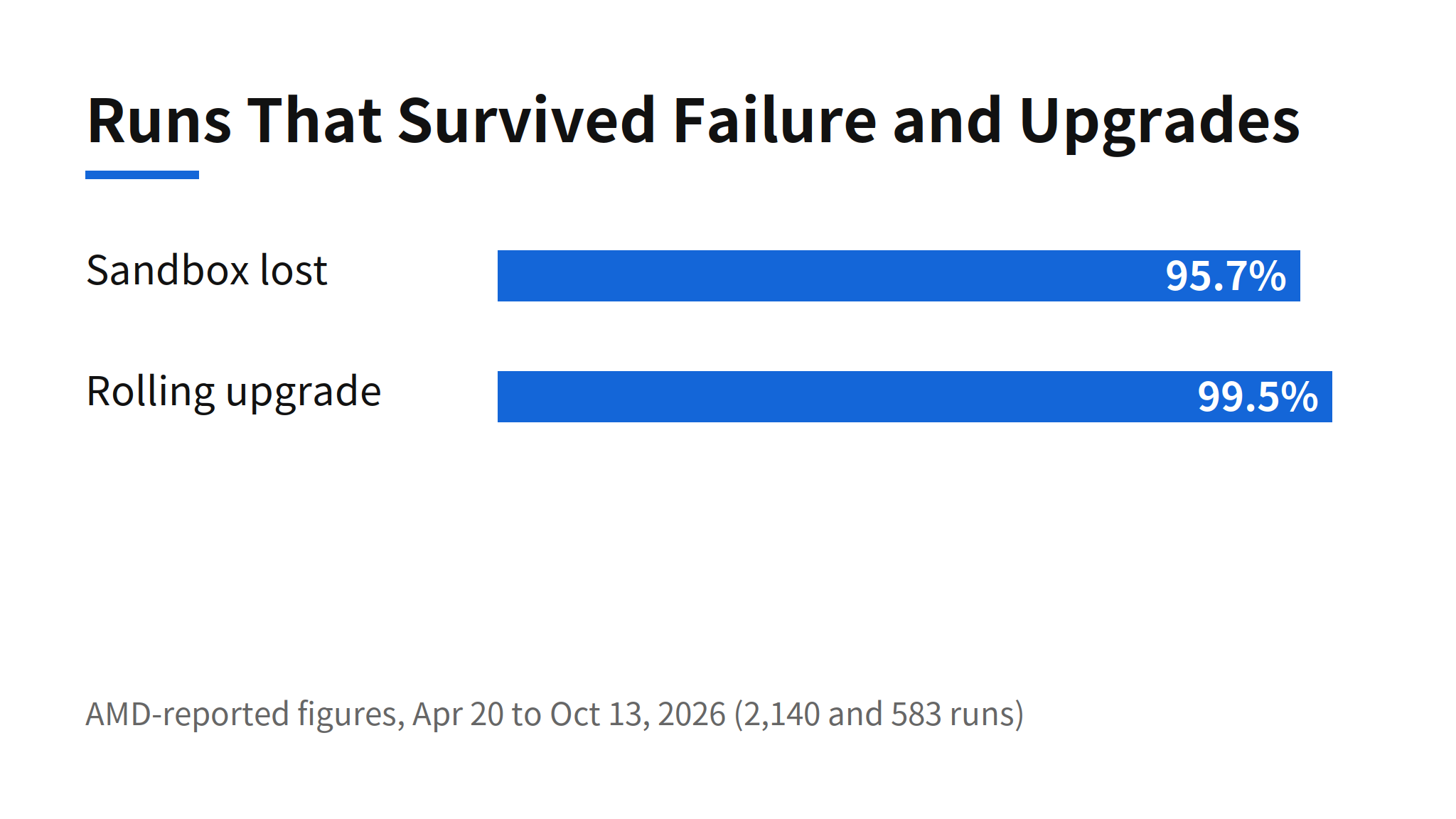
A PrimusClaw run is not pinned to a specific worker. Chat turns are distributed as database rows under a lease, with a default TTL of 45 seconds renewed every 15 seconds. If a harness replica disappears, another replica takes over the run from a checkpoint instead of restarting hours of work.
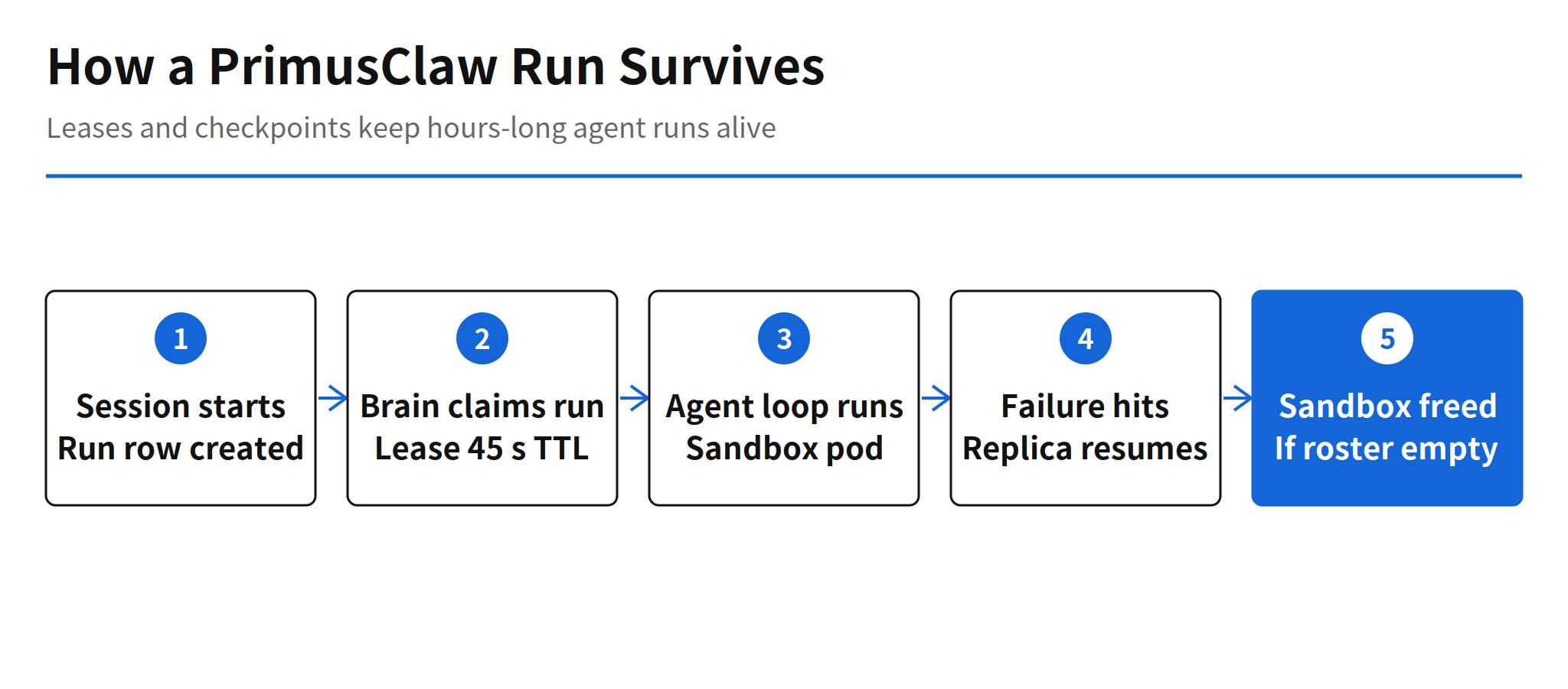
The durability results AMD reports are the practical test of that design. Of 2,140 runs that lost their sandbox, 2,047 (95.7%) still succeeded. Of 583 runs that passed through three rolling API upgrades, 580 (99.5%) ran to completion. The remaining gap is worth noting: roughly one run in twenty did not survive losing its sandbox, so checkpoint recovery is a strong default rather than a guarantee.
Interfaces Built for Existing Agent Workflows
PrimusClaw exposes an API compatible with the Claude Managed Agents quick-start flow, supports A2A v1.0 and bidirectional MCP, and routes model calls through an Anthropic or OpenAI-compatible gateway. The compatibility choices lower the cost of trying it: an existing managed-agent client does not have to be rewritten around a proprietary protocol first.
The workload AMD leads with is GPU optimization. Agents such as Hyperloom and GEAK, which tune GPU kernels, run as PrimusClaw sessions. That placement is the point of the design: an agent that optimizes a GPU may need to run for hours, and it runs best beside the GPU it is optimizing instead of in a distant vendor cloud.
Isolation and Deployment Caveats
The default sandbox runtime is runc, which shares the host kernel and is not a strong isolation boundary. VM isolation through Kata Containers is an opt-in hardening setting, and session binding tokens and the egress filter proxy are also opt-in rather than defaults. A team running untrusted code should treat those options as required configuration, not extras.
Deployment has a prerequisite of its own. A production install needs a Primus-SaFE endpoint, which handles authentication and GPU placement; only an isolated evaluation cluster can run without it. Idle sandbox reclamation is conservative as well: the runtime checks the running job roster and reclaims a sandbox only when the roster reads empty, keeping the sandbox whenever the check cannot confirm. GPU cost savings will therefore vary by workload.
Related Reading
For the hosted counterpart from another vendor, see the earlier report on Mistral Studio managed agents and apps. For the setup problem that managed runtimes also absorb, see Claude Code cloud sessions setting up their own environment.
FAQ
What is PrimusClaw?
PrimusClaw is AMD's open-source managed agent runtime, released on November 6, 2026 under the MIT license. It packages a session store, an agent harness and a per-session sandbox in one repository, and it runs inside the user's own Kubernetes cluster next to AMD Instinct GPUs.
How does PrimusClaw keep long runs alive?
A run is not tied to a specific worker. Chat turns are distributed as database rows under a lease with a 45 second TTL renewed every 15 seconds, and if a harness replica disappears, another replica resumes the run from a checkpoint.
Which agent interfaces does PrimusClaw support?
PrimusClaw supports an API compatible with the Claude Managed Agents quick-start flow, A2A v1.0 and bidirectional MCP. Model calls go through an Anthropic or OpenAI-compatible gateway.
Is the PrimusClaw sandbox strongly isolated by default?
No. The default sandbox runtime is runc, which shares the host kernel and is not a strong isolation boundary. VM isolation through Kata Containers, session binding tokens and the egress filter proxy are opt-in hardening options.