Claude Code Cloud Auto Setup: Plans and How It Works
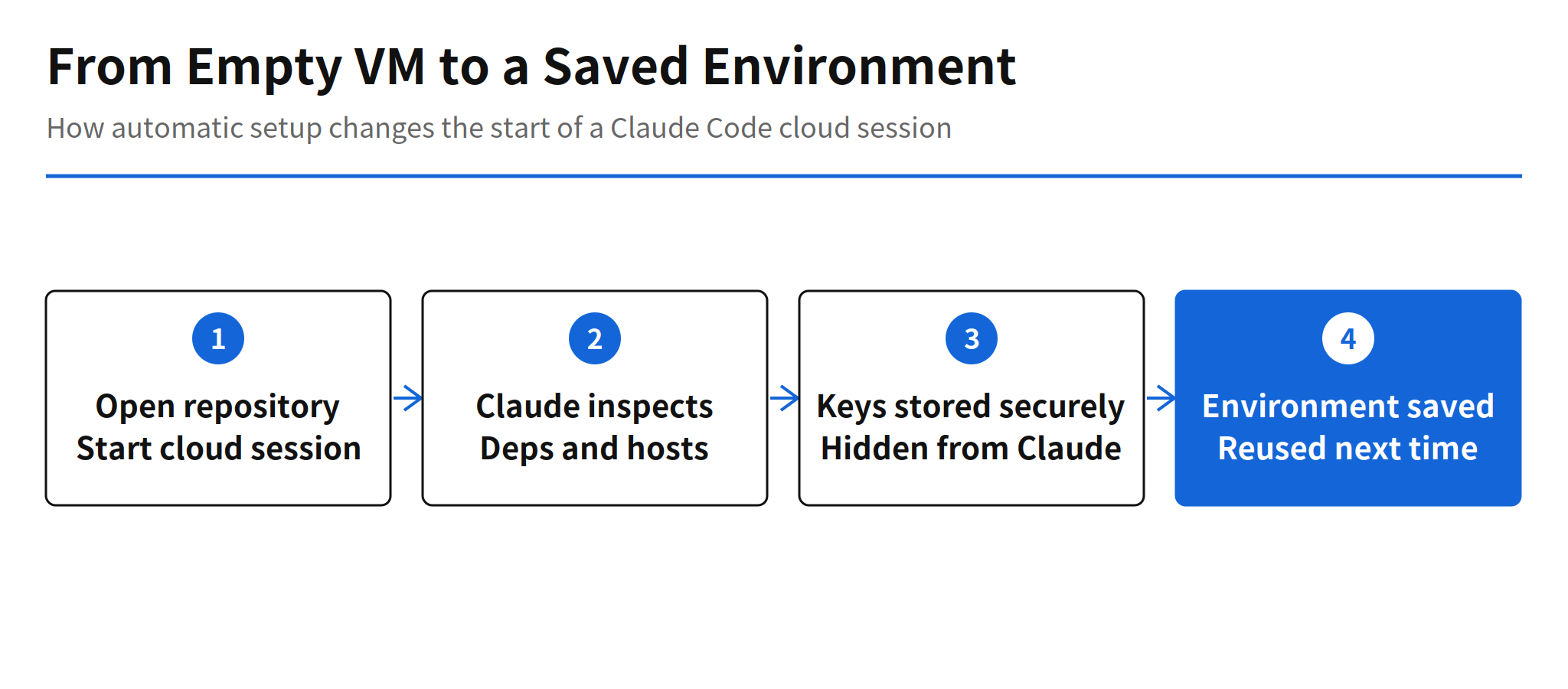
Anthropic developer account @ClaudeDevs announced automatic environment setup for Claude Code cloud sessions on November 6, 2026, at 19:58 UTC. Claude now works out the dependencies, network access and API keys a repository needs on its own, and saves the result. The next session reuses the saved environment instead of starting from a blank configuration.
The announcement names three plans: Pro, Max and Ultra. It also puts the secret handling in plain terms. API keys are stored securely, and Claude cannot see them. That pairing is the core of the release: the agent takes over the tedious part of environment setup, while the credentials stay outside the agent's view.
The Empty Default Environment It Replaces
Until now, the starting point for a cloud session was the default environment, which the Claude Code documentation describes as an empty configuration: no environment variables and no setup script defined. A repository that ran fine on a local machine could stall in a clean virtual machine over one missing dependency or one blocked host, and a person had to fill in the setup before any real work began.
Automatic setup moves that preparation from the user to Claude. Instead of a person opening a settings screen first, Claude inspects the repository, determines what it needs, and persists the environment. For teams that run coding agents in the cloud as a routine, this removes a repeated per repository cost that had little to do with model quality and everything to do with plumbing.
Key Handling Outside the Session
The documentation already describes a related structure called network secrets. Under that design, Anthropic's agent proxy attaches a key to a request after the request has left the session VM, so the key itself never lives inside the VM. That is a sensible architecture for automatic setup, because an agent that provisions its own environment still never holds the credentials it provisions.
One caution applies. The announcement does not state that automatic setup uses the network secrets mechanism, and the similarity between the post and the documentation is not a confirmation. As of November 7, the documentation page still described manual setup only. Teams handing production credentials to this flow should inspect the saved environment directly before trusting it, since the post also does not say whether each stored host and key gets an individual approval step.
Open Questions on Detection and Plan Coverage
Three details remain unconfirmed. The first is the detection method: which files Claude reads, and by what criteria it selects dependencies and hosts, is not described. The second is approval: whether users confirm each saved host and key item by item is not stated in the post. The third is plan coverage: the announcement lists Pro, Max and Ultra only, and while the documentation indicates network secrets can be used on Team and Enterprise plans, automatic setup for those plans is not confirmed.
None of those gaps cancels the direction of the change. Read next to Claude Code v2.1.319, which refined permission handling while a session runs, this release automates the preparation that happens before a session starts. The bottleneck for cloud coding agents is shifting from whether the model can do the work to how little human setup stands between a request and the first task.
Related Reading
For the in session counterpart to this release, see the report on Claude Code 2.1.319 and its background MCP tasks. For another cost removed from the Claude Code workflow, see the background subagent status cost cut of about 99 percent.
FAQ
Which plans get Claude Code cloud auto setup?
The announcement from @ClaudeDevs names the Pro, Max and Ultra plans. Whether Team and Enterprise plans are included is not confirmed in the announcement.
What does Claude figure out during automatic setup?
Claude works out the dependencies, network access and API keys a repository needs, then saves that environment so the next session does not have to rebuild it.
Can Claude see the API keys it sets up?
No. The announcement states that API keys are stored securely and that Claude cannot see them. The Claude Code documentation describes network secrets being attached by an agent proxy after a request leaves the session VM, although whether auto setup uses that exact mechanism is unconfirmed.
Where can a cloud session be started?
According to the Claude Code documentation as reported in secondary coverage, cloud sessions can start from claude.ai/code, the desktop app, the mobile app, or claude --cloud in the terminal.