Claude Code Background Subagents: Status Cost Cut by 99%
Anthropic announced on November 4, 2026 that background subagents in Claude Code now use less of the usage limit. The change targets a small, constant cost: the status line of a running background subagent is rewritten every 30 seconds, and until now each rewrite reread the entire conversation. Status lines are now written by Haiku 5.5 from a short note, and Anthropic puts the cost per update at about 99 percent lower.
The subagent itself is untouched. Its model, its tools and its work stay the same, and only the component that reports progress changes. That distinction is the interesting part of this release. The saving does not come from a better coding model. It comes from removing a bookkeeping request that had quietly become one of the most expensive lines in long agent sessions.
The Cost Users Measured First
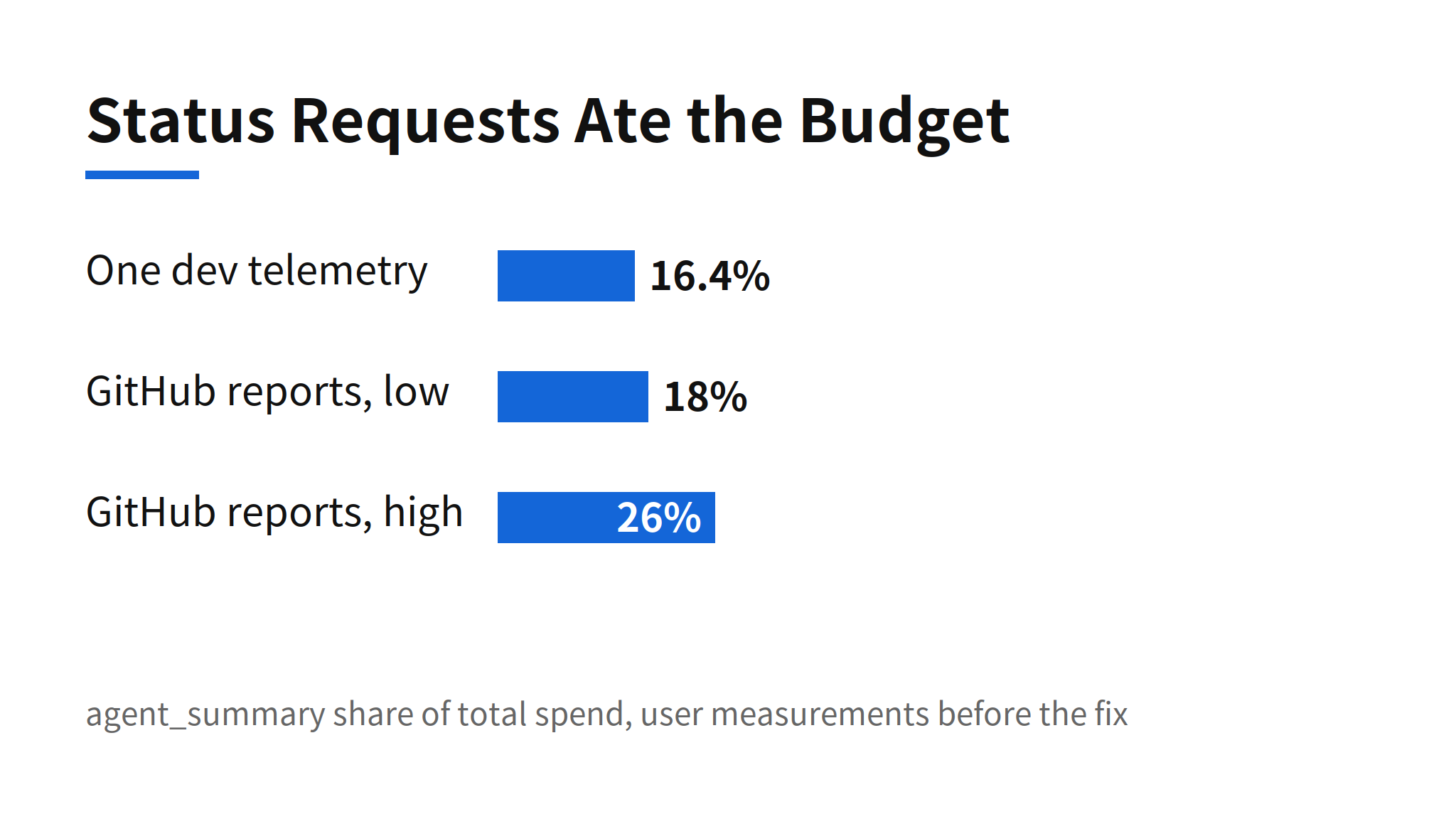
Status line cost became a user complaint in late October, before Anthropic shipped anything. One developer measured the traffic with telemetry and found status requests, labelled agent_summary, taking 16.4 percent of total spend. Measurements collected in GitHub issues put the share at 18 to 26 percent. For a feature that only tells the user what an agent is doing, a fifth to a quarter of spend was hard to defend.
An Anthropic engineer confirmed the mechanism behind those numbers at the time: the system sent the full conversation history again every 30 seconds to produce a short status text. The promised remedy was exactly the one that shipped, sending a short note to a small model instead. This release is therefore less a surprise feature than a kept promise, and the public measurements give it a baseline that most cost optimizations never get.
The New Status Writing Flow
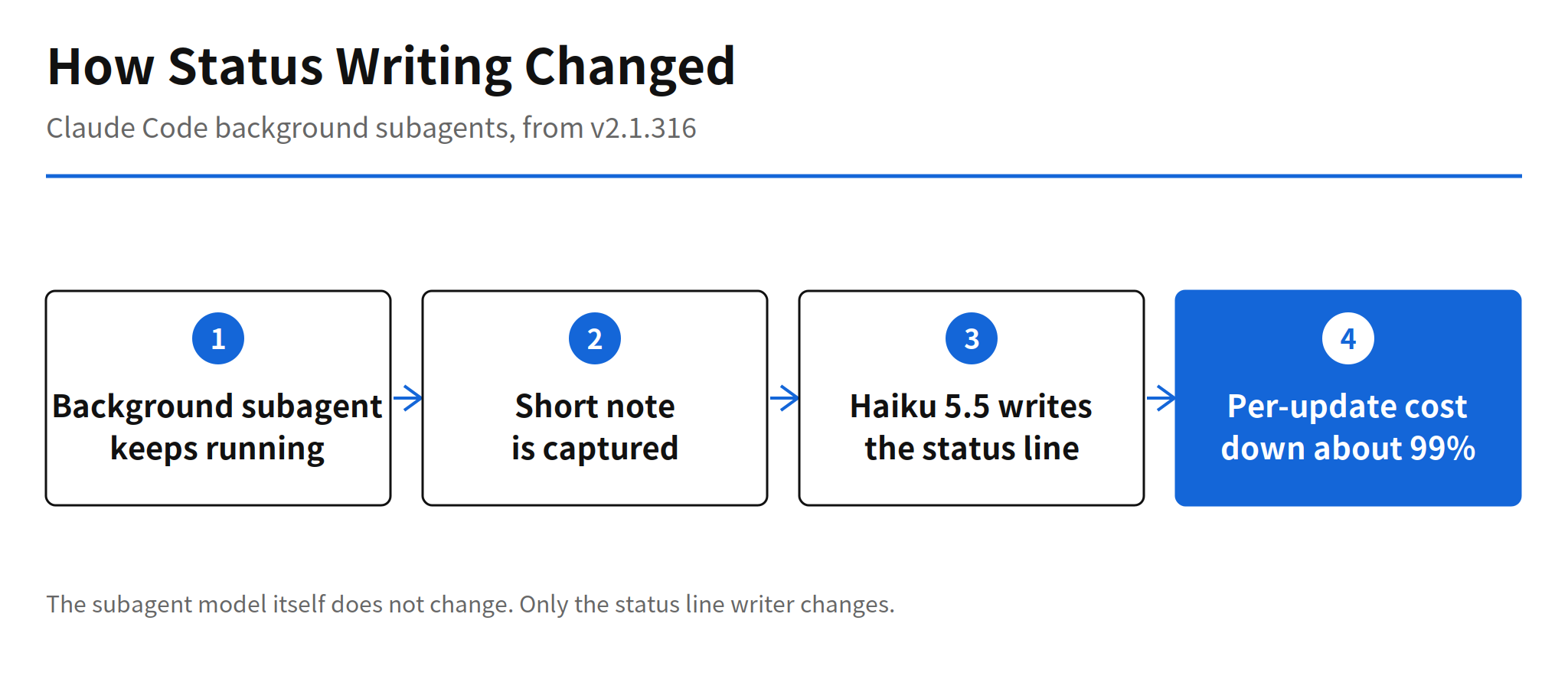
The new design separates two jobs that the old design bundled. The subagent keeps doing its work with its own model, while the status line becomes a summarization task with a small input and a small model. A short note is a far cheaper input than a full transcript, and Haiku 5.5 is a far cheaper writer than the main session model. The 99 percent figure follows from shrinking both sides of that request at once.
There is a general lesson for agent builders in this shape. Long running agents generate a steady stream of auxiliary requests: progress reports, summaries, routing decisions and state checks. Each one looks trivial in isolation. Repeated every 30 seconds across a long session, an auxiliary request with a full context input becomes a primary cost. Routing those requests to a small model with a distilled input is a structural fix, and it preserves the expensive model for the work only it can do.
Coverage and Version Requirements
The change applies to most Pro, Max and Ultra users and to all Team and Enterprise users, according to the announcement. Users need Claude Code version 2.1.316 or later. The scope is the CLI only. Anthropic's explanation, relayed in coverage of the announcement, is that the desktop app does not write status lines in the same way, so there was nothing to change there.
The headline session figure needs reading carefully. Sessions that use background subagents consume about 5 percent less of the overall usage limit, and Anthropic converts that into about 6 percent more prompts on the same limit. A user who rarely runs background subagents should expect little change, because the cost being removed only exists while a subagent is running and reporting. The benefit concentrates exactly where the pain was: long sessions with agents working in the background.
Unverified Figures and Open Questions
Three gaps stand out. First, the announcement frames the saving around subscription usage limits and says nothing about API pay-as-you-go usage, so that case stays unconfirmed. Second, Anthropic has not described what goes into the short note, which leaves open whether a note based status line can be less accurate than one written with the full conversation in view. Third, the user measurements that exposed the problem, 16.4 percent and the 18 to 26 percent range, now offer a clean test: the same telemetry, rerun after updating, should show the agent_summary share collapsing if the fix performs as announced.
Even with those caveats, the direction is clear. As coding agents run longer and in parallel, the cost of watching them work becomes a real budget line, and this is the first prominent case of a vendor measuring that overhead in public, admitting its size and engineering it down. Teams building their own agent harnesses have the same audit to run: find the requests that repeat on a timer, check what share of spend they take, and give them a smaller input and a smaller model before scaling the fleet.
Related Reading
For another take on running agents in the background, see agent-autoloop: Background CLI Agents With Decision Cards. Earlier Claude Code releases are tracked in the Claude Code v2.1.317 report and the v2.1.302 fork subagent report.
FAQ
What changed in Claude Code background subagents?
The model running each background subagent did not change. The status line, refreshed every 30 seconds, is now written by Haiku 5.5 from a short note instead of being produced after rereading the whole conversation each time.
How much cheaper is each status update?
Anthropic says the cost per status update fell by about 99 percent. Sessions that use background subagents use about 5 percent less of the overall usage limit, which Anthropic calculates as room for about 6 percent more prompts on the same limit. Both figures are Anthropic numbers and have not been independently verified.
Who gets the change and which version is required?
The change covers most Pro, Max and Ultra users and all Team and Enterprise users. It applies to the Claude Code CLI at version 2.1.316 or later. The desktop app is not included because it does not write status lines in the same way.
Does the saving apply to API pay-as-you-go billing?
The announcement does not say. The figures it gives are framed around subscription usage limits, so the same saving for API pay-as-you-go usage is unconfirmed.