agent-autoloop: Background CLI Agents With Decision Cards
KKKKhazix published agent-autoloop on GitHub on November 3, 2026. The project runs command line agents in the background: the agent keeps working on its own, and the user is pulled in only at moments that need a judgment, which arrive as a decision card. It is a small automation kernel rather than another agent, written in TypeScript and released under the MIT license.
The problem it targets is the default posture of tools like Claude Code and Codex. They are normally used with a person sitting at the terminal, watching. Close the window or walk away and the work stops. agent-autoloop moves that supervision into the structure itself: routine progress stays in the background, human attention is spent only on decisions, and the whole setup runs on one local machine with no cloud server and no public port.
Release Overview
The repository reached 2,179 stars at observation time, roughly a day after it was created. That speed says the pain point is real and widely shared, although it says nothing yet about sustained use: no independent tests or user reports had been confirmed at the time of the release coverage. The same author previously published AIHOT, tracked here as a separate release, and agent-autoloop applies the same build-in-public energy to a different layer of the agent stack, the operations layer rather than the model or the prompt.
The design splits into a lightweight kernel and plugins. The kernel handles task scheduling and carries no external dependencies. Everything that varies between users sits in plugins: event sources, agents, notification channels, and deployment pipelines can each be swapped. That split is the reason the attachment condition can be so low, and it is also the part of the design most likely to outlast the current release, because it makes the kernel a stable contract instead of a bundle of integrations.
How agent-autoloop Works
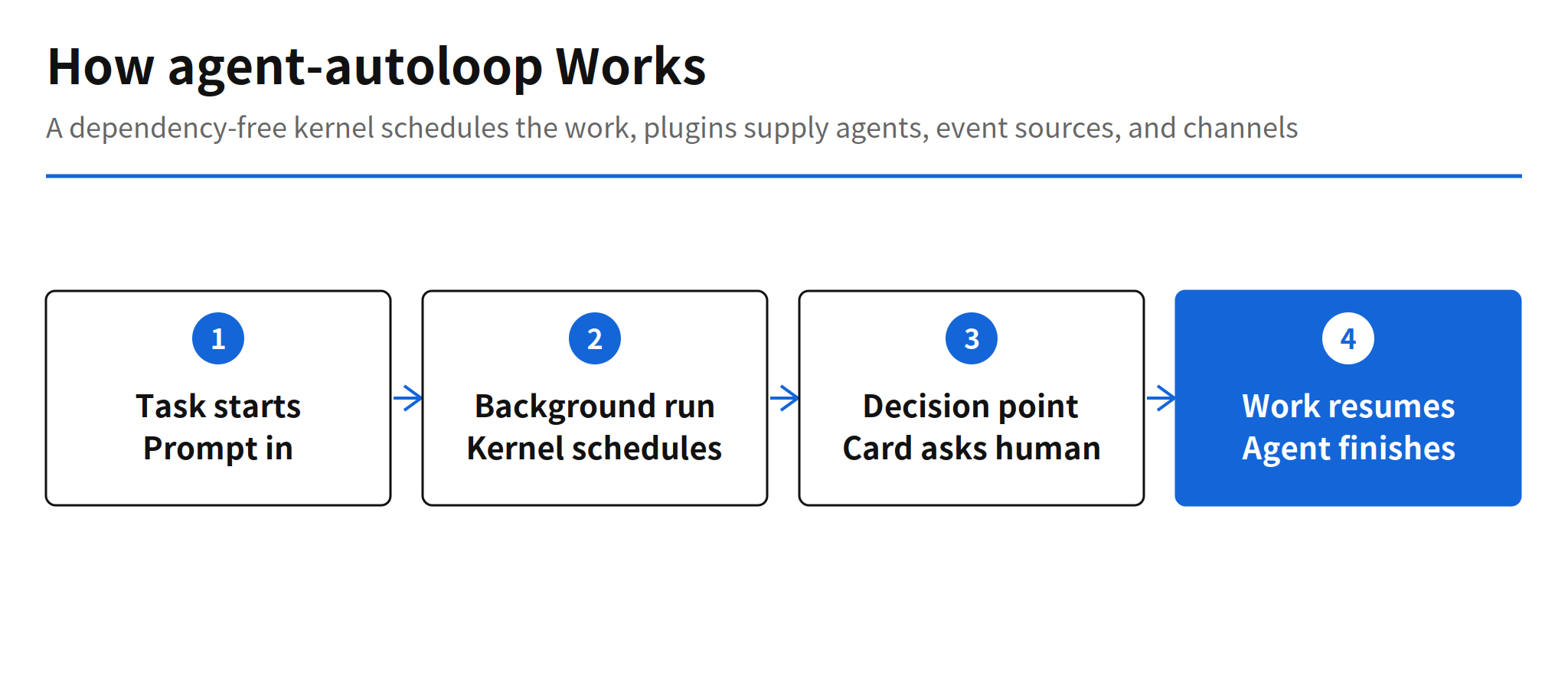
Attaching an agent requires no SDK and no change to the agent itself. Any command line tool that accepts a prompt and prints a final answer can be plugged in as a new agent. In practice that means existing CLI agents a developer already uses, and already has logged in, can be supervised without a wrapper project or a vendor integration.
Supervision lands where the user already works. Decision cards and notifications are supported on Feishu, DingTalk, WeCom, Slack, Discord, and desktop notifications, and overall progress across running work can be checked with a single command. The channel list also marks the project's origin: it is centered on Chinese workplace tools, and how well it connects to the channels Korean teams mainly use is unconfirmed.
The supervision pattern is the product: everything runs unattended except the decisions, and the decisions are packaged as cards a person can answer away from the terminal.
Requirements and Platform Limits
- Operating systems: macOS and Linux at release. Windows is not supported yet.
- Prerequisites: Node 24, Git, and curl, plus one logged-in command line agent. No GitHub account is required.
- Windows plan: the developer wrote in repository issue 17 that the compatibility work would be finished and tested over the November 7 to 8 weekend, then released.
- Where it runs: on the user's own computer, with no cloud server and no public port in the design.
The Windows gap matters for reach, because a large share of developers who might try a tool like this on a work machine are on Windows. The dated commitment in issue 17 is more useful than a vague roadmap entry: it gives that audience a specific weekend after which the claim can be checked against an actual release.
Open Questions on Safety and Evidence
- Attention is not evidence. The 2,179 stars accumulated in about a day. No independent test results or sustained user reports had been confirmed when the release was covered.
- Wrong turns run unattended too. The same background loop that removes babysitting also removes the moment where a person would notice an agent heading the wrong way. The release materials do not describe a separate safety layer for that case.
- Channel fit is regional. Feishu, DingTalk, and WeCom lead the notification list. Slack and Discord are present, but the fit for other regional tool stacks is unconfirmed.
None of this is unusual for a one-day-old open source release, and the honest reading cuts both ways. The decision card is a real control point, because it defines exactly where the system must stop and ask. What is missing is evidence about everything between cards: how often a run drifts, and what a user sees when it does. That evidence will come from usage, not from the launch post.
Practical Significance for Agent Users
For developers already running CLI agents daily, the bottleneck has moved. Model quality still matters, but the recurring friction is operational: work that only progresses while someone watches it. agent-autoloop is a direct answer to that friction, and its shape is easy to evaluate against any existing cron or automation setup, because the contract is so small. A prompt goes in, a final answer comes out, and a card appears when a decision is needed.
The project is also a useful reference design even for teams that never install it. Separating the scheduling kernel from agents, event sources, and notification channels, and separating decisions from execution, are choices that transfer to internal tooling. If the Windows release lands on the stated schedule and the first independent usage reports match the README, agent-autoloop will have earned a place in the standard CLI agent toolkit. Until then, it is a well-shaped prototype with a fast-growing star count and an evidence base that has not caught up.
Related Reading
For another local-first agent tool covered here, see AnyModelBot, which runs more than 70 models without lock-in. For skills that run inside coding agents, see Hallmark v2, a design skill with 50 themes for coding agents. agent-autoloop sits one layer below both: it supervises the agent session itself, whatever model or skill runs inside it.
FAQ
What is agent-autoloop?
agent-autoloop is an open source automation kernel that KKKKhazix published on GitHub on November 3, 2026. It runs command line agents in the background so work continues without a person watching the terminal, and it sends a decision card to the user only at moments that need a human judgment.
Which agents can agent-autoloop run?
Any command line tool that accepts a prompt and prints a final answer can be attached as an agent. The README states that no SDK and no modification of the agent source are required, because agents, event sources, notification channels, and deployment pipelines are plugins around a dependency-free scheduling kernel.
What does agent-autoloop need to run?
agent-autoloop runs on macOS and Linux and needs Node 24, Git, curl, and one logged-in command line agent. No GitHub account is required. Decision cards and progress go to Feishu, DingTalk, WeCom, Slack, Discord, or desktop notifications, and overall progress can be checked with a single command.
When is Windows support expected for agent-autoloop?
Windows is not supported yet. The developer wrote in repository issue 17 that the compatibility work would be finished and tested over the November 7 to 8 weekend before release, so Windows users have a dated plan to watch rather than a shipped build.
Is agent-autoloop proven safe to leave running unattended?
That is not yet established. The repository had 2,179 stars at observation time, roughly a day after release, and no independent tests or user reports had been confirmed. The README also does not confirm what guardrails apply when an agent keeps acting on a wrong judgment in the background, or whether the decision card approval step fills that role.