Hallmark v2 Design Skill: 50 Themes for Coding Agents
Hallmark, a design skill by Nutlope (Hassan El Mghari, of Together AI), reached number one on GitHub weekly trending in the November 2 snapshot for Week 45. It gained 11,600 stars in that week alone. The repository now stands at 45,885 stars and 2,435 forks, under an MIT license, with CSS as its primary language.
The v2 release is the reason for the surge. The theme catalog grew to fifty themes, and two commands were added: redesign, which reworks an existing page, and audit, which reports on a page without changing it. The underlying idea has not changed since v1. Pages built by coding agents repeat the same visual tells, and Hallmark treats those tells as lint targets, catching them while the page is being built rather than after it ships.
Those tells are specific. An eyebrow label above the title, uppercase labels with wide letter spacing, and a headline with a single word picked out in a different color are the kind of patterns the skill flags. Anyone who reviews agent built landing pages has seen all three, usually on the same page. Naming them as lint rules turns a vague complaint about AI looking design into checks an agent can actually run.
Repository Standing in Numbers
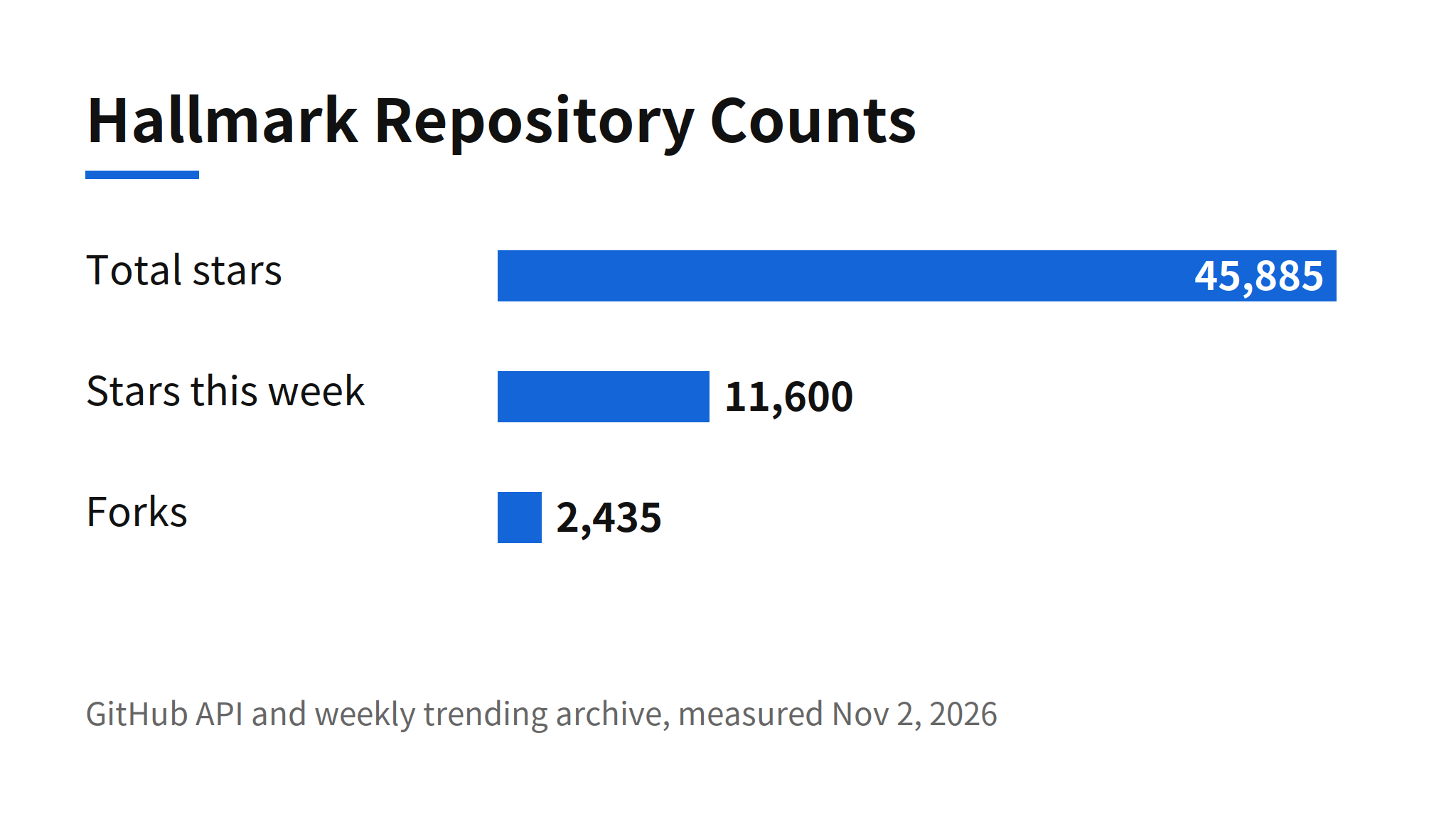
The repository was created on April 27, 2026, and its most recent push was on October 29, 2026, which is the state that carries the v2 content. That timeline matters when reading the star count. The weekly gain of 11,600 is roughly a quarter of the total, so most of the attention is recent and tied to this release, not a long accumulation since spring. Stars and trending rank remain attention signals, though. The README carries no independent evidence that pages built with the skill convert better or score better with users, and that gap should stay in view while the numbers are impressive.
Fifty Themes Defined as Materials
Each of the fifty themes is defined in material terms: paper, type, color and surface. That choice separates the catalog from a simple palette swap. A theme that specifies its paper and surface pushes the agent toward a different texture and depth, not only a different accent color, which is where themed agent output usually stops. The repository also ships 755 publicly licensed photos, selected by topic, with credit shown on the page. Sourcing real photography, and crediting it in place, is part of the same anti slop position: a licensed photo with a credit line looks like an editorial decision, while a generated filler image reads as a placeholder.
The open question is range. Whether fifty themes produce fifty visibly different results, or a narrower band of variations, can only be judged once a body of built pages accumulates. The catalog size is a claim about coverage. The screenshots in the repository show distinct directions, but a handful of curated examples is not the same evidence as fifty themes used in the wild.
Redesign and Audit Commands
The two new commands split the skill into a build path and a review path. Redesign keeps an existing page and its content and wiring in place, and changes the design system and layout on top of it. That is the mode most teams actually need, because the common problem is not a missing page but a shipped page that looks generated. Audit only reports. Keeping a report only mode matters for trust: a team can run audit across a site, read what the skill would flag, and decide whether its taste matches their own before letting it touch any markup.
Installation stays at one line: npx skills add nutlope/hallmark -g, with Node 18 or later required. The harnesses listed in the README are Claude Code, Codex, Cursor and OpenCode, so the skill is not tied to a single agent vendor. That breadth is consistent with where skills are heading. The unit of distribution is a portable instruction and asset pack that several agents can load, and the competition is over whose pack produces the least embarrassing output.
Verification at Eight Widths
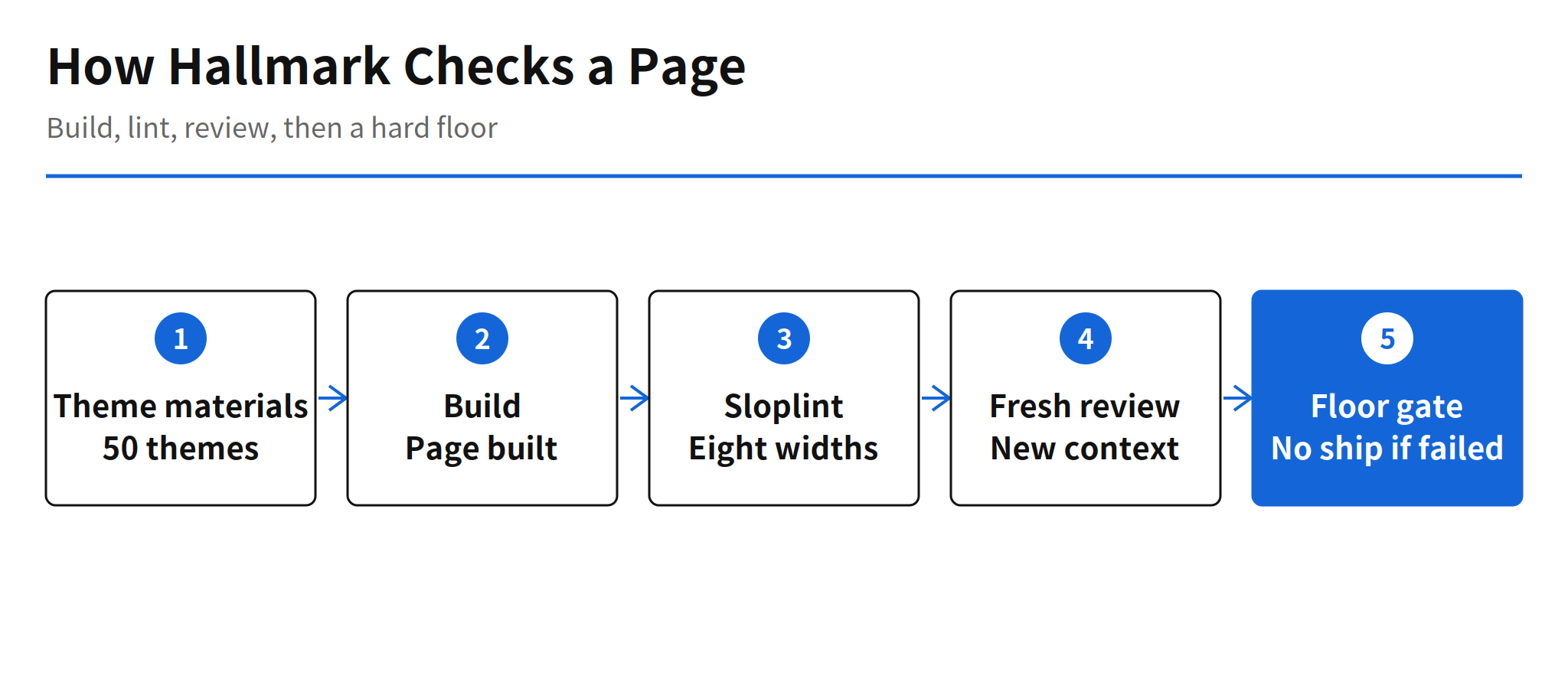
The verification procedure is written into the README. The built result is opened in a real browser and checked with sloplint at eight widths, and the final judgment is made by a fresh context reviewer. Each part of that sentence does work. A real browser catches layout failures that a static read of the markup misses. Eight widths test the responsive range where agent built pages most often break, between phone and desktop. A fresh context reviewer judges the page without the build conversation in its head, which removes the bias of an agent grading the choices it just made and defended.
The Hard Floor
Below the taste layer sits a hard floor: a short list of items that never ship. The README names contrast, focus states, reduced motion support, fabricated facts, and broken phone layouts. This is the most transferable part of the design. Taste rules can be argued with, and a team may reasonably want a different look than the themes offer. The floor is not taste. A page that fails contrast or focus visibility is not a style choice, and a page that invents facts is a defect in any design system. Hallmark describes its gate structure in three parts, Floor, Reflex and Finish, and keeping the non negotiable layer separate from the judgment layers is a structure other skills can copy even if they share nothing else with this one.
A Crowded Month for Design Skills
Hallmark is not arriving alone. Impeccable, a design skill for coding agents, and unslop, a Claude skill for stripping the AI look from vibe coded interfaces, have both trended recently, and taste-skill v2.0.0 took a similar position earlier. Hallmark itself was first covered here in its v1 form in July. The cluster is the story as much as any single tool. Within a few months, design quality for agent output has gone from a prompting tip to a category of installable, versioned, competing products, and one of them now tops the weekly trending chart for all of GitHub, ahead of the usual run of frameworks and model releases.
Read that as a shift in where the bottleneck sits. Generating a page is solved and cheap. The scarce thing is a page that does not announce how it was made. Skills like Hallmark sell that scarcity as a gate: patterns to avoid, materials to start from, checks to pass, and a floor below which nothing ships.
Limits and Unconfirmed Details
- Release date: the exact public release date of v2 is unconfirmed. It is established only by the October 29 repository push and the v2 section of the README.
- Quality evidence: star counts and trending rank measure attention. The README contains no independent verification that page quality or conversion improved.
- Theme range: how different the fifty themes look in real use is not yet established. It needs a body of built examples beyond the repository screenshots.
None of those gaps undermines the confirmed core, which is the release content itself and the trending result. They do set the follow up question for the next release: whether usage evidence starts to appear alongside the attention numbers.
Related Reading
Agent skills as portable packs are also the subject of an earlier post in this series on a codebase mapping skill for coding agents: Floorplan Maps Your Codebase for Claude Code and Codex. Hallmark applies the same distribution idea to design output rather than code comprehension, and the comparison shows how wide the skill category has become.
A follow up comparison now tests Hallmark against Impeccable with outside reviews and a head to head run: Hallmark vs Impeccable: Which Design Skill Fits the Job. The verdict splits by job, Hallmark for new landing pages and Impeccable for fixing existing screens.
FAQ
What is Hallmark v2?
Hallmark is a design skill by Nutlope (Hassan El Mghari of Together AI) that lints the recurring visual tells of AI generated pages while a coding agent builds them. Version 2 expands the theme catalog to fifty themes and adds redesign and audit commands.
How do you install Hallmark?
Install runs as one command, npx skills add nutlope/hallmark -g, and Node 18 or later is required. The supported harnesses listed in the README are Claude Code, Codex, Cursor and OpenCode.
What do the redesign and audit commands do?
Redesign changes the design system and layout of an existing page while keeping its content and wiring in place. Audit only reports, without changing the page.
What does Hallmark refuse to ship?
Its hard floor lists items that never ship: weak contrast, missing focus states, no reduced motion support, fabricated facts, and broken phone layouts. Built pages are also checked with sloplint at eight widths in a real browser, with the final call made by a fresh context reviewer.