AnyModelBot: Local-First AI Bot With 70+ Models, No Lock-In
AnyModelBot is an open source, local-first AI bot that is not tied to one model provider. Through one Modelflare key it connects GPT, Claude, Gemini, Grok, DeepSeek, Kimi, GLM and 70+ more models, and the README positions it directly as an alternative to Grok Bot, OpenAI dots and Claude Duet, the resident bots that each lock the user to a single vendor model.
The early traction is measurable. The repository was created on October 27, 2026 and reached 2,358 stars, an average of about 307 stars per day over roughly 7.7 days, according to the GitHub API figures recorded in the source issue. It is written in Python and released under the MIT License, so the bot layer itself can be inspected, forked and self-hosted without a subscription to AnyModelBot.
Release Overview
The unit of organization is the individual bot. The README says each bot keeps its own persona, default model, workspace and memory, separate from the others. That separation is what makes the multi-model claim practical rather than cosmetic: a writing bot and a coding bot can run different default models and different memory, instead of sharing one chat history and one system prompt with a model switcher on top.
Access is not limited to the app itself. A bot can be talked to inside the app, and the README also lists WeChat, Feishu, Telegram, Slack and Discord as channels where the same bot can be called. For a resident agent, the messenger surface matters as much as the model list, because the value of an always-on bot is that it is reachable from the chat tools already open, not from one more destination app.
How AnyModelBot Works
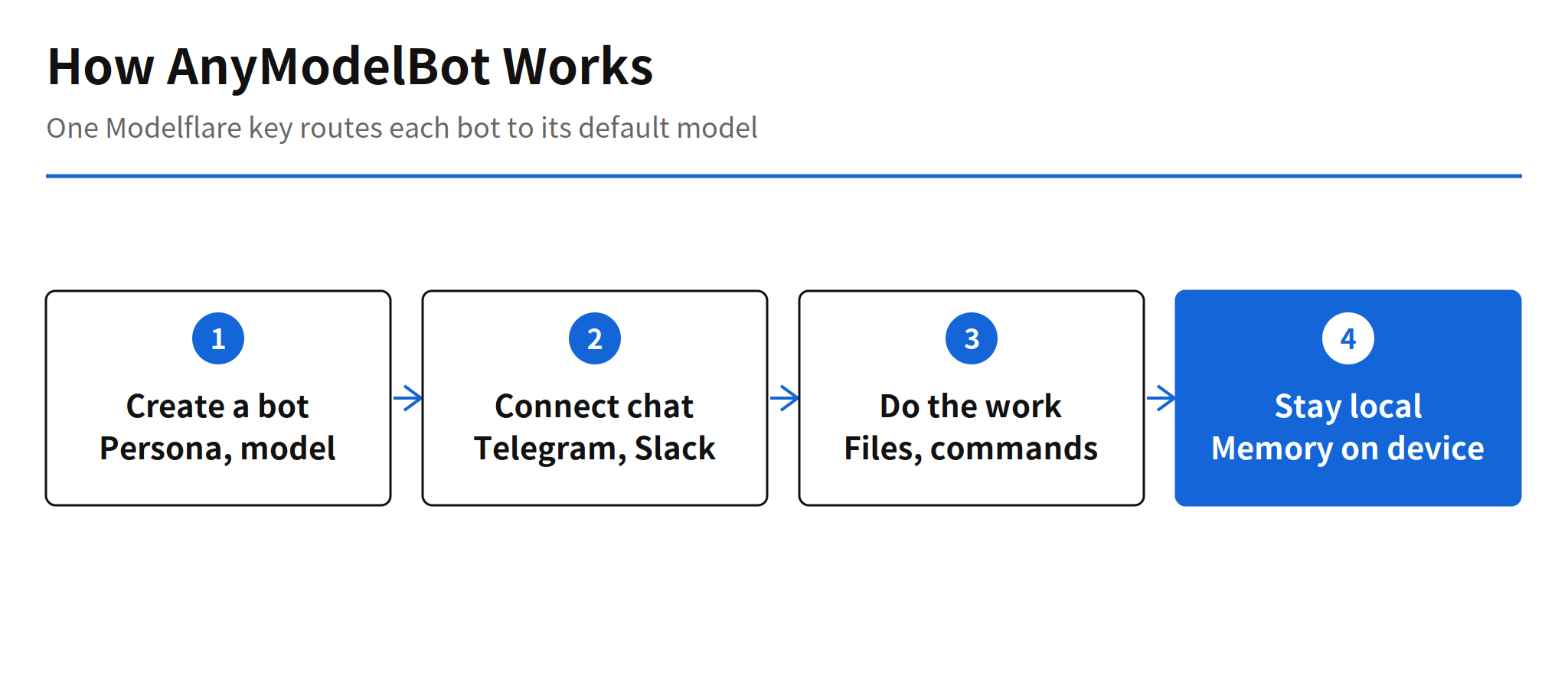
The bot is an actor, not only a chat window. The README says it can read and write files, run commands and control the desktop, and that actions which step outside the workspace ask the user first. That boundary is the central safety claim in the design: autonomy is scoped to a workspace, and crossing the scope line requires approval. How strong that protection is in daily use, including the exact scope of desktop control and the guardrails against accidents, has not been confirmed in the source material.
The data split follows the same local-first line. Conversations, memory, files and API keys stay on the user device, while model calls go through Modelflare and are billed per token. In other words, local-first here describes where state lives, not where inference runs: the models are still remote APIs, and the cost model is token billing through the routing layer rather than a flat bot subscription.
Design Lineage and Market Context
The README names its own references. The design draws on DeepSeek's Super Agent prototype, covered earlier as issue #3690, and the execution base is the DeepSeek Harness. That lineage explains the shape of the project: a harness built for one lab's agent experiments, generalized into a bot shell where the model becomes a replaceable part.
The timing is not accidental. Resident personal agents are becoming a standard product form, but xAI, OpenAI and Anthropic each ship theirs bound to their own models. AnyModelBot takes the same form and moves two decisions to the user: which model answers, and where the bot and its memory run. For users who already switch models per task, that removes the need to maintain a separate resident bot inside each vendor's app.
Unconfirmed Points in the Release
- Routing cost in practice. Actual latency of calls routed through Modelflare, and how much answer quality varies by model inside the same bot, are unconfirmed.
- Tool calling compatibility. The 70+ model list does not by itself prove that file, command and desktop actions work equally well on every model. Per-model compatibility is unconfirmed.
- Desktop control safeguards. The workspace approval rule is stated in the README, but the scope of desktop permissions and accident prevention in real use is unconfirmed.
These gaps do not weaken the structural point of the release, but they decide whether it is a daily driver or a promising shell. A resident bot touches files and a desktop, so the safeguard question in particular is one to verify before giving it a workspace with anything important in it.
Practical Significance for Model Switching Users
The clearest audience is people who already pay for or evaluate several frontier models and resent being forced to pick one home for an always-on assistant. AnyModelBot offers one bot layer, one key, and per-bot model defaults, with memory kept locally instead of inside a vendor account. The trade is operational responsibility: self-hosting, token billing through a router, and safeguards the user has to check personally.
For the wider agent market, the project is a useful test of whether the resident bot form can be separated from the model business. If a community-maintained shell with 2,358 stars in its first week can stay model neutral, the durable value in personal agents may sit in persona, memory and messenger reach rather than in the model underneath, which is exactly the layer the large vendors would prefer to own.
Related Reading
For another coding agent tool built around codebase structure, see Floorplan, which maps a codebase for Claude Code and Codex. For a bundled agent skill set, see MiniMax mcode-stack, a collection of 17 open source agent skills and setup tooling.
FAQ
What is AnyModelBot?
AnyModelBot is an open source, local-first AI bot from modelflare-ai, written in Python and released under the MIT License. The repository describes it as an open source, local-first alternative to Grok Bot, OpenAI dots and Claude Duet.
Which models does AnyModelBot support?
The repository says it connects GPT, Claude, Gemini, Grok, DeepSeek, Kimi, GLM and 70+ more models through one Modelflare key. Tool calling compatibility for each individual model has not been confirmed.
Where does AnyModelBot keep user data?
According to the README, conversations, memory, files and API keys stay on the user device. Model calls pass through Modelflare and are billed per token, and AnyModelBot itself has no subscription.
Which messengers can call an AnyModelBot bot?
The README says a bot can be talked to inside the app and also called from WeChat, Feishu, Telegram, Slack and Discord. Each bot keeps its own persona, default model, workspace and memory.