WorldDraft Benchmark: Can Video Models Just Render?
A team led by Zhiyu Hou, Wen-Jie Shu, and Harold Haodong Chen published WorldDraft on arXiv on November 12, 2026 (arXiv:2611.16217). The paper starts from a division of labor that is becoming common in video pipelines: a multimodal coding agent builds a 4D world in code, with its structure, motion, and camera paths already decided, and a video model only has to render that world into pixels. WorldDraft asks whether current video models can actually hold the narrower job.
The answer, across 432 strictly paired test cases and 12 representative models, is that the narrower job is not yet safe to hand over. Keeping the world intact and realizing the requested appearance pulled against each other, giving the draft more detail made appearance fidelity worse rather than better, and when the draft carried conflicting appearance cues, those cues leaked into the output at rates up to 64 percent. The benchmark is the first quantitative check of an assumption that a growing number of agent plus renderer pipelines are quietly built on.
The split between building a world and rendering it
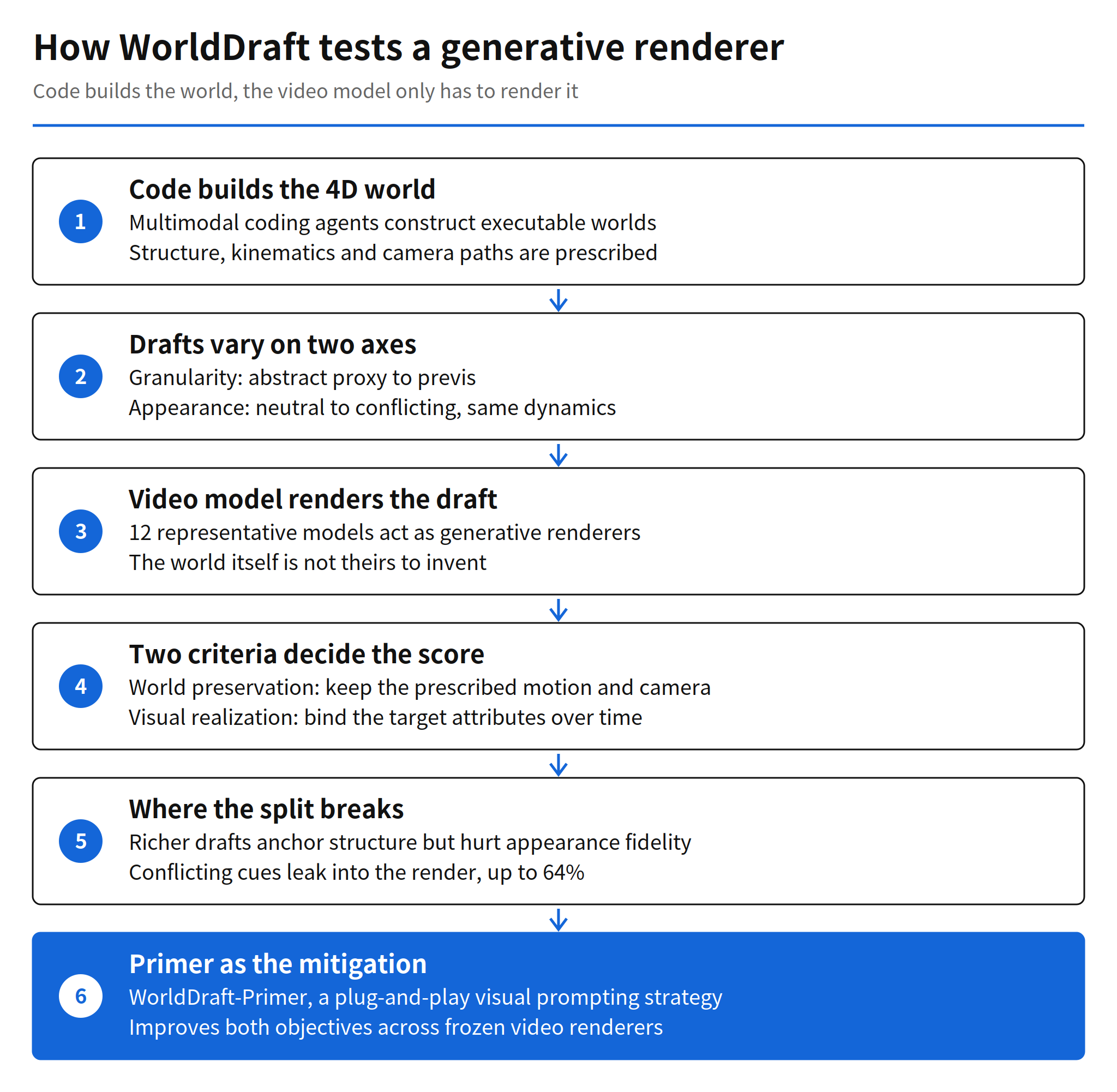
In the setup the paper examines, multimodal coding agents decouple 4D world construction from visual generation. The agent writes code that defines an executable world: what exists, how it moves over time, and where the camera goes. The video model is then repurposed from a world generator into a generative renderer, a component that receives a world it did not invent and supplies texture, lighting, and appearance.
The appeal is easy to see. Asking one model to invent a scene and keep its physics consistent in the same pass is where current video generation produces its familiar failures: objects that drift, motion that ignores the stated setup, camera paths that wander. Code is good at exactly the parts video models are bad at, because kinematics written as a program stay put. If the renderer half of the split worked, pipelines could combine programmatic control with generative visuals and get physically grounded output. WorldDraft exists because that conditional, if the renderer works, had not been measured.
Two criteria for a reliable generative renderer
The paper defines a reliable generative renderer with two complementary criteria. The first is world preservation: the rendered video must retain the prescribed 4D kinematics and camera paths, so the world the code built is the world that appears on screen. The second is visual realization: attributes specified in text must stay bound to their targets persistently over time, so a described color, material, or identity does not slide onto the wrong object or fade as the clip runs.
Both criteria sound like minimum requirements rather than ambitions, and that is the point of the benchmark design. A renderer that changes the motion has not rendered the world, it has generated a different one. A renderer that loses the target attributes has not followed the specification, it has improvised. WorldDraft scores the two separately, which is what allows the central tension to show up in the results instead of being averaged away in a single quality score.
Benchmark design: 432 paired cases in a 3 by 3 grid
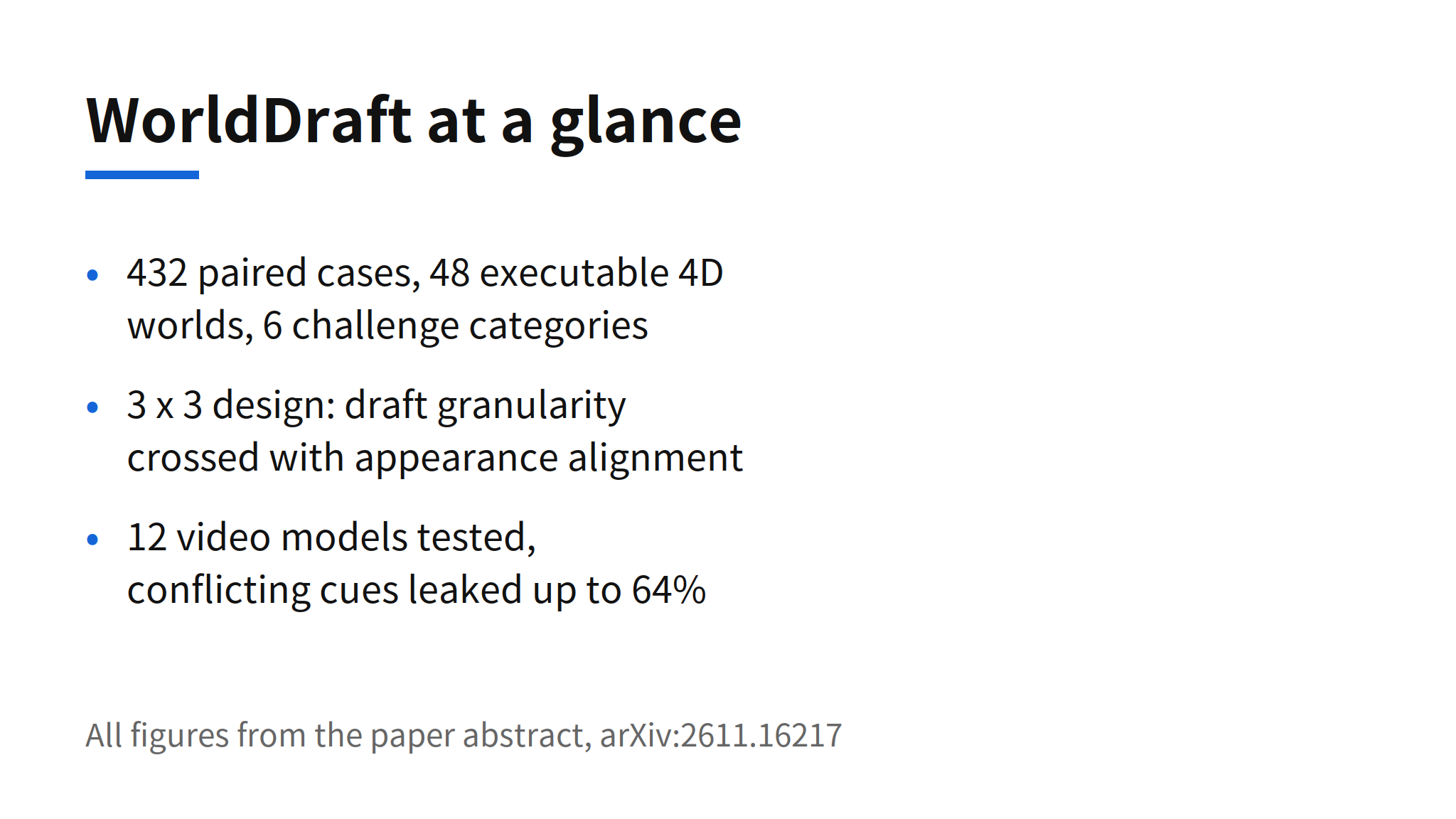
WorldDraft contains 432 strictly paired test cases drawn from 48 executable 4D world families spanning six dynamic challenge categories. Paired matters here: cases are constructed so that comparisons isolate one variable at a time instead of comparing unrelated scenes. The design is a 3 by 3 factorial grid that crosses two factors orthogonally under identical dynamics.
| Factor | Levels | What it varies |
|---|---|---|
| Draft granularity | Abstract proxy to previs | How much scaffolding the draft gives the renderer, from a rough stand-in to a detailed previsualization |
| Appearance alignment | Neutral to conflicting | Whether the appearance cues in the source agree with the target or fight it |
| Dynamics | Held identical | The underlying motion stays fixed, so differences come from the draft, not the world |
Holding the dynamics constant while the draft changes is the methodological core. If a model renders the same world differently when only the draft's detail or its appearance cues change, the difference is attributable to how the model reads drafts, which is precisely the skill a generative renderer is supposed to have. The six challenge categories keep the test from collapsing into a single kind of motion or scene.
Finding one: preservation and realization pull apart
The first finding is that world preservation and visual realization remain in stark operational tension across the 12 evaluated models. Improving one side tended to cost the other. A renderer that clings tightly to the draft's structure has less freedom to realize the specified appearance, and a renderer that pursues the appearance loosens its grip on the prescribed motion and camera work.
For pipeline builders, a tension is a different problem from a simple capability gap. A gap closes as models improve on a single axis. A tension means the interface between the two stages is doing damage: the way a draft communicates structure and appearance to the renderer forces a trade that neither stage chose. That reading is reinforced by the second finding, which is about the draft itself.
Finding two: richer drafts hurt appearance fidelity
The counterintuitive result is that richer draft scaffolding anchored structure but paradoxically impaired appearance fidelity. The natural engineering instinct is to give the renderer more: a more detailed previs, more explicit geometry, more guidance. WorldDraft shows the extra scaffolding does hold the structure in place, and simultaneously makes the rendered appearance less faithful to the specification.
One plausible mechanism, consistent with how these models consume conditioning, is that a detailed draft is itself a strong visual signal. The renderer copies the draft's look along with its layout, so the draft's placeholder appearance competes with the target appearance the text describes. The benchmark cannot by itself prove that mechanism, but the direction of the effect is the actionable part: draft detail is not a free upgrade, and teams building previs driven pipelines should measure appearance fidelity at each granularity level instead of assuming more detail is better.
Finding three: conflicting cues leak, up to 64 percent
The sharpest number in the paper is the source leakage rate. When the draft's appearance alignment moved toward conflicting, the source cues triggered severe leakage, up to 64 percent. In practical terms, attributes that belonged to the source material surfaced in the output where the specification asked for something else. The authors read this as fragile cross-modal disentanglement: the models do not cleanly separate what the draft says about structure from what it happens to look like, or what the text asks for from what the draft shows.
That fragility is the direct warning for production use. Real pipelines rarely feed renderers neutral drafts. Previs material carries placeholder colors, stand-in models, and reference frames with their own look, and a 64 percent worst case leakage rate means those placeholders can end up in delivered footage at scale. Until disentanglement improves, a human review step on appearance, or a draft hygiene step that strips conflicting cues before rendering, is not optional polish. It is the control that stands between the pipeline and a known, measured failure mode.
WorldDraft-Primer: a prompting mitigation
Alongside the benchmark, the authors propose WorldDraft-Primer, a plug-and-play visual prompting strategy. Its reported property is the one the findings make valuable: it consistently improves both objectives, world preservation and visual realization, across frozen video renderers. Frozen matters, because it means the mitigation works on models as they are, without retraining or fine tuning the renderer.
A prompting level fix that moves both sides of a tension at once also supports the interface reading of the problem. If better visual prompting recovers preservation and realization together, part of the failure was in how the draft was presented to the model, not only in the model's raw ability. The abstract does not give the size of the Primer improvement, so how much of the gap it closes remains a question for the full text.
Limits and unconfirmed details
Several things a reader would want are not in the abstract, and this article does not fill them in. The 12 evaluated models are described only as representative; their individual names and per model scores are not in the abstract. The authors' institutional affiliations are not stated there either. Whether the benchmark and its code will be released, and on what schedule, is not specified. The paper was listed on Hugging Face Daily Papers and had received 14 upvotes at the time the source issue was compiled, which signals community interest but says nothing about adoption.
The scope of the claims also needs care. The leakage figure is a worst case under conflicting alignment, not an average across all conditions, and the tension findings are reported qualitatively in the abstract without effect sizes. WorldDraft is one benchmark with 48 world families; whether its categories cover the dynamics a given production pipeline cares about is a judgment each team has to make against its own content.
What this changes for agent and video pipelines
The practical reading is threefold. First, the code builds, model renders split should be treated as a hypothesis under test, not an architecture that is known to work; WorldDraft is the test, and its first results say the renderer stage is the weak link. Second, draft design is now a measured variable: granularity and appearance alignment change outcomes in opposite directions, so drafts deserve the same evaluation discipline as prompts. Third, the Primer result suggests a cheap first response, fix the presentation of the draft before reaching for a bigger model or a retraining budget.
WorldDraft also gives the field a shared vocabulary for a failure that was previously described anecdotally. Preservation, realization, and source leakage are separable, measurable properties, and a pipeline team can instrument its own outputs against the same three ideas even before any public release of the benchmark itself.
Related articles
- ANR Neural Rendering Release: Frame Generation Guide, a previous article on neural rendering and frame generation
- World Labs Atlas Release: Pricing, Tools and How It Works, a previous article on world models and their tooling
FAQ
What is WorldDraft?
WorldDraft is a benchmark of 432 strictly paired test cases across 48 executable 4D world families in six dynamic challenge categories. It tests whether video models can act as generative renderers for worlds that code has already built.
What are the two criteria for a good generative renderer?
The paper defines world preservation, retaining the prescribed 4D kinematics and camera paths, and visual realization, persistently binding text specified target attributes over time. The evaluation found the two criteria in stark operational tension.
What is source leakage in WorldDraft?
Source leakage is what happens when conflicting cues in a draft bleed into the rendered video instead of staying separated from the target appearance. In the WorldDraft evaluation it reached up to 64 percent, which the authors read as fragile cross-modal disentanglement.
What is WorldDraft-Primer?
WorldDraft-Primer is a plug-and-play visual prompting strategy proposed in the same paper. The authors report that it consistently improves both world preservation and visual realization across frozen video renderers.
What does WorldDraft not yet show?
The abstract does not name the 12 evaluated models, give per model scores, state the authors' affiliations, or say whether the benchmark and code will be released. Those details require the full paper.