World Labs Atlas Release: Pricing, Tools and How It Works
World Labs opened Atlas, its next generation world model, to everyone on November 12, 2026. Atlas takes photos, generated images or a blocked out scene and returns keyframes, video clips or 3D Gaussian splats. The launch pairs four hosted tools with a developer API priced in credits, where a full reconstruction run costs $5 and a draft costs $0.50.
The release ends a partner-only preview that began when Atlas was first announced on September 1. Anyone can now sign up for the apps at atlas.worldlabs.ai or call the API, with no waitlist described in the launch material. The model weights stay closed, so the hosted tools and the API are the only ways in.
The Four Tools That Launched With Atlas
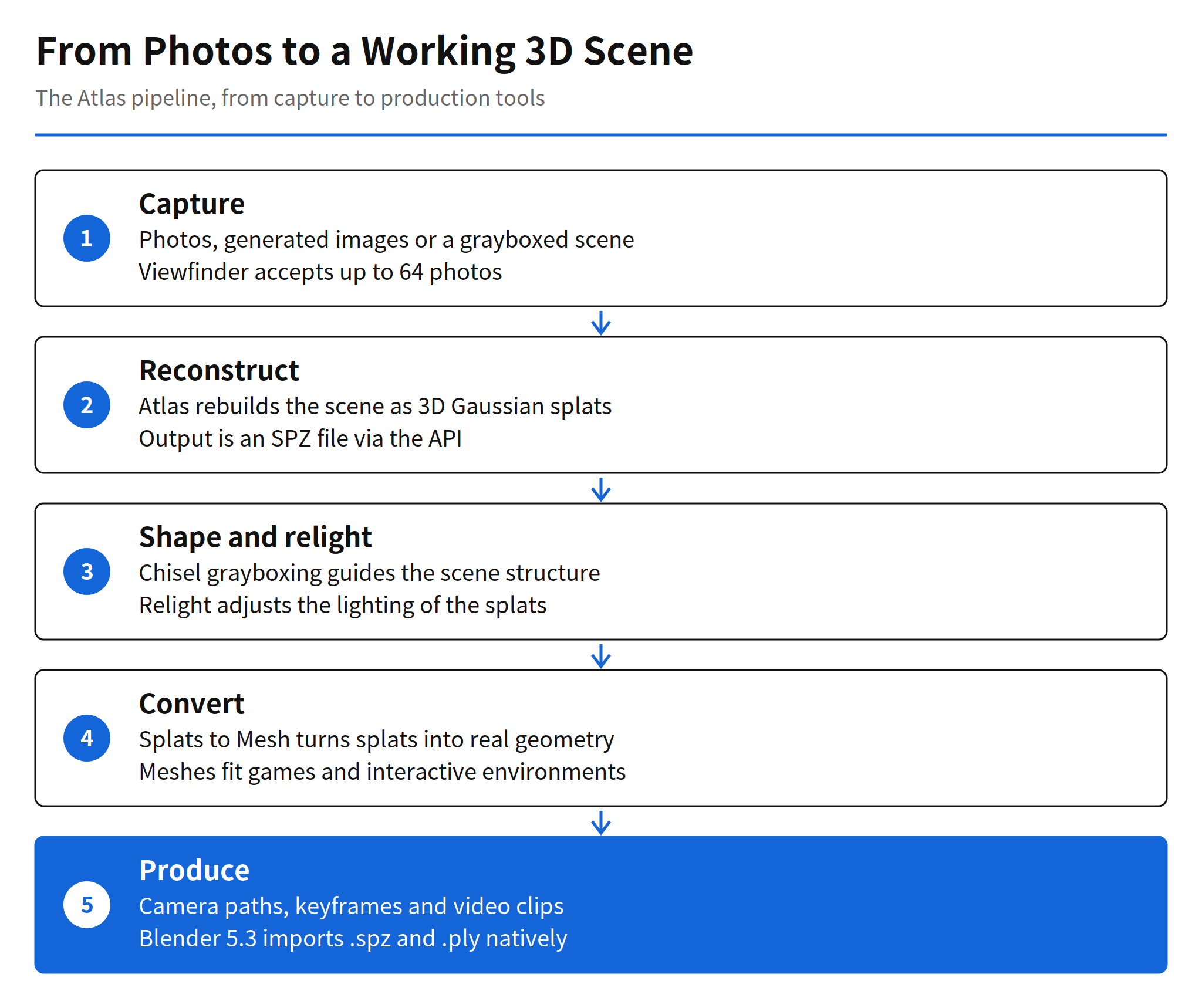
Viewfinder is the entry point for most users. It reconstructs a scene from photos or generated images, accepts up to 64 photos, and lets the user explore new viewpoints and render camera paths through the result. Chisel works in the other direction: the scene starts as a graybox, simple blocks that fix the structure, and every camera view updates as objects move. Splats to Mesh converts splats into meshes with real geometry, which is the step that makes the output usable inside games and interactive environments. Relight handles the lighting of splats, so a scene captured under one lighting setup can be adjusted after the fact.
The four tools map onto the four jobs that used to sit between a camera and a finished 3D scene: capture, structure, conversion and lighting. World Labs describes Atlas as an omni world model, one that places text, image, video frames, camera poses and depth maps into a single spatial context. The product surface is deliberately ordinary, though. Each tool does one recognizable production job, and the output formats are the ones existing pipelines already consume.
API Pricing in Credits
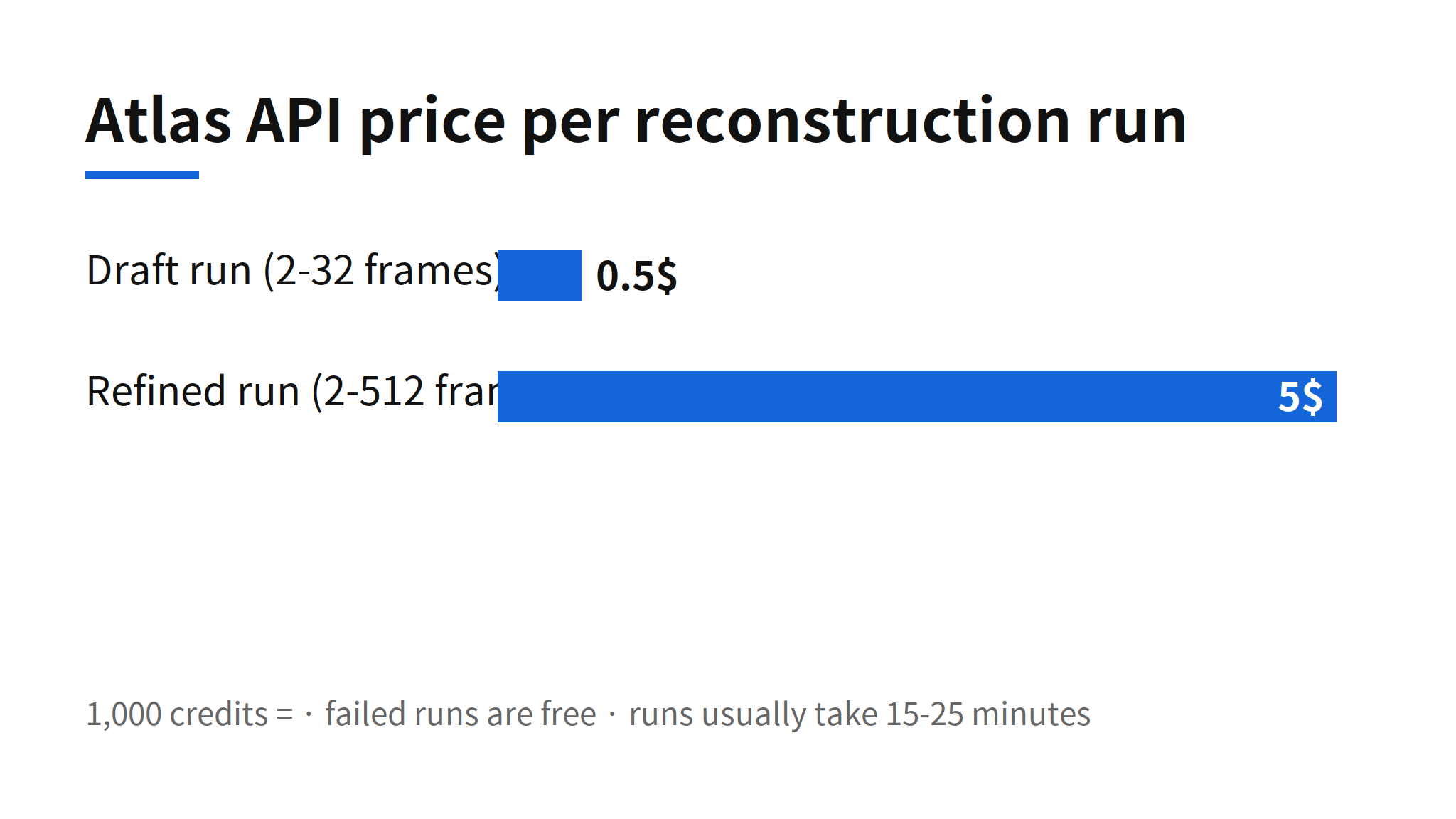
The developer API bills in credits, converted at 1,000 credits per US dollar, and credits do not expire. The core task is posedImages2Splats, which reconstructs posed RGBD frames and refines them into an SPZ file. A refined run accepts 2 to 512 ordered frames for 5,000 credits ($5). A draft run accepts 2 to 32 frames for 500 credits ($0.50). Failed runs are free, and a second task, splats2Mesh, converts the result into a mesh.
Runs are not instant. The documentation puts a typical run at 15 to 25 minutes, and its worked example turns eight frames of a potter studio into 2,000,000 splats in 18 minutes. That timing shapes how the API fits real work: it is a batch step inside a pipeline, not an interactive call. A team generating scenes for a game level or a film previz can queue reconstructions overnight; a tool that needs a scene while a user waits cannot build on this latency without a draft-first pattern.
There is no dedicated pricing page. The credit rate and per-task prices live in the API documentation, which means anyone budgeting a project has to read the docs rather than a rate card. The failed-run policy softens that opacity in one useful way: experimentation errors cost time, not money.
From Partner Preview to Public Release
Atlas was first announced on September 1, 2026 and spent roughly ten weeks in partner hands. Splat creation reached a first group of customers at the end of October through Marble Studio and a beta API task. The November 12 launch is therefore less a debut than a gate opening: the same capabilities, now self-serve. World Labs is also, as background, the company that agreed to join AMD on September 28, 2026, a deal noted in the original issue research.
The launch drew immediate attention. World Labs posted the announcement on X at 10:09 AM PST on November 12, and by mid-afternoon the post had recorded 110,426 views, 1,131 likes and 804 bookmarks. Bookmarks running close to likes is the pattern of a tool people intend to try, not only applaud, though a single afternoon of engagement says nothing about retained usage.
My read: the consequential part of this release is not the model, it is the mesh. Splats are easy to admire and hard to ship, because game engines and DCC tools eat geometry. A priced API that ends in a mesh file, plus a Blender path an agent can drive, turns a research demo into a billable production step. The $5 refined run is cheap enough that the real cost question moves to artist time spent fixing scenes, which is exactly where World Labs wants the comparison to happen.
Viewing, Blender and Agent Workflows
Output lands in formats the existing ecosystem can already open. World Labs points users to its Spark renderer, which reads SPZ v4 as of version 2.4.0, or to Blender. Blender 5.3, released November 10, added native Gaussian splat import, so .spz and .ply files from Atlas open without an add-on. An optional Atlas Blender extension adds generation and editing inside Blender and imports posed RGBD bundles as cameras with point clouds for placing target cameras.
The extension connects to a detail that matters for agent-driven production: an atlas-blender skill in World Labs skills repository on GitHub lets a coding agent drive Atlas generation and editing inside Blender. In practice that means a scene can be requested, reconstructed and adjusted as steps in an agent pipeline, with a human reviewing renders rather than operating every tool by hand. World Labs aims the same pipeline at three industries on its Atlas page: film and VFX, architecture and design, and robotics simulation.
The 1440p Claim and What Is Still Missing
- Video quality claim is a company figure: World Labs says Atlas can generate up to one minute of video at 1440p from a small number of reference images. That is a company claim with no independent verification published yet.
- Weights are closed: the model itself is not released. Access is hosted apps and API only, so pricing and availability stay under World Labs control.
- Rate limits are unpublished: the API rate card lists task submission quotas and concurrent task caps as to be announced. Higher throughput tiers are available by arrangement, with no public numbers.
- No standalone pricing page: per-task prices are documented inside the API docs only, as covered above.
None of those gaps is unusual for a launch week. They do set the verification agenda for the next few months: independent reproductions of the 1440p claim, published rate limits, and examples of Atlas scenes surviving contact with a real production schedule. Until those arrive, the solid facts of this release are the tools, the prices and the formats, and on those three the launch is concrete.
FAQ
What is World Labs Atlas?
Atlas is World Labs next generation world model, opened to everyone on November 12, 2026. It takes photos, generated images or a blocked out scene and returns keyframes, video clips or 3D Gaussian splats, through four hosted tools and a developer API.
How much does the Atlas API cost?
The API bills in credits at 1,000 credits per US dollar, and credits do not expire. The posedImages2Splats task costs 500 credits ($0.50) for a draft run of 2 to 32 frames and 5,000 credits ($5) for a refined run of 2 to 512 frames. Failed runs are free.
What are the four Atlas tools?
Viewfinder reconstructs a scene from photos or generated images and renders camera paths. Chisel shapes a scene through grayboxing. Splats to Mesh converts splats into meshes with real geometry. Relight adjusts the lighting of splats.
Are the Atlas model weights open?
No. World Labs has not released the model weights. Atlas is available only through the hosted apps and the developer API.
How long does an Atlas API reconstruction take?
Runs usually take 15 to 25 minutes. In the documented example, eight frames of a potter studio became 2,000,000 splats in 18 minutes.
Related Reading
- Seedance 2.5 flash Release: 2x Speed, Pricing and Limits, on the video generation side of the same tooling shift
- MiniMax H3-Image Open Weights: 16MP, 6 Steps, License Limits, a contrasting case where the weights did ship