Seedance 2.5 flash Release: 2x Speed, Pricing and Limits
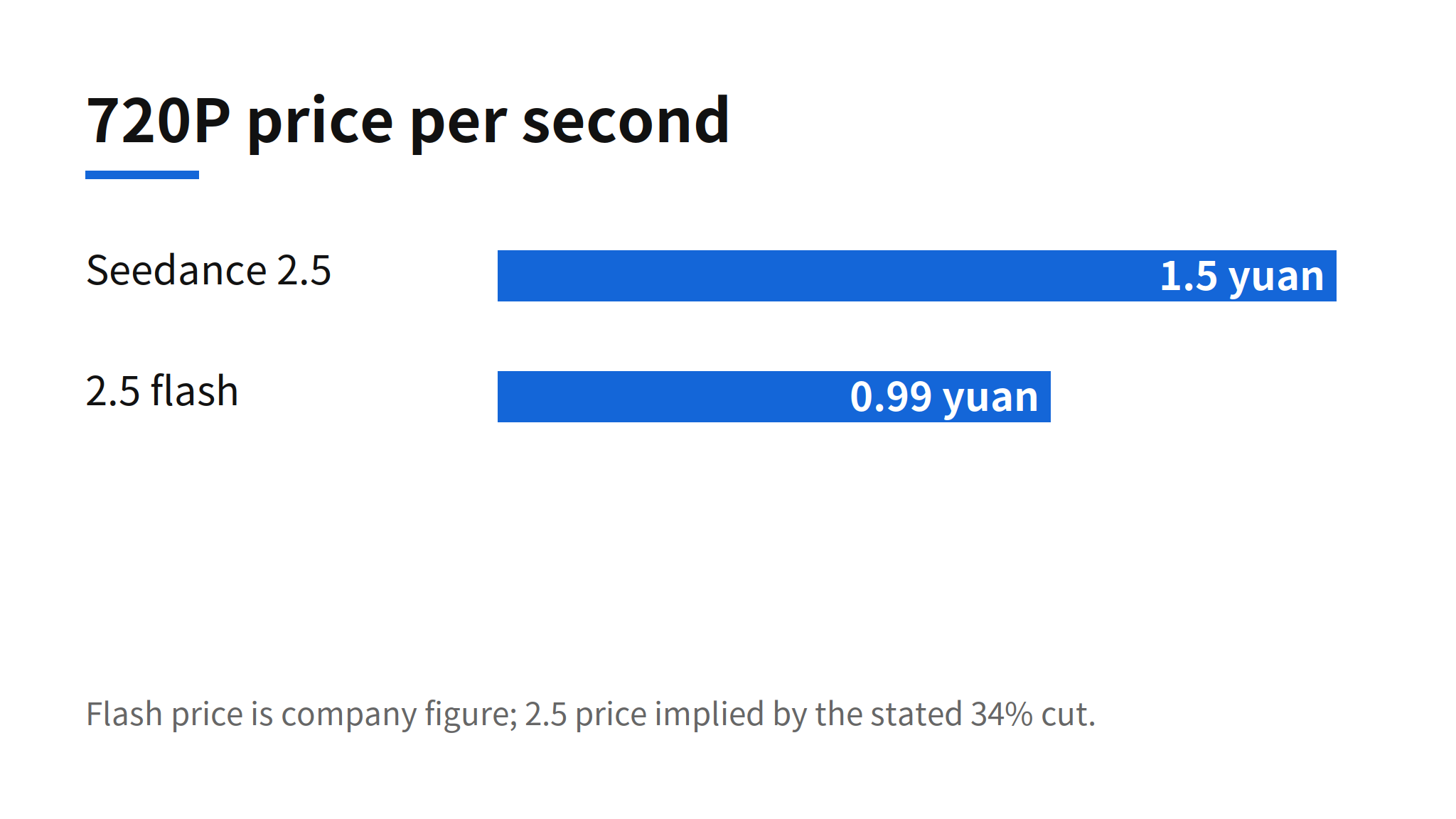
ByteDance subsidiary Volcano Engine released the Seedance 2.5 flash video generation model on November 12, 2026, according to PANews. The company describes flash as the model whose results are currently closest to Seedance 2.5, while generation speed doubles. At 720P, text-to-video and image-to-video cost about 0.99 yuan per second, roughly 34% less than Seedance 2.5.
That trade is the whole product. Seedance 2.5 arrived as a quality flagship with 30 second 4K generation. Flash keeps the 30 second ceiling and the editing features, drops the top resolution to 720P, and competes on the two numbers that decide draft production: price per second and waiting time. For short-form work, where a team generates many takes and keeps one, a cheaper and faster near-flagship model changes the economics more than another small gain at the quality ceiling would.
Specifications and Input Limits
A single generation runs up to 30 seconds. Each input can carry up to 10 images, 5 videos and 5 audio clips, which points the model at reference-driven work rather than a single text prompt: character and product references, motion references and sound can travel together into one take. Output is offered in two tiers only, 480P and 720P. The company says overall performance is better than the previous generation flagship, Seedance 2.0, with a high standard maintained in instruction following, physical motion and audio performance, and the model also carries video editing capability.
The resolution cap is the clearest boundary in the release. Work that needs a 4K master still belongs on Seedance 2.5. Flash fits the earlier and more numerous stages of production: concept takes, storyboard motion tests, social drafts and variant generation, where a 720P result is enough to judge an idea and where volume matters. Treating flash as a cheaper replacement for the flagship in final delivery would misread the positioning the company itself set.
Pricing Arithmetic for Draft Production
At about 0.99 yuan per second, a full 30 second clip costs about 30 yuan in generation fees at the stated 720P rate, before any platform markup or failed takes are counted. The implied Seedance 2.5 rate behind the 34% comparison is about 1.50 yuan per second, or about 45 yuan for the same 30 seconds. The saving per kept clip is modest on its own. The saving that matters is across the discarded takes: ten candidate clips cost roughly 300 yuan on flash against roughly 450 yuan on the flagship rate, and the doubled speed means those ten candidates also arrive in about half the generation time.
The figures above are arithmetic from the company rate, not a measured bill. The full API price table, including whether 480P is priced lower and how editing jobs are charged, is only due with the Volcano Ark API launch on November 15.
Rollout Across Platforms and the API Date
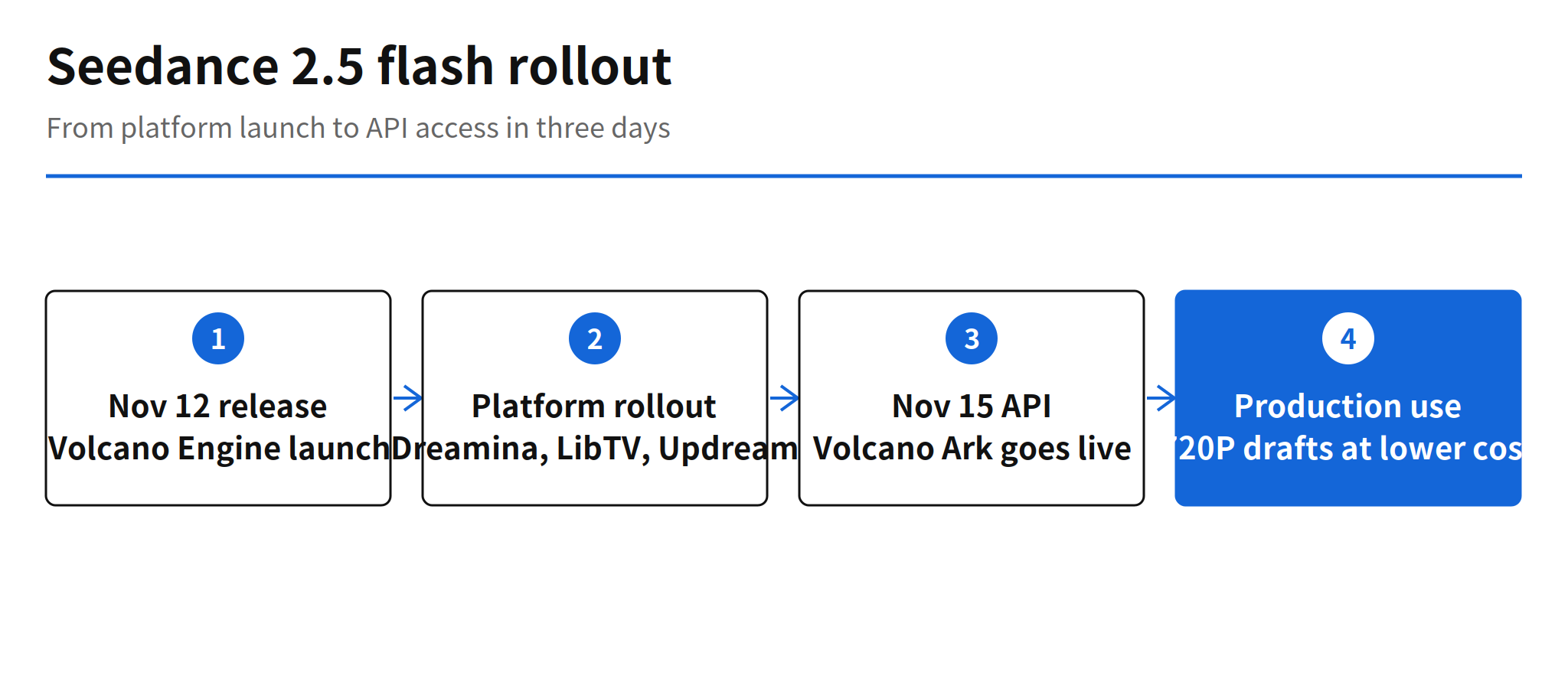
From November 12, flash rolls out in stages to Dreamina, LibTV and Updream. The API follows on November 15 on Volcano Ark, the ByteDance cloud platform that hosts the Seedance family for programmatic use. That split matters for evaluation. Platform users can judge output quality immediately in a consumer interface, while teams that build video generation into a product or a pipeline have to wait for the API date, and for the price table and regional availability that are expected to come with it.
Position Against Seedance 2.5 and Rival Speed Claims
Seedance 2.5, covered in issue #3224, led with 30 second 4K generation, timestamp prompts at one second granularity and up to 30 image references. Flash narrows almost every one of those headline numbers: 720P instead of 4K, and 10 image inputs instead of 30 references. In exchange it halves generation time and cuts the per-second price by about a third. The pattern matches the direction the wider market has taken this autumn. When fal launched FLUX 3 Max in October, covered in issue #3368, its headline claim was speed against Seedance 2.5 rather than a quality record. Speed and unit price have become the shared language of video model launches, because buyers running volume can convert both directly into cost per finished minute.
My read is that flash is less a new model tier than a pricing instrument. ByteDance already owns the quality headline with Seedance 2.5. A near-flagship variant at draft resolution defends the volume end of the market, where a rival with a faster or cheaper offer could otherwise take the high-frequency, low-margin generation traffic and the platform habit that comes with it.
Limits and Unconfirmed Points
- Company figures only: the 2x speed gain and the roughly 34% price cut are Volcano Engine claims reported by PANews. No independent measurement was available at publication.
- No benchmark scores: the launch gives no numeric measure of how close flash results are to Seedance 2.5, despite that closeness being the central quality claim.
- 720P ceiling: productions that need 4K output still require Seedance 2.5, so flash adds a model choice rather than replacing one.
- API details pending: the full price table and regional availability are expected with the Volcano Ark launch on November 15 and were not confirmed in the launch report.
FAQ
How much does Seedance 2.5 flash cost at 720P?
Volcano Engine prices text-to-video and image-to-video at 720P at about 0.99 yuan per second, roughly 34% below Seedance 2.5. A full 30 second clip therefore costs about 30 yuan at that rate. The full API price list is due when the API reaches Volcano Ark on November 15.
How long a video can Seedance 2.5 flash generate?
A single generation can run up to 30 seconds. Inputs accept up to 10 images, 5 videos and 5 audio clips, and output is offered at 480P and 720P only.
Where is Seedance 2.5 flash available?
From November 12 it rolls out in stages to Dreamina, LibTV and Updream. The API is scheduled to go live on Volcano Ark on November 15. Regional availability has not been confirmed in the launch report.
Is Seedance 2.5 flash as good as Seedance 2.5?
The company says flash is currently the model whose results are closest to Seedance 2.5, and that it beats the previous flagship Seedance 2.0 overall. No benchmark scores were published with the launch, and the speed and price figures are company claims without independent measurement yet.
Related Reading
- MiniMax H3-Image Open Weights: 16MP, 6 Steps, License Limits, a recent image model release where step count and unit cost drive adoption
- Seedream 5.5 Release: 100-Round Editing, Pricing and Scores, another ByteDance generation model competing on iteration cost