MiniMax H3-Image Open Weights: 16MP, 6 Steps, License Limits
MiniMax published the MiniMax-H3-Image weights on Hugging Face on November 10, 2026. The license file in the repository also gives November 10 as the release date. One checkpoint generates images from text and edits reference images. Output reaches about 16 megapixels at every aspect ratio, rendered directly in 6 sampling steps with no classifier-free guidance and no upscaler.
The catch is legal, not technical. The license lists the European Union, the United Kingdom, the Republic of Korea and the United States of America as Excluded Territories. A team in Seoul or the US can download the weights, but this license alone does not cover using them there. That single clause decides who the release actually serves, and it is the first thing to check before any benchmark discussion.

Output Size and Sampling Steps
The model renders about 16 megapixels natively, from 4096x4096 at 1:1 up to 6272x2688 at 21:9. Native rendering at that size matters for production work. An upscaler invents detail after the fact, while a model that composes at full resolution keeps text, edges and repeated patterns consistent across the frame. MiniMax reduced the checkpoint to 6 sampling steps, counted as 6 NFEs, and dropped classifier-free guidance entirely.
Fewer steps cut latency and serving cost per image, which is where an open image model earns its place in a local pipeline. The trade-off is that step reduction usually costs prompt adherence or fine detail, and MiniMax published no evaluation table to settle that question. The speed claim attached to this design is a generation time of 10 to 20 seconds, stated by MiniMax. No third party measurement under the same conditions exists yet, so the figure should be treated as a vendor claim.
Derivation From the H3 Video Model
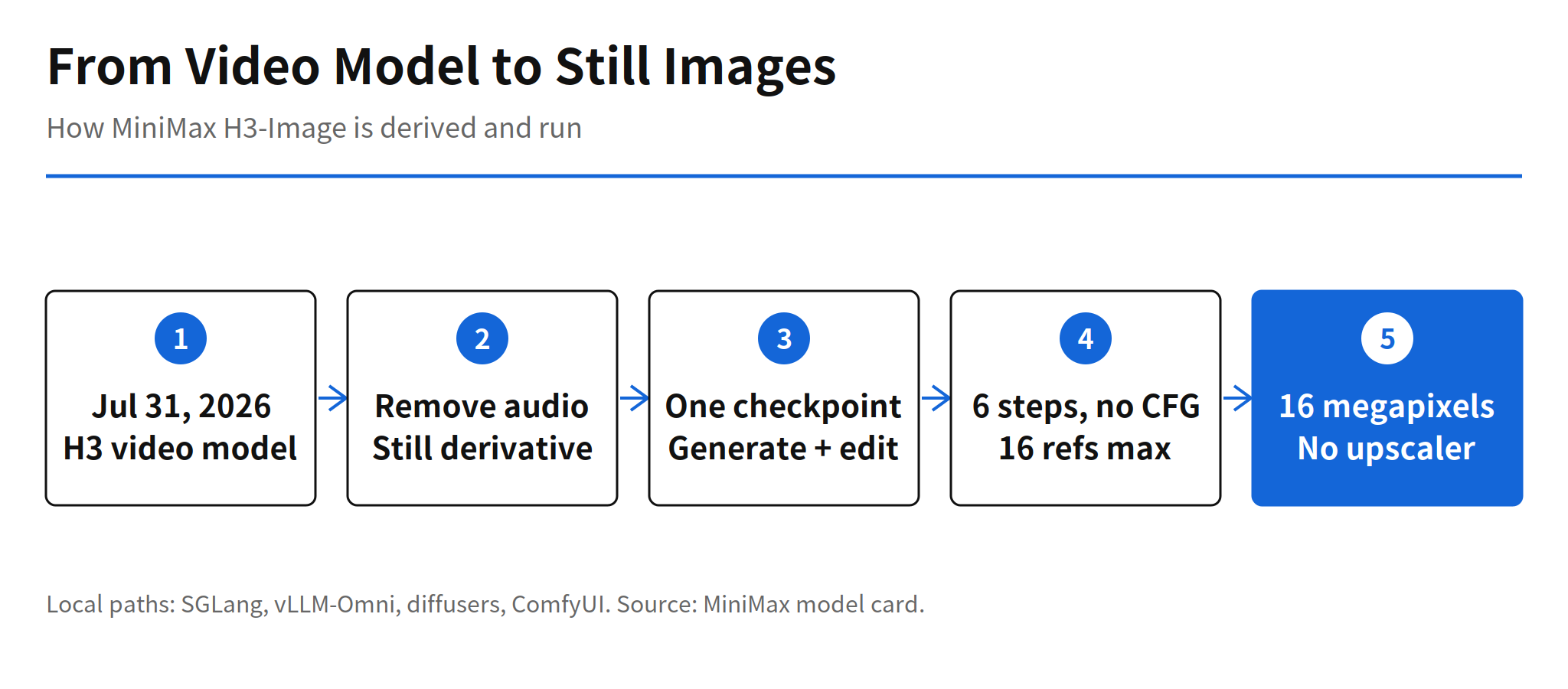
The original H3 is an omni-modal video model released on July 31, 2026. It takes text, image, video and audio in one context. H3-Image is the still-image derivative of that stem: the audio layers are removed, the output becomes a single frame, and the text encoder is reused from MiniMax-H3 unchanged. There was no official blog post for this release. The Hugging Face repository and the API model list carried the announcement, with OrcaRouter publishing the first detailed comparison on the same day.
Reusing a video backbone is a deliberate bet. A model trained on motion learns object permanence and scene layout across frames, and those priors can help composition in stills. The cost is size. Nothing about this checkpoint is small, which the download figures below make plain.
Model Architecture and Download Size
The diffusion transformer has 33.1B parameters, 50 layers, a hidden size of 5376 and 56 attention heads, according to the model card. The checkpoint weighs 68.65 GB in BF16. The text encoder is not in this repository. It comes from the MiniMax-H3 repository as a separate 66.7 GB download, so a full local setup starts at roughly 135 GB before the optional prompt expander. The expander, MiniMax-H3-Image-PE, adds 17.9 GB in NVFP4 and is optional.
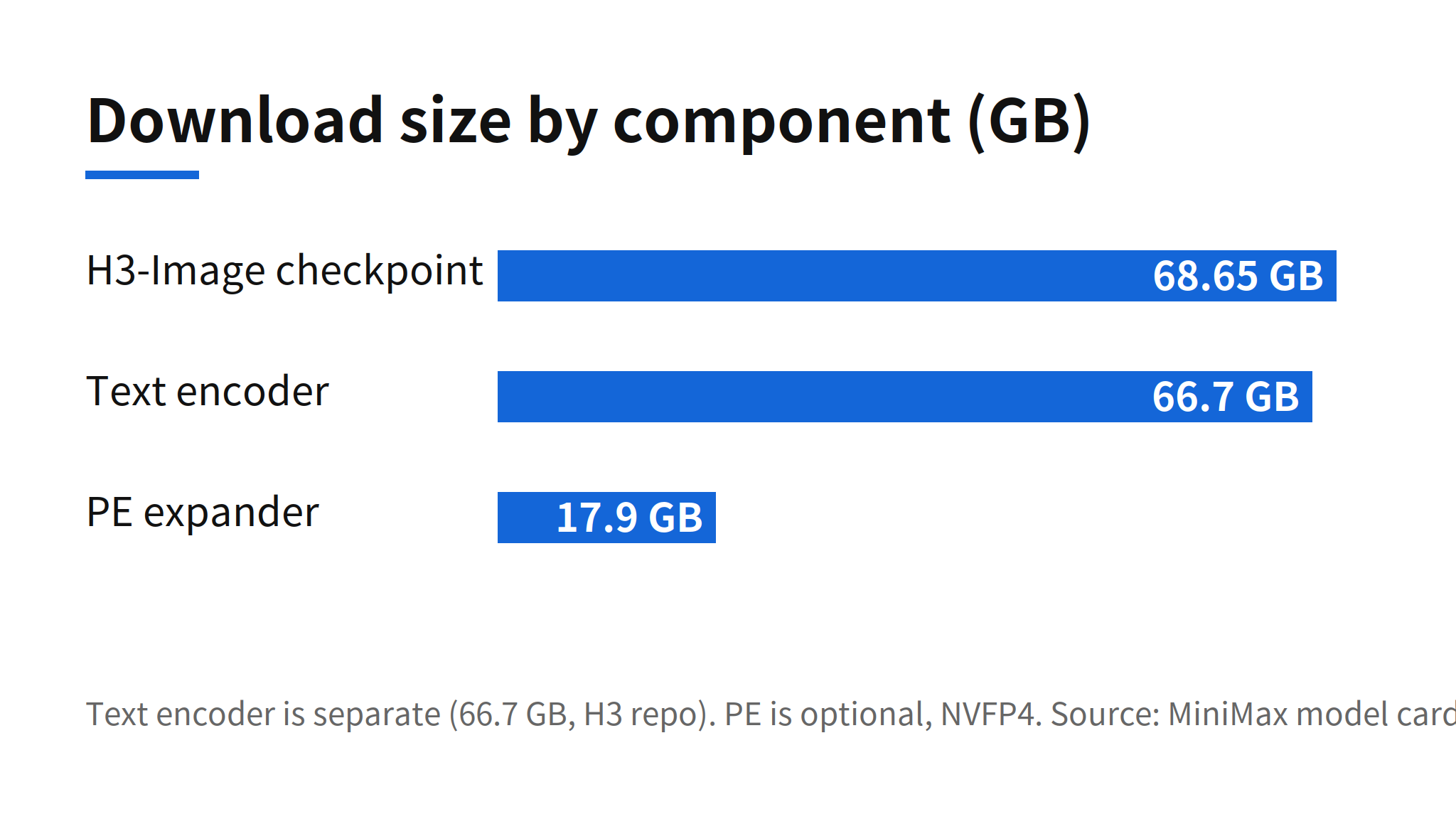
That footprint shapes the real audience. This is a data center or high end workstation model, not a laptop checkpoint. Teams evaluating it for local production should budget storage and memory for the combined download, not the headline 68.65 GB figure alone.
Generation and Editing in One Checkpoint
Generation and editing live in the same weights. The model accepts up to 16 reference images for editing, and MiniMax claims the strongest instruction following among open source models. That claim is currently unverified. No independent benchmark supports it, and the model card carries no evaluation table.
The unified design still has practical value even before benchmarks arrive. A pipeline that generates a base image and then edits it with references normally loads two models and accepts a style shift between them. One checkpoint removes that seam. Whether the editing quality matches dedicated editors is the open question, and it stays open until outside testers publish comparisons.
Local Runtimes and API Pricing
MiniMax documents four local paths: SGLang, vLLM-Omni, diffusers and ComfyUI. That spread covers serving engineers and the ComfyUI creator community in one release, which widens the first wave of community testing. For teams that skip local hosting, OrcaRouter calculated the token based API pricing at $0.02179 for a 1K image and $0.06879 for a 4K image.
A launch discount applies on top of that. Generations above 16,600,000 pixels get 50% off until November 17, 2026 at 16:00 UTC. Early traction on Hugging Face was modest but real for a weights-only release with no blog post: 368 likes and 667 downloads, observed on November 11.
License Exclusions and Permission Thresholds
The H3-Image license excludes the European Union, the United Kingdom, the Republic of Korea and the United States of America. Businesses with annualized revenue above 1 Million USD need separate written permission, and so does offering the model to third parties as a hosted service.
These terms turn an open weights release into a regionally limited one. The four excluded territories include several of the largest markets for commercial image generation, and Korea is named explicitly. A Korean studio cannot treat this as a standard open model download. Separate permission comes first, and until it exists, local alternatives with clear terms are the safer production choice. Downloadable and usable are two different things, and this release is a clean example of the gap.
Missing Benchmarks and Unverified Claims
Three central claims have no outside evidence yet. The strongest instruction following claim comes from MiniMax alone. The 10 to 20 second generation time has no third party measurement under the same conditions. As of November 10, the model had no listing on the Artificial Analysis image board, per OrcaRouter, and the model card includes no evaluation table.
None of that makes the release weak. It makes it early. The architecture numbers, output size and step count are documented in the model card and can be checked directly. The quality ranking cannot. Readers comparing image models this week should separate those two layers: verified specifications on one side, vendor positioning on the other.
Related Reading
Another recent open image release with pricing and scores is covered in the report on Seedream 5.5. For a multimodal model release from the same period, see the report on Gemini Omni 1.2 Flash GA.
FAQ
What did MiniMax release on November 10, 2026?
MiniMax published the MiniMax-H3-Image weights on Hugging Face. One checkpoint handles both text to image generation and reference image editing, at about 16 megapixels in 6 sampling steps.
Can H3-Image be used in South Korea under its license?
No. The license lists the Republic of Korea in its Excluded Territories, along with the European Union, the United Kingdom and the United States of America. Use in those territories is not covered by this license alone.
How large is the H3-Image download?
The checkpoint is 68.65 GB in BF16. The text encoder is not included and adds a separate 66.7 GB download from the MiniMax-H3 repository. The optional MiniMax-H3-Image-PE prompt expander is 17.9 GB in NVFP4.
What does the H3-Image API cost?
OrcaRouter calculated token based pricing of $0.02179 for a 1K image and $0.06879 for a 4K image. A 50% launch discount applies to generations above 16,600,000 pixels until November 17, 2026 at 16:00 UTC.
Are there independent benchmarks for H3-Image?
No independent benchmark was available at release. OrcaRouter noted no listing on the Artificial Analysis image board as of November 10 and no evaluation table in the model card. The 10 to 20 second generation time is a MiniMax claim without third party measurement under the same conditions.