OpenAI Daybreak Red Team and Defense Factory: Release Guide
OpenAI added two finished products to its Daybreak security platform on November 12, 2026, at the Cyber at the Frontier keynote. Daybreak Red Team is an early access penetration testing service that uses OpenAI models to test a company web application for vulnerabilities. Daybreak Defense Factory automates the defensive loop of finding, validating and fixing vulnerabilities at scale, and it delivers the result as a pull request an engineer can review.
The shift is from model access to product. Daybreak already offered approved access to cyber models, with Blue for defensive work and Red for advanced authorized testing. These two launches sit on top of that access. One sells the test itself, and the other sells the patch workflow, which changes what a security team is buying. It is no longer only a stronger model behind an API. It is an agent fleet doing a defined security job, with the vendor framing, the tooling and the human approval gate included.
That framing came with a warning. OpenAI President Greg Brockman said at the keynote: "We're now at a point where companies will be secure only to the extent of the frontier model that they use to defend themselves and how well they utilize that." He also said security fundamentals still matter. The Register reported the same day that critics read the structure as lock-in, because defense capability becomes tied to one vendor frontier model. Both readings can be true at once. A continuous agent defense can be genuinely stronger than periodic manual testing, and buying it from the model maker still concentrates dependence.
Daybreak Red Team and continuous penetration testing
Nancy Wang, who leads cyber applied AI at OpenAI, described Red Team as "superhuman pen-test at the scale of automated continuous scanning." A fleet of agents uses source code and application context to investigate and test attack paths in a web application. That context matters. A scanner that only sees an endpoint can flag a pattern. An agent that also reads the code and understands how the application is built can judge whether a path is reachable and worth reporting, at least in principle.
Red Team also covers the validation work that usually consumes security team time. It checks vulnerability reports arriving from code scanners, bug bounty programs and public disclosure reports, and it tests whether a patch for a flaw actually stops the exploit. That second check is easy to skip under load, and skipping it is how fixed issues quietly stay exploitable. Automating validation does not remove the need for judgment, but it does move human attention from re-checking every report to deciding which validated findings matter most.
Access is limited. Red Team is in early access for some customers, and a waitlist registration is open. OpenAI has not published the selection criteria, and it has not published pricing. A team evaluating the service today therefore cannot model cost per application, cost per scan cycle, or how continuous scanning is metered. Those are not minor details for a product pitched as continuous rather than occasional.
Daybreak Defense Factory and the patch pull request
Defense Factory runs agents built on OpenAI latest cyber model, currently GPT-6 Cyber. The agents scan an organization codebase, hunt for vulnerabilities and develop patches. Engineers review and approve the proposed fixes before they go into production. Wang put the output plainly: "This way engineers get a merge-ready pull request with the patch and a test that shows that it works."
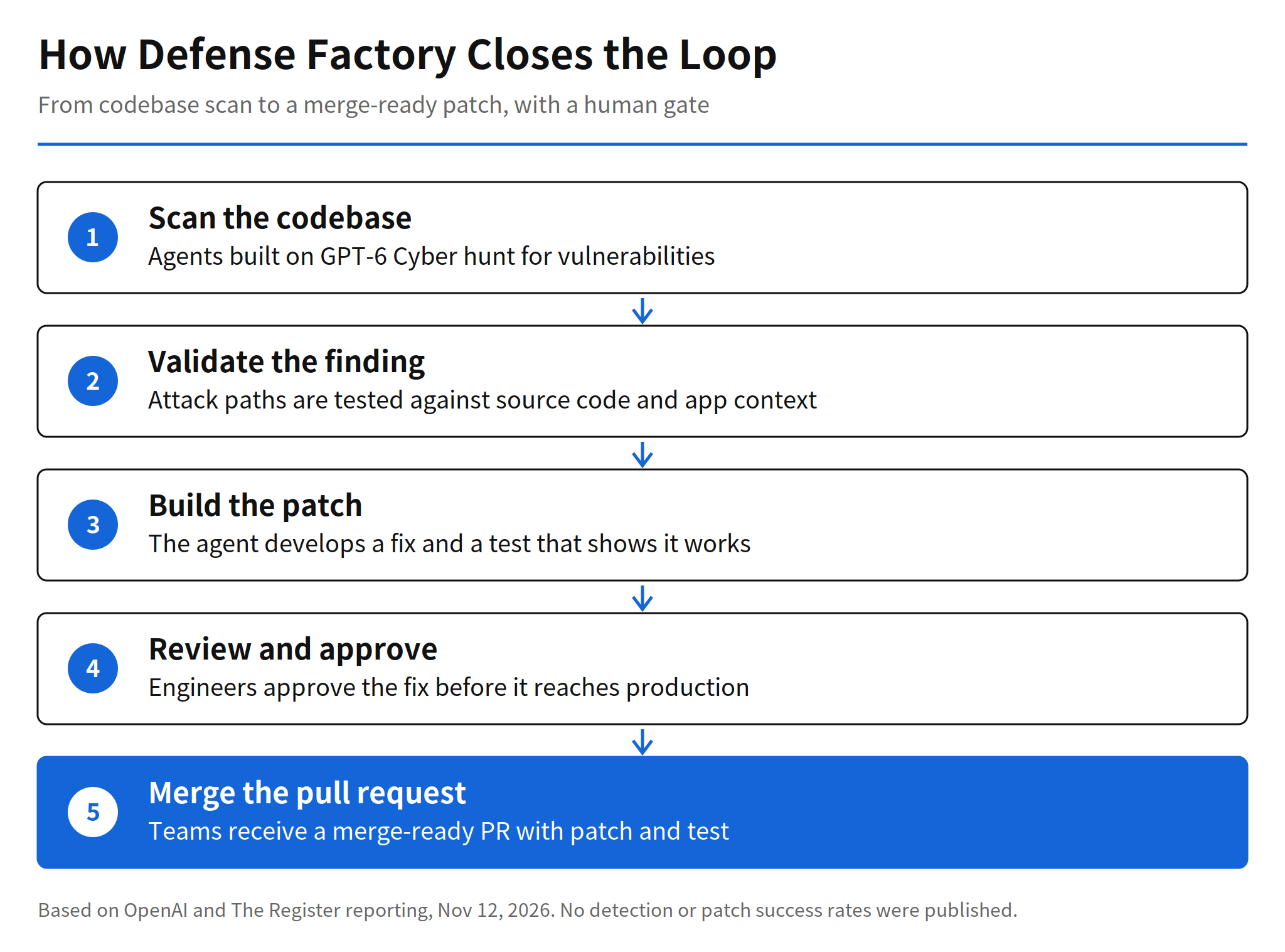
The pull request is the right delivery unit for this kind of automation, and it is worth saying why. A report tells a team that work exists. A pull request with a patch and a passing test enters the review process the team already uses, where ownership, discussion and rollback are already defined. That lowers adoption friction. It also raises the review stakes, because a plausible patch that passes its own generated test can still be wrong for reasons the test does not cover. The quality of the human gate becomes the product real control point, and teams that approve agent patches quickly to clear a queue will get the risk without the benefit.
Defense Factory is also available through a Daybreak plugin inside Codex. OpenAI product page draws a useful distinction there. With the plugin, scans and patch creation happen directly in Codex, with scans running and findings stored locally. With Defense Factory itself, scans and patching workflows run remotely, from findings to fixes at the push of a button. That split gives teams a choice between a local workflow they can inspect closely and a managed workflow that scales with less operational work.
The wider Daybreak platform around the two products
The two launches do not stand alone. Daybreak Blue gives approved teams access to supported general purpose models for defensive work such as code review, vulnerability investigation and remediation, with fewer unnecessary refusals. Daybreak Red gives specialized cyber models for authorized research, including exploit development, penetration testing and red teaming, with additional verification and access controls. Red Team and Defense Factory are products built over that model layer, which explains why the platform story and the lock-in concern arrive together.
OpenAI also lists building blocks for continuous defense on the same page. The Codex Security CLI scans code or changes from a terminal and brings findings, coverage reports and supporting evidence into a development workflow. Security scans can run in CI with the same CLI, alongside existing checks. The Codex Security SDK integrates scans into TypeScript applications, with structured findings, coverage data and scan artifacts. PR review checks pull requests to reduce the risk of reintroducing a vulnerability. In the same period, OpenAI open sourced the Codex Security CLI and SDK, according to the issue record.
Read as a stack, the intent is clear. The CLI and SDK let a team start inside its own pipeline. The plugin brings the loop into Codex. Defense Factory offers the managed version of the same loop, and Red Team adds continuous testing from the attacker side. Each step moves more of the work and more of the operational context toward OpenAI tooling. That is convenient, and it is also the mechanism by which a model choice becomes a platform commitment.
Evidence, pricing and open questions
No independent measurement accompanied the launch. Detection rate, false positive rate and patch success rate were not published for either product. The performance case at launch rests on executive statements at the keynote, including the superhuman pen test description. That does not make the products weak. It makes them unmeasured in public, which is a different and narrower claim. A security buyer should treat the first evaluation period as a measurement exercise on their own codebase, comparing validated findings and accepted patches against their existing scanner and review results.
Pricing is unpublished for both products, and early access criteria for Red Team are unconfirmed. Those gaps limit planning more than the missing benchmarks do, because a continuous service is an operating cost, not a one time purchase. Until OpenAI publishes how scanning frequency, codebase size and patch volume affect price, a team can pilot the workflow but cannot forecast the steady state budget.
The broader context also deserves a plain note. On the same day, The Register reported that a coalition of nonprofits sued OpenAI, Anthropic, Google, Meta and SpaceX AI businesses in San Francisco Superior Court, asking a judge to stop development or deployment of systems more capable than their most advanced existing models, and citing AI driven cyberattack incidents. The lawsuit does not change how Red Team or Defense Factory works. It does show the political pressure around the same capability growth that makes defensive products like these sellable in the first place.
Related articles
- GPT-6 Cyber Release: ExploitGym 48.5% and Critical Rating
- Self-Hosted Claude Managed Agents: Pricing and How It Works
FAQ
What did OpenAI launch on November 12, 2026?
OpenAI launched two products on its Daybreak security platform at the Cyber at the Frontier keynote. Daybreak Red Team tests web applications for vulnerabilities in early access, and Daybreak Defense Factory scans codebases and turns validated findings into patches for engineers to review.
How does Daybreak Defense Factory deliver a fix?
Agents built on GPT-6 Cyber scan a codebase, validate vulnerabilities and develop patches. Engineers review and approve a proposed fix before it reaches production, and they receive a merge-ready pull request with the patch and a test that shows it works.
How much do Red Team and Defense Factory cost?
OpenAI has not published pricing for either product. Red Team is in early access for some customers with a waitlist open, and the criteria for early access selection have not been confirmed.
What performance numbers were published for the new products?
No independent measurements were published at launch. Detection rates, false positive rates and patch success rates were not disclosed, and the performance description at launch rested on statements by OpenAI executives at the keynote.