Gemini Decisions API: Pricing, Speed and How It Works
Google released the Gemini Decisions API on November 11, 2026. It runs a dedicated model, Gemini Decision 1 (gemini-decision-1), through the Gemini API and Google AI Studio. The model does not generate an answer in words. It scores candidate choices in a single forward pass, and returns a calibrated confidence value for each one.
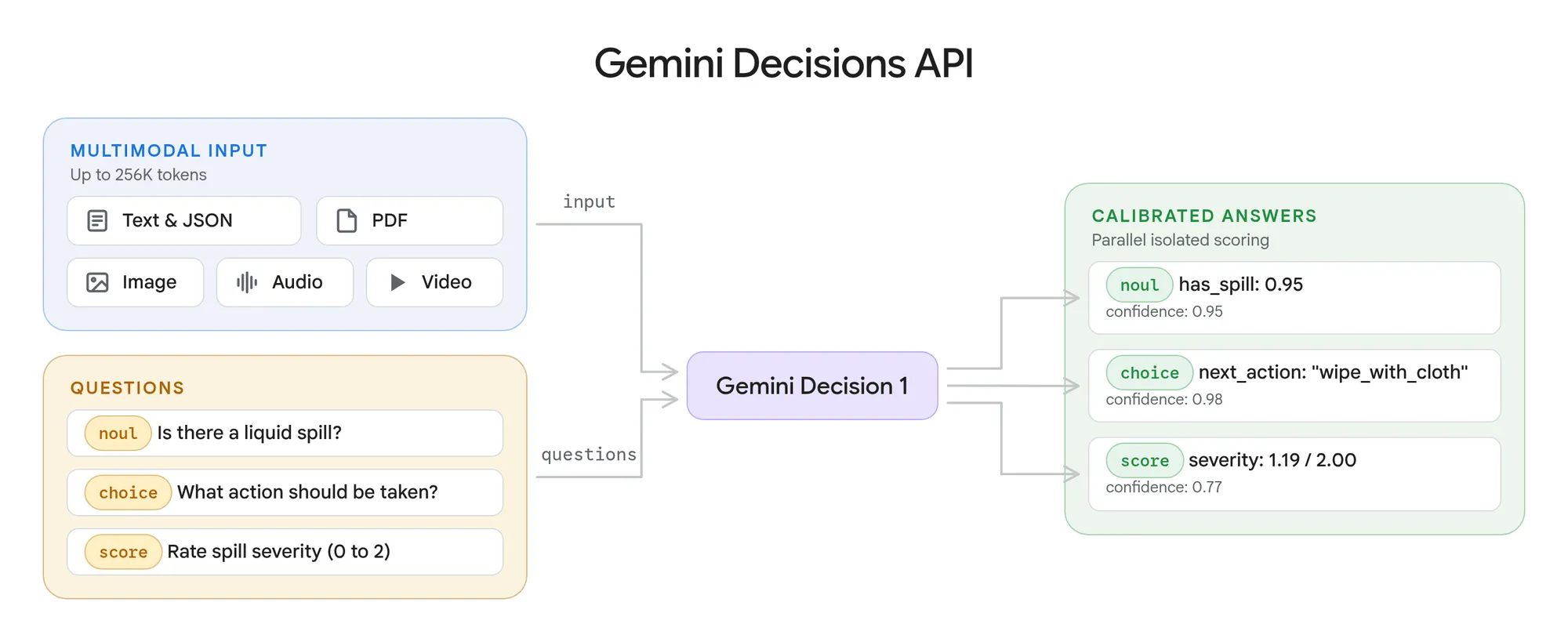
The scale of a single request is the point. One call can carry a shared input of 256K tokens, mixing text, images, audio, video and PDF, together with up to 1,000 independent questions about that input. Pricing is $0.10 per million input tokens, output tokens are not charged, and the shared input is billed once per request no matter how many questions ride on it. Reported latency is 150 to 250ms end to end.
That combination targets a layer of agent systems that rarely makes headlines. Tool selection, model routing and policy checks are decisions with a fixed set of possible answers, and until now they were usually handled by a full generative call per question. If the question count grew, the call count and the bill grew with it. A scoring endpoint collapses that fan-out into one pass.
How the Scoring Pass Works
The request separates the evidence from the questions. The shared input is processed once, and each question is scored against it in parallel. Because the model returns scores rather than prose, there is no generated text to parse, no output token bill, and no per question call to schedule. The answer format is the contract: a choice, plus a number that says how much the model trusts it.
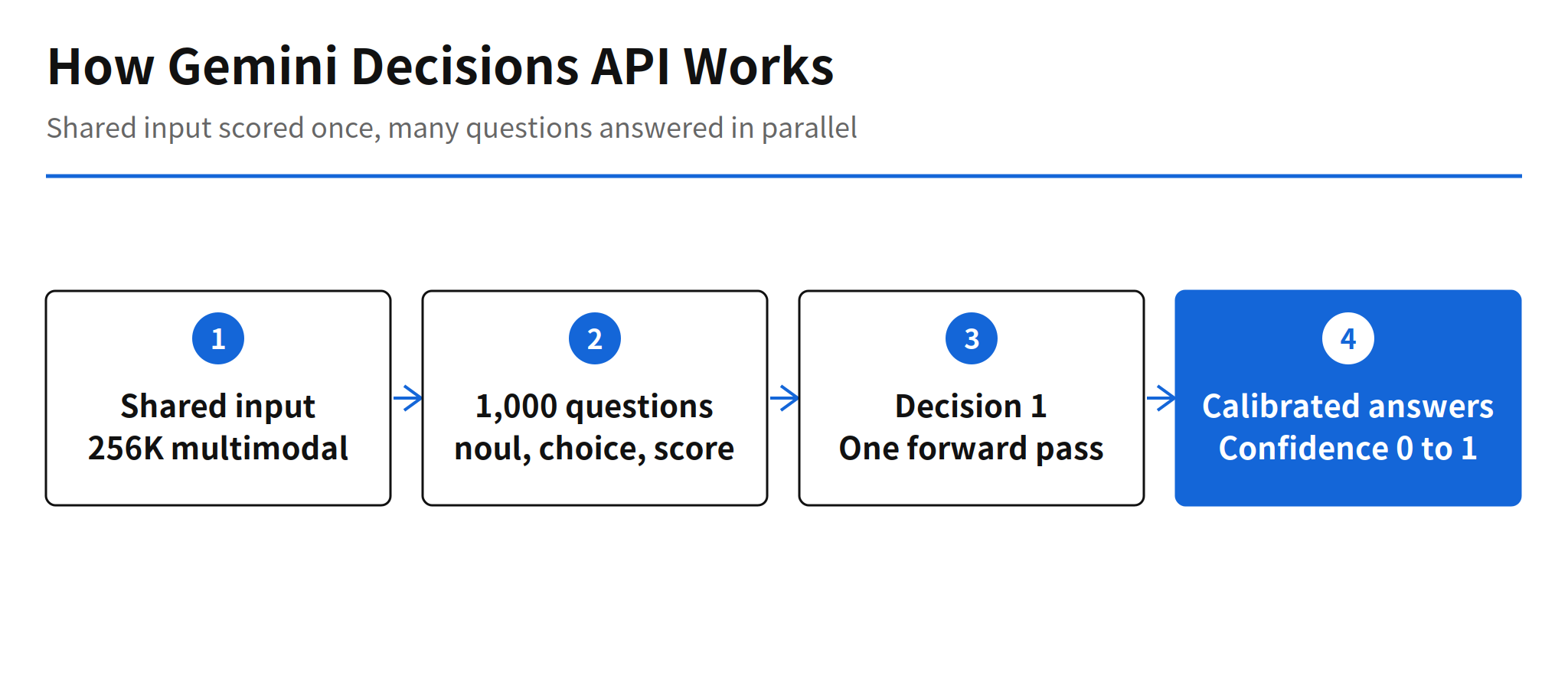
Google says the latency profile follows from that design. For inputs of 16K tokens or less, latency stays nearly flat as the question count rises from 1 to 100. Median model compute is 50 to 100ms, inside the 150 to 250ms end to end range. Those are vendor figures from the launch post, and the flat scaling claim is exactly the part worth testing first on a real routing workload, since it is the property the whole product rests on.
Three Question Types
| Type | What it answers | Output |
|---|---|---|
| noul | Estimates the probability of a yes or no outcome | Probability with a 0 to 1 confidence score |
| choice | Picks one option from 2 to 255 candidates | Selected option with a 0 to 1 confidence score |
| score | Grades content against a rubric | Rubric grade with a 0 to 1 confidence score |
The three types cover most of the judgment calls inside an agent pipeline. Noul fits safety and eligibility gates. Choice fits routing and tool selection, where the candidate set is known in advance. Score fits review and ranking steps that today are often delegated to a generative model asked to behave like a grader. In each case the confidence value matters as much as the answer itself, because a pipeline can route low confidence cases to a larger model or a human instead of treating every score as final.
Latency and Pricing in Practice
The pricing model is as notable as the speed. Generative judging bills for reasoning text that the caller throws away. Here, output is free and the shared input is charged once, so the cost of adding a question is close to zero within a request. That changes the economics of checks that were previously sampled or skipped for cost reasons. Running a policy check on every item, rather than one item in ten, becomes a design choice instead of a budget decision.
For Android and AX work, the natural first candidates are the judgments with clear boundaries: which tool a request should go to, whether content passes a grade threshold, which model tier a query deserves. Each can be measured side by side against the generative call it would replace, on accuracy, latency and cost, with the confidence score providing the fallback rule.
Benchmark Claims and the Cost Table
Google published a comparison table alongside the launch. In its benchmark column, Gemini Decision 1 through the Decisions API posts figures such as 92.2% on JevBench and 58.7% Macro-F1 on Amazon ESCI, ahead of TypeSafe Jev 1.14, GPT-6 Luna through the OpenAI Decisions API, and Gemini 3.5 Flash-Lite in the rows shown. Its calibration error, Top-1 ECE of 0.0250, is the lowest in the table, which matters for a product whose output is a confidence score.
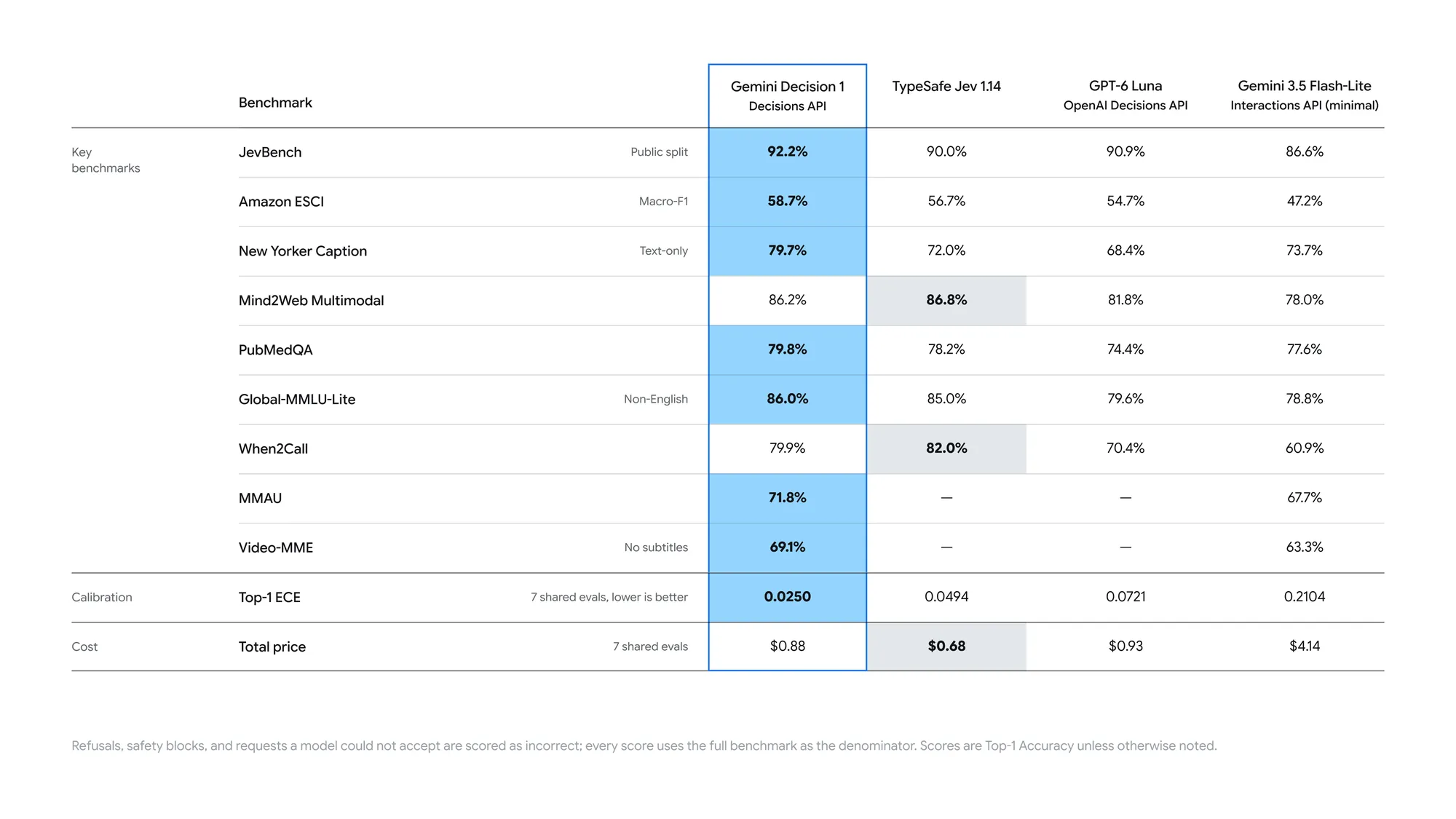
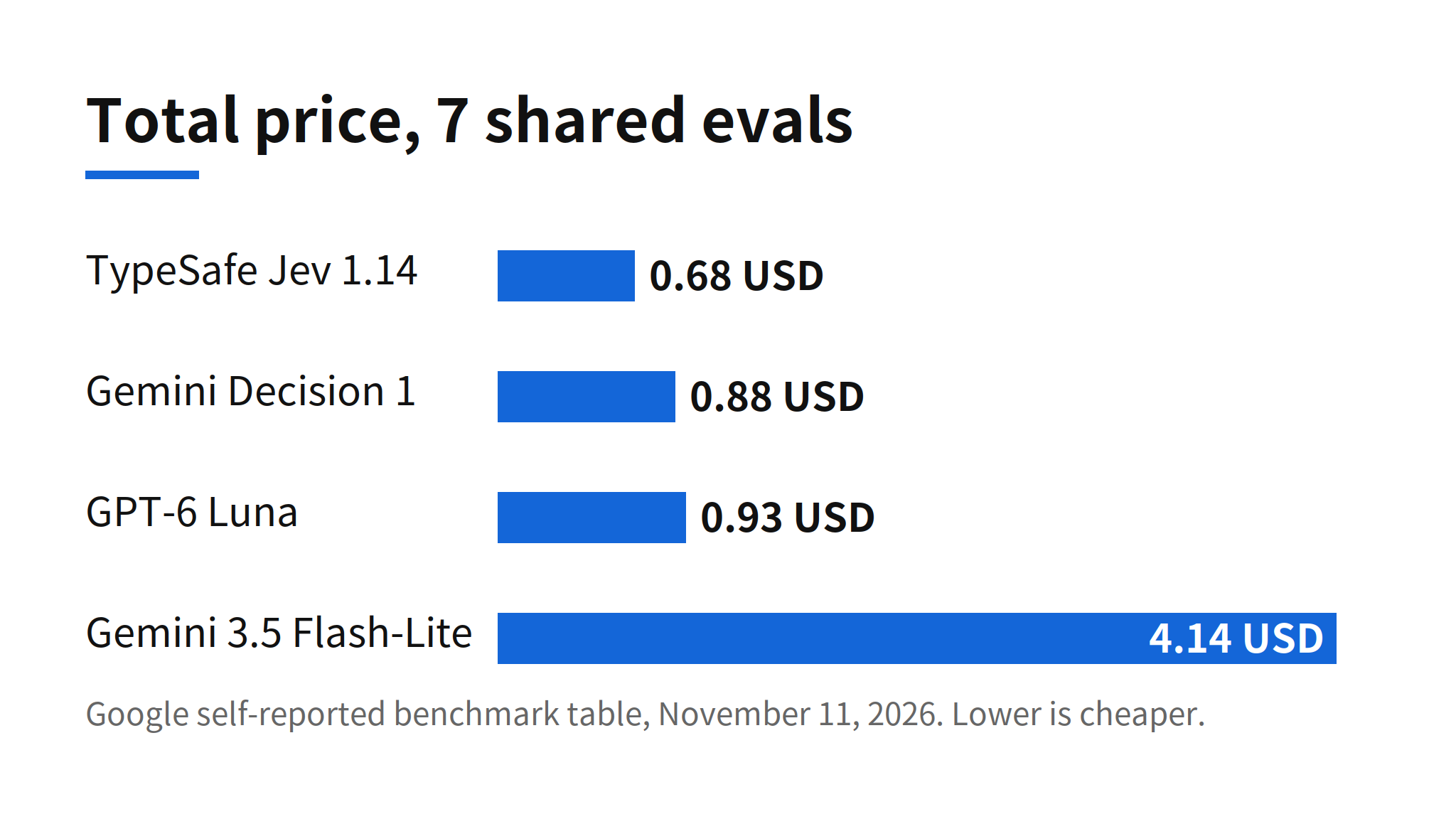
The cost row is the one Google leans on. Total price across the 7 shared evaluations is $0.88 for Gemini Decision 1, against $0.68 for TypeSafe Jev 1.14, $0.93 for GPT-6 Luna and $4.14 for Gemini 3.5 Flash-Lite. Read carefully, that row cuts two ways. Against a generative model used for judging, the roughly 5x gap Google claims is visible. Against the specialist TypeSafe Jev, the new API is accurate and well calibrated but not the cheapest line in its own table.
Early Use Inside Google
Google named two internal users in the launch post. Gemini Notebook uses the API to route queries, and cut latency on everyday queries by up to 40%. Search uses it as a safety layer for MCP tools. Both cases match the product logic: routing and safety checks are high volume, low ambiguity decisions where a 200ms scoring call replaces a much heavier generative one, and where the aggregate saving comes from count rather than from any single call.
A Category Taking Shape
Google is not the first to split decisions out of generation. OpenAI made its own Decisions API generally available on October 22, and TypeSafe Jev, the specialist entry in the benchmark table, comes from the same decision model category covered earlier in issue #3336. Two major providers shipping a dedicated endpoint for the same job, within weeks of each other, suggests the decision layer is becoming a standard part of the agent stack rather than a prompt pattern.
The practical consequence is a new comparison axis. Teams that today pick one generative model for everything will increasingly pick a judging endpoint separately, on calibration and price per thousand decisions. That is a market where a small, fast, honest confidence score beats a fluent paragraph.
What Remains Unverified
The benchmark lead and the roughly 5x cost advantage over Gemini 3.5 Flash-Lite are Google self measurements. No independent verification has been published, and the comparison baseline is Google's own smaller generative model.
- Self reported results: benchmark scores, calibration and the total price row all come from Google launch material, measured against TypeSafe Jev 1.14, GPT-6 Luna and Gemini 3.5 Flash-Lite.
- Cloud availability pending: support for Gemini in Google Cloud is listed as coming soon, and the launch post does not separate a preview label from general availability.
- Missing options noted: MarkTechPost noted that prompt caching and batch options are not yet available, which matters for workloads that rescore the same input repeatedly.
None of that undermines the design, which is simple enough to evaluate directly. A team can take one existing routing or grading call, run it against Gemini Decision 1 for a day, and compare accuracy, latency and cost on its own traffic. If the confidence scores are as well calibrated as the launch table claims, the endpoint earns its place quickly. If they are not, no benchmark table will save it, and that testability is the strongest thing about the release.
FAQ
What is the Gemini Decisions API?
It is a Google API released on November 11, 2026 that runs the dedicated Gemini Decision 1 model. Instead of generating text answers, the model scores candidate choices in a single forward pass and returns a calibrated confidence score for each answer.
How many questions can one request carry?
One request can carry up to 1,000 independent questions alongside a shared multimodal input of up to 256K tokens, mixing text, images, audio, video and PDF. The shared input is charged once per request, regardless of the question count.
What does the Gemini Decisions API cost?
Input costs $0.10 per million tokens and output tokens are not charged. Google reports end to end latency of 150 to 250ms, with median model compute of 50 to 100ms.
What are noul, choice and score questions?
Noul estimates the probability of a yes or no answer. Choice picks from 2 to 255 options. Score grades against a rubric. Every answer carries a confidence score from 0 to 1.
Have the benchmark and cost claims been verified?
No. The benchmark lead and the claim of costing roughly 5x less than Gemini 3.5 Flash-Lite are Google self measurements, and no independent verification has been published. Support in Gemini in Google Cloud is still listed as coming soon.
Related Reading
- Salesforce Koa Decisions: Gemma Decision Model Release, another dedicated decision model aimed at bounded judgments
- Sarvam Prism: Open Decision Model, 44ms, 71.8 Average, an open decision model competing on speed