Sarvam Prism: Open Decision Model, 44ms, 71.8 Average
Sarvam released Prism on November 3, 2026, an open weight model built only for decisions. Prism is a LoRA fine tune of Sarvam 105B. It reads a state, a question, and a set of choices in a single forward pass and returns a probability for each choice, without generating tokens one by one.
In Sarvam self reported measurement, Prism averaged 71.8 across three indexes at a median latency of 44 ms on an NVIDIA B200 GPU. Sarvam says that is the highest score among the decision models it tested with latency under 100 ms, out of 25 models in total. The weights are public under Apache 2.0, so the claim can be checked and the model can be fine tuned on private outcome data.
Release Overview
Sarvam classifies Prism as a System One model, a fast judgment model rather than a reasoning model. The decision model category itself is recent. TypeSafe created it last month with its Jev model, around a simple idea: instead of asking a generative model to pick one answer in prose, put a small dedicated model at many points in a workflow and let it return a calibrated probability for each option.
Prism enters that category from the opposite end of the size range. The base is a 105B model, reduced for this task through LoRA fine tuning and FP8 serving. The latency figure is also the result of engineering work after the first version. Sarvam says the median response started at 664 ms and reached 44 ms through FP8 conversion and kernel consolidation. That history matters for buyers, because it shows the 44 ms figure depends on the serving stack, not only on the weights.
How Prism Works
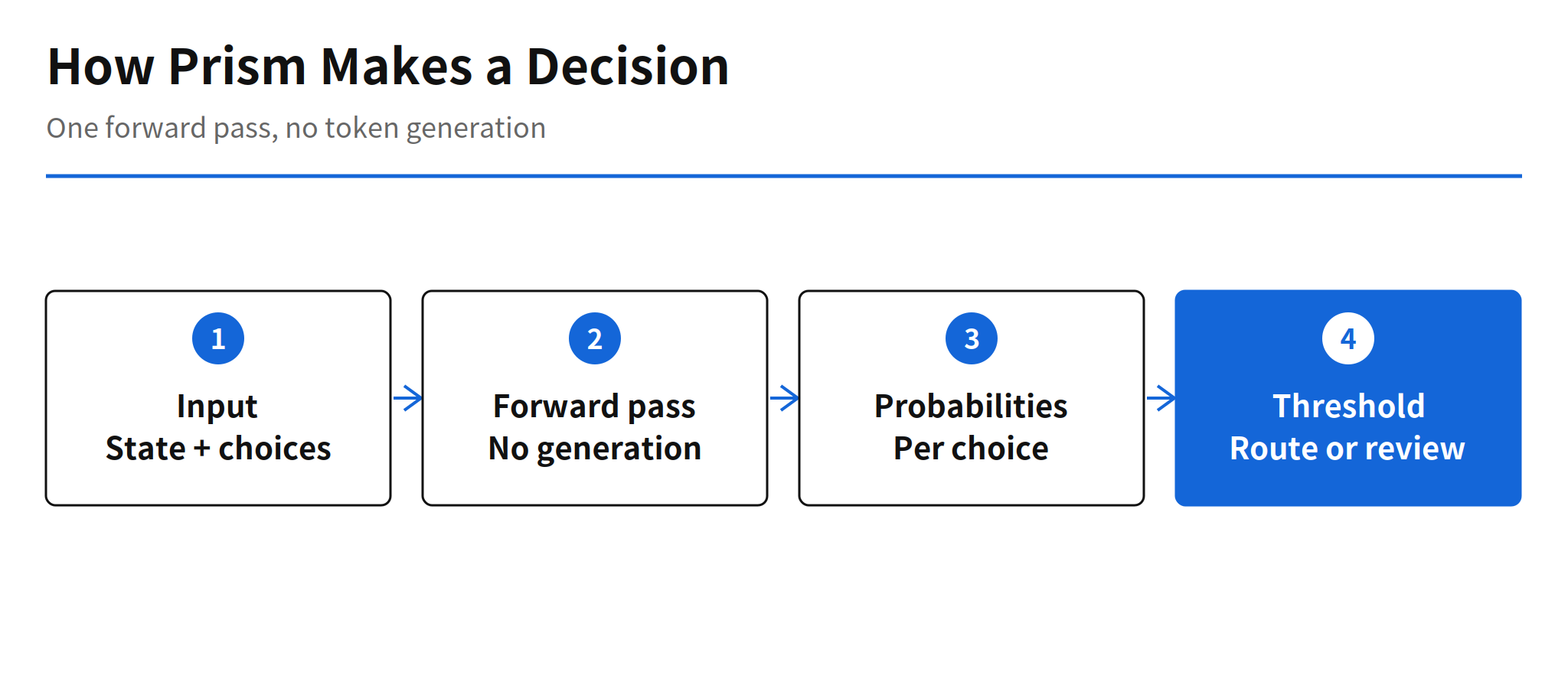
The output shape is the practical point. A probability per choice plugs directly into routing, guardrails, and review queues. A workflow can auto approve above one threshold, send a case to a human between thresholds, and reject below another, without parsing generated text and without calling a large generative model for every judgment. In agent systems, judgments happen more often than generation, so a cheap and fast judgment layer changes the cost structure of the whole workflow.
Index Scores and Latency
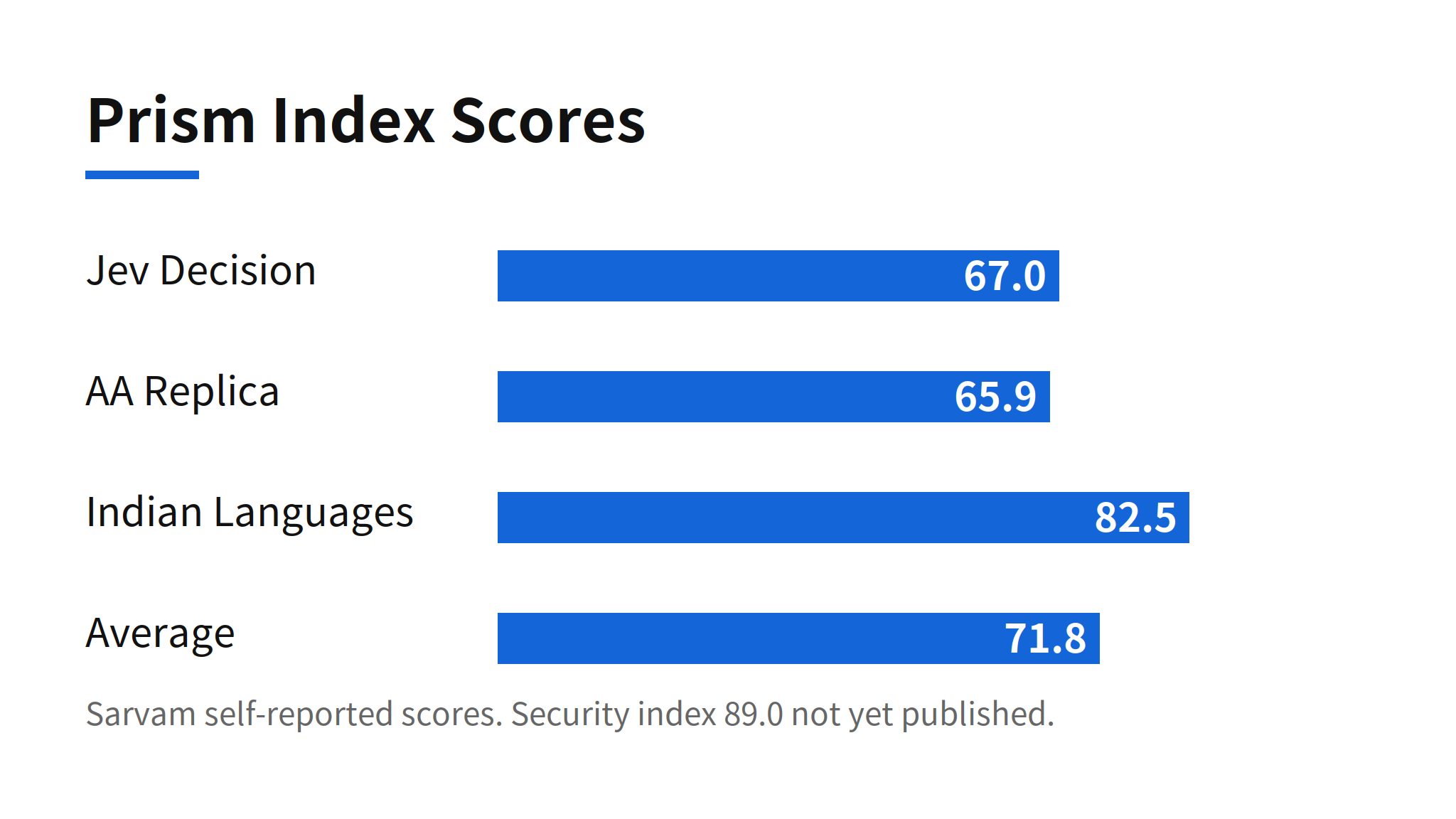
- Jev Decision Index: 67.0. The category defining index, created with the Jev model.
- Artificial Analysis index, reproduced by Sarvam: 65.9. A reproduction, not the original operator run.
- Indian languages index: 82.5. The strongest score, and also a Sarvam internal benchmark.
- Average: 71.8 across the three indexes, at 44 ms median latency on B200 hardware.
The spread between indexes is informative. Prism scores much higher on Indian languages than on the two general indexes, which fits Sarvam focus on Indian language deployment. It also means the 71.8 average should not be read as a single general decision ability. Teams evaluating Prism for English only workflows should weight the 67.0 and 65.9 figures more heavily.
Calibration Results
Sarvam leads with calibration, and that emphasis is well placed. For answers where Prism reported confidence of 90% or higher, the predicted error rate in English was 3.3% and the actual error rate was 2.2%. In Indian languages, predicted error was 5.4% and actual error was 4.4%. In both cases the actual error stayed inside the predicted range, and on the conservative side.
Calibration is what makes threshold automation defensible. An accurate model with unreliable confidence forces operators to add wide safety margins or manual review. A model whose stated confidence tracks its real error rate lets a team set an auto approval threshold and estimate the residual error before deployment. On the reported numbers, Prism confidence can be used that way, at least on Sarvam test distribution.
Order Invariance and Trace Evaluation
Choice order is a known failure mode for judgment by generative models. Sarvam tested 2,000 questions in four different choice orders. With an ordering normalization step in preprocessing, Prism changed its answer in 0 cases. Without that preprocessing, 4.0% of answers changed. The result credits the pipeline as much as the model, and it gives implementers a concrete step to keep.
On recorded agent execution traces, 700 runs with 1,770 questions, Prism reached 78.5% overall accuracy. Task success judgment scored 75.0%, and judgment of whether human review was needed scored 86.4%. The review triage figure is arguably the most deployable one, since routing work to humans is a decision most agent operators already need at scale.
Deployment and Licensing
- Weights: public on Hugging Face under the Apache 2.0 license.
- Serving: FP8 on a single GPU, with at least 120 GB of memory required.
- Hosted option: also available through the Sarvam API.
The 120 GB floor limits casual self hosting. This is not a model for a workstation GPU. The realistic self host profile is a data center GPU or a multi GPU node, which puts Prism in the same procurement class as other large open models. The open weights still matter at that scale, because an operator can fine tune on its own decision outcomes and keep sensitive state and choices inside its own infrastructure.
Limits of the Current Evidence
- Self measurement throughout. Every score, latency figure, and calibration result comes from Sarvam itself.
- Partial comparison method. In the 25 model comparison, two API only models were entered with published response times rather than direct measurement.
- Unpublished security index. The security index, 5,517 questions with a reported score of 89.0%, is a Sarvam internal benchmark. Sarvam says it will publish the index in the coming weeks, and it is not public yet.
- Training data undisclosed. The release does not describe the composition or size of the training data, so the source of the calibration quality cannot be assessed.
None of this makes the release weak. It defines what would confirm it: an independent run of the Jev Decision Index on the public weights, publication of the security index, and calibration measured on a distribution Sarvam did not select. Until then, the right reading is that Prism is a credible and checkable entry in a new category, with its strongest evidence on calibration and its weakest on comparative ranking.
Related Reading
For another open weight release covered here, see NVIDIA GTC Berlin Open Models: Six Families, Open Weights, covering six model families released with open weights. Prism differs in scope, one task and one output shape, but both releases test whether open weights plus a clear deployment path can compete with hosted APIs.
FAQ
What is Sarvam Prism?
Prism is a decision model released by Sarvam on November 3, 2026. It is a LoRA fine tune of Sarvam 105B that reads a state, a question, and a set of choices in one forward pass and returns a probability for each choice, without generating tokens.
How fast is Prism and how well does it score?
In Sarvam self reported measurement, Prism averaged 71.8 across three indexes, with 67.0 on the Jev Decision Index, 65.9 on a reproduced Artificial Analysis index, and 82.5 on an Indian languages index. Median latency was 44 ms on an NVIDIA B200 GPU.
How are the weights licensed and what hardware is needed?
The weights are on Hugging Face under the Apache 2.0 license. Prism runs in FP8 on a single GPU and needs at least 120 GB of memory, and Sarvam also offers it through the Sarvam API.
Are the Prism benchmark results independently verified?
No. All figures in the release are Sarvam self reported measurements. The Indian languages index and the security index are Sarvam internal benchmarks, the security index itself is not yet published, and two API only models in the 25 model comparison used published response times rather than direct measurement.