Salesforce Koa Decisions: Gemma Decision Model Release
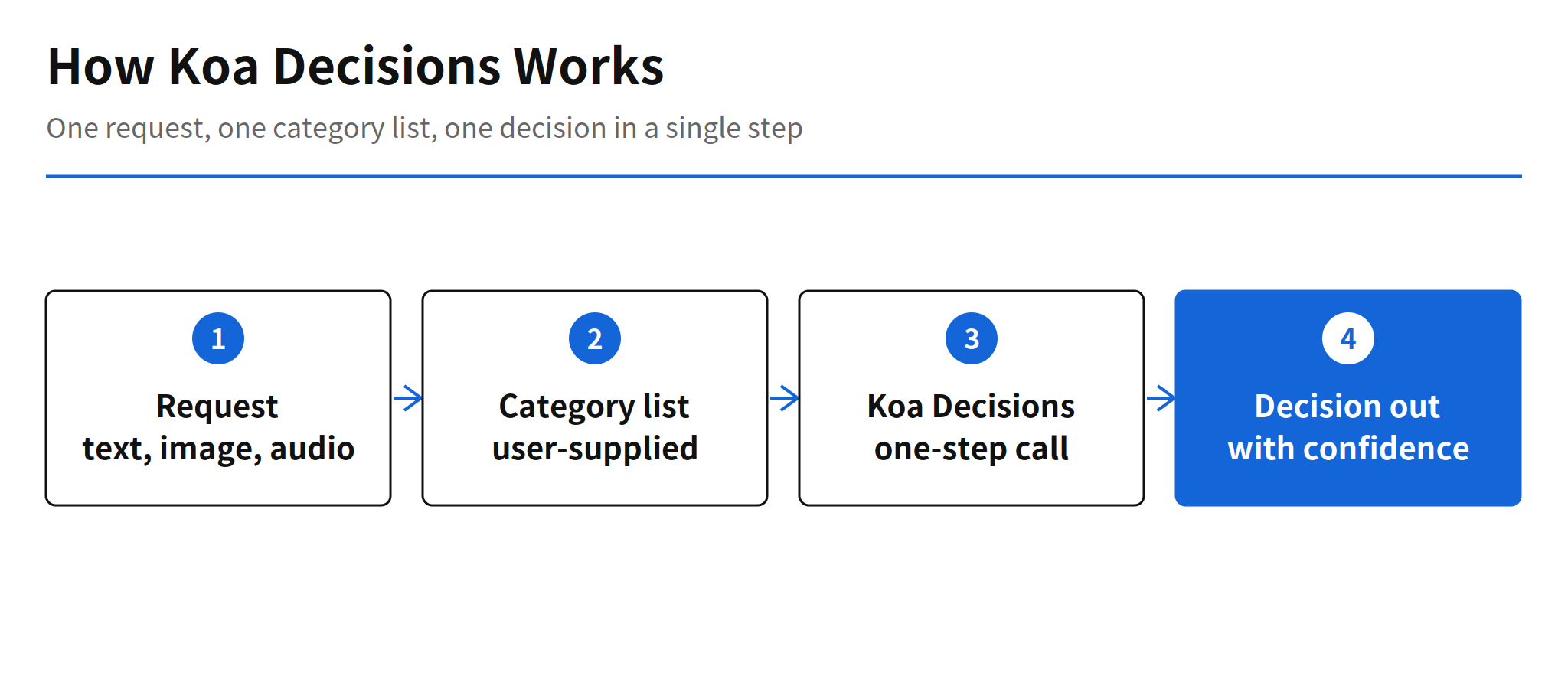
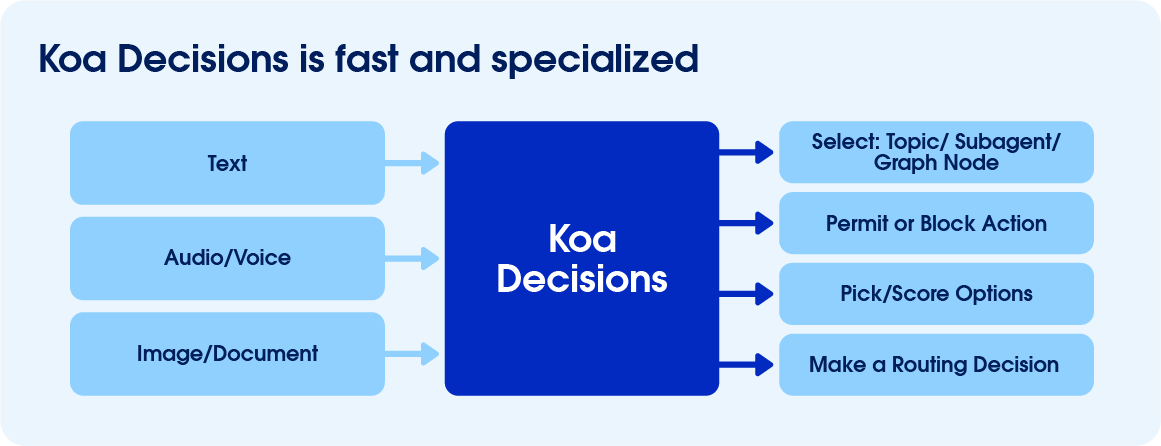
Salesforce introduced Koa Decisions on November 6, 2026, a decision model that succeeds HyperClassifier, the component that has been routing requests inside Agentforce. The data science team built it by applying new training techniques to Google's open-weight Gemma model, and this version adds image and audio inputs to the text the router already handled. The model reads a request and a category list you define, then returns one of the choices, a yes or no answer, or a score, along with a confidence score.
The speed gap is the reason this model class exists. In Salesforce's Agentforce routing measurements, a decision model took about 26 milliseconds where a general-purpose large language model took about 1.4 seconds. Routing is not an occasional call in an agent system. It happens at every step, for every request, so a fifty-fold difference at that layer compounds across the whole workflow. A general model spends most of that time generating language the router never needed. A decision model skips the language and returns the choice.
Decision Model Inputs and Outputs
The interface is deliberately small. The input is a request, which can now carry text, an image, or audio, plus the list of categories the caller supplies. The output is a single decision in one of three shapes: a selected option, a yes or no, or a score. A confidence value travels with the answer, which matters in practice because it gives the surrounding system a way to escalate the cases the model itself flags as uncertain instead of treating every routing call as equally reliable.
Category Changes Without Retraining
The operational detail that stands out is how categories change. A new category can be added to the list without retraining the model. In the official demo, adding Returns to the list made return requests route to that category immediately. Anyone who has maintained a classifier in production knows the alternative: collect examples, retrain, revalidate, redeploy, every time the business invents a new bucket. Removing that cycle turns routing policy into configuration, and configuration can change at the speed of the support team rather than the speed of an ML pipeline.
The demo is also open beyond the customer base. Salesforce says the Koa Decisions demo runs on a free Trailhead account, with no Salesforce contract required. That makes the central claim testable by anyone: put the same request through a general model and through the decision model, and compare the answer format and the latency side by side.
Latency Numbers and Their Limits
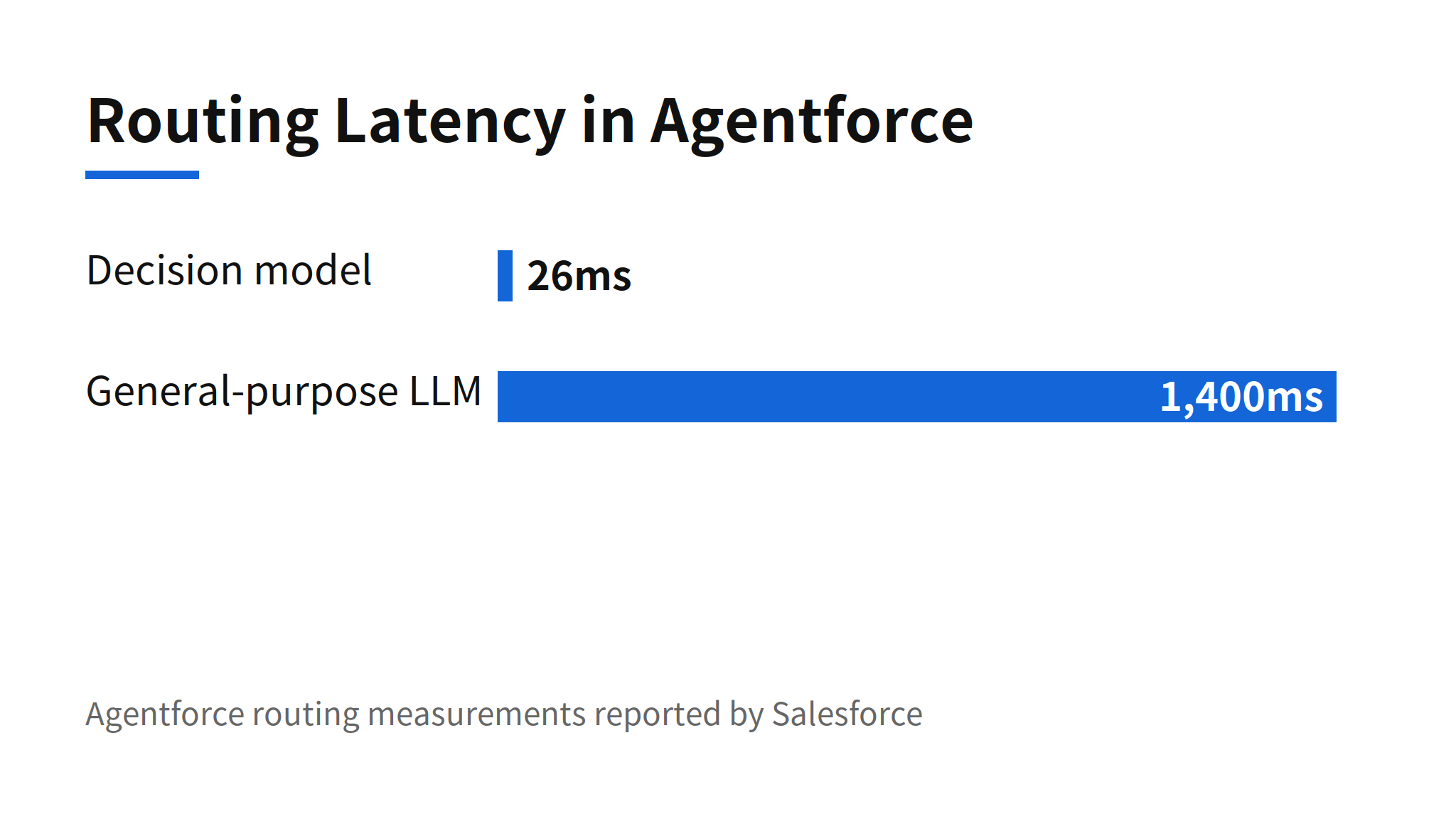
The numbers in this story come from three different places, and keeping them apart matters. The 26 millisecond figure is a decision model measurement in the Agentforce routing context. The 85.5% accuracy and 0.53 second median response time (p95 of 0.63 seconds) come from the underlying Koa-action framework paper, which also reports a median response roughly 1.9 to 7.5 times faster than frontier models under the same serving conditions. The announcement itself publishes no accuracy or latency benchmark for Koa Decisions as a model. Treating the framework numbers as the new model's benchmark would overstate what Salesforce has actually shown, and the honest summary is that the routing gap is demonstrated while the new model's own scores are still unpublished.
Decision Models as an Enterprise Category
Salesforce is not entering an empty field. TypeSafe AI came out of stealth with Jev in mid-September 2026, OpenAI made its Decisions API generally available a month later, and Kakao released its decision-only Kanana-2-v-decide model on the same day as Koa Decisions, November 6. The pattern across all four is the same architectural judgement: agents spend much of their time choosing rather than writing, choosing a tool, a team, a next step, or whether to allow an action, and those choices do not need a frontier model. When a vendor of Salesforce's scale builds the decision layer into its agent platform, the category stops being a startup experiment and becomes a standard part of the enterprise agent stack.
The planned expansion points in the same direction. Salesforce describes growth beyond routing into flows, Apex, prompt templates, and a developer API. The Koa family already includes a separate reasoning model built with NVIDIA. If the decision layer reaches the API surface, the choice between a general model call and a decision model call becomes a per-step engineering decision inside ordinary Salesforce development, not a platform migration.
Open Questions and Availability Limits
- Koa Decisions has no published benchmark of its own. The accuracy and latency figures in circulation belong to the Koa-action framework paper or to the Agentforce routing context, and Salesforce has not released model-level scores for this version.
- The expansion timeline is unconfirmed. Flows, Apex, prompt templates and the developer API are stated plans, with no delivery dates given.
- Pricing and packaging can change. Salesforce notes that availability also varies by region and by customer agreement, so the demo experience is not a guarantee of production terms.
None of that weakens the immediate, practical point. The routing layer of an agent platform is now a specialized model with multimodal inputs, millisecond responses, and categories that change without retraining, and it can be tried today on a free account. Teams building on Agentforce get the decision to test directly: measure their own requests against the published routing gap before deciding how much of their stack to move onto it.
Related Reading
For another decision-only model released on the same day, see the report on Kakao Kanana-2-v-decide, which takes the open-source route for the same category Koa Decisions enters as a platform feature.
FAQ
What is Salesforce Koa Decisions?
Koa Decisions is a decision model Salesforce introduced on November 6, 2026. It is the next version of HyperClassifier, the component that routes requests inside Agentforce, and it was built by applying new training techniques to Google's open-weight Gemma model.
What does Koa Decisions return?
The model reads a request and a user-defined category list and decides in a single step. It returns one of the choices, a yes or no answer, or a score, together with a confidence score. Salesforce describes the processing time as milliseconds.
How fast is a decision model compared with a general LLM?
In Salesforce's Agentforce routing measurements, a decision model took about 26 milliseconds while a general-purpose large language model took about 1.4 seconds. Those figures describe the routing context, not a benchmark of Koa Decisions itself.
Can new categories be added without retraining?
Yes. Salesforce says a new category can be added to the list without retraining. In the official demo, adding Returns to the list made return requests route to that category right away.
Can anyone try the Koa Decisions demo?
Yes. The demo runs with a free Trailhead account, and Salesforce says you do not need to be a Salesforce customer to use it.