Kakao Kanana-2-v-decide Release: 0.04s Decision Model
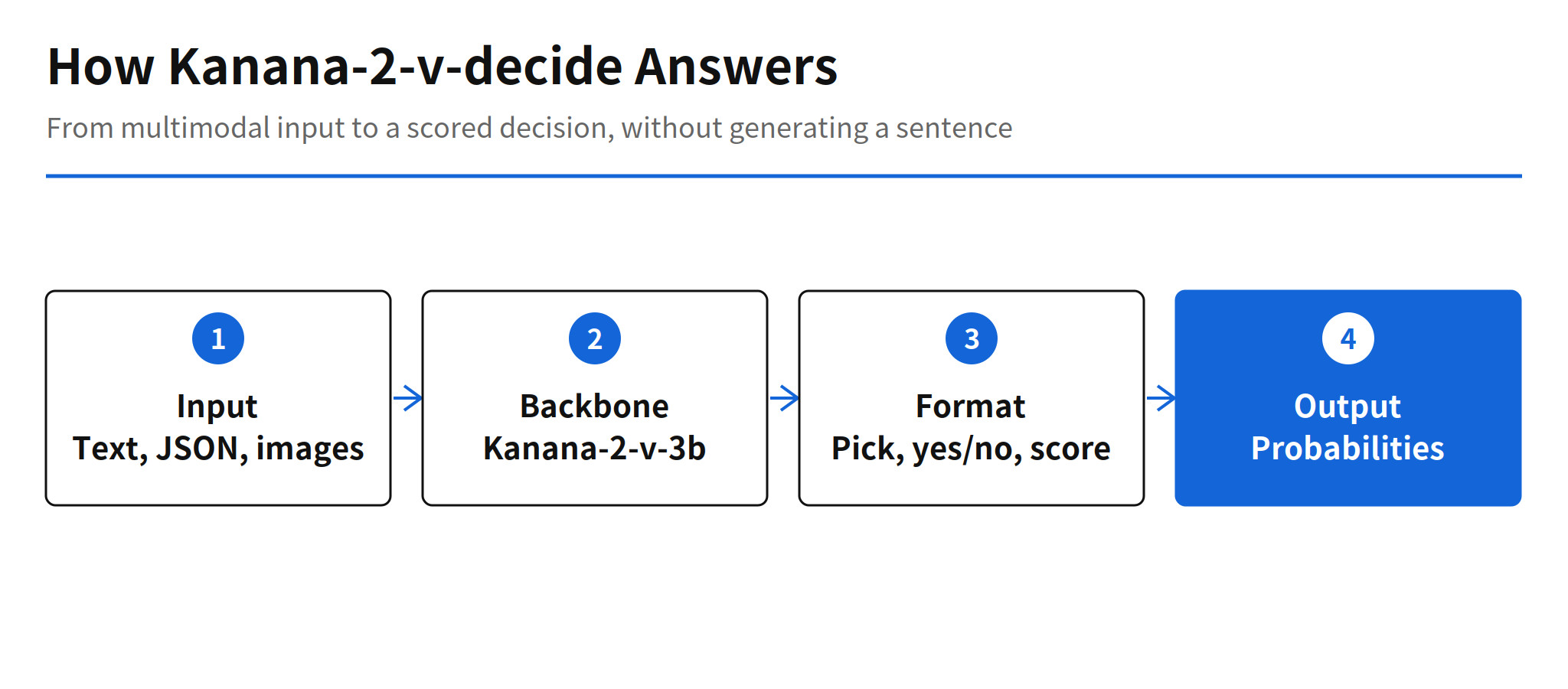
Kakao released the weights for Kanana-2-v-decide on Hugging Face on November 6, 2026, under the model name kakaocorp/kanana-2-v-decide-3b-2611. The model does not generate sentences. Depending on the question type it returns a choice, a yes or no answer, or a score, and it attaches a probability to each candidate. In Kakao measurements on a single NVIDIA H200 GPU, the average response time stayed under 0.04 seconds.
That output format is the whole point of the release. An agent harness spends much of its time on small judgments: which tool to call next, which category a request belongs to, whether a result passes a check. Routing each of those calls through a text generating model means paying for generation and then parsing the prose back into a decision. A model that skips the prose and returns the distribution directly removes both steps, which is why the latency figure matters more here than raw model size.
Model Structure and Input Limits
The model builds on Kanana-2-v-3b, which pairs the Kanana-2-3b language model with a Kakao vision encoder. Of the 3.67B total parameters, the vision encoder accounts for 0.49B and the language model for 3.18B. Inputs can be text, JSON or chat logs, with up to 10 images and up to 20,480 tokens. The embedding dimension is 2,560.
The embedding based design has a practical consequence that the model card and Korean coverage both point out. Questions and candidates are compared as vectors, so a candidate vector computed once can be stored and reused across later calls instead of being re-encoded for every judgment. For a classification step that runs thousands of times against the same label set, that reuse is where much of the cost saving sits, separate from the headline latency number.
The license is the Kanana Open License, which allows commercial use as well as research use. Kakao says it plans to apply the model first to internal projects, including web search and automatic product category classification. Those two named uses are a useful signal of the intended workload: high volume, fixed format decisions inside a larger system, rather than open ended conversation.
Benchmark Scores and the Comparison Problem
On Kakao evaluation set Kanana Decision Bench, which contains 15,909 Korean items, the model scored 72.50. The model card states that this put it 18 points ahead of the next ranked model. On the public benchmarks it scored 61.34 on Decision Index and 61.12 on Decision Index Vision, an average of 61.23 that the model card presents as the highest among the compared models.
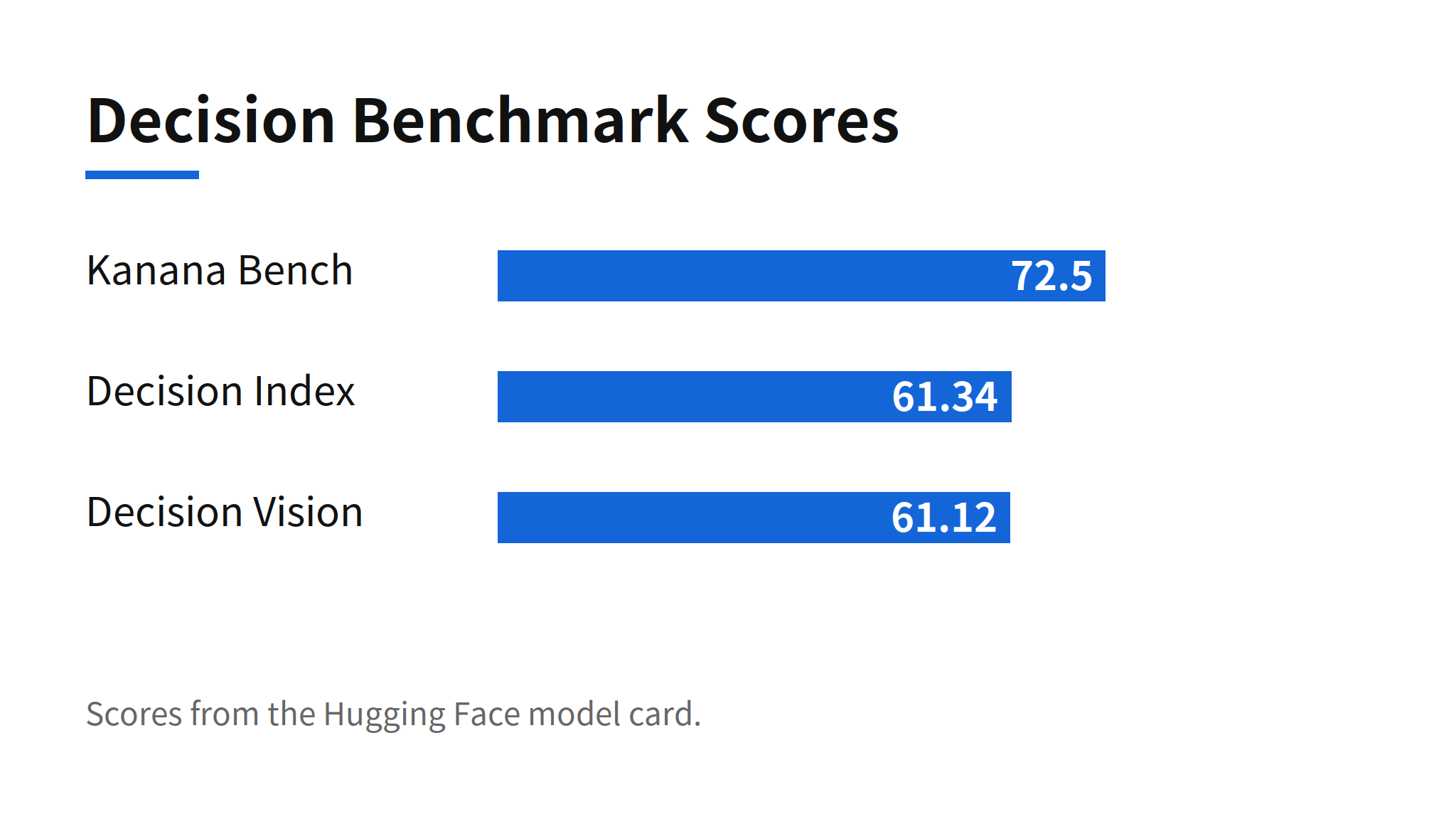
The two score groups should not be read as one result. Kanana Decision Bench is a set Kakao built itself, so the 72.50 figure shows performance on Kakao own distribution of Korean decision tasks. The public average of 61.23 is the number that travels across vendors, and the gap between the two is a reminder that a house benchmark usually flatters its builder. Neither figure is independently reproduced at this point.
The comparison group also shifts between sources. Korean coverage named Microsoft Decision-1, Typesafe AI Jev, Perplexity pplx-decider-v1.1-27B and Upstage Solar Decide as comparison targets. The performance table on the Hugging Face model card instead lists StartLux-Decision-v1.1-2B-Instant, Liquid AI d1-3B and Base Labs Joey-1. Which table corresponds to which test conditions is unconfirmed, so cross source ranking claims should be treated with care until Kakao publishes a single reconciled comparison.
A Separate Decision Layer for Agent Harnesses
Kanana-2-v-decide lands in a category that has filled up quickly. Typesafe AI Jev, Sarvam Prism and Nace AI Drex all appeared in the last few weeks as dedicated decision models, separate from the chat models they support. The shared reasoning is that agent systems make far more small decisions than large generations, and each decision routed through a general model adds latency and parsing risk to a loop that may run hundreds of times per task.
For teams building in Korean, the practical opening is the evaluation set as much as the model. A Korean decision benchmark with 15,909 items gives domestic services a way to test a decision layer on their own language distribution instead of translating an English proxy. Combined with open weights and a commercial license, a team can run the model inside its own stack and measure the decision layer separately from the generation layer, which is the experiment this category has been missing.
Limits and Unconfirmed Details
The speed claims rest on Kakao own measurement. The under 0.04 second average and the claim of being about 43 times faster than GPT-6 Luna both come from Kakao provided material reported by Korean outlets. The detailed measurement setup has not been published and no independent reproduction exists yet, so both numbers should be cited as vendor claims.
The same caution applies to the benchmark lead. The 18 point gap on Kanana Decision Bench is measured on a Kakao built set against a comparison group that differs between the model card and press coverage. What is solid is narrower: an open weight 3.67B multimodal model, a defined decision only output format, a public benchmark average of 61.23, and a license that permits commercial use. That is enough to justify a trial in a decision layer, and not enough to justify replacing one without measuring it on local traffic first.
Related Reading
For another recent open decision model release, see the earlier report on Sarvam Prism, the open decision model with a 44ms response claim. Kanana-2-v-decide and Prism target the same layer of an agent stack, and their benchmark and latency claims make a direct side by side test a natural next step.
For the enterprise platform entry in the same category, released on the same day, see the follow-up report on Salesforce Koa Decisions, the Gemma-based successor to HyperClassifier inside Agentforce.
FAQ
What is Kanana-2-v-decide?
Kanana-2-v-decide is a multimodal decision model that Kakao released as open weights on Hugging Face on November 6, 2026. The released model name is kakaocorp/kanana-2-v-decide-3b-2611. It does not generate sentences. It answers with a choice, a yes or no, or a score, and returns a probability for each candidate.
How large is the model and what can it take as input?
The model has 3.67B parameters in total, split between a 0.49B vision encoder and a 3.18B language model. It accepts text, JSON and chat logs, up to 10 images and up to 20,480 tokens, with an embedding dimension of 2,560.
How fast is Kanana-2-v-decide?
Kakao measured an average response time under 0.04 seconds on a single NVIDIA H200 GPU and described the model as about 43 times faster than GPT-6 Luna. Both figures come from Kakao measurements, and the detailed test conditions and independent reproduction have not been published.
Can Kanana-2-v-decide be used commercially?
Yes. The model is released under the Kanana Open License, which the model card describes as allowing commercial use as well as research use.
Sources
- Hugging Face, kakaocorp/kanana-2-v-decide-3b-2611 model card (2026-11-06)
- Kakao Tech Blog, multimodal decision model Kanana-2-v-decide open source release (2026-11-06)
- ETNews, Kakao releases Kanana 2 as open source (2026-11-06)
- Original issue: ax-trend issue #3837
- Related issue: ax-trend issue #3780, Sarvam Prism
- Related issue: ax-trend issue #3702, Nace AI Drex Max v1