Baidu ERNIE-5.5-Flash-Base: 280B Release, License Limits
Baidu released the weights for ERNIE-5.5-Flash-Base on November 5, 2026. The model has 280 billion total parameters and activates 14 billion per token. Baidu reported 93.3 on MMLU and 82.3 on HumanEval+ from its own evaluation. The release comes with a custom license that excludes the European Union, the United Kingdom and South Korea from the permitted territory, so the license check comes before the benchmark table for readers in those regions.
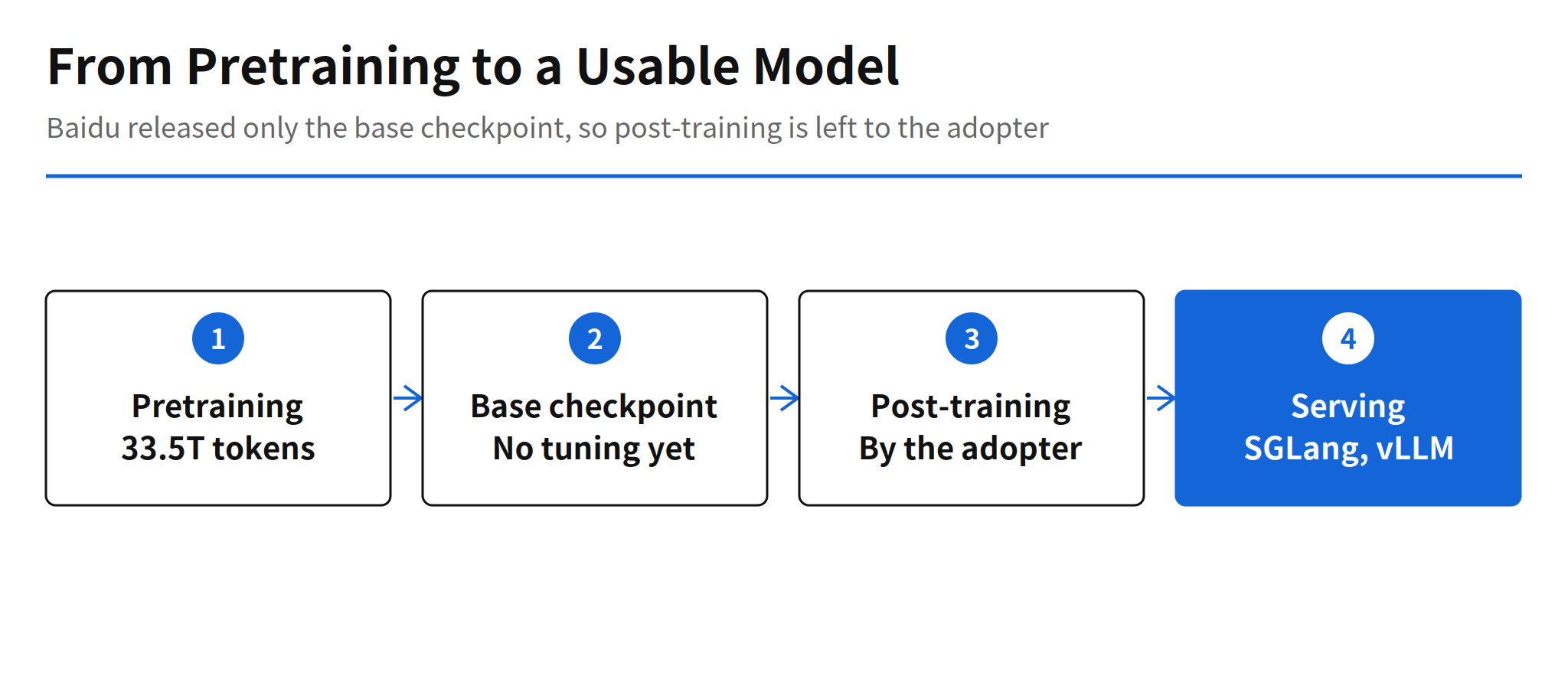
This is a base checkpoint, not a finished chatbot model. Baidu published the state at the end of pretraining, before mid-training and post-training, with no instruction tuning or alignment applied. That choice defines who the release is for. Teams that want to run their own domain adaptation, instruction tuning or reinforcement learning get a starting point with the post-training recipe left open. Teams that want a model they can deploy as an assistant today get a project instead.
Release Scope and Architecture
Pretraining covered 33.5 trillion tokens with a training context of up to 128K tokens, and the model supports a 1M token context for fine-tuning and inference. The gap between the training context and the supported inference context is worth noting when planning long document work, because behavior at the longest lengths rests on the extension method rather than on native pretraining at that length.
The architecture has 43 layers: one dense FFN layer and 42 MoE layers. Routing selects 10 experts per token from 512 routed experts, with one shared expert attached, and the vocabulary size is 201,216. Attention mixes 37 HCA layers with 6 MLA layers. Weights ship in both FP8 and BF16 precision through Hugging Face and ModelScope, with SGLang and vLLM listed as serving paths. That serving support matters for a base model of this size, because the practical cost of evaluating it depends as much on framework support as on the active parameter count.
The release also marks a return to open weights at this scale for Baidu. As The Decoder reported on November 5, this is the first time Baidu has published weights for a model above 100B parameters since the ERNIE 4.5 series in June 2025, roughly 16 months earlier. ERNIE 5.0 and 5.1 did not publish weights.
Benchmark Results and the Comparison Set
Baidu reported six headline scores: MMLU 93.3, MMLU-Pro 78.4, HumanEval+ 82.3, MBPP+ 81.5, LiveCodeBench 40.1 and GPQA 60.2. The comparison set is DeepSeek-V4-Flash-Base, Hy3-preview-Base and MiMo-V2.5-Base, and Baidu states that it measured the comparison models on the same evaluation pipeline. Running rivals through one pipeline removes one common source of distortion in model card tables, where each vendor reports its own best configuration.
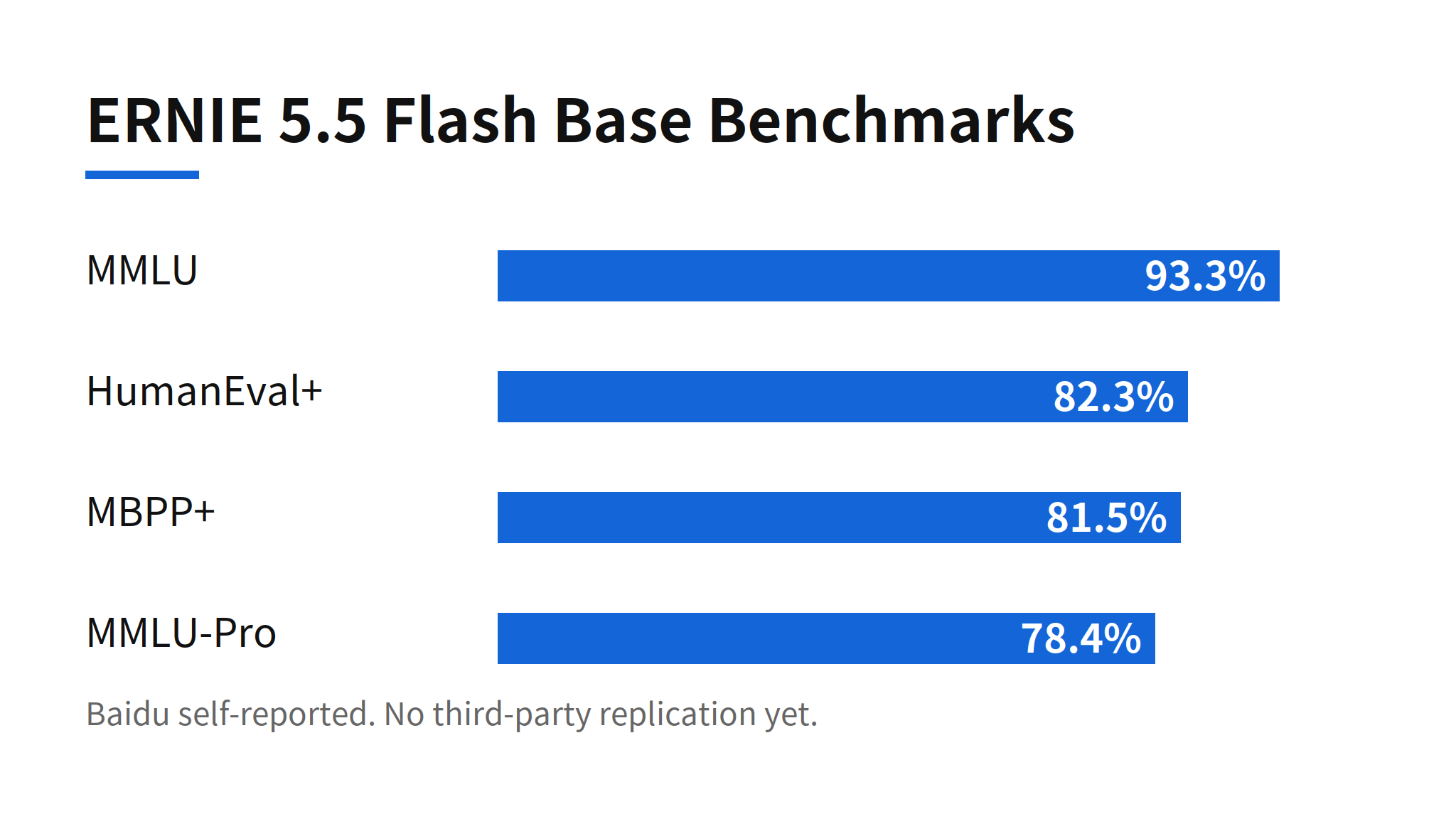
The scores still remain vendor measurements. No third party has reproduced them yet, so the ranking against the three comparison bases is provisional. For a base model, the more durable question is how much of that capability survives a given post-training recipe, and that answer will differ by team. The model card numbers describe the starting point, not the finished system a user would meet.
License Terms and Regional Exclusion
The weights ship under a dedicated license, the ERNIE 5.5 Flash Base Model License v1.0, rather than a standard open source license. Section 1.11 defines the Territory, and that definition excludes the European Union, the United Kingdom and South Korea. Using these weights inside South Korea therefore falls outside the scope the license grants, including for commercial use below the revenue threshold. That single clause removes the model from domestic adoption shortlists in Korea regardless of the benchmark results.
For readers outside the excluded regions, the license still needs a line by line read before any product plan. A custom model license with a revenue gate and an attribution duty behaves differently from Apache or MIT weights in procurement review, and the approval requirement above US$50 million in related revenue can affect larger deployments even where the territory clause does not.
Limits and Unconfirmed Details
Three items remain open. First, every benchmark figure is Baidu's own measurement, with no independent replication published so far. Second, the model card gives no release schedule for a post-trained ERNIE 5.5 Flash version, so the timing of a ready to use model is unconfirmed. Third, the serving benefit of the mixed attention design, 37 HCA layers with 6 MLA layers, has no independent measurement yet, so its effect on real serving cost is hard to judge before outside operators publish their own numbers.
The practical reading follows from those limits. As a research artifact, a 280B base checkpoint with 14B active parameters is a substantial release, and it gives post-training teams a new starting point to test. As a product input, the territory exclusion decides the question first for South Korea, the EU and the UK, and the custom license terms decide much of the rest elsewhere.
Related Reading
For another open weights release with a different license posture, see the earlier report on Kimi open weights. For a compact open model family aimed at translation, see PLaMo 3 Translate open weights, from 0.8B to 31B.
FAQ
What did Baidu release on November 5, 2026?
Baidu released the weights for ERNIE-5.5-Flash-Base, a base model checkpoint taken at the end of pretraining. It has 280 billion total parameters with 14 billion active per token, and it carries no instruction tuning or alignment.
Which regions does the ERNIE 5.5 Flash Base license exclude?
The ERNIE 5.5 Flash Base Model License v1.0 excludes the European Union, the United Kingdom and South Korea from its Territory definition. Use in South Korea therefore falls outside the scope the license permits.
What scores did Baidu report for ERNIE-5.5-Flash-Base?
Baidu reported MMLU 93.3, MMLU-Pro 78.4, HumanEval+ 82.3, MBPP+ 81.5, LiveCodeBench 40.1 and GPQA 60.2. All figures come from Baidu's own evaluation, run on the same pipeline as the comparison models DeepSeek-V4-Flash-Base, Hy3-preview-Base and MiMo-V2.5-Base.
When will the post-trained ERNIE 5.5 Flash version be released?
That schedule is unconfirmed. The model card does not state a release date for a post-trained ERNIE 5.5 Flash version, so only the base checkpoint is available to evaluate now.