Cognition SWE-2 Flash: Pricing, Speed and Benchmarks
Cognition released the coding model SWE-2 Flash on November 4, 2026, and made it available straight away in Devin Desktop and Devin CLI. The pitch is simple and specific: the model costs one fifth of SWE-2, runs three times faster, and is free until November 30.
That positioning matters more than the launch itself. SWE-2 remains the flagship for the hardest work, while Flash is aimed at the volume underneath it: automation, code review, feature development and documentation updates that run every day. A cheaper, faster tier only changes team economics if it is good enough for that routine work, so the benchmark story and the training recipe behind it deserve a close read.
A Daily Work Tier Below SWE-2
SWE-2 came first as Cognition's upper coding model, and Flash now sits below it as the everyday line. The work Cognition names for it is deliberately unglamorous: automation, code review, feature development and documentation updates. These are repeat tasks where a team runs a model many times a day, and where unit price and latency decide whether agent use stays a pilot or becomes routine.
Read that way, the one fifth price and 3x speed claims are the real announcement. Frontier coding competition has mostly been fought on the hardest tasks. This release shifts the contest toward the cost of repeated work, and the free window until November 30 gives Devin users a low risk way to test whether Flash clears the quality bar on their own repositories before paying for it.
The Mid-Training Stage Before Reinforcement Learning
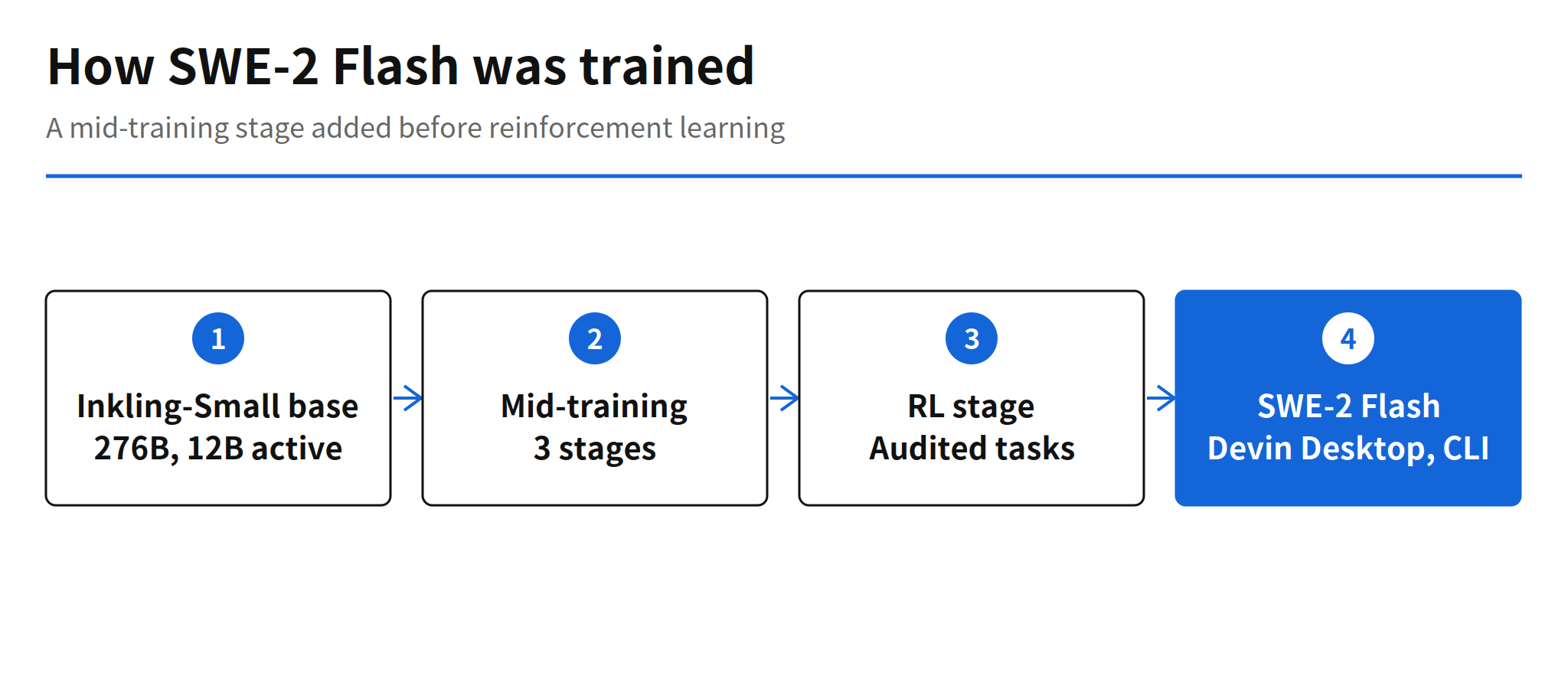
The base model is Thinking Machines Inkling-Small, a mixture of experts model with 276B total parameters and 12B active parameters. On top of that base, Cognition changed the recipe in one named way: for the first time, it added a mid-training stage in front of reinforcement learning.
The mid-training stage used a dataset at a scale of trillions of tokens, mixing science articles, blogs and code, split into three stages. Cognition says it chose which data mixtures were efficient using token efficiency curves, rather than fixing the mixture by intuition. In the reinforcement learning stage that followed, the team audited task instructions, environments and verifiers directly, and widened the range of task types. Cognition credits that audit and widening work with most of the improvement in that stage.
For teams post-training their own models, this is the reusable part of the release. The claim is that a deliberate stage between base training and reinforcement learning, with mixtures selected by measured token efficiency, raised the starting point enough that the later stage had far more to work with. The reported base to final gaps below are consistent with that story, although they come from Cognition alone.
Reported Benchmark Gains
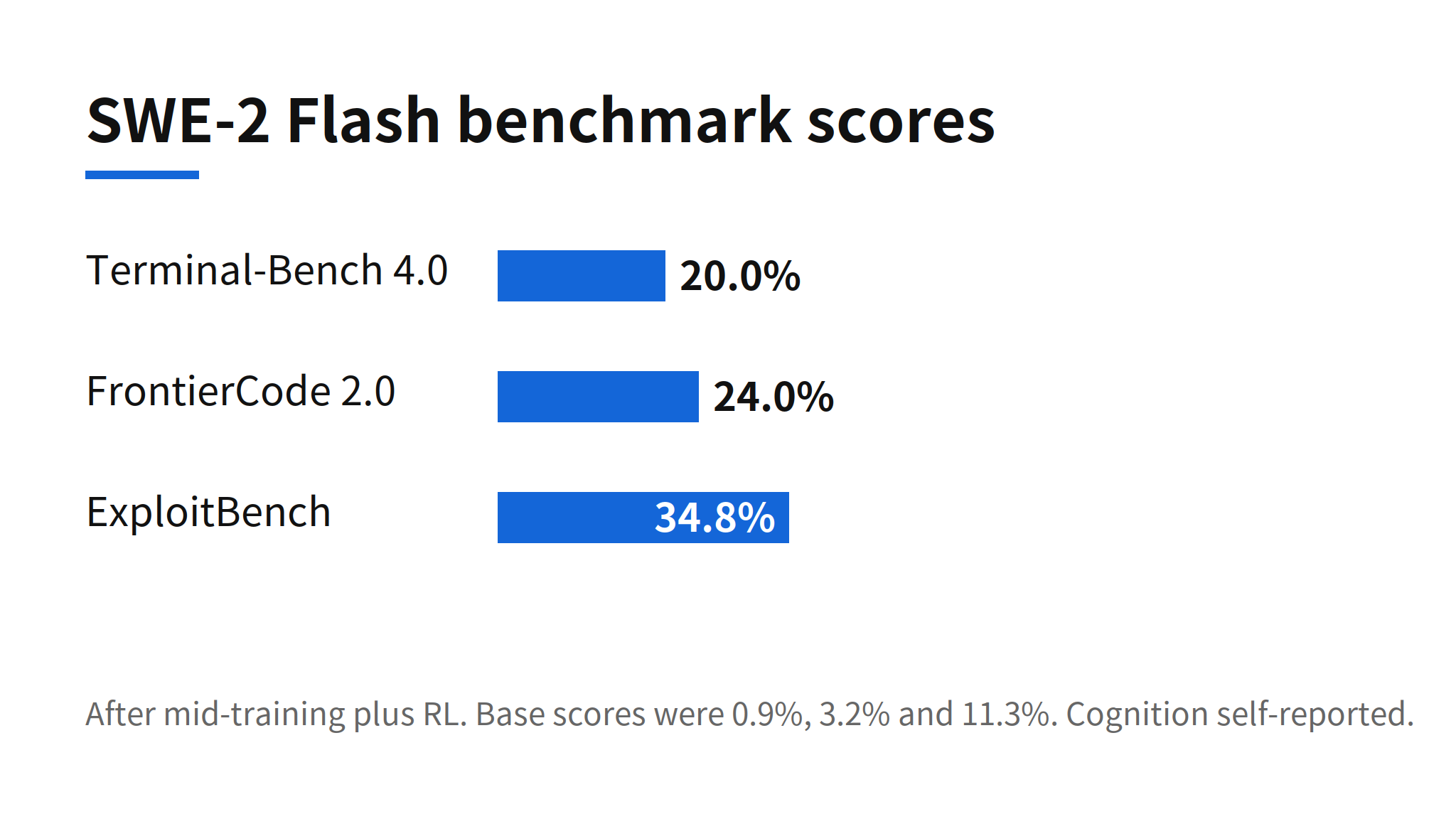
Cognition reports three comparisons against the base model. Terminal-Bench 4.0 rose from 0.9% to 20.0%, and FrontierCode 2.0 rose from 3.2% to 24.0%. A separate line of training aimed at cybersecurity work lifted ExploitBench from 11.3% to 34.8%.
Two readings are worth keeping apart. The relative gains are very large, in part because the base model scores start close to zero on the first two benchmarks. The absolute scores, 20.0% and 24.0%, are more modest, and they frame Flash as a workable everyday model rather than a flagship replacement. That fits the product placement: Cognition is selling throughput on routine tasks, and the numbers it chose to publish support exactly that claim.
Cognition also says the model outperforms every US open weight model in its comparison. That claim rests on Cognition's own comparison table, and the announcement does not publish the full comparison conditions or harness details, so it should be read as a vendor claim until independent runs appear.
Closed Weights and the Sharing Program
The weights are not being released. Cognition gives a direct reason: the same capability could be used by attackers, a concern that connects to the cybersecurity training behind the ExploitBench result. For now, the only way to use SWE-2 Flash is inside Devin products.
In place of a release, Cognition says it is building a program to share the weights safely with industry partners and research labs, with details expected in the coming weeks. Eligibility and timing are not yet published. Until they are, outside teams cannot reproduce the benchmark results, inspect the model, or run it on their own infrastructure, which limits how far the launch claims can be checked.
Limits and Unconfirmed Points
The practical test is available now and costs nothing until November 30: run Flash on real review and automation queues inside Devin Desktop or Devin CLI, and compare its output quality and latency against the SWE-2 work it would replace. Vendor benchmarks cannot settle that comparison for a specific codebase. A team that finds Flash adequate for most routine tasks keeps the flagship budget for the hard minority, and that split is where the one fifth price becomes a real saving rather than a headline.
Related Reading
For another recent coding model release with the opposite weight policy, see the Kimi K3.1 Pro report, where the weights were published. For open weight coding benchmarks from a smaller lab, see the Ricursive Ripple-65B report.
FAQ
What is SWE-2 Flash?
SWE-2 Flash is a coding model Cognition released on November 4, 2026. It sits below the flagship SWE-2 model, is built on Thinking Machines Inkling-Small, and is available in Devin Desktop and Devin CLI for everyday work such as automation, code review, feature development and documentation updates.
How much does SWE-2 Flash cost?
Cognition says SWE-2 Flash costs one fifth of SWE-2 and runs three times faster. It is free until November 30, 2026. The announcement does not publish the underlying rate card behind the one fifth comparison.
What benchmark gains does Cognition report for SWE-2 Flash?
Compared with the base model, Cognition reports Terminal-Bench 4.0 rising from 0.9% to 20.0%, FrontierCode 2.0 from 3.2% to 24.0%, and ExploitBench from 11.3% to 34.8%. All of these figures are Cognition measurements and have not been independently verified.
How was SWE-2 Flash trained?
For the first time in this recipe, Cognition added a mid-training stage before reinforcement learning. The mid-training data mixes science articles, blogs and code at a scale of trillions of tokens across three stages, with mixtures chosen by token efficiency curves. In the reinforcement learning stage, the team audited task instructions, environments and verifiers and widened the task types.
Are the SWE-2 Flash weights available?
No. Cognition is not releasing the weights, citing the risk that attackers could use the same capability. The company says it is building a program to share the weights safely with industry partners and research labs, with details expected in the coming weeks.