BLA Harden: How It Blocks AI Reverse Engineering Agents
BLA is an adversarial defense shield that protects shipped software against AI reverse engineering agents. The repository description names the targets directly: binaries, Electron apps, JS bundles, Python and WebAssembly, defended against agents like REA that can now work through a build with a single command.
The defense does not try to make analysis impossible in the classic obfuscation sense. According to the README, a hardened build makes the analyzing agent hit its resource budget, follow decoys and consume tokens, while normal user execution behavior stays unchanged. The target is the agent economics and reasoning path, not a human analyst reading code by hand.
The early signal is strong for a niche security tool. The repository reached 2,060 stars in about 9.8 days, roughly 210 stars per day by GitHub API figures, and the README badge shows GitHub Trending #15 Daily. That pace suggests the problem resonates beyond reverse engineering specialists: anyone shipping a client side build now has to assume an agent will read it.
Release Overview and Protected Formats
The protected format list is the practical core of the release. Binaries and WebAssembly cover compiled distribution, Electron apps and JS bundles cover the desktop and web JavaScript surface, and Python covers interpreted code that often ships with little protection at all. A single shield across those formats matters because agent based analysis is format agnostic in practice: the agent chooses whatever tool fits the artifact in front of it.
The entry point is deliberately small. The README gives one command:
bla harden .A one line workflow lowers the trial cost to near zero, which helps explain the star velocity. It also sets an expectation that still needs verification: hardening that is this easy to apply has to prove it does not break the build it protects, and the source issue records performance cost and false positives as unconfirmed.
Three Defense Layers in Detail
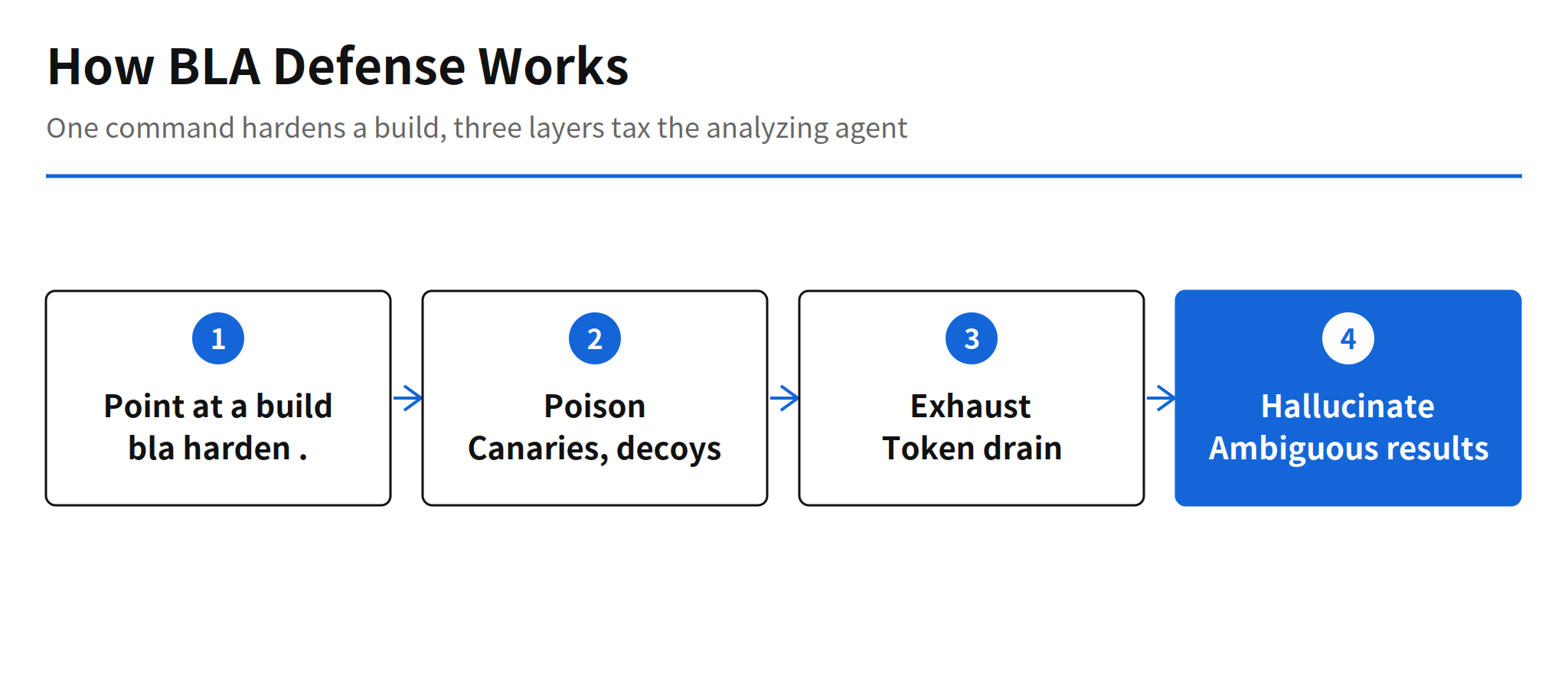
- Poison. The build is planted with well-formed fake evidence: canaries, honey metadata and decoy control flow. The evidence is shaped to look real, so an agent that trusts surface signals follows it instead of discarding it.
- Exhaust. The agent resources get drained as it chases that material. For an LLM based agent, resource means token budget and time, so exhaustion is a direct cost attack rather than a purely technical block.
- Hallucinate. Analysis results come back truncated or ambiguous. Even an agent that finishes the run ends with output that cannot be trusted at face value, which undermines the next automated step built on that output.
The three layers attack three different agent assumptions at once: that evidence in the artifact is honest, that analysis budget is sufficient, and that the final report reflects the real program.
That layering is what separates BLA from single trick obfuscation. A decoy alone can be filtered once it is known. A decoy combined with budget pressure and degraded output forces the agent operator to spend more, verify more, or accept a weaker result, and each of those responses raises the cost of routine reverse engineering.
Shift From Human Analysts to Agent Budgets
Traditional obfuscation was designed against people. It raised the reading effort for a human analyst, who could still work slowly and selectively. An AI agent changes the defense calculation because it reads everything, follows references mechanically, and pays for that breadth in tokens. Planted evidence that a human might spot and skip in minutes can occupy an agent for a large part of its budget.
BLA is an early, concrete example of tooling built for that new opponent. The source issue frames it the same way: coding agents can now reverse a shipped artifact with one command, so defense tools aimed at agent resource budgets and reasoning are starting to appear. If this category holds, protection reviews will need an agent test pass alongside the usual human review, using the same REA style tools an attacker would use.
Unconfirmed Points in the Release
- Empirical results. Whether the README results reproduce across REA tools in general is unconfirmed. A defense tuned to one agent behavior may transfer poorly to another agent with different filtering.
- Cost on legitimate use. The performance cost of a hardened build and the chance of false positives are unconfirmed. A shield that slows the real product trades one problem for another.
- Bypass speed. The techniques are public, so how quickly bypass methods follow is unconfirmed. Published canary patterns in particular can become signatures that future agents learn to ignore.
These gaps are normal for a tool that is under two weeks old, but they decide the buying decision. Teams evaluating BLA should run it on a non critical build first, measure startup and runtime overhead themselves, and test it against the exact agent stack they worry about, rather than relying on the README claims alone.
Practical Significance for Teams Shipping Client Code
The clearest audience is teams shipping Electron apps, JS bundles or Python tools whose client code contains logic they would rather not hand to competitors on day one. BLA will not make a build unreadable, and the source material does not claim that it does. What it offers is friction priced in agent budget: routine, low effort reverse engineering becomes slower, more expensive and less reliable.
For the wider market, the project is a signal that agent offense and agent defense are becoming a paired industry. Offensive agents created the demand, and defensive tools like BLA, with 2,060 stars in under ten days, show that supply is arriving quickly. Expect this pairing to keep tightening, with each side adapting to the published techniques of the other.
Related Reading
For another security tooling release, see Verlintas NOIR, an Android privacy audit tool that works through adb. For a different side of the security economy, see OpenAI Bug Bounty, where critical payouts rose to $172,000.
FAQ
What is BLA?
BLA is an adversarial defense shield from qybaihe, written in TypeScript and released under the MIT License. The repository says it protects binaries, Electron apps, JS bundles, Python and WebAssembly against AI reverse engineering agents like REA.
How does BLA harden a build?
The README gives one command, bla harden ., pointed at a protected build. After hardening, an analyzing agent is meant to hit a resource budget and follow decoys that consume tokens, while normal user execution behavior stays unchanged.
What are the Poison, Exhaust and Hallucinate layers?
Poison plants well-formed fake evidence such as canaries, honey metadata and decoy control flow. Exhaust drains the agent resources, and Hallucinate makes analysis results truncated or ambiguous, according to the README summary in the source issue.
What remains unconfirmed about BLA?
The source issue lists three open points: whether the README empirical results reproduce across REA tools in general, the performance cost and false positive risk on protected builds, and how quickly bypass methods follow once the defense techniques are public.