OpenAI LifeVal: GPT-6 Astra Scores 80.6% on Daily Tasks
OpenAI released LifeVal on November 2, 2026, an evaluation that measures how well models handle everyday tasks. In the chart OpenAI published with the release, GPT-6 Astra averaged 80.6% reward, up from 49.3% for GPT-5.2. The release itself is the useful part for most readers. The score comes with real limits, because OpenAI did not publish how many tasks were averaged or how those tasks were graded.
That split matters. LifeVal points agent evaluation toward a practical question, whether a system can finish ordinary work, and the task list behind it reads like a requirements list for a personal assistant product. At the same time, every number in the release is a self reported OpenAI measurement, produced with an evaluation OpenAI says it spent the past year using to improve its own models.
What LifeVal Measures
LifeVal tests completion, not advice. OpenAI says the evaluation looks at whether work gets finished, using examples such as finding childcare, applying for government services, building a budget, and ordering groceries. That framing separates LifeVal from question answering benchmarks, where a plausible answer can score well even when no real world step has been completed.
The practical difference is in what counts as failure. Advice can be correct in outline and still leave forms unfilled, constraints unchecked, or orders unplaced. A completion test has to account for those steps, which is why an everyday task benchmark is closer to how people will judge assistant products in use. Whether LifeVal grading actually captures that full chain cannot be checked from the release, because the rubric was not published.
How the Task Set Was Built
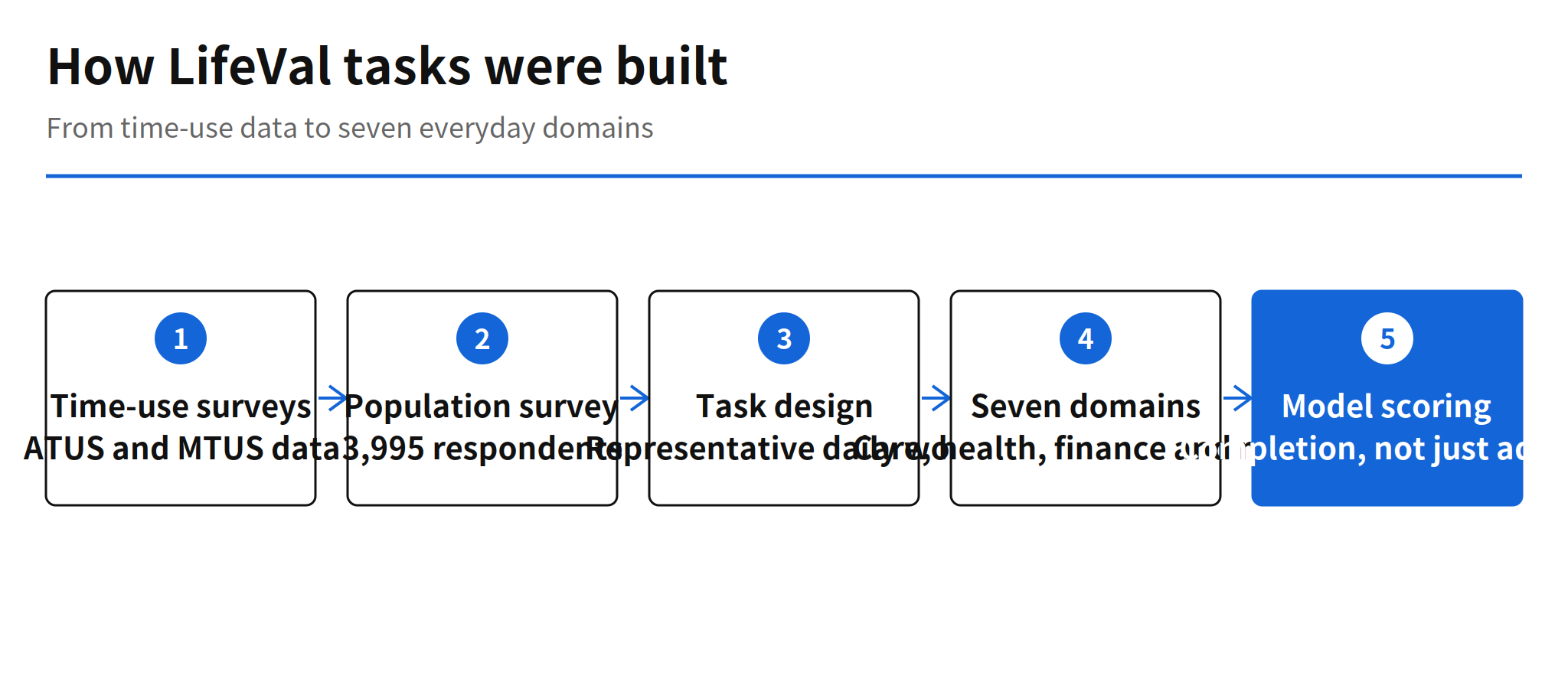
OpenAI built the task list from the American Time Use Survey and the Multinational Time Use Study, together with a new survey of 3,995 people described as a demographically representative sample. Grounding the list in time use data is a sensible design choice. It anchors the benchmark in how people actually spend their days, rather than in tasks chosen because models happen to be good or bad at them.
The tasks cover seven domains: care, health, education, home administration, personal finance, shopping, and access to government services. Read as a product document, that list is a map of the work OpenAI expects users to hand to an assistant. OpenAI also notes on the same page that ChatGPT now has more than 1 billion weekly users, which explains the scale of the bet. At that user count, small gains in finishing routine work affect far more sessions than gains on specialist tests.
Model Scores Reported by OpenAI
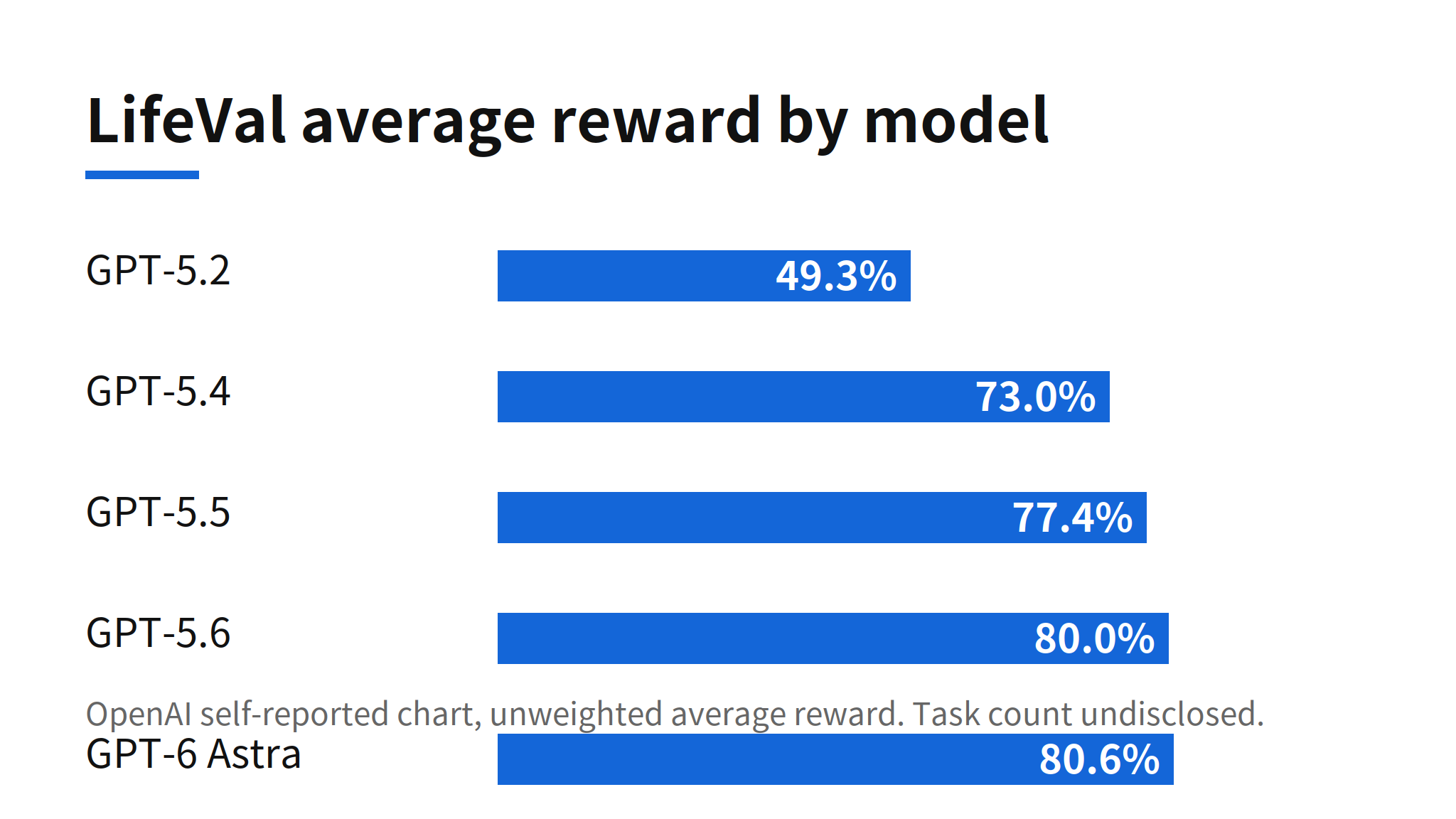
The chart reports unweighted average reward for five OpenAI models. GPT-5.2, dated December 11, 2025, scored 49.3%. GPT-5.4 scored 73.0%, GPT-5.5 scored 77.4%, GPT-5.6 scored 80.0%, and GPT-6 Astra, dated September 3, 2026, scored 80.6%. The steep rise between GPT-5.2 and GPT-5.4, followed by much smaller steps, is the pattern to notice. Most of the reported gain arrived in one generation, and the recent models cluster near 80%.
That clustering can mean several different things, and the release does not provide enough detail to choose between them. It could reflect genuine saturation on this task set, a grading scale that compresses differences at the top, or an evaluation that the newer models were directly optimized against. OpenAI states that it used LifeVal for the past year to track and improve everyday task performance, so the last explanation cannot be ruled out. A benchmark used as a training target will tend to show progress on itself, whether or not the same progress generalizes.
Example Task Scores
OpenAI published scores for individual example tasks, and they sit well above the overall average. Kindergarten enrollment scored 93.1%, organizing volunteers for flood preparation scored 98.0%, finding a new home scored 100%, watching a game remotely with a grandmother scored 96.3%, and preparing a diet matched to a diabetes diagnosis scored 90.4%.
Examples chosen for a release page are usually among the stronger results, so these figures should not be read as typical. Their value is different. They show the shape of the tasks, multi step errands with personal constraints, a health condition, a family member in another location, a deadline driven enrollment. An assistant that handles tasks of that shape reliably would change how people use it, moving it from a drafting tool toward delegated execution. The average score, not the examples, is the better guide to how close that shift is, and the average comes without a task count to weigh it by.
Contrast With Expert Work Benchmarks
LifeVal sits at the opposite end of the spectrum from expert work evaluations. On the same day, SemiAnalysis released GDPx, covered in related issue #3716, which tested 206 expert tasks across 11 fields and found that even the best model reached only 12.0%. The two results are not in conflict. They measure different populations of work, and the gap between 80.6% on everyday tasks and 12.0% on expert tasks is itself the informative finding.
For product planning, that gap suggests a sequencing. Routine personal work is the nearer term surface for agent products, because reported completion rates there are already high enough to design around, subject to independent verification. Expert work, where the best reported result remains low, still needs human review built into the workflow rather than treated as an exception. Teams that mix the two categories in one roadmap, with one trust level, will misjudge both.
Every score in this post comes from OpenAI, the maker of both the benchmark and the models being scored. No task list, grading rubric, or evaluation code was released with the announcement, so no outside team can reproduce these numbers yet.
What OpenAI Did Not Disclose
- Task count. The release does not say how many tasks the average covers, so the weight of the 80.6% figure cannot be judged.
- Scoring method. The rubric behind average reward, the identity of the graders, and the number of attempts allowed are all unpublished, which blocks external reproduction.
- Cross provider comparison. Only OpenAI models appear in the chart. There are no scores for Claude, Gemini, or Grok, so the release cannot be used to compare providers.
- Separation from training. The evaluation doubled as an improvement target for a year, so score growth and general capability growth cannot be separated from the published material.
- External access. No plan to publish the task set or evaluation code was announced.
None of this makes the release empty. Benchmark announcements from a lab about its own models are routinely read this way, as directional claims with a useful design signal attached. The design signal here, a task taxonomy drawn from time use data, is available to any team building its own evaluation, even while the scores remain unverifiable.
Practical Meaning for Agent Products
For teams building assistants, the task list is worth more than the headline score. Care, health, education, home administration, personal finance, shopping, and government services form a concrete backlog, and each domain carries its own failure cost. A missed grocery item is an annoyance. A mishandled government application or a diet plan that ignores a diagnosis carries real consequences, so completion rates alone do not set the trust level a domain deserves.
The sensible reading of LifeVal for a builder is therefore two part. Use its taxonomy to decide which everyday tasks to evaluate internally, with published rubrics and reproducible grading. Treat its scores as an unverified claim about one provider, useful for tracking the direction of the field and not for vendor selection. That stance keeps the genuine signal in the release, the shift from knowledge tests to work completion, without importing numbers that no one outside OpenAI can check.
Related Reading
Other OpenAI coverage on this site includes OpenAI Bug Bounty: Critical Payouts Rise to $172,000, on how the company prices security reports for its systems. For a benchmark with a different design, see Weight-Space Programming: LLM Edits Weights, MATH-500 Gains, where the evaluation target and the reported gains are stated in reproducible terms.
FAQ
What does LifeVal measure?
LifeVal measures whether a model finishes everyday work rather than whether it gives good advice. OpenAI examples include finding childcare, applying for government services, building a budget, and ordering groceries, across seven domains including care, health, education, home administration, personal finance, shopping, and access to government services.
What score did GPT-6 Astra get on LifeVal?
GPT-6 Astra averaged 80.6% reward in the chart OpenAI published with the release. Earlier models in the same chart scored lower, with GPT-5.2 at 49.3%, GPT-5.4 at 73.0%, GPT-5.5 at 77.4%, and GPT-5.6 at 80.0%. All of these figures are OpenAI self reported measurements.
How was the LifeVal task set built?
OpenAI built the task list from the American Time Use Survey, the Multinational Time Use Study, and responses from a new survey of 3,995 people described as a demographically representative sample. OpenAI says it used the evaluation over the past year to track and improve everyday task performance in its own models.
Can LifeVal scores be compared across model providers?
No, not from this release. OpenAI did not publish the number of tasks, the scoring rubric, who graded the work, or how many attempts were allowed, and the comparison set includes only OpenAI models. Without those details, outside teams cannot reproduce the scores or place Claude, Gemini, or Grok on the same scale.