Weight-Space Programming: LLM Edits Weights, MATH-500 Gains
A research team at MIT CSAIL (Rikiya Takehi, Jayden Teoh, Alex Zhang and Omar Khattab) has published early results for what they call weight-space programming: a general purpose frontier LLM reading and writing the weights of a neural network directly, by reasoning, with no optimizer and no gradients. The model named in the blog, GPT-6 Astra, identified which game each of several trained networks played from raw weights alone, wrote game playing weights from scratch that beat PPO training, and repaired a math defect in Qwen3.5-0.8B by changing 0.016% of its weights.
The headline number is the repair. MATH-500 rose from 7.9% to 48.1% and GSM8K from 13.8% to 67.1% after the edit, and the share of answers cut off by the token cap fell from 93% to 33%. Until now, weights were territory for symbolic optimizers such as Adam and Muon, or for separate models trained to generate weights. LLMs optimized text artifacts, prompts and code. The claim here is that inference alone reaches into the weight space of a differentiable network, and that it reaches as far as a 0.8B language model, not only toy networks.
Reading Trained Games From Raw Weights
The reading experiments come first, and they are the control for everything after. Given only the 17,253 raw weights of an MLP, the model correctly identified all four games the network had been trained on with PPO: Breakout, Pong, Pac-Man and Freeway. In a second reading test, it examined three character level language models reduced to their middle layers and identified both the training language and the induction heads in all three. Correct identification matters because it separates comprehension from lucky editing. A system that can say what a network does, from numbers alone, is doing something closer to code review than to random perturbation.
Writing Weights That Beat PPO Training
The writing results are stronger than the reading ones. In three MinAtar games, weights written from scratch beat networks trained with PPO for 100 million steps in every game. In Breakout, the written weights scored 517.4 points, roughly twenty times the 25.3 points of a network trained for 500 million PPO steps. Gradient training is normally the unquestioned way to produce weights, so a reasoning model matching and then exceeding it, at least at this scale, is the result that will draw the most scrutiny. The scale caveat is real: MinAtar networks are small, and nothing in the blog claims this transfers directly to writing a frontier model from nothing.
A Single Repair Pass in Kinetix
Between reading and writing sits a debugging result. On a Kinetix driving task, the model first explained the cause of a failure, then changed 3.5% of the weights in one pass, and the success rate moved from 0% to success on all 1,024 episodes. That sequence, diagnose in words and then patch the weights, is the shape of ordinary software maintenance applied to a network. It is also the shape that matters most for practice, because most real work on deployed models is repair of a specific defect, not training from zero.
The Qwen3.5-0.8B Edit in Numbers
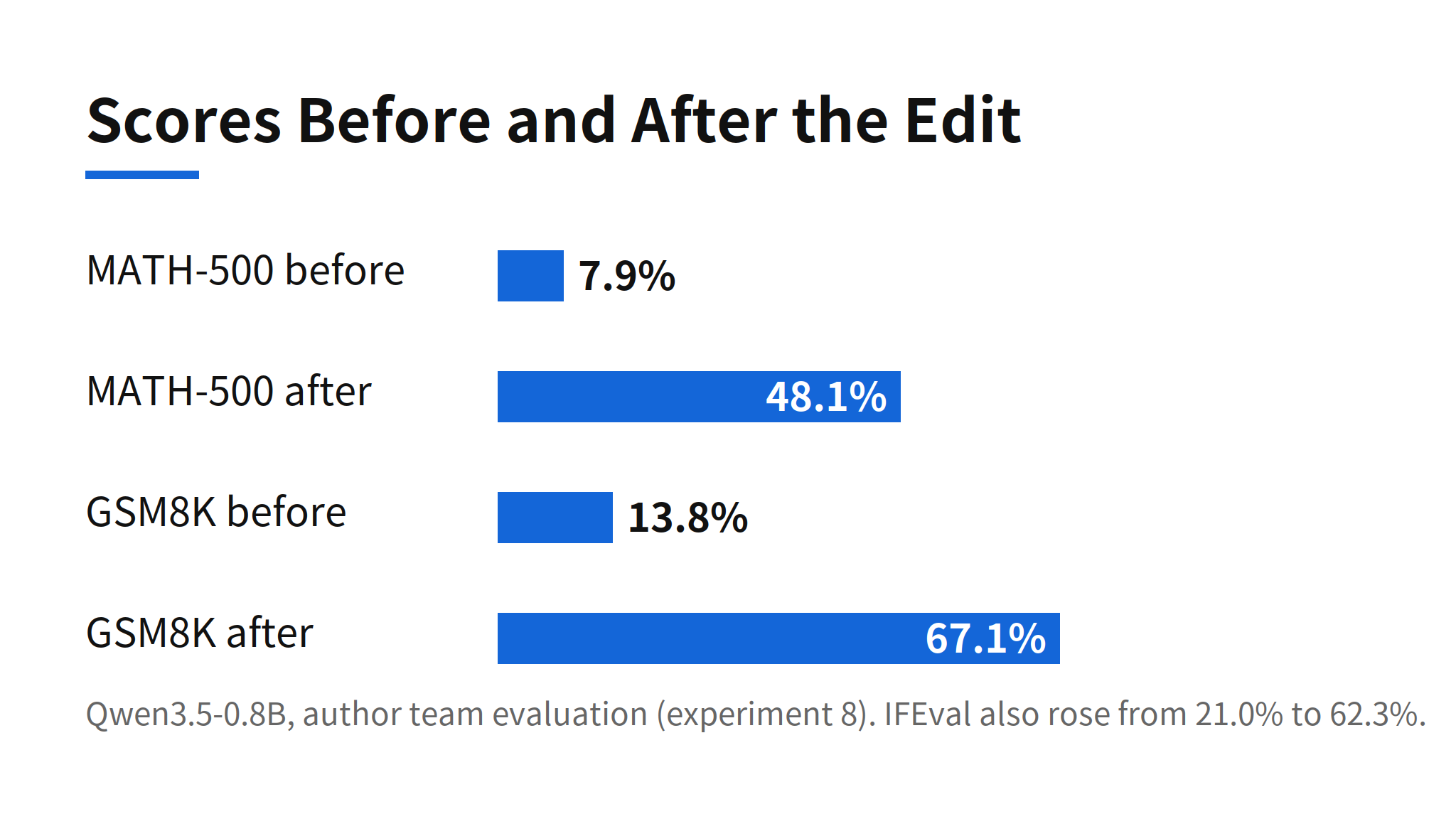
The diagnosis was specific. The model traced the cause of a repetition loop to one direction written by the MLPs in layers 15 and 19, and removed it by subtracting that direction from 64 output columns. The total change was 131,072 weights, 0.016% of the model. The effect was not narrow: alongside the math gains, instruction following on IFEval rose from 21.0% to 62.3%, roughly a threefold increase, which fits the loop explanation. A model that stops repeating itself mid answer scores better on almost every benchmark that requires a complete answer, and the drop in token cap cutoffs from 93% to 33% points the same way.
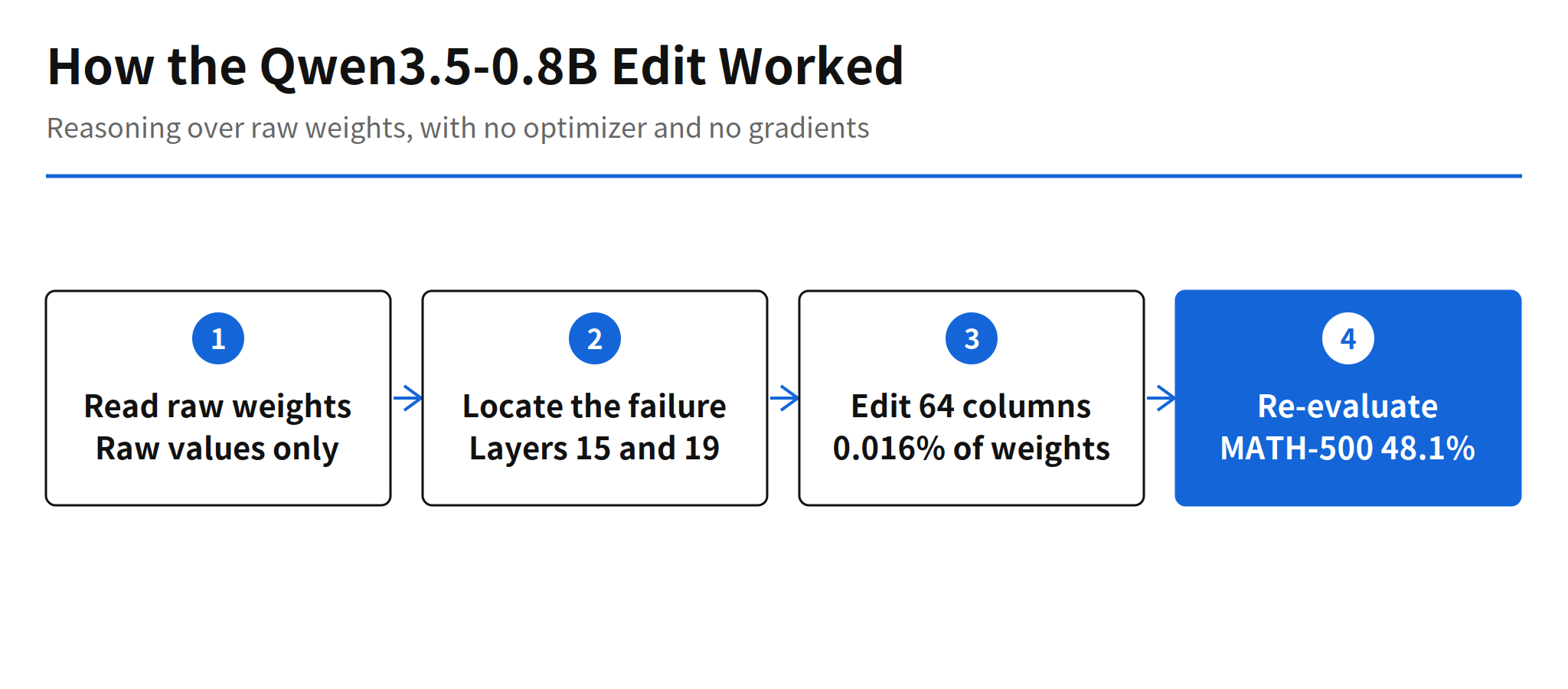
Read conservatively, this is a debugging result rather than a capability result. The base model was severely impaired by one defect, and removing the defect recovered performance that training had already put there. That reading does not shrink the finding. A repair that costs one reasoning pass and touches a ten thousandth of the weights is a fundamentally cheaper maintenance operation than retraining or fine tuning, and it was aimed by an explanation a human can inspect.
Limits Stated in the Results
The blog includes its own failures, which strengthens the parts that worked. Identifying a sycophancy model from weights alone failed in all four attempts; it succeeded only after attention patterns were also allowed. And on Gemma 3 270M, a model with almost no looping behavior, the MATH-500 improvement was only about one point. The authors' interpretation is the disciplined one: weight editing removes a defect direction, and it does not manufacture an ability the model never had. Anyone hoping this becomes a shortcut around training should sit with that second result.
The pattern across experiments is consistent: the method finds and removes what is broken, at a cost set by reasoning rather than by gradient steps.
Verification Status and Open Questions
- The editing model is unidentified: the blog names it GPT-6 Astra but does not state which organization built it or whether outsiders can access it, so no third party can rerun the core experiments with the same model.
- No peer review yet: there is no arXiv paper, and the scores are the author team's own evaluations.
- Partial independent check: the full experiment logs are public on GitHub and the edited Qwen3.5-0.8B is posted on Hugging Face. The blog states that Hugging Face rebuilt the model from the logs and re-ran the evaluation, which covers the artifacts of the Qwen experiment, not the whole program.
- Scale is unproven: the largest edited model is 0.8B parameters. Whether weight reading stays tractable at 8B or 80B is an open question the blog does not answer.
The team says it is building a benchmark and a harness for measuring this kind of work, which is the right next artifact. A shared benchmark would let other groups test whether the effect survives different editors, different target models and adversarial defect types. Until then, the practical implication is narrower and still significant: for open weight models, an audit that reads weights directly and a patch that removes one diagnosed direction are now demonstrated options, and both change the cost structure of model maintenance if they hold up. Weight access is the precondition, which is one more reason the open model releases matter beyond price.
Related Reading
Weight editing is only possible where weights are public. The open releases that create that surface are covered in an earlier post in this series: NVIDIA GTC Berlin Open Models: Six Families, Open Weights. Weight-space programming is, in effect, a new use for exactly that openness.
FAQ
What is weight-space programming?
Weight-space programming is the approach proposed by MIT CSAIL researchers Rikiya Takehi, Jayden Teoh, Alex Zhang and Omar Khattab, in which a general purpose frontier LLM reads and writes neural network weights directly, by reasoning, with no optimizer and no gradients.
What did the model change in Qwen3.5-0.8B?
It traced the cause of a repetition loop to one direction written by the MLPs in layers 15 and 19, and subtracted that direction from 64 output columns. That changed 131,072 weights, 0.016% of the model, and MATH-500 rose from 7.9% to 48.1% while GSM8K rose from 13.8% to 67.1%.
Has weight-space programming been peer reviewed?
No. There is no peer review and no arXiv paper yet, and the scores are the author team's own evaluations. The full experiment logs are public on GitHub, the edited Qwen3.5-0.8B is on Hugging Face, and the blog states that Hugging Face rebuilt the model from the logs and re-ran the evaluation for that experiment.
Can weight editing create capabilities a model does not have?
The authors' own results suggest not. On Gemma 3 270M, which has almost no looping behavior to remove, the MATH-500 gain was only about one point. Their reading is that a weight edit removes a defect direction rather than adding an ability that was never there.