AiSOC: Open-Source AI SOC With Full Agent Audit Trails
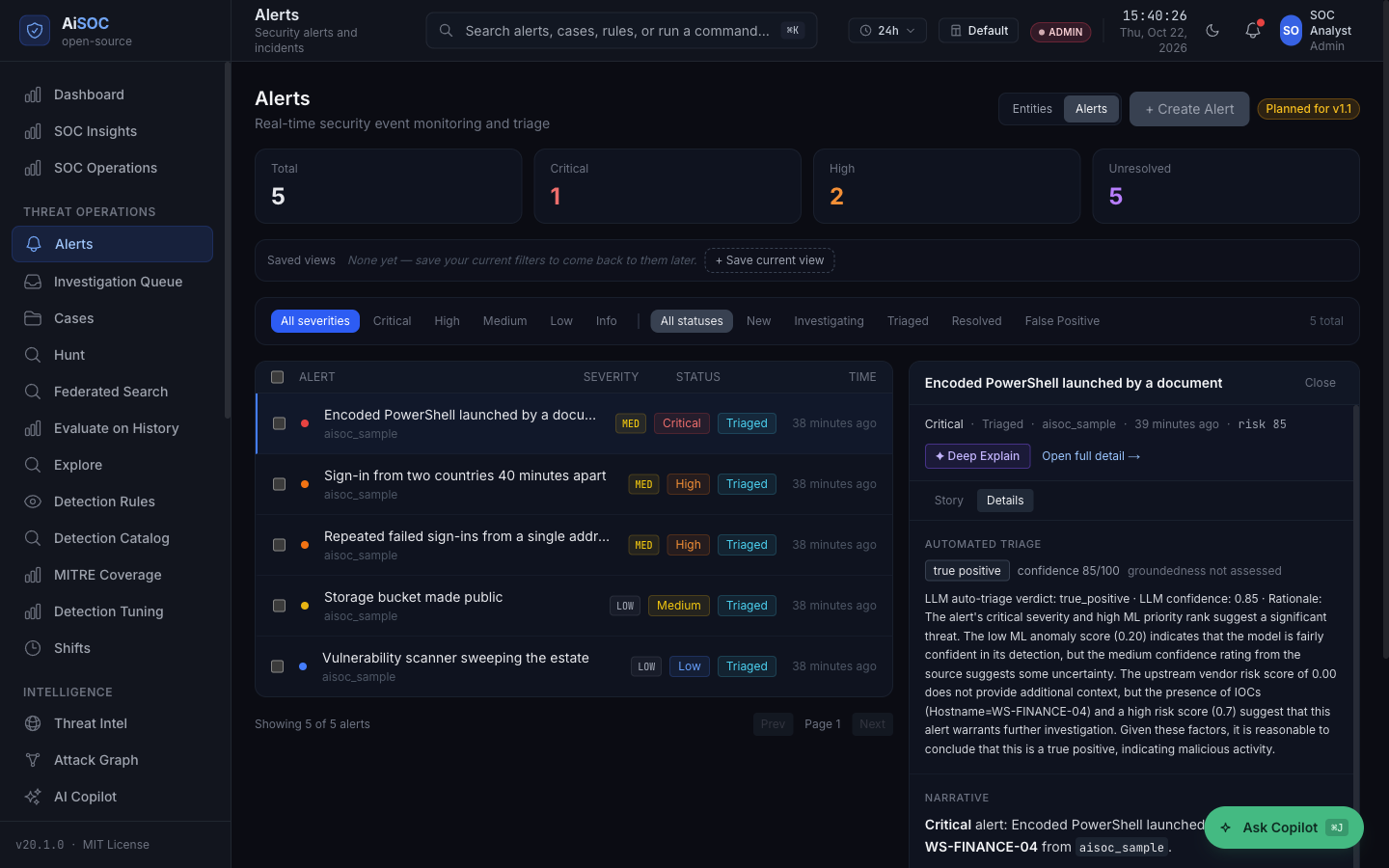
AiSOC, a self-hosted open-source AI security operations center published by beenuar, entered GitHub trending with 6,539 stars alongside its v21.0.0 release on November 1, 2026. The project is written in Python and released under an MIT license. Its defining choice is not the agent itself but the record around it: every prompt and tool call the investigating agent makes is logged, so a verdict can be replayed later instead of taken on trust.
That emphasis answers the oldest operational objection to agents in security work. Alert volume has exceeded human review capacity for years, and many teams now attach LLM agents to triage and investigation. A verdict without a trace is hard to use in operations, because nobody can show why the agent reached it. AiSOC treats the trace as a first-class output rather than a debug extra.
The intake side is conventional SOC work done at scale. Telemetry from security tools is normalized, a rule library of 7,023 rules with 2,538 active rules correlates related events, and the correlated output becomes an incident for the agent to investigate. When new threat intelligence arrives, the system also sweeps the historical records it already collected, so an indicator learned today can reopen evidence gathered earlier.
AiSOC in Numbers
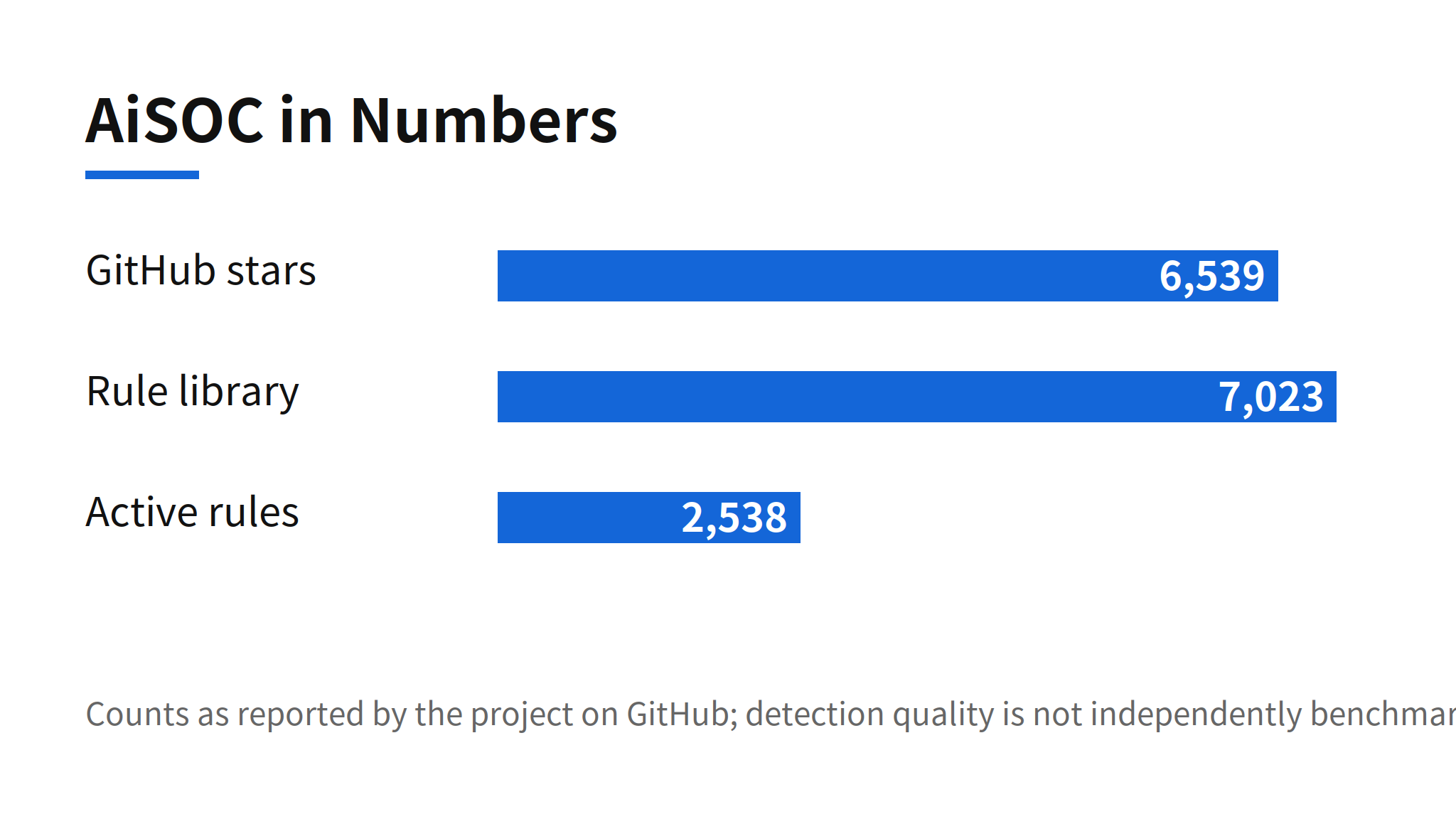
The three numbers describe different things and should not be merged into one quality claim. The star count measures attention. The library size measures coverage breadth on paper. The active rule count is the subset that actually runs. None of them measures detection quality, and the project itself supplies the figures, a distinction the limits section below keeps explicit. Release pace is the fourth signal: v21.0.0 followed v20.4.0 by one day and v20.3.0 by two, which shows an actively moving codebase and, at the same time, a moving target for operators who need stable versions.
How an Incident Moves Through AiSOC
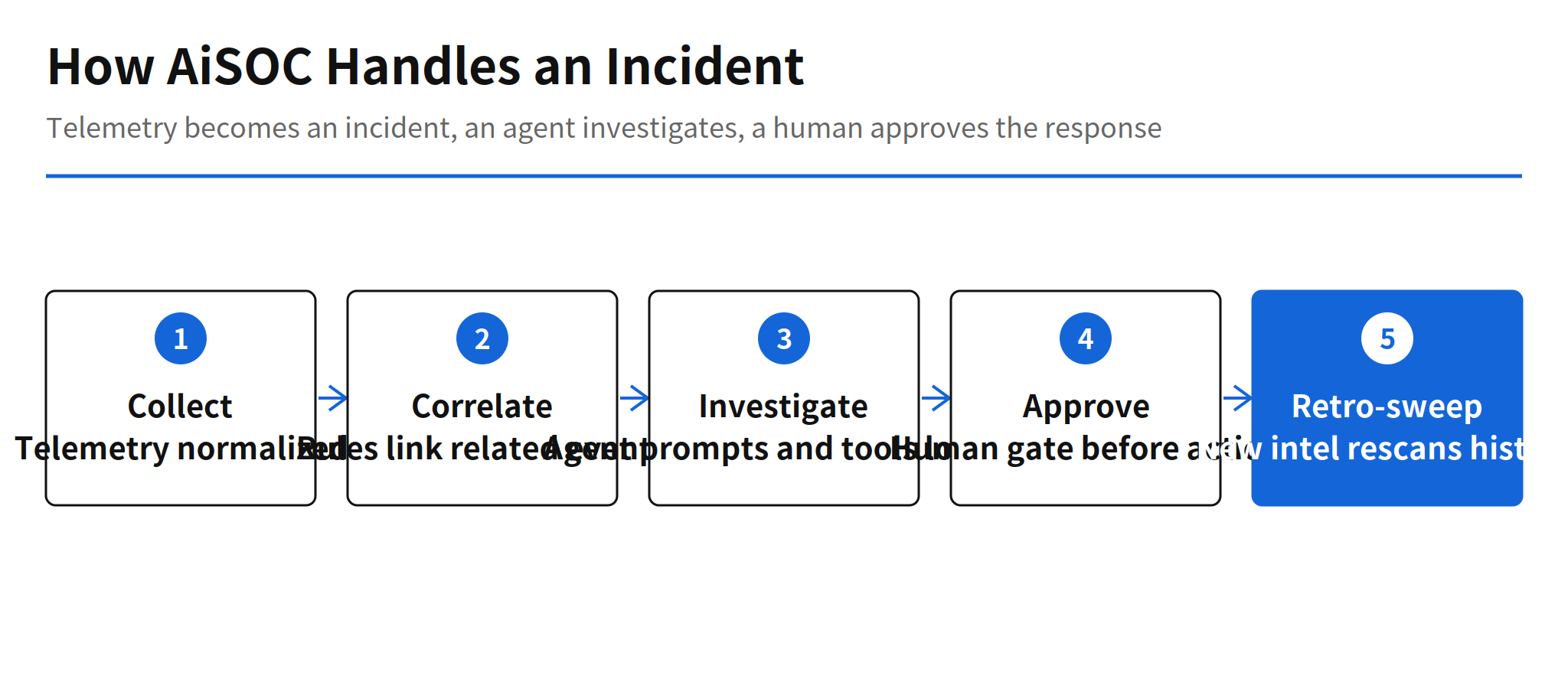
The investigation stage is where the audit design pays off. Because prompts and tool calls are recorded in full, a reviewer can reconstruct the exact sequence that produced a verdict, check which evidence the agent actually used, and spot the step where a weak investigation went wrong. That is a different standard from a summary written after the fact. A summary can omit the decisive step without anyone noticing; a replayable log cannot hide it as easily.
The response stage then puts a person at the last gate. The README states the rule directly: a human approves before anything reaches a vendor. Automated investigation can therefore run at machine speed while external action, the step that changes systems outside the SOC, still waits for a named human decision. For agent operations outside security, this pairing is the transferable pattern: log everything the agent did, and keep the irreversible step behind approval.
Running AiSOC Without an API Key
AiSOC runs without an API key, which lowers the barrier for a self-hosted security tool that would otherwise depend on a paid model account before it could be evaluated at all. It also ships an MCP server for Claude, Cursor and Continue, connecting the SOC to the agent tools a team may already use instead of forcing its own interface as the only entry point.
Getting started is deliberately short. A full install is one make up after cloning the repository. Without Docker, pip install aisoc-sandbox runs a single alert through an agent verdict offline in about 30 seconds, which gives a realistic first look at the investigation flow before any infrastructure commitment. The sandbox path matters for evaluation: security teams rarely grant a new tool network access and telemetry on day one, so an offline demo is often the only route to a serious internal review.
Limits and Unconfirmed Details
- Detection quality: the relationship between rule count and detection quality has not been confirmed by an independent benchmark. The rule figures are the project's own reporting.
- Release pace risk: releases are arriving at a daily cadence. The burden of version pinning and upgrade verification in a production deployment is unconfirmed.
- Local model accuracy: the built-in local model's verdict accuracy is confirmed only within the range of the README demo.
Those gaps set the standard for judging later versions rather than weakening the confirmed core. An independent detection benchmark and published upgrade guidance for production operators would turn a fast-moving, well-instrumented project into one a security team can adopt with fewer open questions.
Related Reading
Auditability on the device side is the subject of an earlier post in this series: Verlintas NOIR: Android Privacy Audit via adb, 1,187 Stars. NOIR shows what an installed app exposes, while AiSOC shows what an investigating agent did, and both treat a verifiable record as the product. Continuous checking of code before release is covered in Claude Security: Continuous Monitoring Rescans Every Commit.
FAQ
What is AiSOC?
AiSOC is a self-hosted open-source AI security operations center by beenuar. It normalizes security telemetry, correlates it with a rule library into incidents, and has an AI agent investigate each incident. It is written in Python and released under an MIT license.
How does AiSOC keep agent work auditable?
Every prompt and tool call the investigating agent makes is recorded, so an investigation can be replayed later exactly as it ran. Response actions also stay behind a human gate: the README states that a human approves before anything reaches a vendor.
How do you try AiSOC without a full deployment?
A full install starts with make up after cloning the repository. Without Docker, pip install aisoc-sandbox runs one alert through an agent verdict offline in about 30 seconds. The system runs without an API key and ships an MCP server for Claude, Cursor and Continue.
What is not yet proven about AiSOC?
The link between its rule count and detection quality has not been confirmed by an independent benchmark, and the rule counts are the project's own figures. The built-in local model has only been confirmed within the README demo range, and the cost of version pinning under its daily release pace is unconfirmed.