gpu-unlock for RTX 30: BF16 Gains up to 80% Claimed
Zagitta's gpu-unlock is an open-source project that removes the FP/BF16 tensor core instruction issue-rate limit on NVIDIA's RTX 30 series (Ampere). The repository was created on October 18, 2026, and had 3,639 stars at the time of checking. It starts from the premise that consumer Ampere cards are limited to lower FP16/BF16 instruction issue rates than professional cards. The project combines firmware unlock research from CMP cryptocurrency mining GPUs, aiming to draw out compute headroom from a card you already own.
For developers running local inference or image generation, it could be an option for raising performance without a new card. One disclosure first: every gain figure in this post rests on the repository's benchmarks and community reports. Independent reproduction figures have not been confirmed.
No Driver Patching and No VBIOS Changes
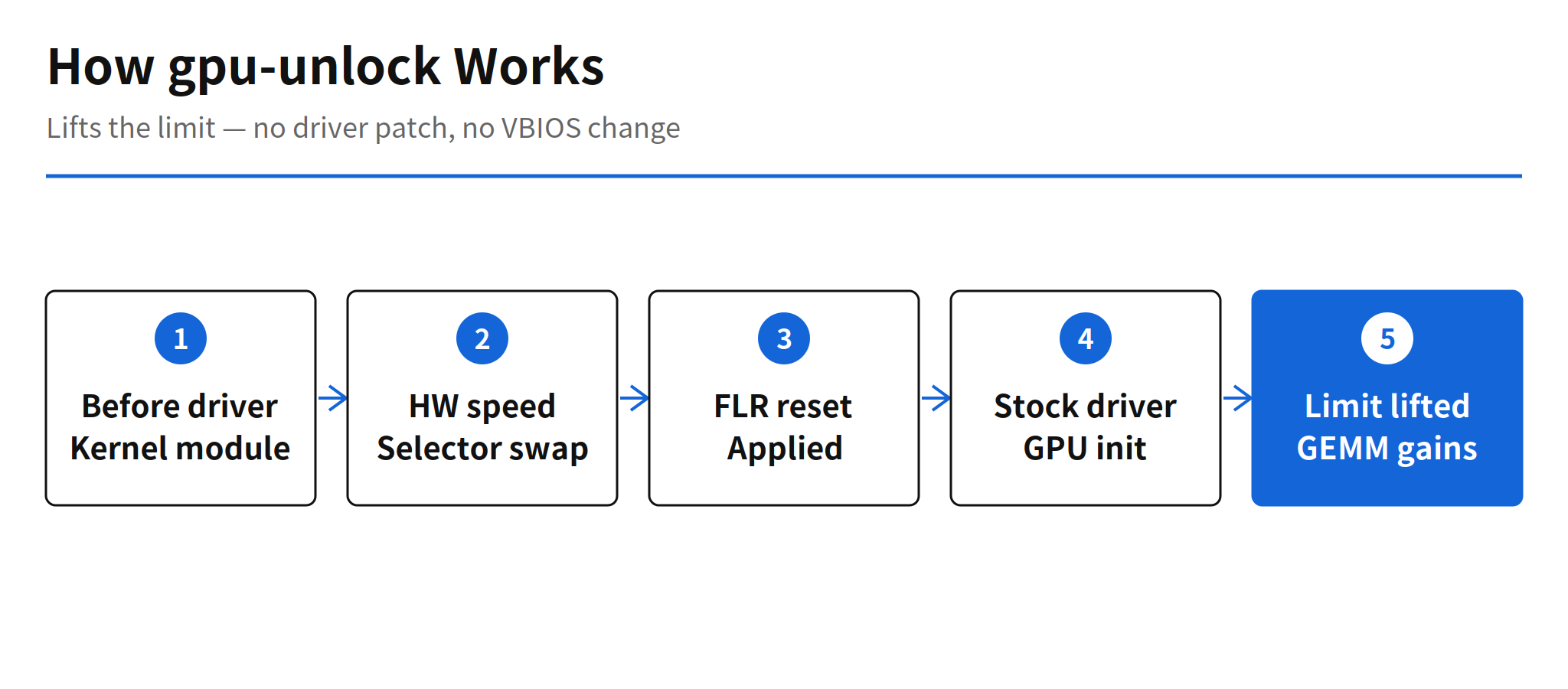
The mechanism is closer to a simple reordering. A Linux kernel module runs before the NVIDIA driver loads, changes the hardware rate selector, and performs a Function Level Reset (FLR). The unmodified driver then initializes the GPU. So there is no need to patch the driver anew, and the VBIOS is not permanently altered.
Supported GPUs are listed as GA102, GA103, GA104, and GA106. An experimental Windows implementation exists as well, using a UEFI approach, documenting roughly 82.5% higher BF16 throughput on an RTX 3090. It is flagged as a hardware-only experimental stage, so it should not be weighed the same as the Linux path.
The Numbers: BF16 Up 80% and TF32 Up 94% on a 3090 Ti
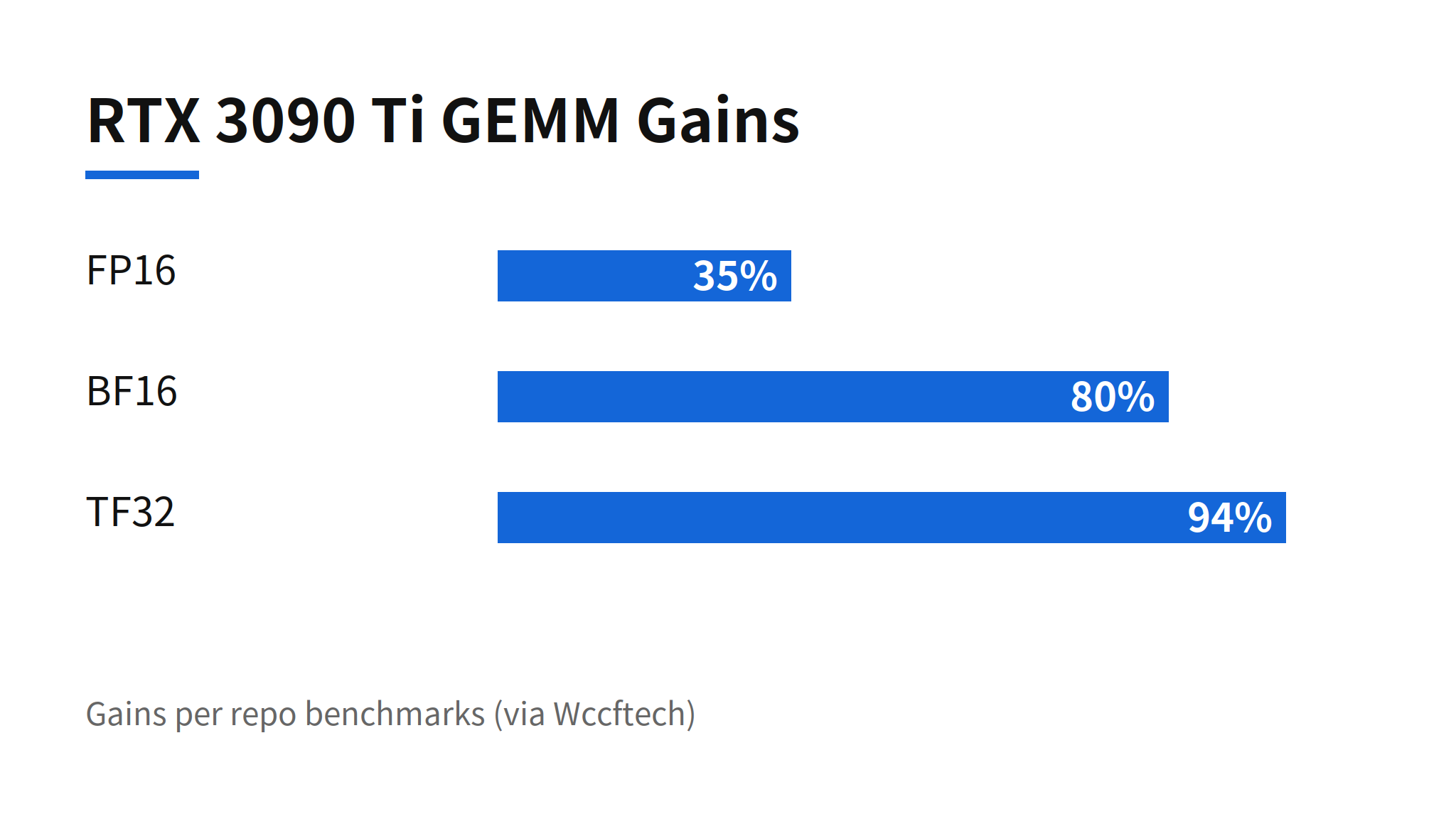
In the repository's benchmarks, an RTX 3090 Ti (at a 450W limit) ran dense matrix multiplication (GEMM) tests. FP16 rose 35%, from 87.46 TFLOPS to 118.39 TFLOPS. BF16 rose 80%, from 87.50 TFLOPS to 157.41 TFLOPS. TF32 rose 94%, from 42.58 TFLOPS to 82.61 TFLOPS.
| Card | Metric | Before | After |
|---|---|---|---|
| RTX 3090 Ti (450W) | FP16 | 87.46 TFLOPS | 118.39 TFLOPS (+35%) |
| RTX 3090 Ti (450W) | BF16 | 87.50 TFLOPS | 157.41 TFLOPS (+80%) |
| RTX 3090 Ti (450W) | TF32 | 42.58 TFLOPS | 82.61 TFLOPS (+94%) |
| RTX 3080 Ti (315W) | BF16 | 71.59 TFLOPS | 113.98 TFLOPS |
| RTX 3080 Ti (315W) | TF32 | 35.65 TFLOPS | 65.28 TFLOPS |
| RTX 3080 10GB (320W kept) | FP16/BF16 | about 65 TFLOPS | 110–113 TFLOPS |
Reports from other cards point the same way. An RTX 3080 Ti report shows BF16 rising from 71.59 TFLOPS to 113.98 TFLOPS. It also shows TF32 rising from 35.65 TFLOPS to 65.28 TFLOPS, at a 315W power limit. An RTX 3080 10GB report shows FP16/BF16 rising from about 65 TFLOPS to 110–113 TFLOPS, keeping the original 320W power limit.
Real AI Workloads Split
GEMM figures do not carry straight over to real workload speed. In ComfyUI tests on an RTX 3090 Ti, MOSS-Image SFT BF16 ran 58.6% faster, Qwen-Image 2.1 Turbo BF16 57.2% faster. Z-Image Turbo BF16 ran 56.1% faster. An INT8 configuration, by contrast, gained only 0.3%. A vLLM report on an RTX 3090 showed prompt processing throughput up 33%, while token generation speed was effectively unchanged.
That split is the key to understanding this project. Where tensor core compute is the bottleneck, the effect is large; where it is not, there is almost none. Memory bandwidth does not grow, and no CUDA cores are added. There is also no convincing evidence yet of gaming performance or DLSS runtime improvements.
Points Still Unconfirmed
- Results are not universal. Among RTX 3080 Ti 20GB reports, at least one case completed the unlock procedure without the expected BF16 gain. The variance factors are unconfirmed.
- Benchmark sourcing is limited. The figures rest on the repository and community reports; independent reproduction figures have not been confirmed. The repository's license notation also could not be confirmed through the GitHub API.
- Not every workload gets faster. As seen above, sections bottlenecked elsewhere, such as INT8 or token generation, see split results.
The point is not that "everything gets faster," but that gains appear only where tensor core compute is the bottleneck.
The practical judgment settles like this. A team running local AI on older GPUs has reason to review this option before replacing hardware. Given the experimental stage, measuring on your own card and your own workload is the safer course. Do not decide adoption on GEMM figures alone; check first whether your workload's bottleneck sits in the tensor core section.
Sources
- GitHub: Zagitta/gpu-unlock (October 18, 2026)
- Wccftech: RTX 30 GPUs get up to 2x faster AI compute with gpu-unlock (October 24, 2026)
- ax-trend issue #3529
- Related issue #3334: OpenMOSS-Team 'MOSS-Image-SFT', an open 5B text-to-image model with strong text rendering and layout generation, Apache 2.0
FAQ
What does gpu-unlock do?
gpu-unlock is an open-source project by Zagitta that removes the FP/BF16 tensor core instruction issue-rate limit on NVIDIA's RTX 30 series (Ampere). It starts from the premise that consumer Ampere cards are limited to lower FP16/BF16 instruction issue rates than professional cards. The repository was created on October 18, 2026.
Does gpu-unlock patch the driver or change the VBIOS?
No. A Linux kernel module runs before the NVIDIA driver loads, changes the hardware rate selector, and performs a Function Level Reset (FLR). The unmodified driver then initializes the GPU, and the VBIOS is not permanently altered.
Which GPUs are supported?
Supported GPUs are listed as GA102, GA103, GA104, and GA106. An experimental Windows implementation exists as well, using a UEFI approach and documenting roughly 82.5% higher BF16 throughput on an RTX 3090. It is flagged as a hardware-only experimental stage, so it should not be weighed the same as the Linux path.
How large are the performance gains?
In the repository's benchmarks, an RTX 3090 Ti at a 450W limit saw BF16 rise 80%, from 87.50 TFLOPS to 157.41 TFLOPS, with TF32 up 94% and FP16 up 35%. Real workloads split: ComfyUI BF16 image models ran about 56 to 59% faster, while an INT8 configuration gained only 0.3%. Every gain figure rests on the repository's benchmarks and community reports, and independent reproduction figures have not been confirmed.