Claude Code v2.1.328: Auto Mode on Bedrock and Foundry
Anthropic released Claude Code v2.1.328 on November 19, 2026. The headline change is where auto mode works. Auto mode for Claude Opus 4.6 and Sonnet 4.6 is now available on Amazon Bedrock, Google Cloud's Agent Platform, Microsoft Foundry and the Claude apps gateway, and interactive sessions that do not set a permission mode now start in auto mode. Until this release, that combination was tied to Anthropic's direct route, so teams running Claude Code through a cloud provider had to work around it or do without it.
The default matters as much as the expansion. A session with no permission mode configured previously started under the standard prompting flow. Now it starts in auto mode, which lets Claude Code proceed with more actions on its own. For an individual developer that removes friction. For a team that built its review process around permission prompts appearing by default, the same change quietly removes a checkpoint, and it will arrive through a routine version update rather than through a settings change anyone approved.
Auto Mode Expansion and the New Starting Default
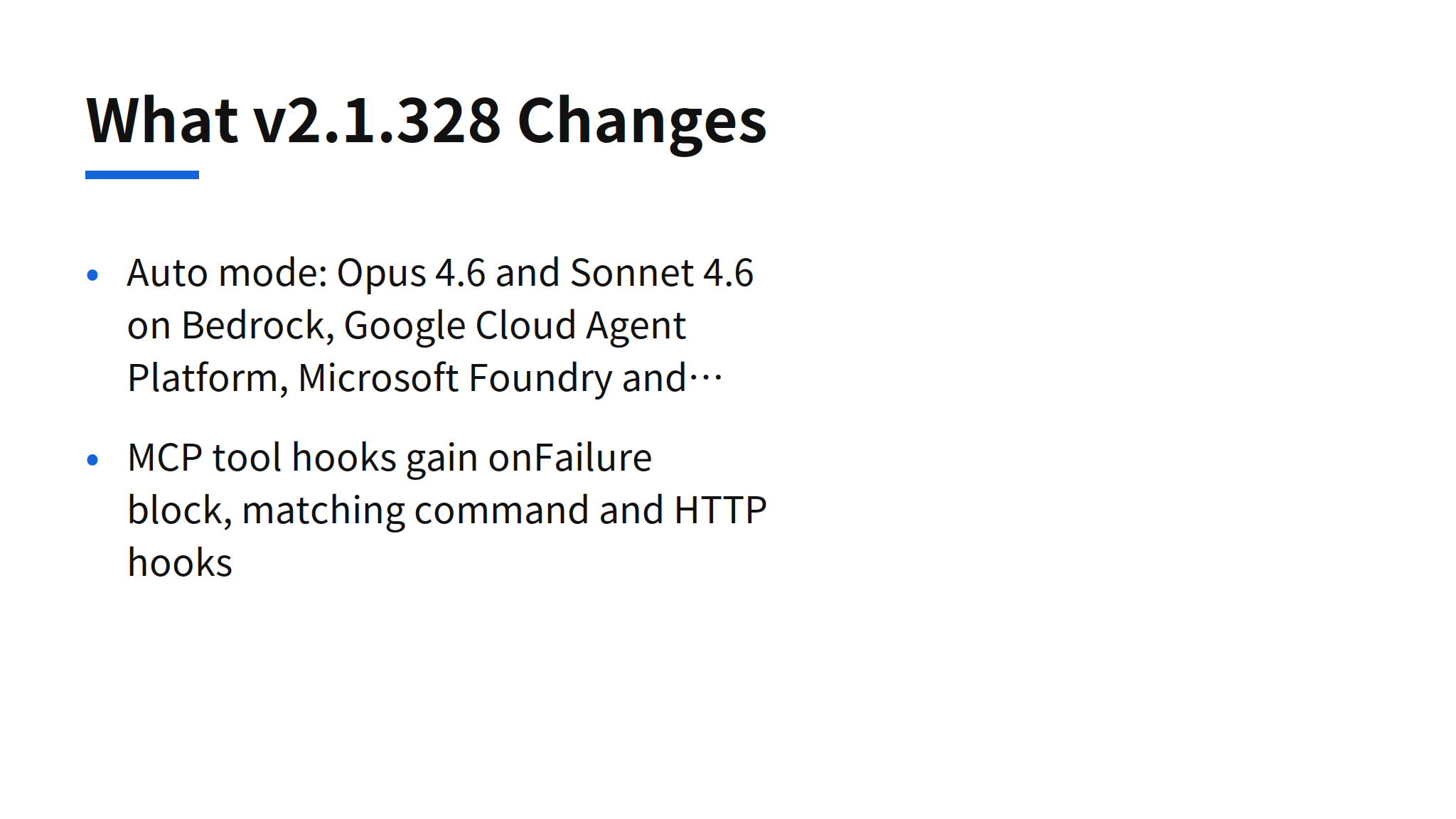
The changelog entry is specific about scope. Auto mode covers Opus 4.6 and Sonnet 4.6 on the four routes named above. The release also fixes a related failure in the same area: auto mode previously failed on every turn outside Claude Desktop when CLAUDE_CODE_DISABLE_EXPERIMENTAL_BETAS was set behind a gateway that rejects betas, on Bedrock, Agent Platform, Foundry or the Claude apps gateway. Fixing that in the same release that expands auto mode suggests the cloud routes were tested as a group, rather than auto mode being switched on and left to surface gateway problems later.
This continues the direction of the last two releases covered here. Code Mode arrived as an experimental feature in v2.1.323 and could be combined with agent teams in v2.1.326. Version 2.1.328 pushes the other half of that pairing, auto mode, out to the platforms where larger organizations actually run the tool. The sequence reads as a deliberate order: ship the execution model first, then widen the permission model once the execution model has settled.
Hook Blocking, Deferred Tool Calls and Telemetry Warnings
Three smaller additions give operators more control over automated sessions. MCP tool hooks gained "onFailure": "block", matching what command hooks and HTTP hooks already had, so a hook whose call fails can block the action instead of letting it continue. A new environment variable, CLAUDE_CODE_DISABLE_DEFERRED_TOOL_RESUME, lets a host stop claude -p --resume and --continue from running a tool call that a hook deferred. And when an OpenTelemetry exporter has no endpoint, so its data would likely be lost, /status and claude doctor now show a notice instead of failing silently.
Each of these addresses a failure that is invisible until it costs something. A hook that fails open can let an action through that a policy meant to stop. A deferred tool call that runs on resume can execute in a context the operator no longer expects. Telemetry with no endpoint produces a gap that looks like a quiet system. None of the three is a feature a user would ask for by name, and together they indicate the release was shaped by hosted and embedded deployments, where Claude Code runs inside someone else's wrapper and the wrapper owner carries the risk.
The release adds two related governance items. Apps that embed Claude Code can switch on the policy plugin's allowManagedModsOnly option, and the changelog states that an admin's managed settings still win. The Claude apps gateway also gained a startup warning when a policy's maxEffortLevel is not a valid effort level. A warning at startup is the right place for that class of error, since an invalid effort cap would otherwise apply unevenly or not at all, with no visible sign.
Code Mode and Session Fixes
The fix list is long, and the Code Mode entries are the most consequential. A script is no longer stopped when a permission prompt outside auto or bypass mode, a plan approval or a question stayed open for ten minutes. Scripts in auto and bypass permissions modes can again call an MCP server that connected while a previous script was running. Scripts also keep a loaded skill, hook context or a note typed with a permission approval when a session resumes after one reply ran several scripts.
Two session fixes sit outside Code Mode. Automatic compaction no longer reuses the session's earlier system prompt instead of rebuilding it the way /compact does, which means an automatically compacted session and a manually compacted one now follow the same rule. Markdown rendering no longer freezes on some very long or malformed input. The release also fixes the effort regression introduced in v2.1.327, where effort could be turned off for a subagent's model for the whole session if Bedrock, Google Cloud's Agent Platform or Foundry refused the progress summary's effort setting. That regression is directly connected to this release's theme: the cloud routes are now primary enough that a provider refusing one setting could degrade an entire session.
Self-hosted runner support also expanded, with a --repository-folder option for naming the folder a session uses at capacity 1, a --hook-label option for the orchestrator, and new orchestrator metrics for queue wait by reason and for sessions given up on, counted by cause. Those additions are niche, but they point the same way as the rest of the release, toward Claude Code being operated as managed infrastructure rather than as a single developer's terminal tool.
Limits and Unconfirmed Points
- Precedence against organization policy is not stated: the changelog does not say what wins when the new auto mode starting default meets an organization's own permission policy. The managed settings note appears only in the policy plugin item.
- No per platform rollout detail: the changelog lists Bedrock, Google Cloud's Agent Platform, Microsoft Foundry and the Claude apps gateway together, with no separate availability timing or regional limits for any of them.
- Model scope is two models: auto mode in this release is stated for Opus 4.6 and Sonnet 4.6 only. The changelog does not extend it to other models.
- Version 2.1.327 was not covered separately: it shipped on November 17, and this release contains its effort regression fix, so anyone on 2.1.327 has a concrete reason to move to 2.1.328 rather than wait.
The practical step for teams on cloud routes is short. Update to v2.1.328, then check what an unconfigured session does in your environment before the update reaches everyone. If your process depends on permission prompts as a review gate, set the permission mode explicitly in managed settings rather than relying on the previous default, because the previous default no longer exists.
FAQ
What is the headline change in Claude Code v2.1.328?
Auto mode for Claude Opus 4.6 and Sonnet 4.6 is now available on Amazon Bedrock, Google Cloud's Agent Platform, Microsoft Foundry and the Claude apps gateway. Interactive sessions that do not set a permission mode now start in auto mode.
What changed for MCP tool hooks?
MCP tool hooks gained the onFailure block option, matching command and HTTP hooks. When a hook call fails, the hook can now block the action instead of letting it proceed.
What does CLAUDE_CODE_DISABLE_DEFERRED_TOOL_RESUME do?
The new environment variable lets a host stop claude -p --resume and --continue from running a tool call that a hook had deferred. It is aimed at hosts that embed or wrap Claude Code sessions.
Which Code Mode problems were fixed?
The release fixes a script being stopped when a permission prompt or plan approval stayed open for ten minutes, and a case where a script in auto mode could not call an MCP server that connected while a previous script was running.
What remains unclear about the new default?
The changelog does not say which side wins when auto mode as the starting default conflicts with an organization's own permission policy. The note that managed settings still win appears only in the policy plugin item, so teams should verify their managed configuration after updating.
Related Reading
- Claude Code v2.1.326 Release: Code Mode and Agent Teams, the previous release in this sequence
- Claude Code v2.1.323 Release: Code Mode and 1M Context, where Code Mode first appeared