Claude Code v2.1.323 Release: Code Mode and 1M Context
Anthropic released Claude Code v2.1.323 on November 12, 2026 as a GitHub release. Two changes carry the release. The first is Code Mode, an experimental opt-in in which Claude writes JavaScript to call its own tools. The second is quieter and easier to miss: for model IDs that Claude Code does not recognize, the assumed context window rose from 200K to 1M tokens, a fivefold increase that applies by default.
The rest of the release is the usual dense mix for this project, and parts of it matter in daily use. Plugins gained version gating through engines["claude-code"] in the manifest, the subagentStatusLine setting was removed, long hooks in headless sessions now send a progress heartbeat every 30 seconds, and Artifact tool uploads accept .docx files. Underneath those headlines sits a long list of permission, sign-in and sandbox fixes, several of which close cases where a command could run without the prompt a user expected.
Code Mode, Opt-In and Written in JavaScript
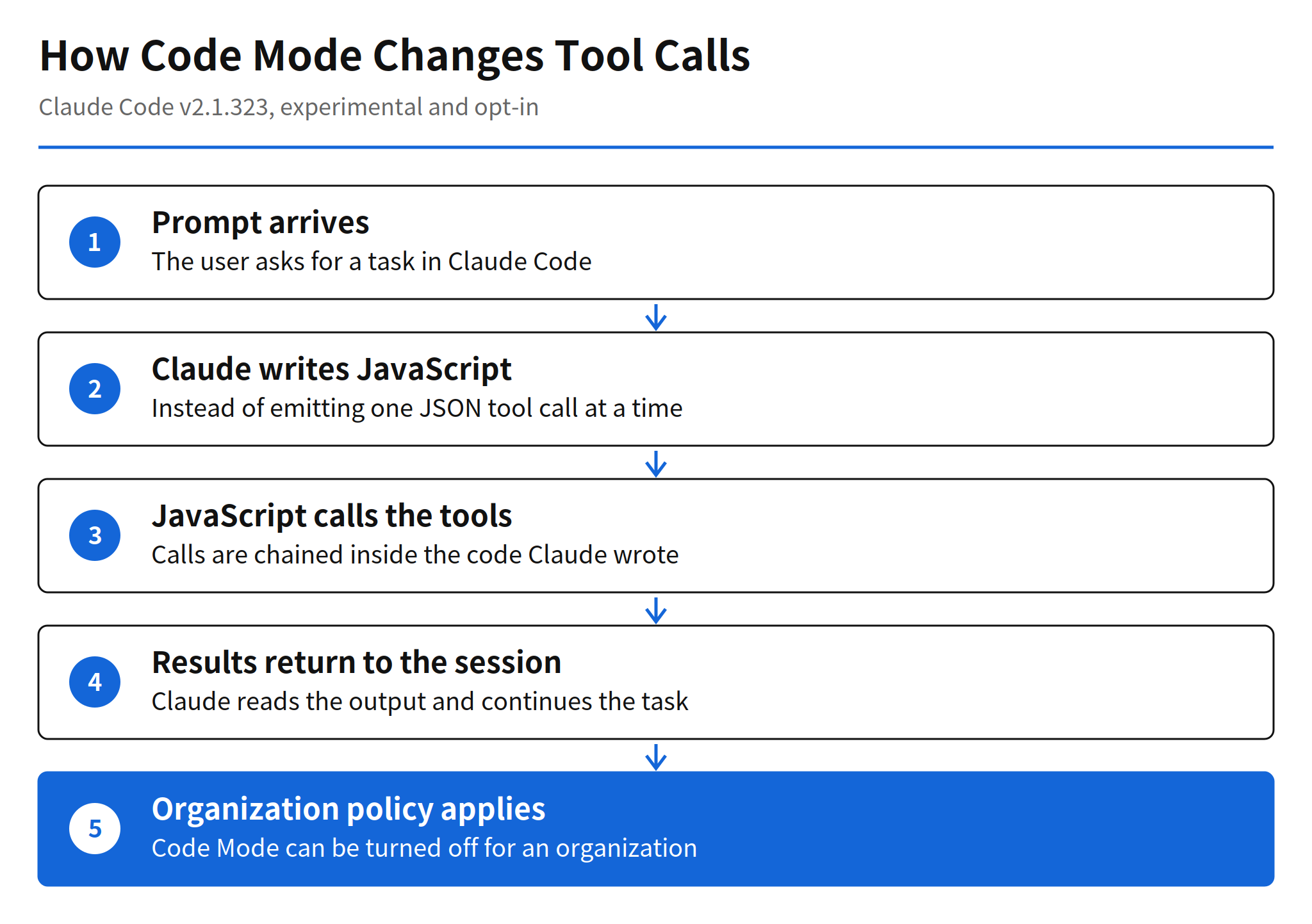
In the standard harness pattern, the model emits one structured tool call, waits for the result, then emits the next. Code Mode changes who assembles the sequence. Claude writes JavaScript, and the JavaScript calls the tools, so a chain of dependent calls can be expressed as code in a single step instead of a series of model turns. The release note is one sentence long: Code Mode is experimental, it is opt-in, and the note links to a documentation page for turning it on, or for turning it off for an organization.
That organization switch is the detail that tells you how Anthropic expects this to be adopted. An experimental execution mode that an admin can disable centrally is aimed at teams, not only at individual tinkerers. It also fits the direction of the plugin changes in the same release: more capability, paired with more explicit control over which versions and modes are allowed to run.
Two limits need to be stated plainly. First, Anthropic has published no measurements for Code Mode: no token savings, no latency numbers, no success-rate comparison against sequential tool calls. Any claim that it is faster or cheaper is, at this point, a guess about a plausible mechanism rather than a measured result. Second, the linked documentation page at code.claude.com/docs/en/code-mode returned a Page Not Found response when checked for this article, the same result recorded in the original issue research. The exact activation steps are therefore unconfirmed here, and this article does not invent them.
My read: Code Mode moves part of the harness into the model. That is the interesting bet. If a model can plan a tool chain as code, the harness needs fewer round trips and less orchestration logic. The cost is a new failure surface, since generated code that calls tools is harder to inspect mid-flight than a list of individual calls. Until Anthropic publishes measurements, the sensible posture is to test it on low-risk work and keep it off by default in shared environments.
The 1M Default for Unrecognized Models
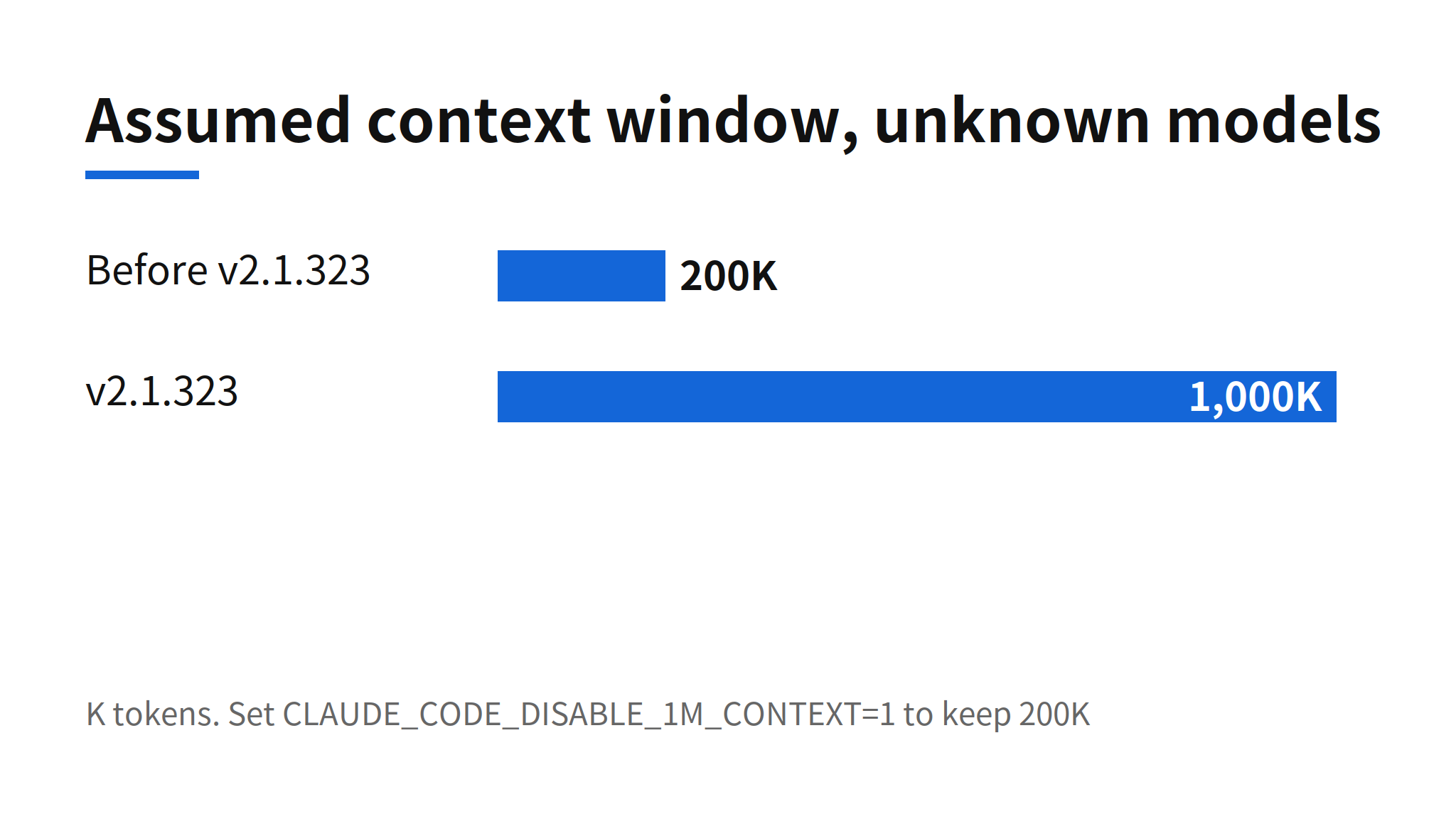
When Claude Code meets a model ID it does not recognize, it has to assume a context window size for planning, compaction and limits. Before this release the assumption was 200K tokens. In v2.1.323 it is 1M tokens. Teams that want the old behavior can set CLAUDE_CODE_DISABLE_1M_CONTEXT=1 and keep the 200K assumption.
The change mainly affects teams running custom endpoints, gateways or third-party models under their own IDs, which is a growing share of serious deployments. For a model that really has a 1M window, the old default wasted most of the space. The release notes themselves flag the opposite risk: if the third-party model behind an unrecognized ID has a smaller window, a session can fill past the real limit and then fail on every turn. That failure mode is worse than a conservative default, because it arrives late, after the session has accumulated work.
The practical move is small and worth doing before the update, not after a broken session. If your team routes Claude Code to any model ID Anthropic would not recognize, decide which assumption is true for that model, and set the environment variable explicitly if the answer is 200K. Defaults that change silently are exactly the kind that should be pinned in configuration once noticed.
Plugin Version Gating in plugin.json
Plugin manifests can now declare engines["claude-code"] in plugin.json, a version range for Claude Code itself. A plugin outside its stated range is not installed, not updated and not loaded, and install and update pick the newest plugin version that fits the range. Anyone who has maintained editor or browser extensions will recognize the pattern: as the host ships weekly, sometimes daily, plugin compatibility needs to be declared and enforced rather than discovered through breakage.
The validation tooling grew in the same direction. claude plugin validate now type-checks a plugin TypeScript hooks module, with each finding reported as a warning and --strict failing on it. The install command also reports unsetOptionCount, the number of userConfig options not yet set, which helps plugin authors and users see incomplete setup instead of guessing at it.
Smaller Additions in This Release
- subagentStatusLine removed: subagent rows now use the default appearance. The key is still read if it remains in a settings file, so old configuration will not break anything; it simply has no effect.
- 30-second heartbeat: while a hook runs long in
claude -pand SDK sessions, Claude Code now sends a progress heartbeat every 30 seconds, so a host such as Claude Desktop does not end the turn as hung. The note adds that this takes effect once the host includes this version. - .docx Artifact uploads: the Artifact tool asset upload accepts Word documents alongside the formats it already took.
- Usage credit options: when a model needs usage credits that are turned off or used up, an options menu now offers stop, switch to usage credits, or upgrade, instead of a dead end.
- Managed auto mode model:
CLAUDE_CODE_AUTO_MODE_MODELis now supported in managed settings for Claude Desktop sessions on third-party providers, effective once Desktop includes this version. - Progress summary switch:
CLAUDE_CODE_DISABLE_AGENT_PROGRESS_SUMMARIES, available since 2.1.318, can be set to 1 to turn off subagent progress summaries and the requests that write them. - Startup warnings: a start-up warning now flags Bash allow rules with a
*in a variable value, such asBash(PORT=* npm run dev), and a warning names a plugin language server that cannot start, with what to check.
Fixes That Change Daily Behavior
The fix list is long, and most of it is narrow. A few entries change behavior that users can feel. Running /compact again, or after a command such as /context, no longer summarizes away a message Claude had not answered yet. A setting saved in a running session no longer undoes a hand edit made to settings.json moments earlier, and a settings file deleted during a session stays deleted. Both fixes protect the user own edits from the tool, which is the correct priority.
The permission fixes deserve a slower read. Several close cases where Bash allow rules skipped a prompt they should not have skipped, including rules with an attached wildcard such as Bash(ls*), combined sudo flags, and commands run through wrappers such as sudo and env. Separately, --permission-mode auto and a settings defaultMode: auto now start in Manual mode, which asks first, when auto mode is unavailable, instead of starting in a mode that could allow more. None of this is a headline feature, but for a tool that runs shell commands, the difference between asking and not asking is the product.
Sign-in handling also received a cluster of fixes for background and named-profile sessions, including cases where a session could move to another sign-in or send a conversation under the wrong account. Those fixes matter for the same reason: an agent that acts under the wrong identity is a correctness and trust problem at once.
Limits and Unconfirmed Points
- Code Mode activation steps unconfirmed: the linked documentation page returned Page Not Found when checked for this article. The release note confirms the mode exists, is experimental and opt-in, and can be disabled for an organization; the step-by-step enable procedure is not confirmed here.
- No Code Mode measurements: Anthropic published no performance, token or reliability figures for Code Mode in this release.
- 1M default risk is documented, not quantified: the warning about smaller third-party windows comes from the release notes. How many deployments use unrecognized IDs with smaller windows is not stated anywhere in the release.
- Fix list is selective here: the full release notes contain dozens of additional fixes across sign-in, sandboxing, MCP and rendering. This article covers the ones that change visible behavior or permission outcomes; it is not a complete changelog.
FAQ
What is Code Mode in Claude Code v2.1.323?
Code Mode is an experimental, opt-in mode in which Claude writes JavaScript to call its own tools, instead of emitting one structured tool call at a time. Anthropic links a documentation page for turning it on, and for turning it off for an organization. No performance or token measurements for Code Mode have been published.
What changed about the context window in v2.1.323?
For model IDs that Claude Code does not recognize, the assumed context window rose from 200K to 1M tokens. Teams that need the old assumption can set CLAUDE_CODE_DISABLE_1M_CONTEXT=1 to keep 200K. Anthropic warns that a third-party model with a smaller real window can fail on every turn once a session fills past it.
How does plugin version gating work in v2.1.323?
A plugin manifest can now declare engines["claude-code"] in plugin.json. A plugin outside its stated Claude Code version range is not installed, updated or loaded, and install and update pick the newest version that fits the range.
What else was removed or added in v2.1.323?
The subagentStatusLine setting was removed, so subagent rows use the default appearance. The release also adds a 30-second progress heartbeat during long hooks in claude -p and SDK sessions, and .docx support for Artifact tool asset uploads.
Should teams update to v2.1.323 right away?
Most teams can update, but teams using custom model IDs or third-party endpoints should decide on the 1M context default first, because it changes when sessions fill and fail. Code Mode is opt-in and experimental, so leaving it off until Anthropic publishes measurements is a reasonable default.
Related Reading
- Claude Code 2.1.319: MCP Tasks Go Background, Release Notes, the earlier release in this sequence, four versions before this one
- Claude Code Cloud Auto Setup: Plans and How It Works, on the cloud environment side of the same tool