Cursor Security Incident: Fireworks Key, Traces, Extension
Cursor published the results of a two week investigation on November 13, 2026, and the picture is now complete. The incident started with an access key Cursor had issued to Fireworks. The key was exposed by Fireworks, and an attacker used it to copy a read-only storage bucket containing coding agent traces from sessions that were not in Privacy Mode. Traces were exposed for fewer than 0.05% of non-Privacy users, and fewer than 0.01% of customers had API credentials exposed.
The same chain explains the tampered extension that appeared in late October. Using a stolen credential from the exposed data, the attacker placed malicious copies of Anthropic Claude Code extension, versions 2.1.312 and 2.1.313, directly on the cache serving the Cursor VS Code extension marketplace. At most 5,000 users may have received the malicious build during an exposure window of about 11 hours on October 29. Cursor says the last attacker activity it saw was on November 1 and was blocked, and it believes the incident is contained.
The important point is structural. No Cursor production system was breached first. A vendor key, a shared training data bucket and credentials left inside agent traces formed a path from a supplier incident to internal SaaS tools and then to a marketplace cache. Each step used access that existed for a legitimate reason.
Attack chain from vendor key to marketplace cache
The bucket held limited coding agent traces, mostly from 2025, from sessions not in Privacy Mode, which Cursor was permitted to use for model training. That detail matters for scope. The exposed data was historical offline analysis material, not live traffic, and Privacy Mode sessions were outside it. It also matters for risk, because a small number of those traces contained credentials that had not been redacted.
Starting with those credentials, the attacker reached select SaaS tools used by Cursor. From those tools they accessed select archived non-production source code repositories, some containing business contact information, limited customer support data and email conversations, product usage metrics and contact details, summaries of some coding agent conversations, and some credentials users had sent to the Cursor support team. The progression is the lesson. Trace data is often treated as low sensitivity exhaust. Here it held working credentials, and working credentials turned a data copy into system access.
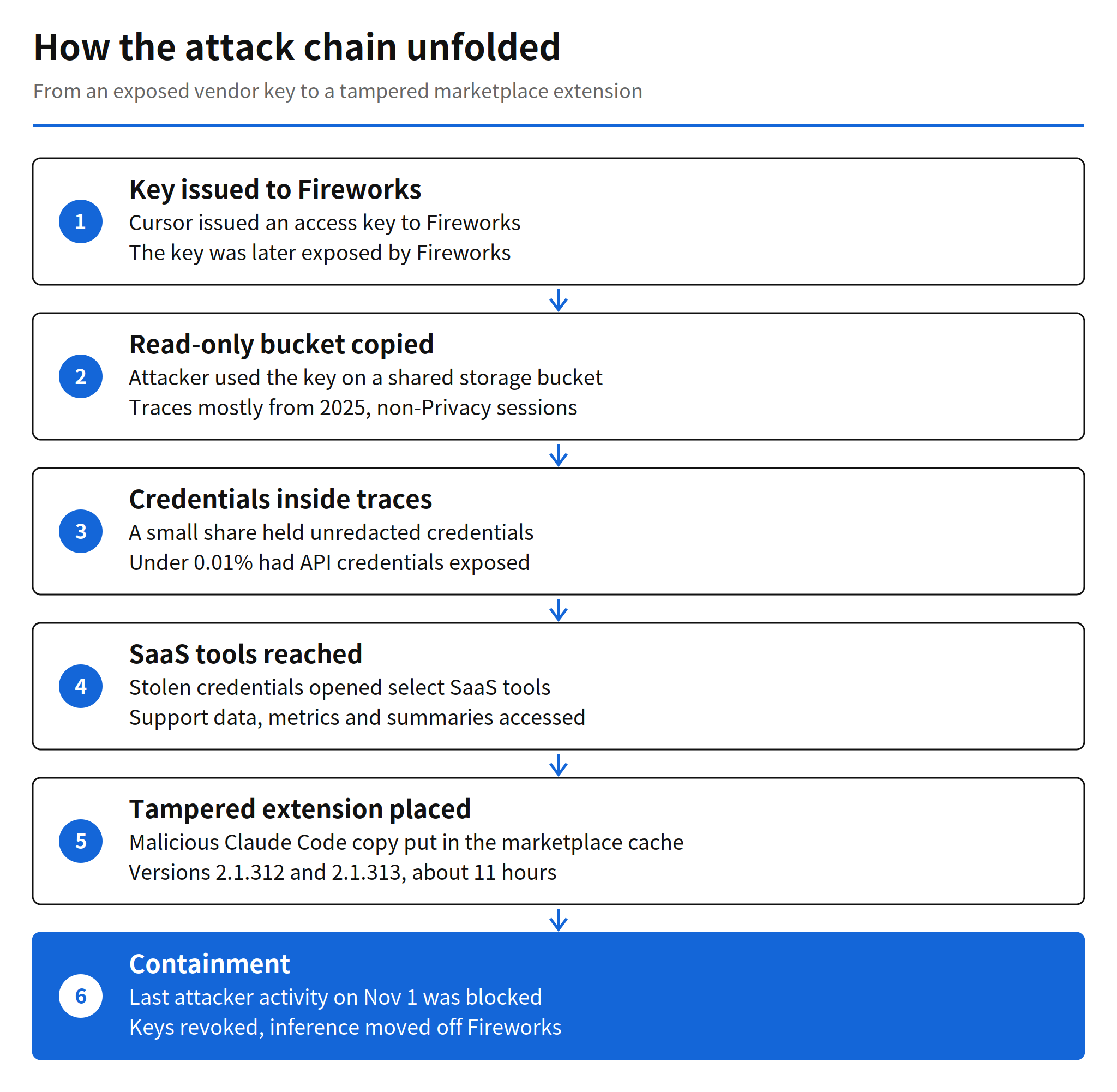
Cursor monitoring identified the unauthorized activity. After becoming aware of it, Cursor deactivated the vendor key, opened an incident response workstream, and began revoking and rotating credentials while hunting for further access. As more access was identified, it was cut off. Out of caution, Cursor temporarily disabled internal and product services well beyond what the evidence required, which disrupted some features, and restored each service once it was safe.
Exposed data and affected shares
Cursor disclosed the impact as shares, not counts. The absolute number of traces and credentials was not published, so the size of the affected population cannot be derived from the post. That limits outside verification. A reader can confirm the proportions Cursor claims, but not how many traces were copied or how many credentials were usable.
Notification was direct. Cursor said it identified the users whose traces were exposed and notified each of them directly, and that if a user did not receive a notification, their data was not in those traces. Where credentials were exposed, Cursor emailed team admins a list of the specific keys to rotate and asked the third party services that issued those credentials to revoke them. Customers whose support or business data may have been involved were also notified directly.
Tampered Claude Code extension in the marketplace cache
On October 29, the attacker used a stolen credential from the exposed internal data to place the malicious extension copies directly on the cache used to serve the Cursor marketplace. Cursor stressed two boundaries. Anthropic did not publish this copy, and this was not a vulnerability in an Anthropic product. The marketplace source, Open VSX, never had the malware.
Only users who requested specific cached versions of the extension on October 29 could have received the malicious build, and the ceiling Cursor gives is 5,000 users. Cursor took the build down, took the extension marketplace offline, and worked with the cloud provider hosting the attacker server to take that server down. On October 30, Cursor published a security notice on its blog and on X with indicators of compromise, remediation steps and scripts to check a system, and began notifying affected users and team admins in the app and by email.
The remediation warning deserves emphasis. If a customer installed or updated to tampered version 2.1.312 or 2.1.313 from the Cursor marketplace during the window, uninstalling the extension alone may not be enough. Cursor asks those customers to follow the steps in the security notice. That sentence separates this from a routine bad update, where removal usually ends the problem.
Systems and data that were not affected
Cursor listed clear exclusions. Prompts and code from Privacy Mode users were not affected. Live traffic and active inference requests were not exposed, and the production systems and infrastructure that run Cursor were not reached. The Cursor app, its official updates and release signing keys were not exposed, because Cursor ships from a separate code hosting system the attacker never accessed. Customer code repositories were not affected.
Other marketplace extensions were validated as authentic, and the marketplace store was reviewed and rebuilt. Other products, including Cloud Agents for customer teams and Grok Bot, were not affected, according to Cursor. These exclusions are claims by Cursor based on its investigation, and the post says external forensics experts supported that investigation. No independent report with separate findings was included in the November 13 post.
Response measures and containment status
The response went beyond the exposed key. Cursor moved all inference traffic off Fireworks, deactivated the key it had issued to Fireworks, and cut off Fireworks access to every shared data set. It rotated every exposed credential it found, highest risk first, and as a precaution rotated all credentials in use across its internal systems, even where there was no evidence of exposure.
Cursor also expanded network access restrictions across its service providers, where possible, so compromised credentials cannot be used outside their intended location. It added secret scanning and protections across all code repositories and expanded scanning to other internal data sources. As a precaution, it redeployed all production infrastructure and services, and reviewed every internal service before restoring it.
On containment, the wording is measured. Cursor says it believes the incident is contained, that the last attacker activity seen was on November 1 and was blocked, and that monitoring for anomalous activity continues. If additional information affecting customers is identified, Cursor says it will contact them directly. Questions go to security@cursor.com.
Practical checks for teams using coding agents
The first check is trace policy. In this incident, Privacy Mode was the line between traces that sat in a shared bucket and traces that did not. A team that sends agent sessions to a vendor for training or inference should know whether its sessions are in that shared pool, how long traces are kept, and whether credentials inside traces are redacted before storage. The failure here was not only a leaked key. It was also unredacted credentials surviving inside stored traces.
The second check is vendor key scope. A single issued key reached a bucket whose contents then unlocked more systems through secondary credentials. Scoping a vendor key narrowly, restricting where it can be used from, and rotating it on a schedule all reduce what one exposure buys an attacker. Cursor own remediation list points in that direction, with network restrictions and broader secret scanning.
The third check is extension provenance. The tampered build arrived through a cache, not through the upstream source, and the upstream source never carried it. Teams that install editor extensions at scale should pin versions, watch for unexpected version changes, and treat a vendor security notice as an action item rather than news. For this incident, the concrete action is narrow: check for Anthropic.claude-code 2.1.312 or 2.1.313 installed from the Cursor marketplace on October 29, and follow the October 30 notice if either version was present.
Related articles
- IBM Granite LLMON: Prompt Injection Defense, How It Works
- OpenAI Daybreak Red Team and Defense Factory: Release Guide
FAQ
What started the Cursor security incident?
The chain started at Fireworks. An attacker obtained an access key Cursor had issued to Fireworks after the key was exposed by Fireworks, and used it to copy data from a read-only storage bucket Cursor used to share data with the vendor.
How many users were affected by the trace exposure?
Cursor said coding agent traces were exposed for fewer than 0.05 percent of users who were not using Privacy Mode, and that fewer than 0.01 percent of customers had API credentials exposed. Cursor identified the affected users and contacted each of them directly.
Which Claude Code extension versions were tampered with?
The tampered versions were Anthropic.claude-code 2.1.312 and 2.1.313 in the Cursor VS Code extension marketplace. At most 5,000 users who requested specific cached versions on October 29 may have received the malicious build, which was available for about 11 hours.
What should users who installed the tampered extension do?
Cursor asks those users to follow the steps in its October 30 security notice, which includes indicators of compromise and check scripts. Uninstalling the extension alone may not be enough, according to Cursor.