Google Flow: Five New Creator Tools, Character to Final Cut
Google released five new tools in Flow, its AI creative studio, on November 12, 2026. The set covers the repetitive middle of video production rather than raw generation: Character Poster and Character Arc keep a character and a signature style consistent, Pixel Machine applies retro digital styles, Lucid Glass simulates light passing through glass, and Pocket Studio turns a single phone take into polished shots from multiple camera angles. All five are available in Flow now, and Google says users can also build tools of their own.
The detail that defines this release is authorship. Every tool was built by a working creator, not by the Flow product team alone: artist and filmmaker James Gerde, filmmaker Anurag Tiwari, creative director Ezra Paulekas, and Ryan McCoy, who brings more than 20 years of previs and visual effects work on major films. Google is shipping practitioner workflows as product features, which is a different bet from shipping a bigger model and waiting for users to invent the workflows themselves.
Five tools built by the creators who use them
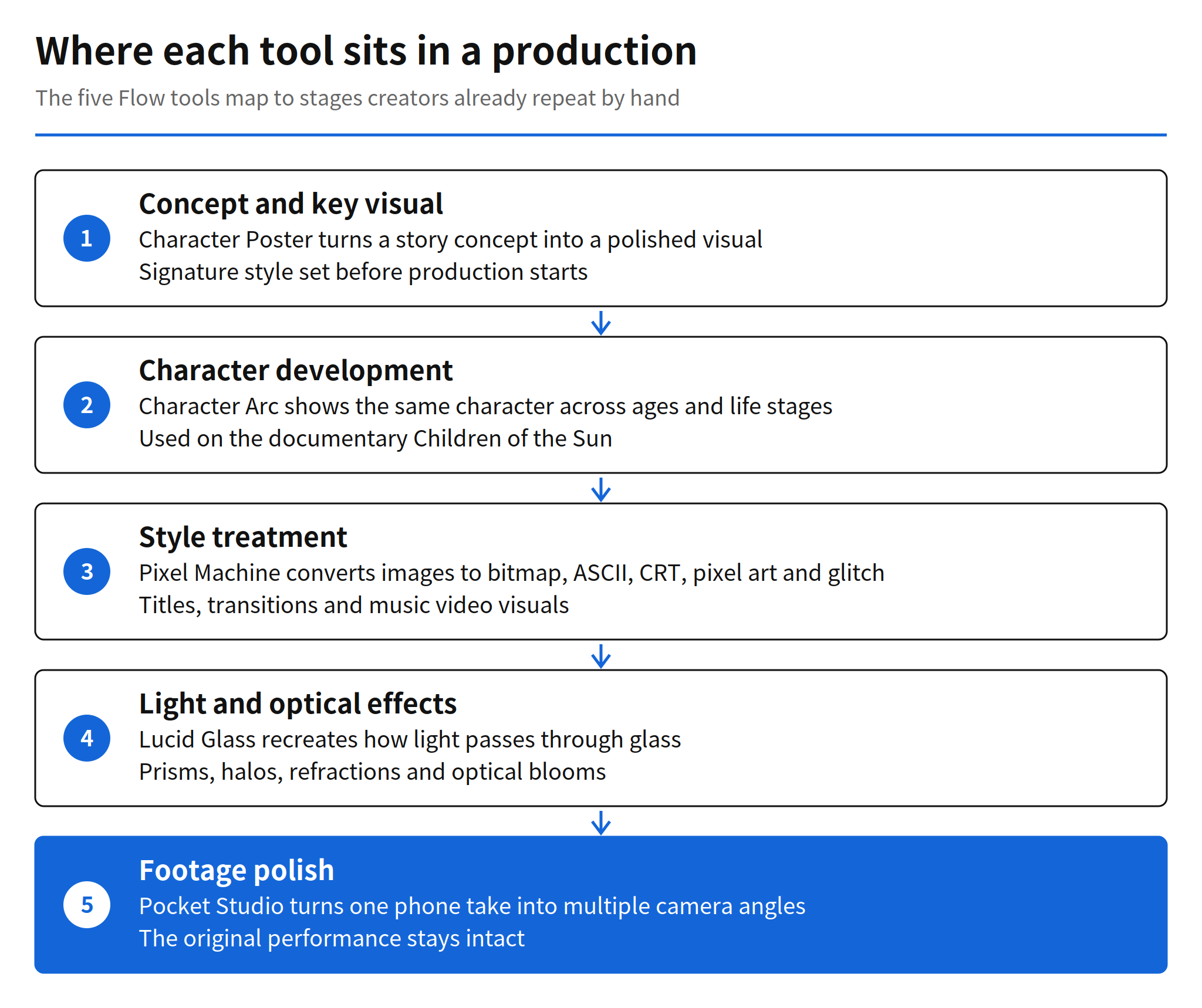
The five tools split cleanly by production stage. Two handle characters, two handle look and light, and one handles footage that was already shot. That spread matters because it shows where Google thinks the friction in AI video work now sits. Generation quality gets the headlines, but the daily cost for a creator is keeping the same character recognizable across scenes, holding one visual style across a social feed, and rescuing footage that was captured once, on a phone, with no second take.
Character tools for consistency across a story
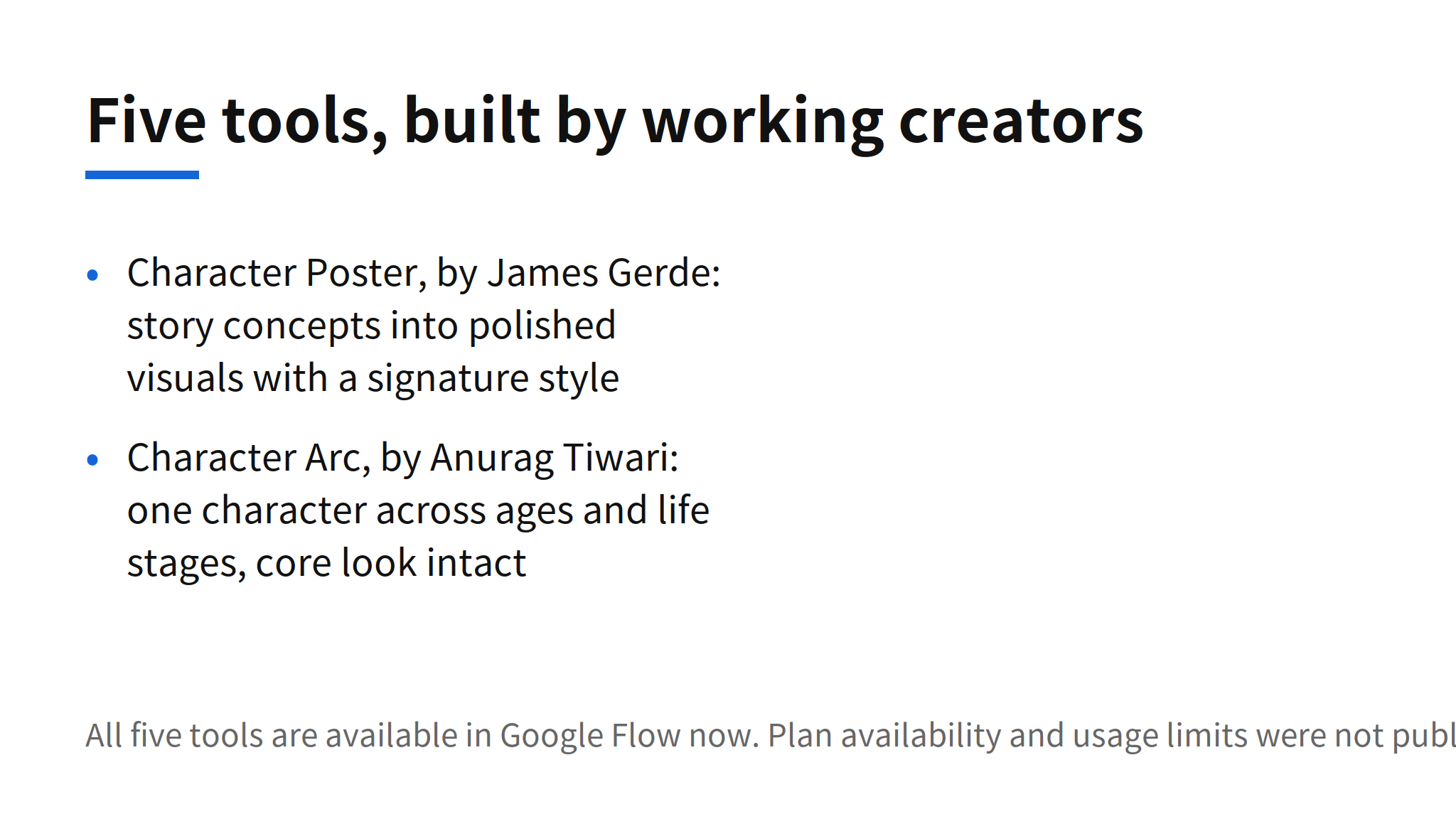
Character Poster, by James Gerde, turns a simple story concept into a polished visual and helps a creator maintain a signature style across social stories. Gerde treats his social feeds as curated galleries where visual consistency is the product, so the tool encodes a publishing discipline as much as a generation feature. For creators who post serially, a recognizable look is what makes separate posts read as one body of work, and doing that by hand means re-prompting and re-selecting until the style drifts back into line.
Character Arc, also by a practitioner, comes from filmmaker Anurag Tiwari. It visualizes the same character across ages and life stages without losing the core appearance, which speeds up character development before full production begins. Tiwari is using it on his documentary Children of the Sun, where the protagonist's life runs from childhood to adulthood and has to connect present-day interviews with events from 1974. That is a concrete stress test: the character has to stay identifiable across decades of story time, in a nonfiction film where the audience knows the real person.
The practical limit is worth stating plainly. A tool that ages a character convincingly in stills or short clips still has to hold up across motion, dialogue and editing, and Google published no measurements of how consistent the output stays over a long sequence. The documentary use case is evidence that a professional trusts it in production, and it is also a single, vendor-presented example.
Style and light tools for a signature look
Pixel Machine, Tiwari's second tool in the set, converts images into bitmap, ASCII, CRT, pixel art and glitch styles. Google positions it for stylized title treatments, transitions and music video visuals. These are deterministic-looking retro effects that creators currently assemble with layered filters and manual tweaks, so packaging them as one tool is about iteration speed: trying five period looks on the same frame becomes a selection task instead of a rebuild task.
Lucid Glass, designed by artist and creative director Ezra Paulekas, recreates how light passes through glass, producing prisms, halos, refractions and optical blooms. Optical effects are a useful test of taste in AI tooling, because a physically plausible refraction is easy to describe and hard to fake with a generic glow filter. A dedicated tool built by a creative director suggests the effect is tuned against real lens and glass behavior, although, again, Google offers the creator's account rather than side-by-side comparisons against conventional VFX work.
Pocket Studio and the phone footage problem
Pocket Studio is the tool most likely to change how footage gets shot. Built by Ryan McCoy, whose background is major film previs and visual effects over more than 20 years, it turns everyday phone video into polished shots and generates multiple camera angles from a single take while keeping the actor's original performance intact. Previs is the discipline of planning shots before committing to them, and Pocket Studio applies that thinking after the fact: the coverage a small crew could not shoot gets synthesized in post.
The implication runs in both directions. For short-form and independent creators, one-take multi-angle output removes the reshoot, which is often the difference between publishing and abandoning a piece. At the same time, generated angles are generated imagery, so continuity of background detail, hands and props across synthesized angles is exactly where artifacts would appear. Google does not quantify angle accuracy or artifact rates, so the honest reading is that Pocket Studio is a promising workflow claim that productions will validate take by take.
What this release signals about AI video tools
Read together, the five tools mark a shift in where AI video products compete. Flow already generates video; this release adds the connective tissue around generation, in the form of tools authored by the people who feel the friction. Character consistency, house style, optical effects and coverage are post-generation problems, and they are the problems that decide whether generated footage becomes a finished piece. Google is also opening the pattern itself, stating that users can build their own tools in Flow, which turns the studio into a small platform for practitioner workflows rather than a fixed feature list.
That platform reading has a caveat. A tool ecosystem is only as durable as its distribution and pricing, and Google published neither the plan availability nor the usage limits for these five tools. Creators deciding whether to rebuild a pipeline around Flow still cannot tell from this announcement what the tools cost at volume or whether they sit behind a specific tier.
Limits and unverified points
Three gaps should stay attached to the announcement. First, pricing and limits are unpublished: the post does not say which plans include the tools or what usage caps apply. Second, quality is unmeasured in public: every description comes from Google and the tool creators, with no independent benchmark of output quality or processing speed. Third, the policy boundary for character tools is unaddressed: the post does not discuss how far Character Arc style consistency tools may be applied to footage of real people, a question that matters for documentary and newsroom use precisely because Tiwari's example is a real person's life.
None of that cancels the release. Five practitioner-built tools, available immediately in a major AI studio, aimed at consistency and post work rather than another model bump, is a clear signal of where the category is heading. The verification work now sits with creators, who will find out quickly whether one-take coverage and decade-spanning characters survive contact with real productions.
Related articles
- Gemini Omni 1.2 Flash GA: 15-Second Video, $0.07 Pricing
- Seedance 2.5 flash Release: 2x Speed, Pricing and Limits
FAQ
What are the five new tools in Google Flow?
The five tools are Character Poster by James Gerde, Character Arc and Pixel Machine by Anurag Tiwari, Lucid Glass by Ezra Paulekas, and Pocket Studio by Ryan McCoy. Google released all five on November 12, 2026, and all were built by working creators.
What does Pocket Studio do with phone footage?
Pocket Studio turns everyday phone footage into polished shots and generates multiple camera angles from a single take while keeping the actor's original performance intact, according to Google.
How is Character Arc being used in a real production?
Filmmaker Anurag Tiwari is using Character Arc in his documentary Children of the Sun, tracking the protagonist's life from childhood to adulthood between present-day interviews and events from 1974.
What did Google not publish about the five Flow tools?
The announcement does not state which subscription plans include the tools or what usage limits apply, and no independent measurements of output quality or processing speed have been published.