Perplexity Decider v1.3 Release: Locate, Pricing and Scores
Perplexity released Decider v1.3 and Decider Flash v1.3 on November 12, 2026. Both models are on Hugging Face under an Apache license, and both are also available through OpenRouter and the Perplexity Decisions API. They do not write text. Given an input and a set of questions, each model returns a probability distribution over the possible answers, and a new feature called locate can also return the exact span of source text that supports an extraction, with start and end character positions.
That narrow job description is the point. Routing, moderation, filtering, reranking and output judging are high volume steps inside agent pipelines, and they rarely need free form generation. A dedicated model that answers many questions about the same input in one forward pass, and returns probabilities a caller can threshold later, removes token by token generation from that layer. Because the weights are open, a team can also move that layer to local or low cost hosting instead of paying a frontier model to act as a classifier.
Decision Model Basics
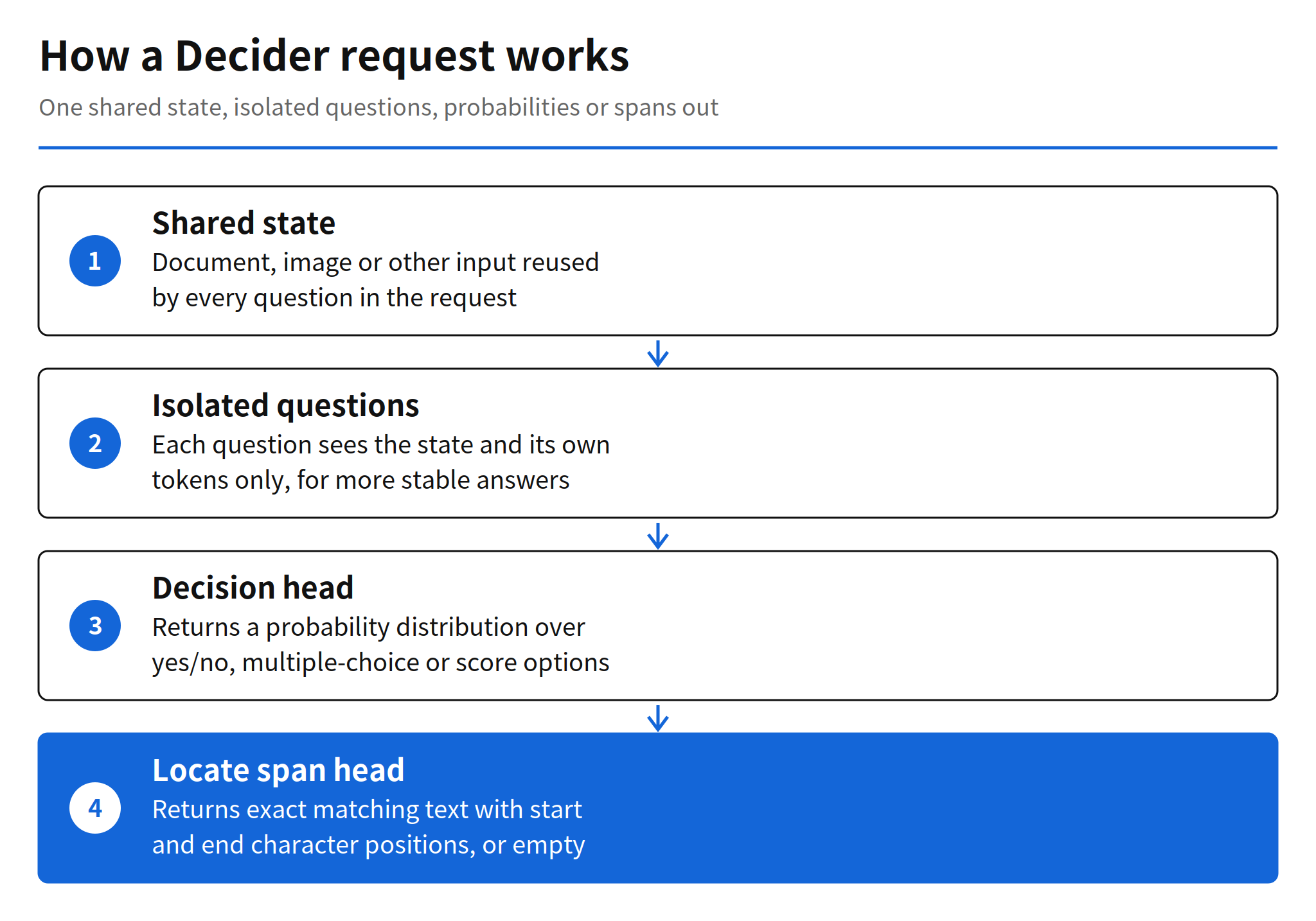
A Decider request has two parts. The state is the shared input, such as a document, a summary, a search result set or an image. The questions sit after the state, and each question carries its own answer options, labeled with predefined tokens such as A, B or C. A special marker token marks the position where the model prediction is read out, and a learned decision head turns the hidden state at that position into scores for the options, which are then converted to probabilities. One request can therefore ask whether a summary is faithful and whether it is written for experts or a general audience, while paying for the state only once.
Three question types cover the surface. Yes or no questions handle binary decisions. Multiple choice questions handle custom multi class labels. Score questions handle ordered levels. Perplexity lists judging outputs for faithfulness, quality and safety, routing requests by difficulty, moderation and security checks, filtering and tagging, and retrieval and reranking as the intended uses. The model family is inspired by Jev, the System One Model from TypeSafe AI, and it sits between a general LLM and a task specific classifier. It keeps the prompt flexibility of the first and the probability output of the second.
Locate Span Extraction
Locate changes the output shape. Instead of choosing from predefined options, a locate question describes what to find, either as a short label such as location or as an instruction such as extracting the city name where a job is located. The model returns the exact matching text from the state, along with its start and end character locations. If it finds no match, it returns an empty list. A single request can mix locate questions with classification and scoring questions about the same input, for example asking whether a job requires senior level experience while also extracting the required skills.
The implementation explains why locate ships as an add on rather than as part of the backbone. Perplexity adds a new locate token, a span head and a LoRA adapter, and trains only those parts while the backbone and the decision head stay frozen. Merging the locate adapters into the backbone caused some regression on ordinary decision requests, and the team states that merging is currently still not lossless. The adapters therefore stay unmerged and activate only for locate requests. That is an honest limitation, and it matters for anyone packaging the model, because locate behavior depends on that separate adapter path being present and enabled.
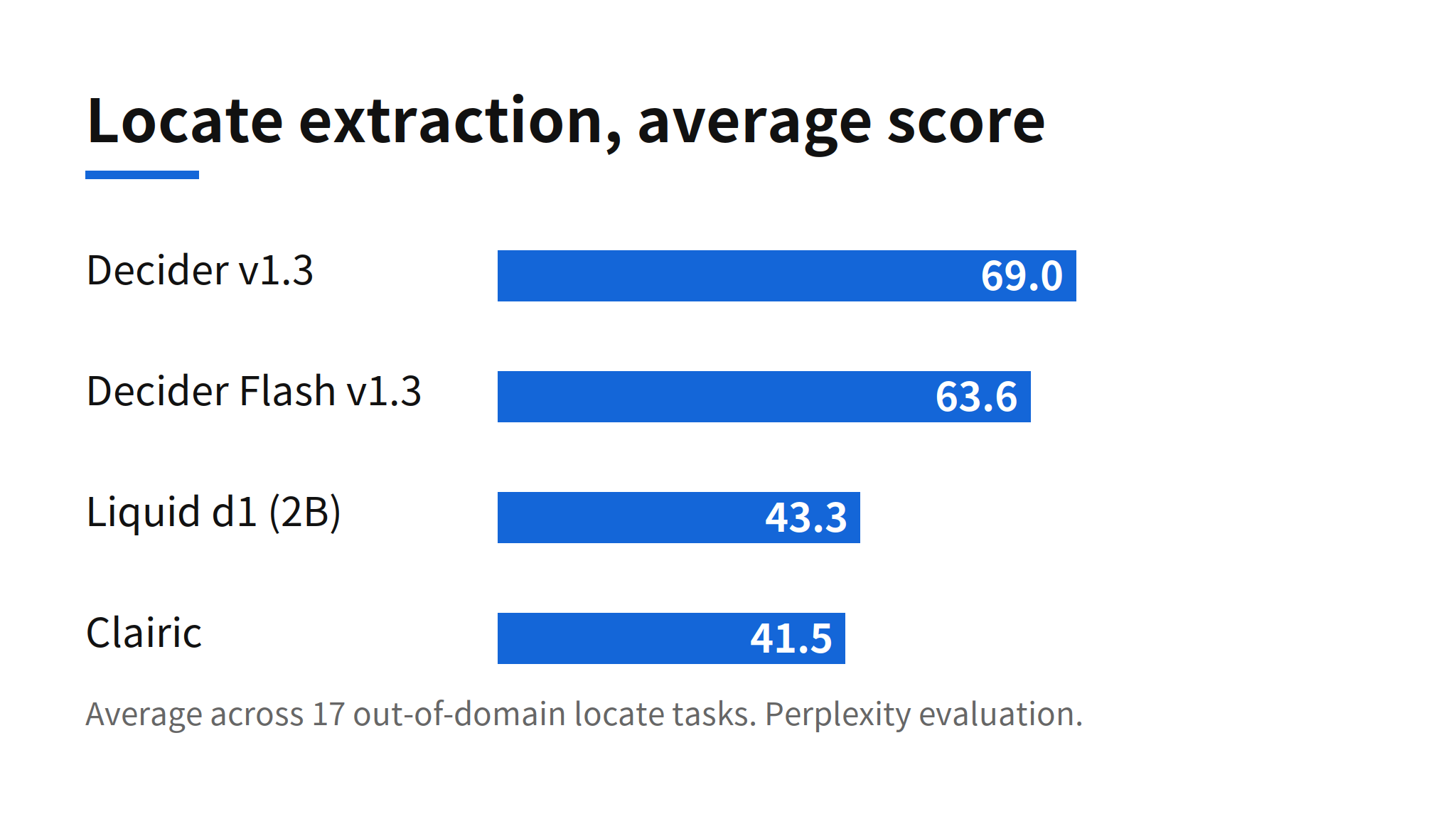
On 17 out of domain locate tasks, covering Wikipedia text, scientific papers, cyber threat reports, support tickets, privacy policies, resumes and legal contracts, Decider v1.3 reached an average score of 69.0 and Flash v1.3 reached 63.6, using each task primary metric. The comparison models scored lower across the board, with Liquid d1 at 43.3, Cloudflare Clairic at 41.5 and GLiNER large v2.5 at 33.6. Named entity recognition and personal information tasks were scored with exact span F1, extractive question answering with character level F1, and structured extraction with field accuracy, so the average mixes metrics by design and should be read as a broad comparison rather than a single uniform score.
Isolated Questions Attention in v1.3
The main architectural change in v1.3 is the attention pattern. The backbones start as generative models with causal attention, and Perplexity reports that making the full attention layers bidirectional improved performance in ablation studies. Bidirectional attention then forces a choice about how the state and the questions interact. In v1.2, everything saw everything, so computation over the state was shared but an answer to one question could change depending on what else was asked. In the fully cacheable pattern, the state sees only itself, which makes it reusable across requests, but Perplexity does not use it by default because letting the state see the questions matters for several tasks.
v1.3 chooses the middle pattern, isolated questions. The state attends to all the questions, while each question attends only to the state and its own tokens. Questions can still influence one another indirectly through the shared state, but results are more stable. The robustness numbers support that choice. On 372 multiple choice questions with reordered options, reassigned labels and renamed labels, Decider v1.3 changed its semantic answer on 0.27% of questions under each transformation, compared with 2.69% to 4.84% for Jev 1.14. On repeated identical inputs, Decider v1.3 showed no changes, while Jev 1.14 changed on 1.88% of questions. For a model whose output feeds routing and filtering rules, that stability is a practical feature, not a cosmetic one.
My read: the isolated questions pattern is the most transferable idea in this release. Any team that batches several judging questions into one LLM call faces the same cross talk problem, where adding a question changes an earlier answer. Structuring attention, or at minimum prompt layout and answer parsing, so that questions cannot directly rewrite each other is worth testing even without adopting Decider itself.
Training Recipe and Model Sizes
The larger model starts from Qwen3.8-27B and the smaller Flash model starts from Qwen3.5-4B. Training runs in three stages for both sizes. The first stage is generalist training, with full fine tuning on large corpora built from hundreds of public datasets converted into the shared state and question format, covering sentiment, natural language inference, intent detection, entity matching, moderation, fact checking and ratings. Benchmark training splits are excluded from this stage. The second stage is a narrower LoRA stage aimed at specific domains and tasks, merged back with a weight so the model does not drift far from the generalist version. The third stage adds vision capability through another LoRA adapter, with text metrics prioritized because Perplexity observes much more text usage.
Flash is then distilled from the larger model. The teacher predicted distribution replaces the gold labels, and the smaller model is trained to minimize KL divergence to that distribution. Perplexity reports that this objective outperformed cross entropy on the same data for held out generalization, even though cross entropy did better on benchmarks with dedicated training data. For both text stages, the final weights average three runs with different random seeds. The team also states that it removes training samples that could overlap with any evaluation it uses, and runs bias audits, which is relevant context for the scores that follow.
Evaluation Scores Across Domains
On query classification, across 63 tasks with references independently relabeled by a frontier LLM, Decider v1.3 reached 91.6% mean accuracy, which Perplexity states is 6.54 percentage points above its production classifiers. Flash v1.3 also beat the production baseline in that comparison. On a domain suite spanning claim verification, healthcare, cybersecurity, programming, government, law and finance, Decider v1.3 led Jev 1.14 in all seven domains, by up to 12.9 percentage points in finance and 9.3 points in law. Flash v1.3 trailed Jev 1.14 in finance, programming and law, and performed similarly in the other domains, which sets a clear boundary for the smaller model.
Retrieval tells a similar story. Across 72 retrieval tasks, in a zero shot pointwise setting over the top 50 candidates from embedding models, Decider v1.3 reached a mean nDCG@10 of 83.99, ahead of Qwen3-Reranker-8B by 1.81 points and Jev 1.14 by 2.24 points. On BEIR, both Decider models beat Qwen3-Reranker-8B, by 8.78 and 7.05 points respectively. On multilingual classification, across 19 tasks in eight languages including Korean, Japanese and Chinese, Decider v1.3 averaged 88.16% and Flash v1.3 averaged 86.50%, against 85.41% for Jev 1.14. On five vision tasks centered on document classification, Decider v1.3 averaged 76.99% accuracy and Flash v1.3 averaged 72.77%.
Real world traffic adds useful scale. Perplexity sampled one million deduplicated, PII masked requests from the first 18 days of the Decisions API, containing 2,318,887 individual questions, with user permission for research. Information extraction, domain classification and sentiment analysis together made up 50.8% of those questions. Against frontier LLM judges, Decider v1.3 reached 93.98% agreement, compared with 93.68% for v1.2 and 93.35% for Jev 1.14. The gaps by category were small and mixed, with Jev ahead on relevance ranking and Decider ahead on information extraction and on intent and routing, so the production sample supports a narrow lead rather than a runaway one.
Access, Pricing and Choosing a Model
Access is straightforward. Both models can be downloaded from Hugging Face under an Apache license, called through OpenRouter, or called through the Perplexity Decisions API. The release post does not state hosted API pricing in its text, and this article does not invent a price. Anyone comparing hosted cost should check OpenRouter and the Decisions API documentation directly, and should also weigh local hosting cost for the open weights, since a 27B backbone and a 4B backbone have very different serving footprints.
Perplexity guidance on choosing is direct. Use Decider v1.3 for nuanced judgments, detailed rubrics and workflows where errors are costly. Use Flash v1.3 for high volume routing, labeling and filtering where latency and cost are the main constraints. In both cases, tune the decision threshold on a small, representative labeled development set from the actual workload, because label frequencies and the relative cost of false positives and false negatives vary by application. A fixed cutoff copied from a benchmark is unlikely to transfer.
Internal use at Perplexity shows the pattern in production. For security rules, Decider reviewed samples from recorded agent logs, checking both missed problems and false alarms, and in one day it read 1 billion tokens across 7,000 agent sessions and identified flaws that led to 14 rule fixes, 6 of which were approved and shipped within two days. For page quality filtering, Decider judges crawl pages in the same forward pass as domain, audience, harmful content and personal information checks, which Perplexity describes as considerably faster and cheaper than an LLM judge. Those are vendor reported outcomes, but they illustrate the intended deployment shape, many cheap decisions wrapped around a smaller number of expensive generative calls.
Limits and Unconfirmed Points
- Scores are Perplexity evaluations: the accuracy, reranking and locate figures in this article come from Perplexity release post. No independent replication is cited, and Perplexity itself notes that public leaderboards can be gamed through repeated submission and tuning.
- No matched comparison with rival decision APIs: there is no same condition, head to head score in the release against the Gemini Decisions API or Kanana-2-v-decide. Those systems are context for the category, not measured rivals in this release.
- Hosted pricing not stated in the release text: the post lists Hugging Face, OpenRouter and the Decisions API as access routes without giving API prices. Cost comparisons need current pricing from those services and a local hosting estimate.
- Locate adapters are unmerged: merging the locate adapters into the backbone currently causes regression on decision requests, so locate depends on a separate adapter that activates only for locate requests.
- Cost chart caveat: the release cost comparison for one million production requests mixes local Decider runs with hosted services, with unspecified local hardware cost accounting and no matched latency comparison, so it should not be read as a controlled price benchmark.
FAQ
What is Perplexity Decider v1.3?
Decider v1.3 is a decision model released by Perplexity on November 12, 2026. It does not write prose. Given an input and a set of questions, it returns a probability distribution over yes or no, multiple choice, or ordered score answers, for classification, routing, ranking and output evaluation.
What does the locate feature do?
Locate returns the exact matching text from the input together with its start and end character positions, and returns an empty list when nothing matches. Perplexity targets named entity recognition, personal information identification and extractive question answering with it.
How can Decider v1.3 be accessed and what does it cost to use the weights?
Both Decider v1.3 and Decider Flash v1.3 are on Hugging Face under an Apache license, and are also available through OpenRouter and the Perplexity Decisions API. The release post does not state API pricing in the text used for this article, so hosted pricing should be checked on those services directly.
How accurate is Decider v1.3?
On 63 classification tasks with references relabeled by a frontier LLM, Decider v1.3 reached 91.6 percent mean accuracy, 6.54 percentage points above Perplexity production classifiers. These are Perplexity evaluations, and no independent replication is cited in the release.
Should a team choose Decider v1.3 or Decider Flash v1.3?
Perplexity recommends Decider v1.3 for nuanced judgments, detailed rubrics and workflows where errors are costly, and Flash v1.3 for high volume routing, labeling and filtering where latency and cost dominate. It advises evaluating both on representative examples from the actual workload.
Related Reading
- Gemini Decisions API: Pricing, Speed and How It Works, the Google decision model covered earlier in this series
- Kakao Kanana-2-v-decide Release: 0.04s Decision Model, the Kakao decision model in the same category