Jensen Huang Resigns: NVIDIA CEO Transition, Kress Interim
Jensen Huang has resigned as President, Chief Executive Officer and board member of NVIDIA, effective immediately. The board announced the transition on November 12, 2026. Colette Kress, the company's Executive Vice President and Chief Financial Officer, agreed to serve as Interim Chief Executive Officer while keeping the CFO role, and the board appointed Harvey C. Jones as its first-ever Chair. A search for a permanent CEO, covering internal and external candidates, is now under way.
The announcement ends a 33-year run. Huang founded NVIDIA in 1993 and led it for its entire life as a public company, from a graphics chip maker into the supplier whose GPUs sit under most large AI training and inference work. The release gives no reason for the resignation, and that gap matters for how the rest of this story should be read: the governance facts above come from NVIDIA itself, while the explanations for why this happened come from press reporting that NVIDIA has not confirmed. Both layers are covered below, kept separate.
The Announcement
The NVIDIA Newsroom release is short and procedural. It states the resignation, the interim appointment, the dual CFO role, the permanent CEO search and the new board chair in a few paragraphs, then closes with the earnings schedule. Kress joined NVIDIA in September 2013 and has run its finance organization since then. Before NVIDIA she spent nearly 25 years in finance roles at technology companies including Cisco and Microsoft. Jones, the new chair, is described as an entrepreneur, technology executive and venture investor of more than 30 years, including service as Chief Executive Officer and Executive Chairman of Synopsys. TechCrunch adds that Jones has sat on NVIDIA's board since 1993, which would make the person running the succession search one of the few people in the building whose tenure matches Huang's.
The quotes in the release do the continuity work. Jones says the board has full confidence in Kress and the leadership team and expects operations, customer commitments and the product roadmap to continue without interruption. Kress says the focus remains on serving customers, partners, developers and shareholders, and on building on the foundation created over the last 33 years. None of that is boilerplate to skip. For a company whose customers plan data center builds quarters ahead, the operative sentence in the whole release is the one about the roadmap continuing, because GPU allocation and delivery timing are inputs to other companies' capital plans, not just to NVIDIA's own.
The Reported Background
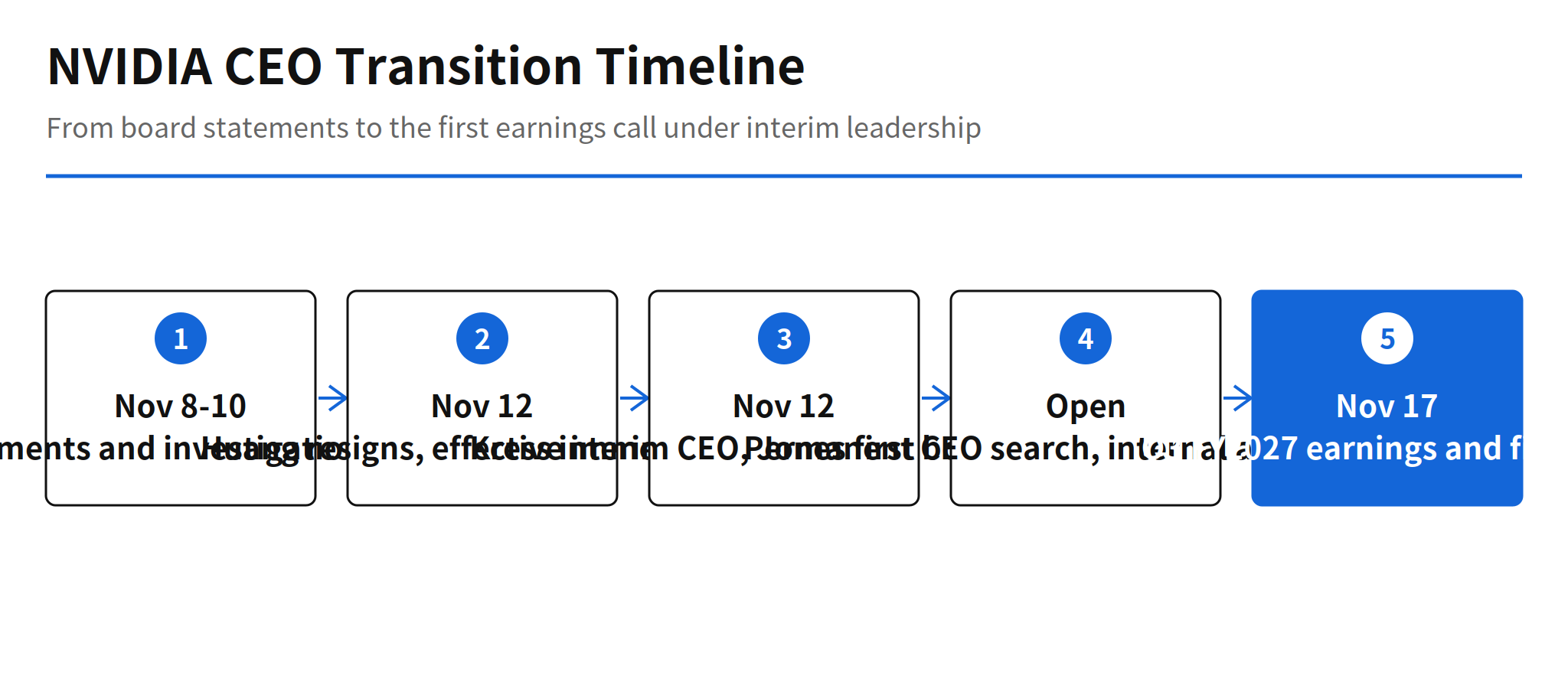
NVIDIA's release does not say why Huang resigned, and the company's newsroom shows the question was already moving before Thursday. The release page links a statement from the independent board members dated November 10 and two further board-related items dated November 8, alongside the November 12 transition announcement. TechCrunch reports that the board accepted the resignation on Wednesday, following days of controversy around Huang, and that a regulatory filing accompanied the decision. TechCrunch and other outlets have reported allegations involving a personal relationship and foreign intelligence concerns, plus a board investigation announced on November 8, as the background to the resignation.
Those allegations are reported here as allegations. They come from media coverage, not from NVIDIA's announcement, and the details differ between outlets and are still developing. Treating them as established fact would go past what the primary source supports. What is established is narrower and still large: the founder resigned with immediate effect, no successor was ready, the CFO is holding both jobs, and the board created a chair position it had never needed before. Whatever the full background turns out to be, the governance structure that ran NVIDIA for 33 years ended in a single announcement.
Market Reaction
Investors priced the uncertainty immediately. TechCrunch reports NVIDIA shares were down nearly 12% in early trading on Thursday, and that the stock had fallen by as much as 19% since Friday, a market capitalization loss of more than $855 billion. The selling spread to the companies closest to NVIDIA's spending. CoreWeave shares fell about 9% on Thursday, Nebius fell about 16%, and IREN fell 6.6%, according to the same report.
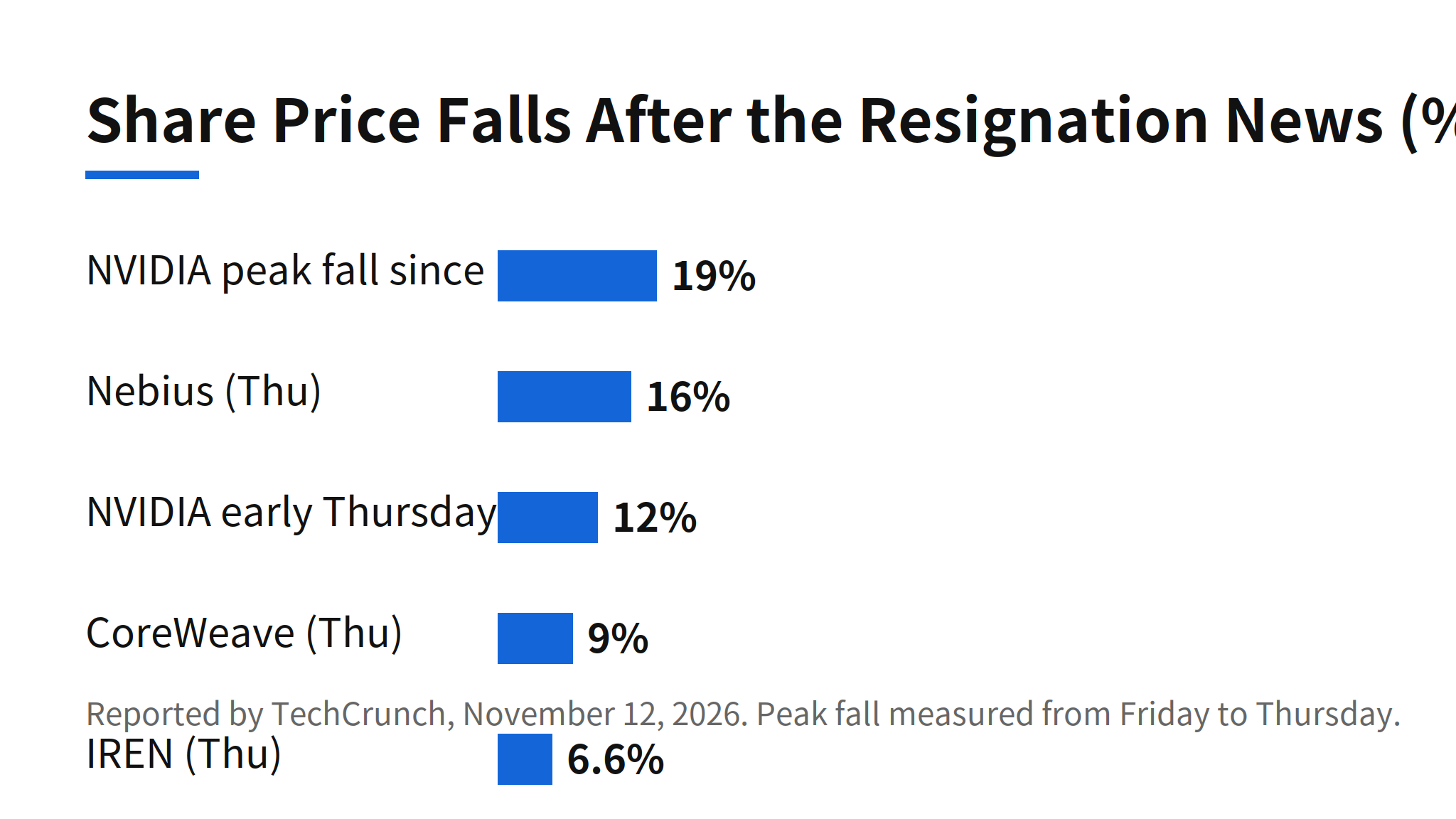
The context makes the size of the move less surprising. TechCrunch notes NVIDIA's revenue had risen to $96.22 billion as of its second quarter, from $5.93 billion in the quarter right before the ChatGPT moment, and that the share price had risen more than 1,450% from about $15 before that launch to an all-time high of $243 last month. A stock carrying that much of the AI buildout's expected future does not get to lose its founder quietly. The 19% peak fall is the market charging for a question it cannot yet answer: how much of NVIDIA's position was the company, and how much was the specific person who ran it with around 60 direct reports and, as TechCrunch puts it, no heir apparent and no succession plan.
What the Interim Team Inherits
The harder problem is not the share price. Under Huang, NVIDIA became a financier of its own market. TechCrunch tallies $99 billion of investments and another $25 billion of commitments as of the end of the second quarter, plus $36 billion in cloud service commitments. The named positions include $2 billion into CoreWeave in January and $2 billion into Nebius in March, $30 billion into OpenAI and $10 billion into Anthropic, $3.5 billion into MediaTek for custom AI chips, and possible credit guarantees of up to $105 billion for an OpenAI data center campus in Ohio. Chinese customers still accounted for about $7.9 billion of second-quarter revenue, roughly 8% of the total, inside a long-running fight over export controls that Huang personally lobbied on.
Every one of those threads ran through the CEO's office. An interim team led by the CFO is well placed to keep the financial machinery moving, and Kress has run that machinery for 13 years. It is a different question whether an interim team signs the next nine-figure commitment, guarantees the next data center, or renegotiates the terms of the buildout while a permanent search is open. The conservative reading is that big new commitments slow until the succession settles, and that slowdown, if it comes, lands on the neoclouds and labs whose financing plans assume NVIDIA keeps writing checks at the recent pace. Their share moves on Thursday suggest investors are already running that scenario.
My read: the resignation itself is a governance event, but its blast radius is a financing event. NVIDIA's product roadmap is executed by thousands of engineers and is the least fragile part of this story. The fragile part is the web of investments, guarantees and cloud commitments that one office approved and championed. Watch the November 17 call for two things: whether Kress speaks about investment pace in the present tense or the future tense, and whether anyone puts a date on the permanent CEO search.
Limits and Unconfirmed Points
- Reason for the resignation: NVIDIA's announcement gives none. Media reporting on the background is attributed above and remains unconfirmed by the company.
- Permanent successor timing: the board says a search has begun and will consider internal and external candidates. No timeline is given.
- Investment and data center commitments: whether the interim team maintains the recent pace of investments, guarantees and cloud commitments is unconfirmed. The November 17 earnings call is the first scheduled checkpoint.
- Huang's stake and role: TechCrunch reports Huang is the largest individual shareholder at about 3.5% of shares, without supervoting rights. The announcement assigns him no continuing role.
FAQ
Who is the interim CEO of NVIDIA?
Colette Kress, NVIDIA's Executive Vice President and Chief Financial Officer since September 2013, agreed to serve as Interim Chief Executive Officer. She keeps the CFO role until a permanent successor is named.
Did NVIDIA say why Jensen Huang resigned?
No. The November 12, 2026 announcement states that Huang resigned as President, Chief Executive Officer and board member, effective immediately, and gives no reason. Explanations circulating in the press are media reporting, not statements confirmed by NVIDIA.
Who chairs the NVIDIA board now?
The board appointed Harvey C. Jones as its first-ever Chair of the Board. Jones previously served as Chief Executive Officer and Executive Chairman of Synopsys, and TechCrunch reports he has been on NVIDIA's board since 1993.
When does NVIDIA report earnings?
NVIDIA reports third-quarter fiscal 2027 results on Tuesday, November 17, 2026, at approximately 1:20 p.m. PT, followed by its earnings call at 2 p.m. PT. It is the first public checkpoint for the interim leadership team.
Related Reading
- NVIDIA GR00T 2 Release: Performance, Data and How It Works, the robotics foundation model line the interim team now owns
- NVIDIA Vera CPU Agent Performance: 1.6x Throughput, the CPU side of the roadmap the board says continues without interruption