Samsung Gemini Glasses Release: Pricing and How It Works
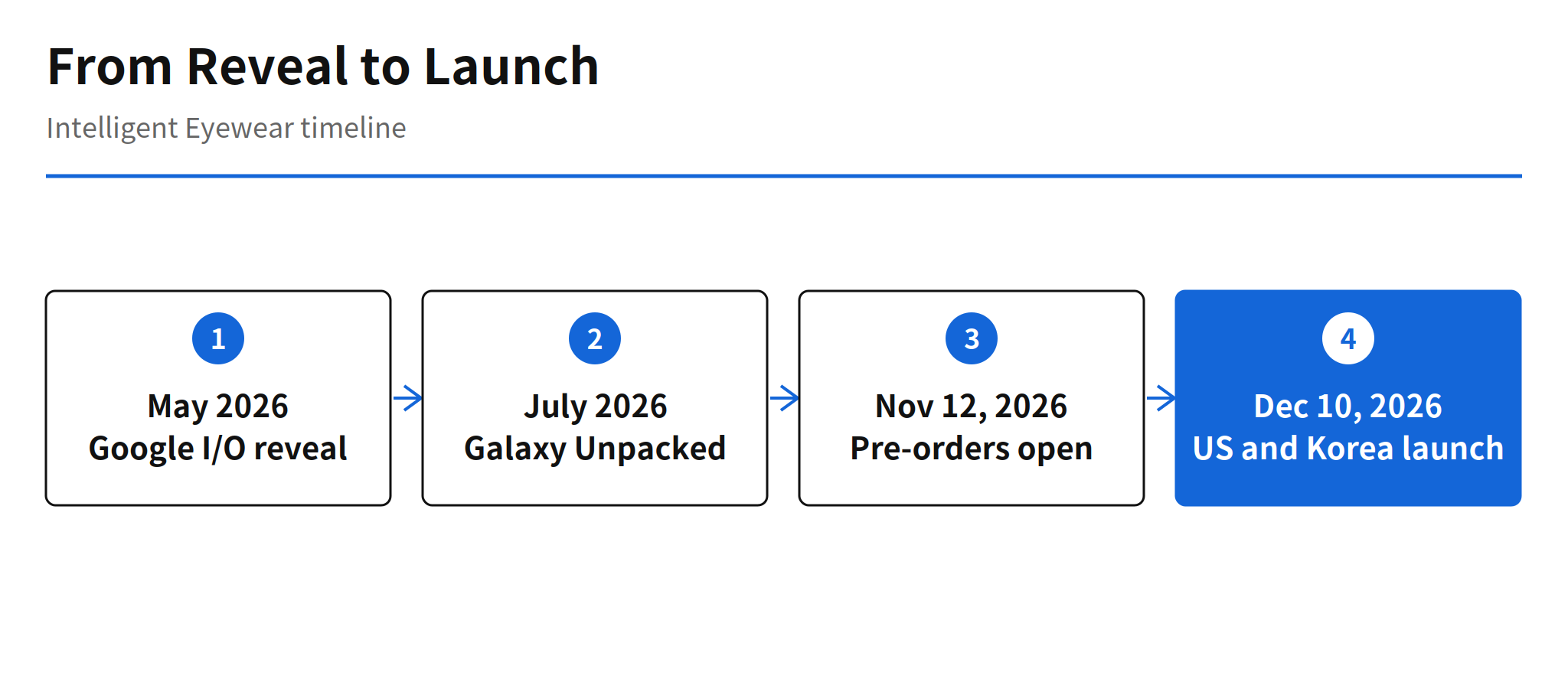
Samsung announced the full Intelligent Eyewear lineup on November 12, 2026, built in collaboration with Google with Gemini built in. Pre-orders started the same day, and the glasses go on sale on December 10 in the United States and South Korea. US pricing starts at $395 for Warby Parker frames and runs from $449 to $489 for Gentle Monster frames. There is no display in the lenses. A 12MP camera sees the surroundings, and Gemini answers by voice through open-ear speakers.
That combination is the point of the product. The glasses shown earlier in 2026 as an Android XR concept are now a consumer product with a price, a date and retail channels, and Korea is in the first launch wave. At the same time, the limits are built into the design: navigation and translation arrive as audio only, the phone does a share of the computing, and only specific Galaxy, Pixel and iPhone models are supported at launch.
Designs and Pricing
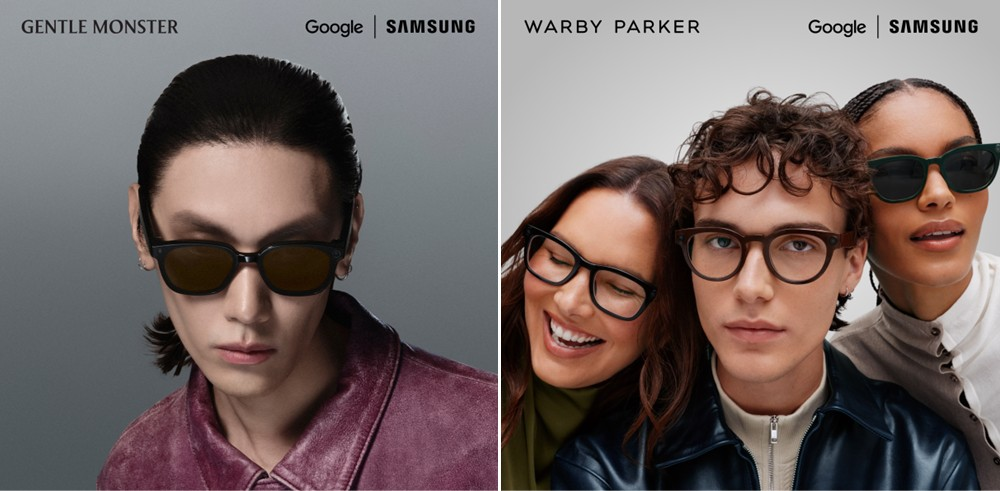
The lineup covers 30 designs across two eyewear brands. Gentle Monster contributes 16 variations based on six frame designs, in bold colors including dark red, pink, gray and yellow, with tinted, clear, blue or brown lenses. Warby Parker contributes 14 variations based on three frame designs, Alden, Reid and Wren, in Pine, Saddle and Jet Black, in optical and sun versions. Google notes that prescription options are available for most frames, which matters for a product people are expected to wear all day rather than carry as a gadget.
Both collections launch in the United States. The Gentle Monster collection also launches in Korea, sold through the Gentle Monster official online store, while Warby Parker sells through its own retail and online channels, with guided demos at more than 360 stores. Hands-on demonstrations are also planned at select Samsung retail locations from December 10. Samsung lists the weight as around 41 grams, with a model range of 39.6 to 43.9 grams for Gentle Monster and 40.4 to 42.6 grams for Warby Parker, measured with standard lenses and without prescription lenses.
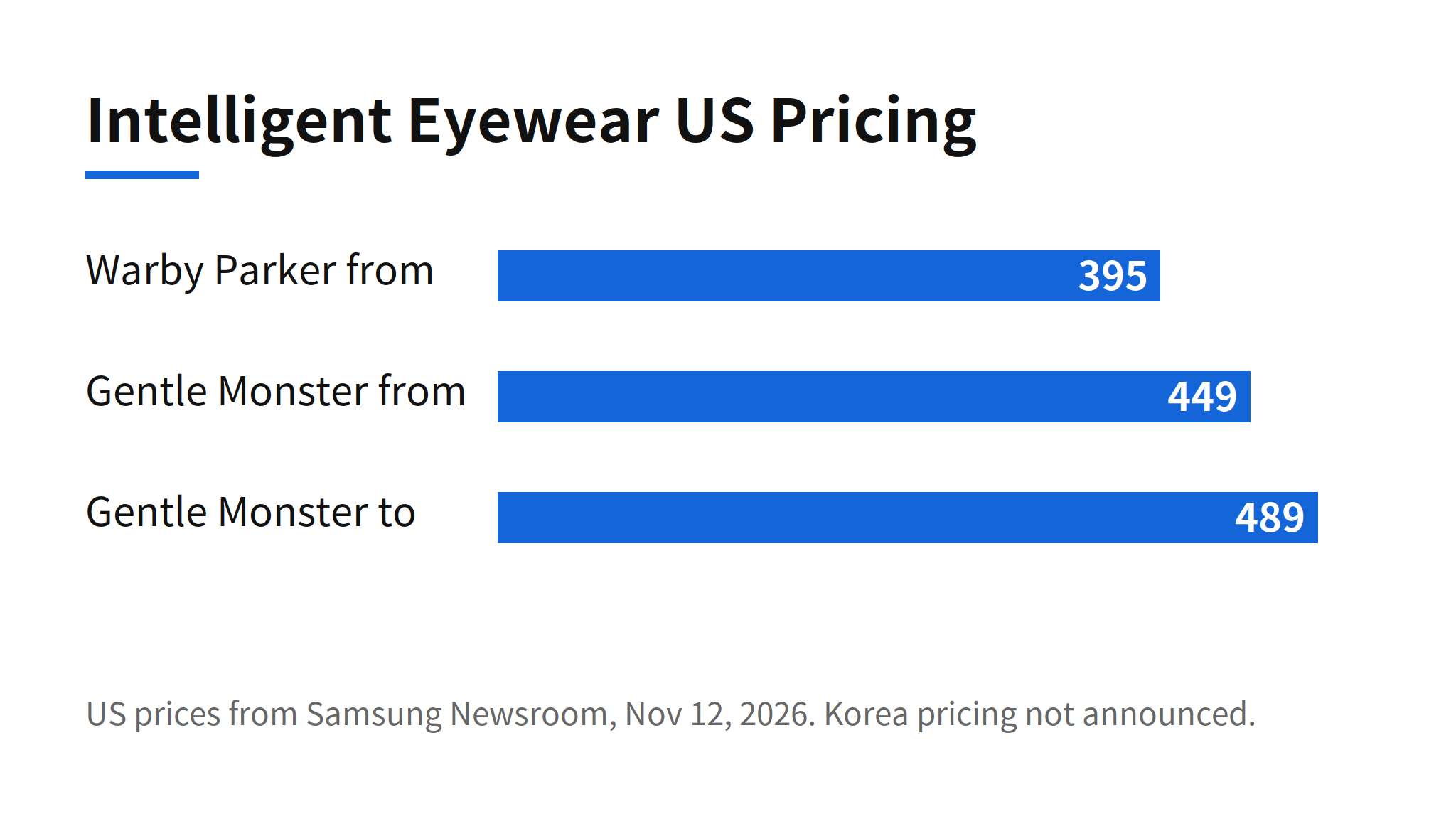
The pricing puts the product in premium eyewear territory rather than developer hardware territory. A buyer at $395 to $489 is comparing these frames with ordinary designer glasses plus a separate AI device budget, not with a headset. That framing also raises the bar for the everyday case: the glasses have to be comfortable and ordinary looking enough to wear before the AI features earn their place.
Hardware and How It Works
The hardware list is phone-like in miniature. The processor is the Snapdragon AR1 Gen 1 Platform. The camera is 12MP HDR, taking photos at 3,024 by 4,032 in a 3:4 portrait ratio and video at 3K 30fps or 2K, with HDR supported up to 2K. Audio comes from two open-ear speakers and a four-microphone array. Memory is 2GB and storage is 64GB, before preloaded software. Connectivity is Wi-Fi 6E and Bluetooth 5.4, and water and dust resistance is rated IPX4 for the glasses only.
Battery life is rated at up to nine hours on a single charge in a mixed-use scenario that can include Gemini conversations, music, video capture and notifications, and up to 72 hours with a fully charged charging case. Google describes the case as able to recharge the frames up to seven times. Case weight differs by collection, at 194.5 grams for Gentle Monster and 166.8 grams for Warby Parker. Samsung is explicit that a split-computing system offloads part of the processing to the connected phone, which is how a 41-gram frame can run a camera, radios and an assistant without carrying a phone-sized battery. The trade-off is that the phone is not an accessory to this product. It is part of the computer.
Gemini Features in Daily Use
Activation starts with Hey Gemini, which Google says these glasses support for the first time, or a tap on the frames. From there the examples from Samsung and Google cluster into a few jobs. Users can ask about what they see, such as a landmark or an object, and continue with follow-up questions. They can photograph a whiteboard in a meeting, ask Gemini to summarize the takeaways and save the result into Samsung Notes. Google Maps delivers turn-by-turn directions into the ear, and Google Translate delivers real-time speech translation with automatic language detection across more than 70 languages.
The background work may matter as much as the questions. The glasses can prioritize, group and summarize notifications by context, read important updates aloud and take voice replies, calls and messages while the wearer's hands are occupied. Google adds two accessibility-facing pieces. Guided Vision offers conversational audio descriptions for people who are blind or have low vision, or for anyone reading small print or looking for an everyday item. Through a collaboration with Aira, users can say Hey Gemini, open Aira Explorer and stream the camera feed to a trained human visual interpreter. Music playback covers services such as YouTube Music, Spotify and Apple Music, and Audible audiobooks, according to Google.
My read: the strongest case for these glasses is not photography. It is the short, spoken interaction that currently forces a phone out of a pocket: a translation, a direction, a notification triage, a question about the thing in front of you. The weakest case is anything that needs confirmation on a screen. With no display, the user cannot glance at a translated menu or a route, so the product lives or dies on whether voice answers are accurate enough to trust without seeing them.
Privacy Design for Wearers and Bystanders
Both companies put unusual weight on privacy mechanics, and the specifics are more concrete than the usual assurances. A recording LED shows when the camera captures images or video, the wearer gets an inner light and a sound at the same time, and Samsung says built-in safeguards are designed to disable camera capture if the external LED is covered or not working properly. When the wearer asks Gemini about what they are looking at, bystanders' faces are automatically redacted before Gemini responds. In Gemini Live conversations, surrounding sounds including other people's voices are filtered to protect bystander privacy.
On the data side, Google states that camera visuals from Gemini on glasses are not saved to Gemini History and are not used for AI model training or ad targeting. Users keep control over app-specific permissions and their Gemini activity. The product is designed for users aged 18 and over, with age verification required for device activation and app downloads. These are launch claims from Samsung and Google, not independent audit results, and they should be read that way. Still, the LED interlock is a design decision with a clear test: cover the light and the camera should stop. Reviewers will be able to check that claim on day one.
Compatibility and Limits
- Phone compatibility: Galaxy S, Galaxy S FE and Galaxy Z Fold, Flip and Fold Ultra models running One UI 9.0 or higher; Pixel 7 series and later running the Android 17 September 2026 update or later; and iPhone 13 and later with at least 6GB RAM running iOS 26.6 or later. Other Android phones are not supported at launch.
- Assistant split: Gemini is built in across supported phones. Bixby is available only when the glasses are connected to a Galaxy phone.
- No display: directions, translations and answers are audio only. There is no visual confirmation in the lenses, unlike display-based Android XR glasses such as the XREAL AURA covered in the related issue.
- Korea pricing: Samsung's global announcement lists US prices only. Korean pricing for the Gentle Monster collection has not been announced.
- First-wave availability: pre-order quantities, including the first Gentle Monster wave in Korea, are unconfirmed. General availability starts December 10 in the United States and, for Gentle Monster, in Korea.
FAQ
How much do the Samsung and Google Intelligent Eyewear cost?
In the United States, Warby Parker Intelligent Eyewear starts at $395 and Gentle Monster Intelligent Eyewear ranges from $449 to $489 depending on the model. Samsung has not announced pricing for Korea.
When do the Intelligent Eyewear launch and where?
The glasses launch on December 10, 2026, with pre-orders starting November 12. Both collections launch in the United States, and the Gentle Monster collection also launches in South Korea.
Which phones work with the Intelligent Eyewear?
Compatible phones are Galaxy models running One UI 9.0 or higher, Pixel 7 series and later running the Android 17 September 2026 update or later, and iPhone 13 and later running iOS 26.6 or later. Bixby is available only with Galaxy phones.
Do the glasses have a display?
No. There is no display in the lenses. Answers, directions and translations are delivered by voice through open-ear speakers, using a 12MP camera and a four-microphone array for input.
Related Reading
- Gemini Intelligence on Pixel 10: Rambler and Automation, the phone-side Gemini features the glasses draw on
- Google TPU 8tx and 8i Max Release: Confidential, Big Context, the infrastructure side of the same Gemini platform
Sources
- Samsung Announces December Release for Intelligent Eyewear, Samsung Global Newsroom (November 12, 2026)
- See our intelligent eyewear lineup and pre-order your pair, Google Blog (November 12, 2026)
- Android Police coverage of the pre-order launch (November 12, 2026)
- Original issue: ax-trend issue #3952