AWS Emulator Release: Local Testing, Pricing and Limits
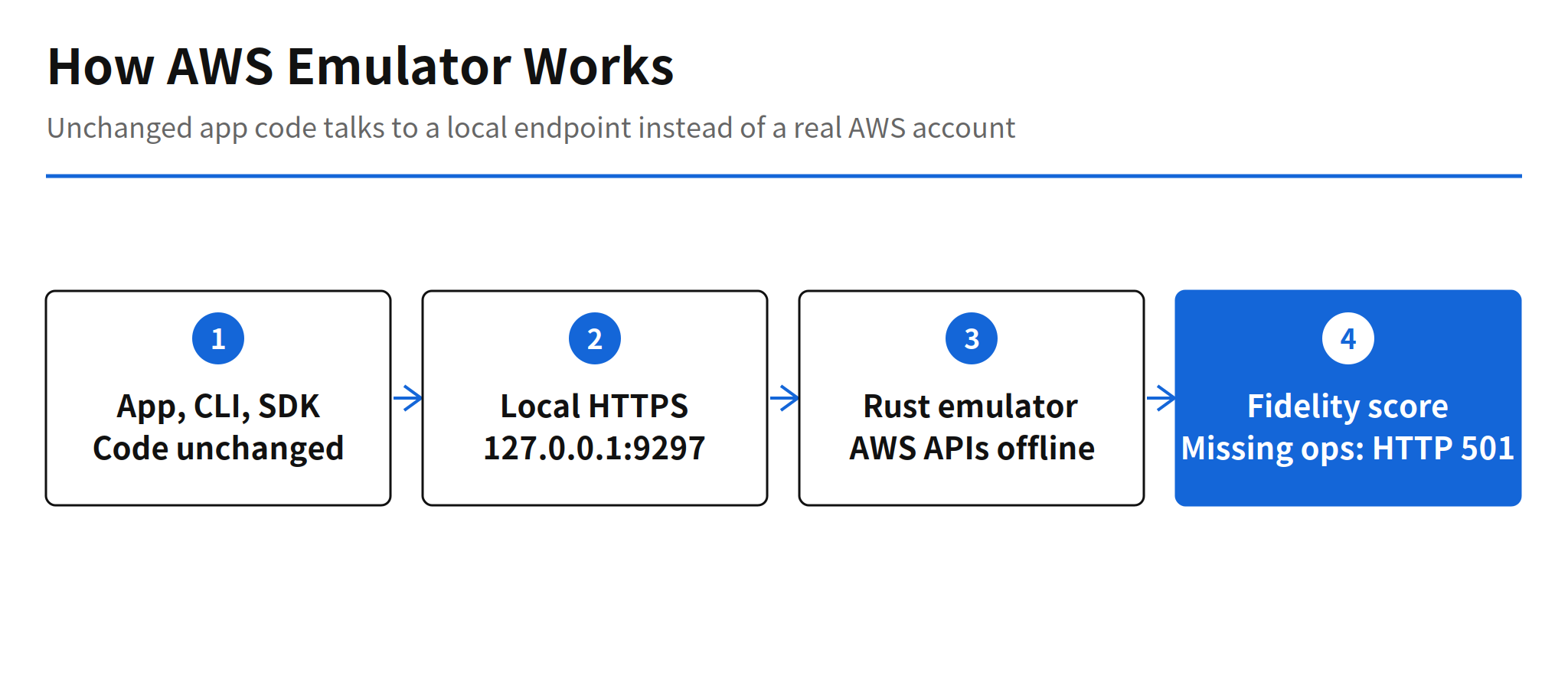
AWS released AWS Emulator on November 11, 2026. It is a local emulator that runs on a developer machine and answers the same AWS APIs as the cloud, and AWS charges no additional service fee for it. The AWS CLI, the AWS SDKs and coding agents connect to a local HTTPS endpoint at 127.0.0.1:9297, and application code does not change.
The second half of the announcement is the part that will be quoted for years. Amazon says autonomous AI agents wrote all of the code, and that the team neither wrote nor reviewed code directly. That claim, the published fidelity scores and the stated limits matter as much as the tool itself, because they define how far a local pass can be trusted.
Local Endpoint and Installation
The emulator is written in Rust. Linux users install it from RPM and Debian packages, while macOS and Windows users run it through Docker. The source is public on GitHub under the CC0 license. The repository, aws/aws-emulator, was created on September 11, 2026, and had 1,630 stars at the time of observation.
Local AWS emulation has been third party territory for years, with tools such as LocalStack filling the gap. AWS shipping its own emulator is unusual on its own. An official emulator also changes the reference point for correctness: behavior questions now have a first party answer, and the fidelity scores described below are published by the same organization that runs the real services.
A Codebase Written Entirely by Agents
The project started as a weekend experiment. Senior engineer Matthew Goldberg asked Kiro to write tests and implementation, and a first version of Amazon SQS appeared in 15 minutes. The experiment expanded to the rest of AWS over that weekend and grew into the product. According to About Amazon, thousands of agents wrote tests, found issues and fixed code during the build.
The agents worked in three teams. One team created tests. A second team compared responses against real AWS, found the places where the emulator diverged, and filed those gaps as issues. A third team took one issue at a time and fixed it. The fidelity test suite now runs to tens of thousands of tests, which is the mechanism that makes the no human review claim even arguable: the verification harness, not a reviewer, is what the release process leans on.
The statement that no human wrote or reviewed the code is Amazon's own account. No independent audit result has been published, so the claim should be read as a vendor statement about its process, not as a verified fact about every line in the repository.
Fidelity Scores and the HTTP 501 Rule
AWS publishes a fidelity score for each service with every release, in k/n form. That format is more useful than a single coverage percentage, because a team can check the exact services it depends on before trusting local results. Fidelity also varies widely by service, so a strong score on one service says nothing about another.
Operations that are not implemented yet return HTTP 501. The effect is deliberate: a test fails at once instead of passing against a stub that pretends to work. For teams evaluating the emulator, that failure mode is the right default, since a silent partial behavior would produce local passes that collapse on the real cloud.
Limits That Change What a Pass Means
AWS states the largest limit directly. The emulator does not evaluate IAM policies and resource based policies the way real AWS does, so a request that real AWS would deny can succeed locally. Permission bugs are exactly the class of bug that local testing would be convenient for, and they remain outside what this tool verifies.
One emulator instance also imitates one account only. Cross account and cross region behavior is not reproduced. Combined with the uneven fidelity scores, the practical rule is narrow: a local pass is evidence inside the published score range for the services used, and it is not a guarantee that the same test passes on real AWS.
Why a Local Endpoint Matters for Coding Agents
Giving a coding agent a real AWS account comes with cost and permission risk attached to every loop. A local endpoint that runs offline removes both. An agent can create resources, check results and repeat the cycle any number of times without a bill and without credentials that reach production. That is a practical change to agent workflows, separate from the novelty of how the emulator itself was built.
The precedent is the other half of the story. AWS has now shipped a formal product that, by its own account, agents wrote without direct human code review. Whether other vendors follow depends on the part of this release that is easiest to copy and hardest to fake: a public fidelity score, a test suite in the tens of thousands, and a hard failure for anything unimplemented.
FAQ
What is AWS Emulator?
AWS Emulator is a local emulator released by AWS on November 11, 2026. The AWS CLI, AWS SDKs and coding agents connect to a local HTTPS endpoint at 127.0.0.1:9297 and use the same AWS APIs as the cloud, with no changes to application code and no additional service charge.
How is AWS Emulator installed?
The emulator is written in Rust. On Linux it installs from RPM and Debian packages, and on macOS and Windows it runs through Docker. The source code is published on GitHub under the CC0 license.
Who wrote the AWS Emulator code?
Amazon says autonomous AI agents wrote all of the code. Thousands of agents wrote tests, filed issues where responses diverged from real AWS, and fixed those issues, and the team did not write or review code directly. No independent audit of that claim has been published.
What happens when an operation is not implemented?
An operation that is not implemented yet returns HTTP 501, so a test fails immediately instead of passing against a partial behavior. AWS publishes a fidelity score for each service with every release in k/n form.
What are the main limits of AWS Emulator?
The emulator does not evaluate IAM policies or resource based policies the way real AWS does, so a request that AWS would deny can succeed locally. One emulator instance imitates one account only, and cross account and cross region behavior is not reproduced.
Related Reading
- Runpod for Agents Release: MCP, 35 Skills, Pricing and Setup
- browser-use 1.0 Release: CDP Direct, 80% Code Deleted