ERNIE 5.5 Flash Preview: Release, Pricing and Game Demo
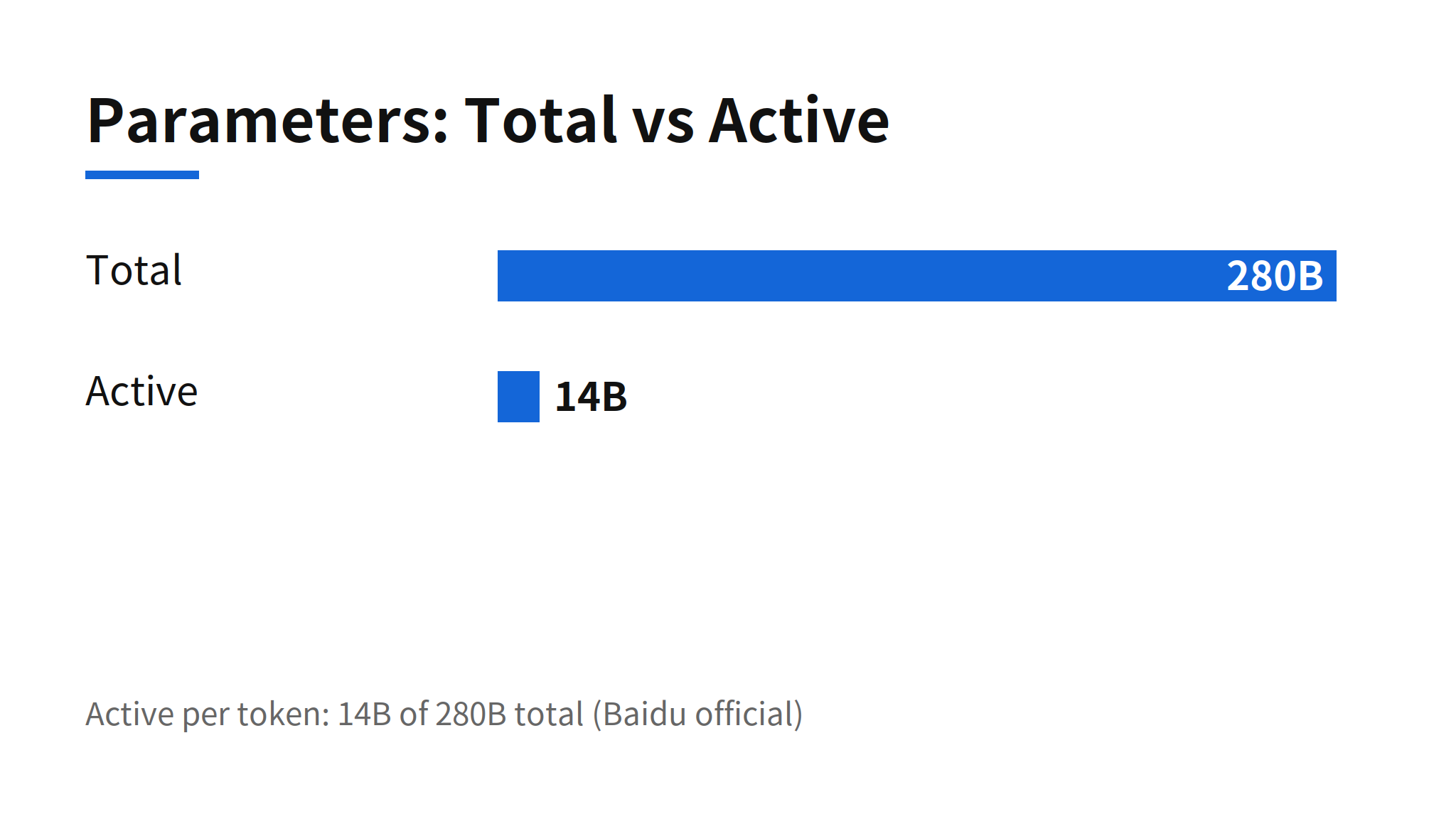
Baidu released ERNIE 5.5 Flash Preview on November 11, 2026, the first post-trained version of the ERNIE 5.5 Flash Base checkpoint. The model carries 280B total parameters with 14B active per token and a 1M token context, and it is available now through the Qianfan platform API. Reported pricing on OpenRouter is $0.28 for input and $1.13 for output per million tokens, and the weights are expected under Apache 2.0 before November 25.
The strongest evidence in the release is a workload, not a chart. In a single 11-hour coding run, the model wrote a complete third-person wuxia game, Yunxiu Xing, in C++ for Unreal Engine 5.8. That claim is specific enough to test, and it frames the release correctly: this is a preview of a post-training program aimed at long coding, 3D and knowledge tasks, with Baidu itself warning that post-training is not finished and some abilities may still be incomplete.
Release and Access
The Base checkpoint arrived first, on November 5, as weights only. Without instruction tuning or alignment, a pretrained base is hard to use directly for real work. Preview adds the first round of post-training on top of that checkpoint, which is why Baidu opened it through an API before calling it finished. The sequence matters for expectations: teams are being invited to evaluate an intermediate checkpoint, and the scores and behaviour can still move before a final release.
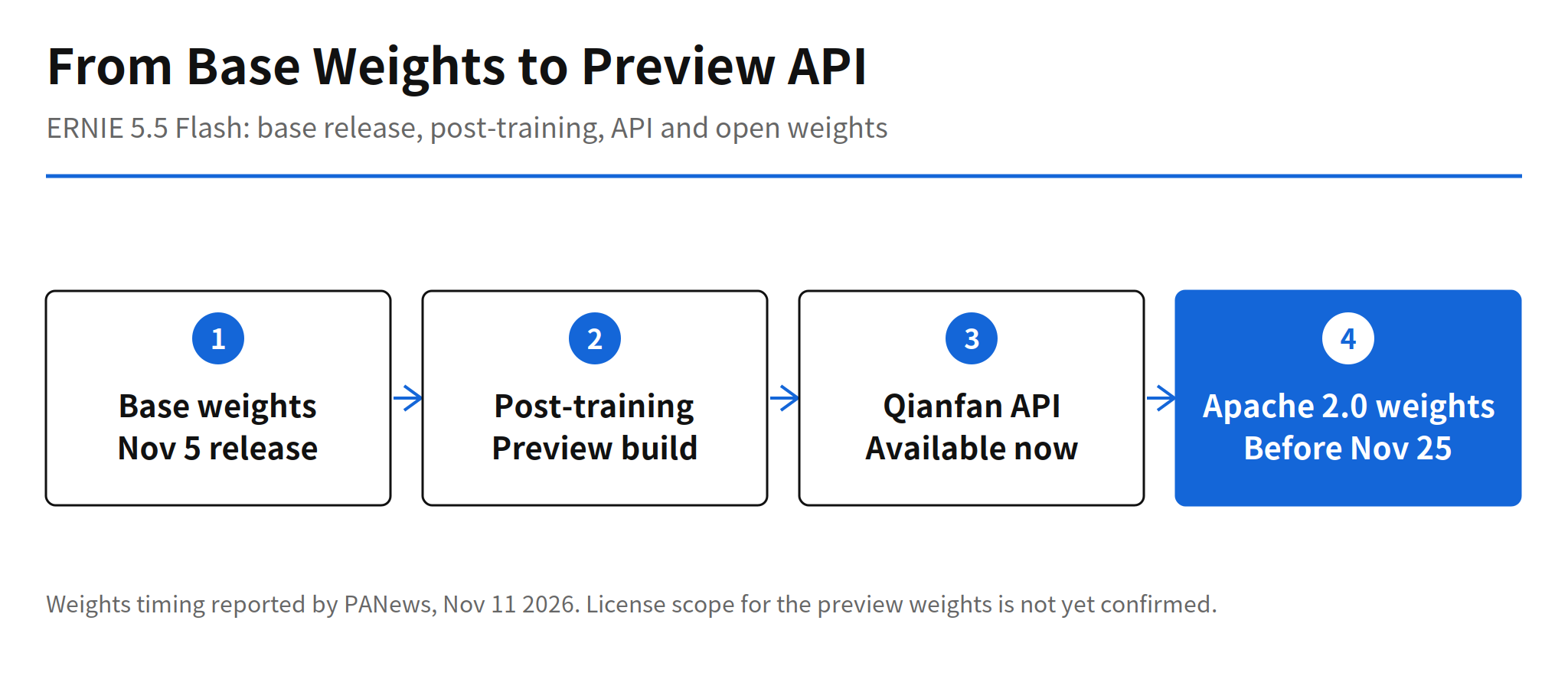
Access today runs through Qianfan, Baidu own platform. The weights path is the open question. Reporting puts the Apache 2.0 weight release before November 25, but the Base weights shipped under a custom Baidu license that excluded some regions, including South Korea. Whether the Apache 2.0 terms for the Preview weights remove that exclusion has not been confirmed, and anyone planning a download based product should wait for the actual license text rather than the headline.
The pricing signal is equally provisional. The $0.28 and $1.13 figures come from reporting on the OpenRouter listing, and a free variant, listed as :free, was also observed in the OpenRouter model list during this research run. Why a free variant exists and when the final pricing structure will be fixed are not established in public material. For cost planning, the useful point is the order of magnitude: at these reported rates, a long agent run that revises its own output many times stays cheap enough to leave running, which is exactly the usage pattern the demos are built around.
Game and 3D Work in Single Runs
The Yunxiu Xing demo deserves attention for its constraint, not only its duration. The model is text only and cannot see the screen, so it cannot look at the game and spot a visual bug. Instead, it converted playtest feedback, such as a character floating in the air, into code tests, then revised the code and repeated the loop. That is a practical pattern for any team using a text model on visual software: the feedback channel has to be translated into checks the model can run, and the quality of that translation decides how far the loop gets.
Mobile work followed the same pattern at smaller scale. Starting from design documents alone, the model produced close to 100 mobile mini-games across Cocos, Unity, LayaAir, PixiJS and Canvas 2D, with 24 of them shown in video. Volume here is not proof of quality, and none of these outputs has independent review in the release material. The narrower, defensible reading is that the model can hold a design document, a target engine and a build loop together across many small projects without a human rewriting the scaffold each time.
In 3D work, two agents divided an airport and a passenger aircraft between them using the Blender Python API, including finding and downloading map vector data on their own. A separate AI film blocking scene contained about 2,100 objects and 1.82 million triangles and served as a composition guide for Seedance 2.5. Blocking is a good fit for a language model because the deliverable is structured placement rather than final rendering, and errors are visible and correctable in the next pass.
Knowledge and Video Workloads
The knowledge work training environment behind the release is large: 300,000 workspaces, 10 million reference files and more than 40 file formats. The examples Baidu chose are document shaped. One is a 20-page report on AI data centre power costs. Another is a 24-page autonomous driving report built from an analysis of 4,169 federal crash reports. These are tasks where the bottleneck is reading volume and structure, not a single hard insight, and where a 1M token context and a low per-token price change what one run can attempt.
Video work points the same way. Baidu says more than 150,000 video production environments were built and the finished video totals about 5,300 minutes. The pelican test video was a 116-second 2D animation made with more than 10,000 lines of Python code, across 20 visual styles. Code generated animation is verifiable in a way prompt generated video is not: the code can be rerun, inspected and patched, so a model that writes code well gets a second path into video production.
Benchmark Claims and Open Questions
Benchmark results on the official page appear only as image tables, which limits checking. The figure most often relayed by reporting is Terminal-Bench 4.0 at 46.5, described as a Baidu self-evaluation, with no external verification yet. Treating that number as a ranking would be a mistake. Treating it as a reason to run your own terminal and coding tasks against the Qianfan API is reasonable, because the API is live and the test costs little at the reported prices.
Baidu states on the official page that post-training is unfinished and some abilities may be lacking. Combined with vendor only benchmarks, an unconfirmed license scope and unsettled pricing, the correct first use is evaluation on your own workload, not migration of a production workload.
Three questions stay open after this release. The license question is first: whether Apache 2.0 for the Preview weights removes the regional exclusion seen in the Base license. The pricing question is second: why a free variant is listed and when the paid structure is fixed. The capability question is third and can only be answered by remeasurement, since every number in the release, from the game build to the benchmark tables, is presented by Baidu itself.
Why ERNIE 5.5 Flash Preview Matters
A model that activates 14B parameters per token while drawing on a 280B pool changes the cost shape of long agent work. Combined with a 1M token context and low reported token prices, it makes a specific workflow plausible: hand a cheap model a large, revision heavy job, such as a game build, a 3D blocking pass or a report over thousands of source files, and let it iterate for hours. The preview status cuts both ways. The same release that demonstrates that workflow also warns that it is unfinished, so the teams that benefit first will be the ones that measure it on their own tasks now and revisit the decision when the weights and license land.
FAQ
What is ERNIE 5.5 Flash Preview?
ERNIE 5.5 Flash Preview is the first post-trained version of Baidu ERNIE 5.5 Flash Base, released on November 11, 2026. It has 280B total parameters with 14B active per token and a 1M token context, and Baidu positions it for coding, 3D modeling, knowledge work and content creation.
How much does ERNIE 5.5 Flash Preview cost?
Reported pricing on OpenRouter is $0.28 for input and $1.13 for output per million tokens. A free variant was also observed in the OpenRouter model list, and the final pricing structure has not been confirmed in public material.
What did ERNIE 5.5 Flash Preview build in the game demo?
In a single 11-hour coding run, the model wrote a third-person wuxia game called Yunxiu Xing in C++ for Unreal Engine 5.8. As a text-only model with no screen access, it converted playtest feedback such as a character floating in the air into code tests and revised the code in repeated loops.
When will the ERNIE 5.5 Flash Preview weights be released?
The weights are expected under Apache 2.0, reported as arriving before November 25, 2026. Whether that license removes the regional exclusion that applied to the Base weights, which excluded South Korea, has not been confirmed.
What are the known limits of ERNIE 5.5 Flash Preview?
Baidu states that post-training is not finished and some abilities may be incomplete. Benchmark results appear only as image tables on the official page, the reported Terminal-Bench 4.0 score of 46.5 is a Baidu self-evaluation relayed by reporting, and no external verification exists yet.
Related Reading
- Baidu ERNIE-5.5-Flash-Base: 280B Release, License Limits (the Base checkpoint this Preview post-trains)
- BotPsy 0.8B Release: On-Device Agent Scores and Limits