NVIDIA Invests in Four Korean Startups: Point2, Upstage
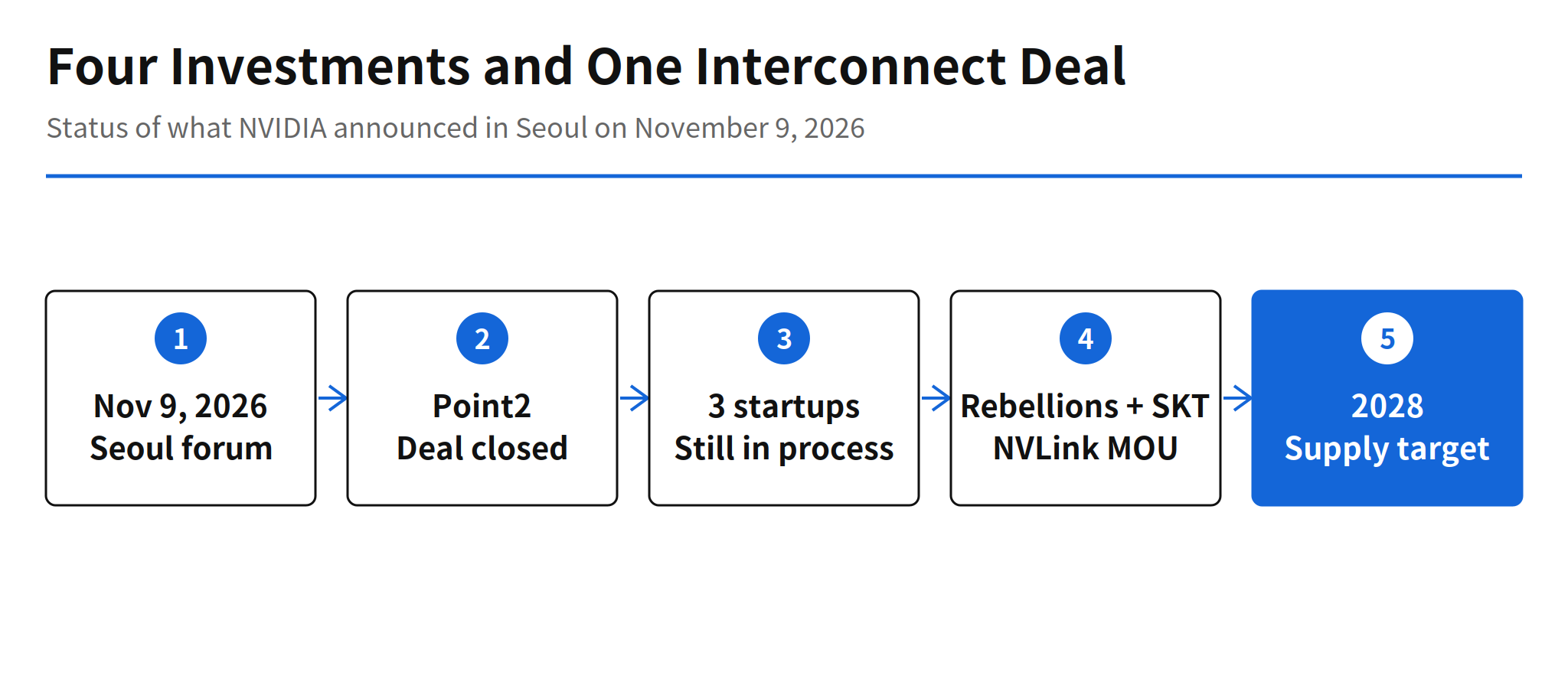
NVIDIA used its AI Startup Partnership Forum at COEX in Seoul on November 9, 2026 to announce direct investments in four Korean startups: Point2 Technology, Upstage, Motif Technologies and Realworld. Only the Point2 deal has closed so far. The other three are still in process, and every one of the four is a direct investment by NVIDIA itself rather than a deal through its venture arm NVentures. The investment amounts were not disclosed for any of the four companies.
The same day brought a second, more technical announcement. NVIDIA, SK Telecom and Rebellions signed a memorandum of understanding to connect Rebellions' next-generation R200 neural processing unit to NVLink Fusion, NVIDIA's interconnect standard, and to test an inference system that pairs NVIDIA MGX racks with GPUs inside an SK Telecom AI data center. The supply target in that plan is 2028. Taken together, the two announcements show NVIDIA moving from selling hardware into Korea to holding equity in Korean model and chip companies, and offering Korean silicon a defined place inside its own rack architecture.
The Four Investments and Their Status
| Company | Field | Status |
|---|---|---|
| Point2 Technology | RF interconnect components for data centers | Closed |
| Upstage | Large language models | In process, Series C second tranche |
| Motif Technologies | Large language models | In process |
| Realworld | Robot foundation models | In process |
Point2 Technology makes interconnect components that move data between AI chips and racks inside a data center over radio frequency links instead of copper or optics. The company was founded by KAIST graduates together with Professor Bae Hyun-min, who heads the KAIST entrepreneurship center. Point2 had already taken an investment from NVentures, NVIDIA's venture investment subsidiary, in the first half of 2026. The distinction matters for reading this new deal: money from NVentures is a venture portfolio decision, while this round comes directly from NVIDIA corporate, which usually signals a strategic interest in the technology itself. Interconnect is a plausible place for that interest, because moving data between chips and racks is one of the binding constraints on large AI clusters.
Upstage and Motif Technologies both build large language models, and both deals are still moving. Upstage expects the NVIDIA investment to arrive in the second tranche of its ongoing Series C round. Motif used the same day to announce the closing of a bridge round for its next-generation foundation model work, and it plans to release its follow-up model, Motif 4, in the first quarter of 2027. Realworld builds robot foundation models, which puts it in the same physical AI space where NVIDIA has been expanding its own platform. For all three, the practical value of an NVIDIA stake is not only the capital. It is the signal to customers and later investors that the GPU supplier has examined the company closely enough to buy in.
The Rebellions NVLink Fusion MOU
The memorandum between NVIDIA, SK Telecom and Rebellions has three concrete parts. Rebellions' next-generation NPU, the R200, will connect to NVIDIA systems through NVLink Fusion. An inference system combining NVIDIA MGX racks with GPUs will be tested at an SK Telecom AI data center. And the partners set a supply target of 2028. The strategic reading is straightforward: if a Korean NPU plugs into NVIDIA's interconnect fabric, the Korean chip stops competing with the NVIDIA rack and becomes a component inside it. That is a very different market position from trying to displace NVIDIA accelerators, and it is the first concrete path of that kind for a Korean chip company.
The limits are just as clear in the source reporting. The memorandum contains no volume commitments and no amounts, so nothing has been ordered yet. Whether the 2028 target turns into real adoption depends on the test results at the SK Telecom data center. The announcement also carried a caveat that power and total cost of ownership savings vary with configuration and operation, and no measured figures were presented. An MOU with a test plan is a starting gun, not a purchase order, and the trial data will decide what happens next.
From Inception Support to Direct Equity
NVIDIA has worked with Korean startups for years through Inception, its startup support program, which counts more than 1,000 member companies in Korea. That support was real but arm's length: preferential GPU pricing and introductions to investors were the main tools. Direct equity is a different instrument. It puts NVIDIA on the cap table, aligns the startup's roadmap conversations with the platform owner, and gives NVIDIA a financial reason to care about the company's outcome. More than 20 Korean startups met NVIDIA executives at the forum, alongside Ryu Je-myeong, a vice minister at the Ministry of Science and ICT, which underlines that both sides treated the day as ecosystem policy as much as deal news.
For Korean AI companies, NVIDIA has until now been a supplier: the company they buy GPUs from. These investments start to convert that supplier relationship into an ownership relationship. The open question is how much that changes behavior on either side. A stake does not guarantee GPU allocation, joint products or distribution, and none of those was announced. What it does guarantee is attention, and in a market where the platform owner picks ecosystem winners early, that attention is the asset being bought.
Limits and Open Questions
- Amounts and stakes are undisclosed. No investment size or ownership percentage has been published for any of the four companies, so the scale of the commitment cannot be judged yet.
- Three of the four deals have not closed. Upstage, Motif Technologies and Realworld are still in process, and final completion and terms depend on follow-up announcements.
- The MOU has no commercial terms. There are no volume or amount conditions, and the 2028 supply target rests on trial results at the SK Telecom data center.
- No efficiency figures were measured in public. Power and total cost savings from the NPU configuration carry a results-vary caveat, with no benchmark numbers presented.
Related Reading
NVIDIA's platform push into robotics and agent infrastructure provides the backdrop for two of these deals. See the report on NVIDIA GR00T 2 and robot foundation models, the field Realworld works in, and the report on NVIDIA Vera CPU agent performance for the compute layer of the same ecosystem strategy.
FAQ
Which Korean startups is NVIDIA investing in?
NVIDIA announced investments in Point2 Technology, Upstage, Motif Technologies and Realworld at its AI Startup Partnership Forum in Seoul on November 9, 2026. All four are direct investments by NVIDIA itself.
Which of the four investments is already complete?
Only the Point2 Technology investment has closed. The investments in Upstage, Motif Technologies and Realworld are still in process, and all three are also structured as direct corporate investments.
How much is NVIDIA investing in each startup?
The investment amounts and stakes have not been disclosed for any of the four companies, according to the reports from Seoul.
What does the Rebellions and SK Telecom MOU cover?
The memorandum links Rebellions' next-generation R200 NPU to NVIDIA NVLink Fusion and tests an inference system pairing NVIDIA MGX racks with GPUs at an SK Telecom AI data center, with a supply target of 2028. It contains no volume or amount terms.
How is this different from NVIDIA Inception in Korea?
Inception has supported more than 1,000 member companies in Korea, mainly through preferential GPU pricing and investor introductions. These four deals are direct equity investments by NVIDIA itself, which is a different kind of commitment.
Sources
- Seoul Economic Daily: Nvidia Unveils Surprise Investments in Four Korean Startups (November 9, 2026)
- Chosun Biz: Nvidia to invest in four South Korean AI startups (November 9, 2026)
- MLQ: Nvidia, SK Telecom and Rebellions agree to pair Korean NPUs with Nvidia GPUs (November 9, 2026)
- Original issue: ax-trend issue #3899