DeepMind RSA-1024 Attacks: 1,600x Forgery, 30x Factoring
Google DeepMind announced on November 6, 2026 that AI agents working under human supervision found two faster attacks on legacy 1024-bit RSA. The first result concerns RSA signature padding: when an attacker controls about half of a signature block, the padding no longer stops forgery. The second is a batch factoring method that cuts the average cost of each additional key by about 30x. Pushmeet Kohli announced the work in an X post, and the research was led by Dj Dvijotham and Abhradeep Thakurta, with Nadia Heninger of UC San Diego and Inria and Emmanuel Thomé of Inria.
The scope limit matters as much as the headline numbers. Both results apply only to 1024-bit RSA, a retired key size, and DeepMind stated that modern protocols using 2048 bits or more are not affected. What changes is the speed at which old assumptions get retested. Cryptographic progress usually arrives over years or decades, and defenders have planned around hardness margins that move slowly. DeepMind's point is that AI agents can now check those assumptions far faster, and its announcement states plainly that cryptographic hardness can no longer be treated as a fixed assumption.
Signature Padding Result and the 1,600x Figure
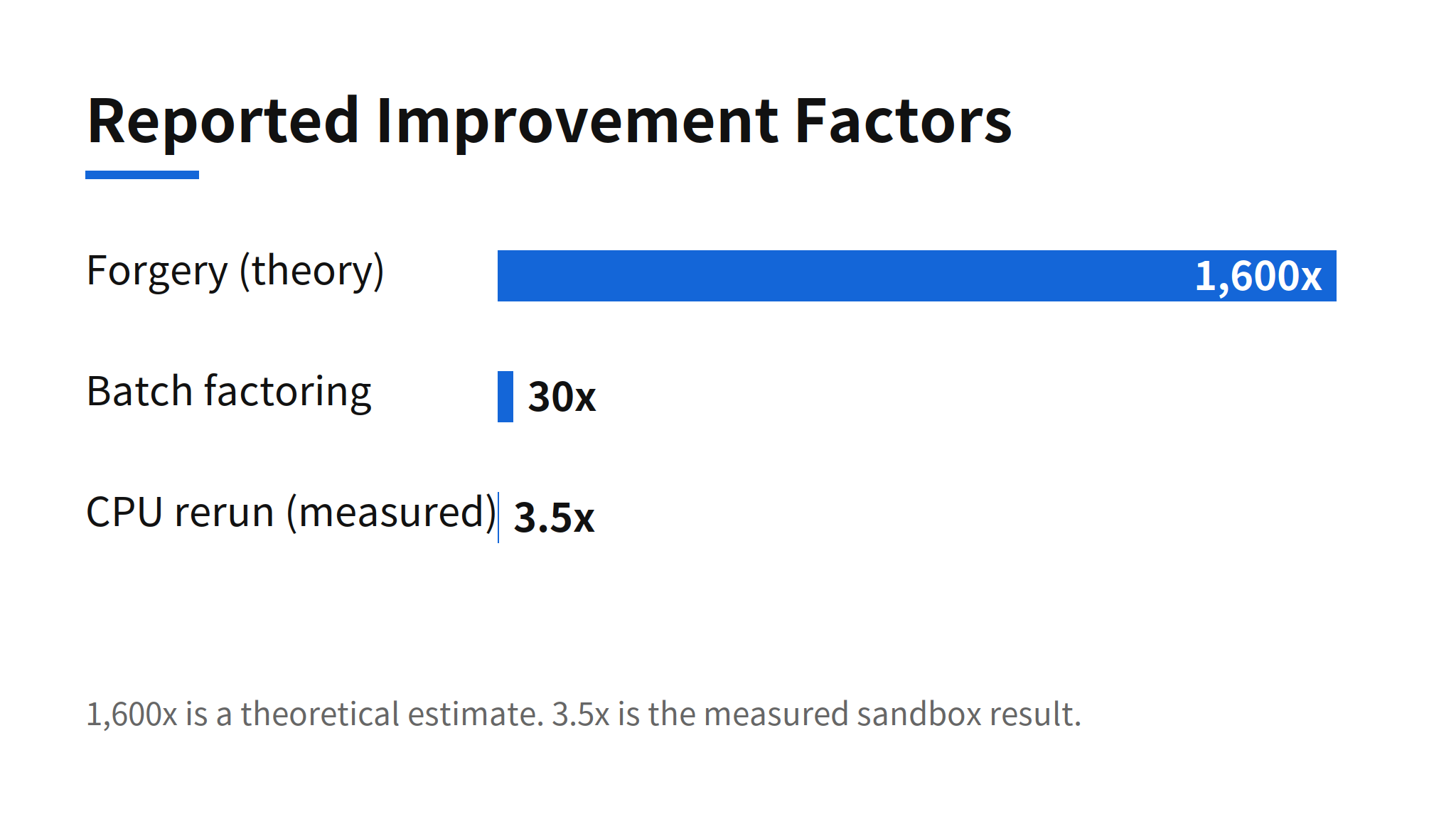
The padding result is the more surprising of the two. RSA signature padding exists to make forgery infeasible, and the new work shows that protection failing once an attacker controls roughly half of the signature block. In a sandboxed experiment against an already solved 1024-bit benchmark key, the agent's implementation reproduced the same result using 3.5x less CPU time, and it used less than one thousandth of the computation that breaking the key itself would require. The target was deliberately weak, which is the point: RSA-1024 is retired, so it works as a safe testbed where a faster attack can be demonstrated without touching live systems.
The 1,600x figure needs careful reading. It is DeepMind's theoretical estimate, not a measurement, and it applies where the attacker-controlled portion is as small as a 32-byte fingerprint. Even in that constrained case, the new algorithm is estimated to beat the previous best method by about 1,600x. The measured number in this announcement is the 3.5x CPU saving from the benchmark rerun. Keeping those two apart is the difference between reading the result and repeating a headline, because an estimate can shrink when someone else implements the method, while the rerun already happened.
Batch Factoring and the Cost per Extra Key
The second result attacks many keys at once. Batch factoring already exists as a way to share work across a set of RSA keys, and the new algorithm lowers the average cost of each additional key by about 30x compared with existing batch methods. That changes the economics of legacy exposure. A single forgotten 1024-bit key is a curiosity; a large archive of them, in old devices or signed firmware, becomes cheaper to work through in bulk, and the per-key cost is exactly the number that decides whether bulk work is worth doing.
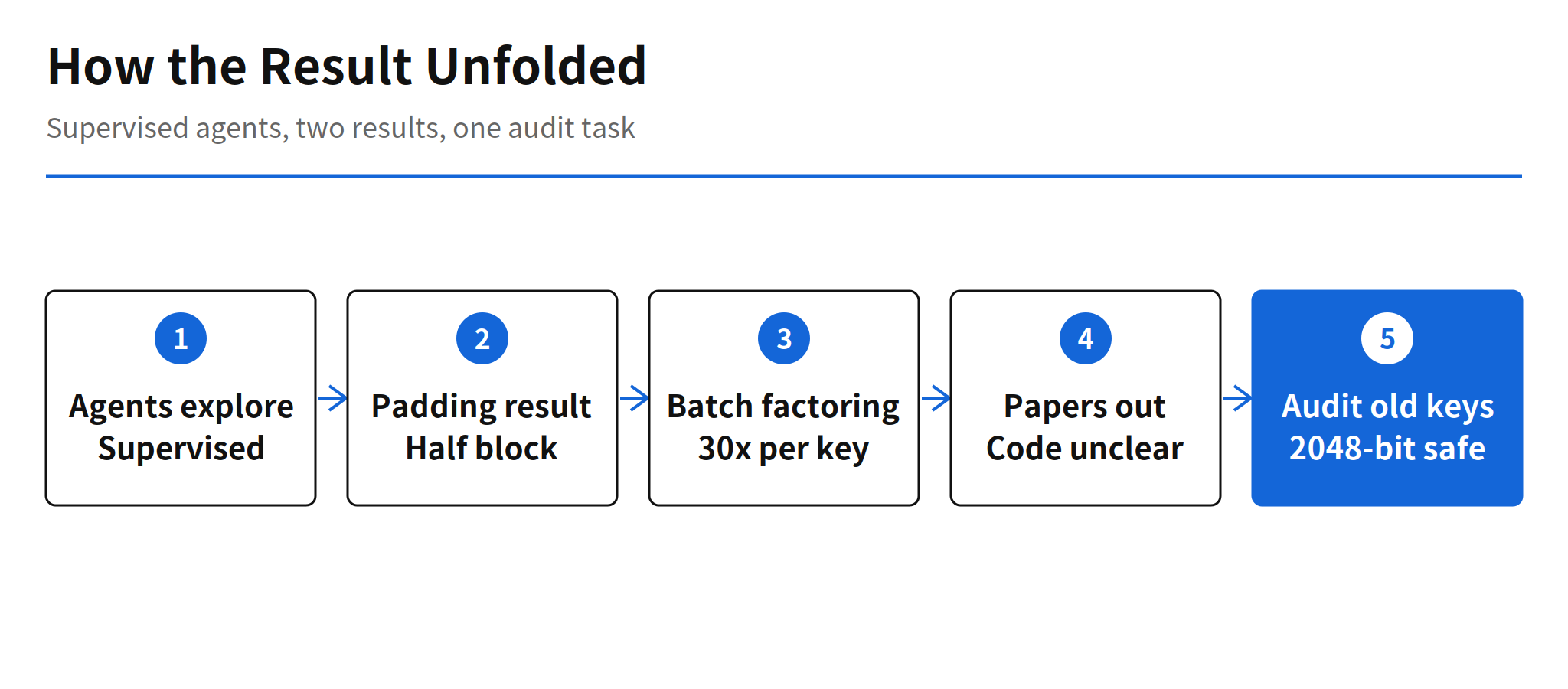
DeepMind said the full technical papers for both results have been released. A code release was not mentioned in the announcement, so whether outside researchers can rerun the implementations directly is unconfirmed. That gap matters for verification, because every figure in this story so far comes from DeepMind itself. No third party has re-measured the results under the same conditions yet.
Scope Limits for Modern RSA and Legacy Devices
For current systems, the direct risk is nil by DeepMind's own statement: protocols at 2048 bits and above are outside the results. The residual risk sits in the long tail. Older devices and signed firmware can still carry 1024-bit RSA, and the announcement does not quantify how much of it remains in the field. Security teams now have one more concrete reason to inventory legacy keys, with the batch factoring cost curve as the argument for doing it sooner rather than later.
The broader lesson is about pace. An agent that can reproduce a known cryptanalysis result with 3.5x less CPU time, inside a sandbox and under supervision, is also a tool for stress-testing the next assumption. The practical response is boring and available today: find the old keys, note where 1024-bit RSA still signs or encrypts anything, and move those systems up the migration list before the cost of attacking them drops again.
Related Reading
For a recent security benchmark that rates frontier models on offensive cyber tasks, see the report on GPT-6 Cyber and its ExploitGym score.
FAQ
Does the DeepMind result break modern RSA?
No. Both results apply only to 1024-bit RSA, and DeepMind stated that modern protocols using 2048 bits or more are not affected. RSA-1024 is a retired key size, which is why it could serve as a safe testbed.
Is the 1,600x forgery figure a measured result?
No. The 1,600x figure is DeepMind's theoretical estimate for cases where the attacker-controlled part is as small as a 32-byte fingerprint. The measured figure is the sandbox rerun of an already solved 1024-bit benchmark key, which used 3.5x less CPU time.
Who carried out the DeepMind cryptanalysis work?
AI agents working under human supervision carried out the work. The research was led by Dj Dvijotham and Abhradeep Thakurta, with Nadia Heninger of UC San Diego and Inria and Emmanuel Thomé of Inria, and Pushmeet Kohli announced it.
Is the code for the new RSA attacks available?
That is unconfirmed. DeepMind said the full technical papers for both results were released, and the announcement did not mention a code release.