Nooks Node and Revenue Agent Platform: $500M Growth Deal
Nooks announced on November 4, 2026 that it had secured a $500 million growth capital commitment from the General Catalyst Customer Value Fund. On the same day it formally launched the Revenue Agent Platform and unveiled Node, a personal AI assistant for sales representatives. The funding structure is the unusual part. This is not an equity round, and its size only makes sense alongside the platform claim that follows it.
The platform now covers the full sales cycle in one system. Deal, Outbound, Expansion and Coaching Agents are already running, and Inbound Agents are scheduled for the first quarter of 2027. Node sits at the individual level inside that system. It watches every deal for a representative, surfaces the deals that have stalled and the decision makers who have gone quiet, and drafts the follow-up email for approval before anything is sent.
Nooks says more than 2,000 companies already use its agents, including Glean, Notion, Deel, Factory and Replit. It also says the agents learn from more than 1 billion real sales interactions. Those two numbers frame the funding logic: a lender that is repaid from customer value needs a large, proven customer base first, and Nooks is presenting its installed base as that proof.
Growth Capital Structure
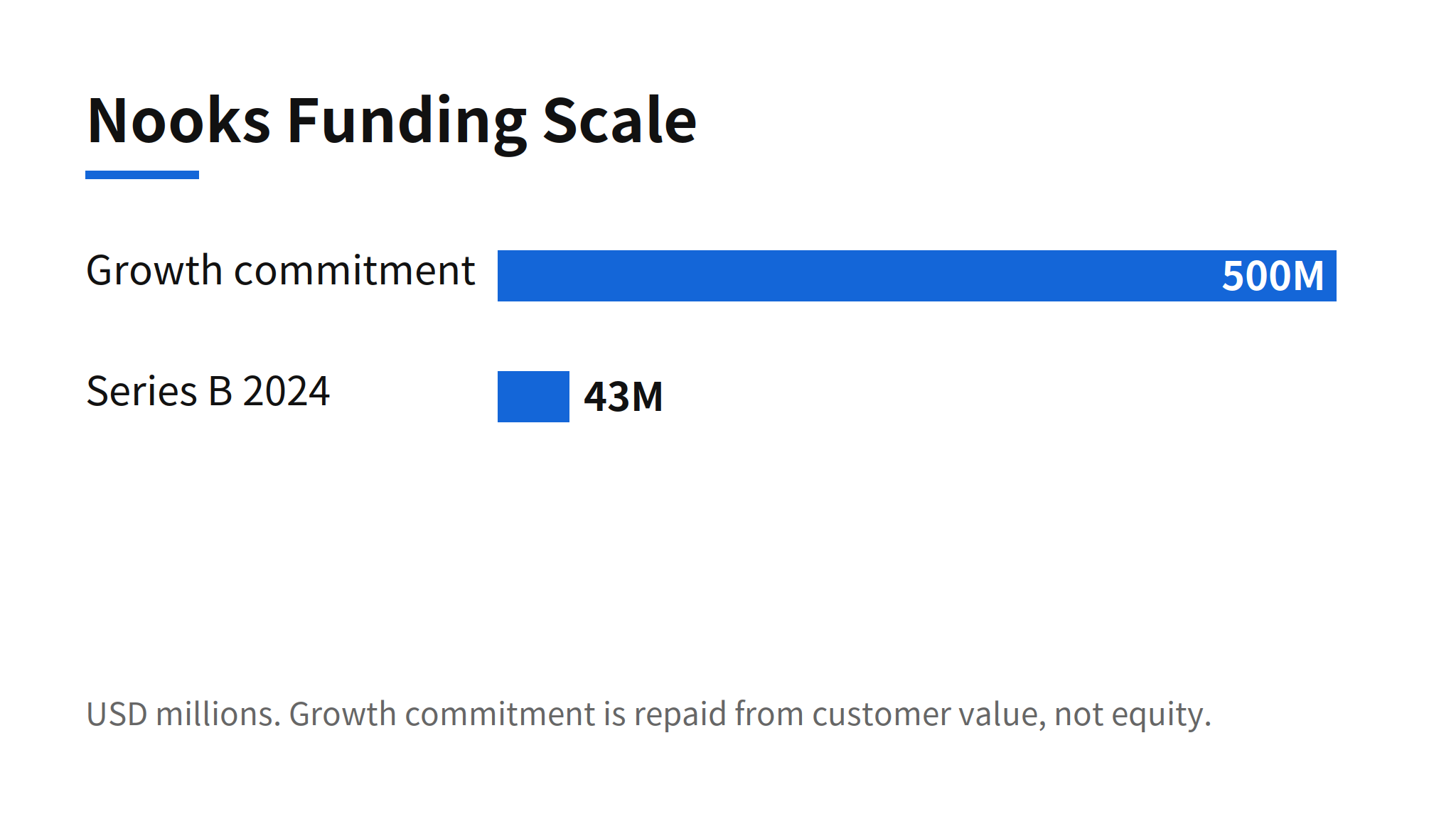
The Customer Value Fund does not buy shares in the usual venture sense. Nooks describes it as capital for companies with proven customer economics, directed at sales and marketing spending and repaid from the customer value that the spending creates. In practice that ties repayment to revenue performance rather than to a future exit or a fixed interest schedule, although Nooks did not publish the actual repayment terms.
The scale is worth placing against the company history. Nooks raised a $43 million Series B in October 2024, led by Kleiner Perkins. The new commitment is more than eleven times that round. Read carefully, it is also a different kind of claim. An equity round prices the whole company. A growth commitment of this type prices one narrower thing, the expected return on additional sales spending, and it only works if the underlying sales engine already converts spending into retained customers at a predictable rate.
An agent company used the revenue record created by its own product as collateral for $500 million of non dilutive growth capital. That structure, more than the headline amount, is the signal in this announcement.
Whether the full $500 million will actually be drawn is not confirmed. Nooks published the commitment size, not a draw schedule, and commitments of this kind are normally drawn against performance over time. Treating the full amount as cash already received would overstate what was announced.
Revenue Agent Platform Lineup
The platform launch turns a set of separate products into a named system that spans the sales cycle. The current lineup is:
- Deal Agents for work on live opportunities.
- Outbound Agents for first contact and prospecting, the area Nooks started in.
- Expansion Agents for growing existing accounts.
- Coaching Agents for representative development.
- Inbound Agents, planned for the first quarter of 2027, for handling incoming interest.
The design principles Nooks states for these agents are goal ownership, long term context retention and a learning loop that improves with each interaction. That vocabulary will sound familiar to anyone who has followed coding agents, and the similarity is not accidental. Nooks argues that sales follows coding, law and support as the next occupation to be reorganized around agents. The harder test is that sales has no compiler and no test suite. A deal outcome depends on people, timing and information that never enters the system, so context retention and rehearsal carry more weight here than raw generation quality.
Node, the Representative Level Assistant
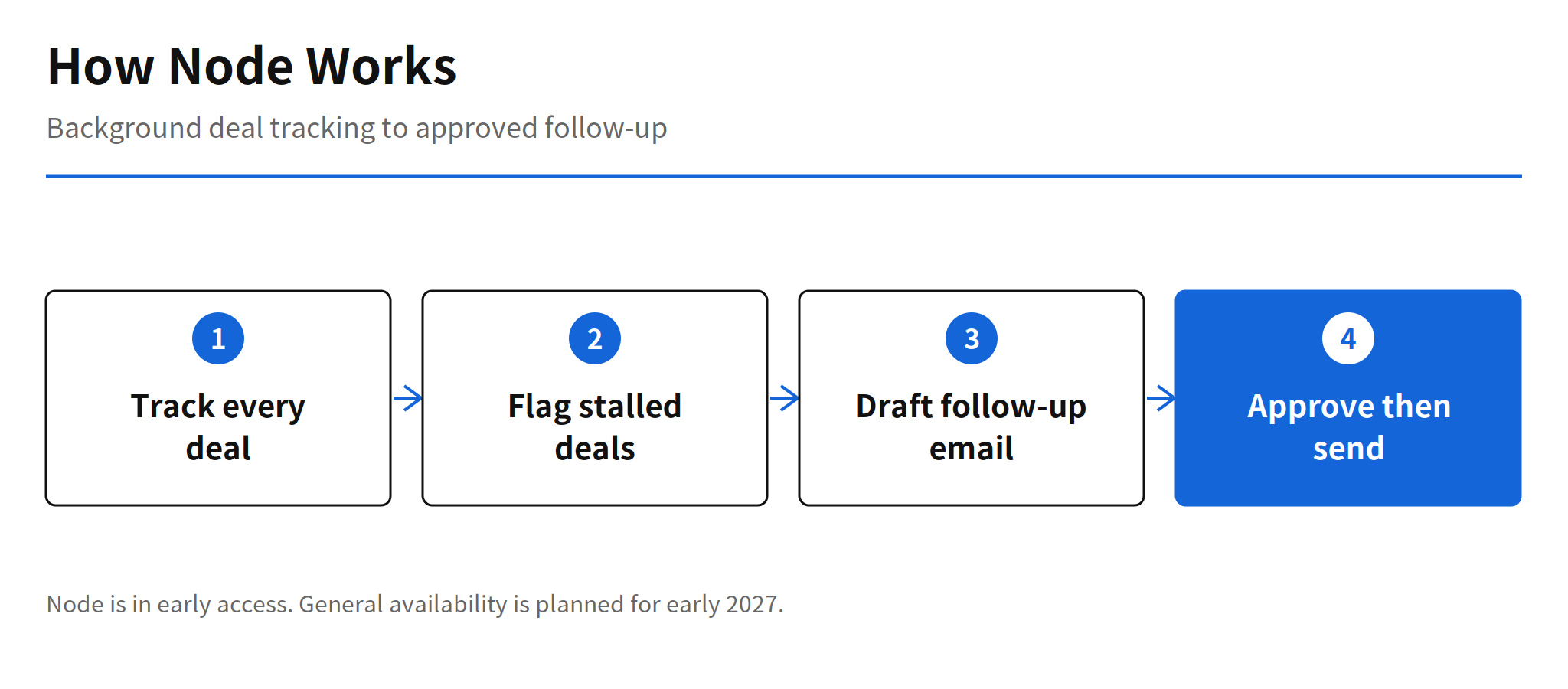
Node works at the level of a single representative rather than a team pipeline. It keeps track of every deal in the background, so the representative does not have to maintain that picture manually. When a deal stalls or a decision maker goes quiet, Node raises it first, before the representative notices it in a routine review. It then drafts the follow-up email, and the draft is sent only after the representative approves it.
That approval step matters for how the product should be judged. Node is not presented as an autonomous sender. The agent does the monitoring and the drafting, which are the parts that consume attention without requiring judgment, and the human keeps the send decision. For a sales organization, that split is also a trust requirement. A wrong draft costs a review click. A wrong sent email costs a customer relationship.
Node is not yet generally available. It is offered through early access applications now, with general availability planned for early 2027. Any evaluation of its effect on close rates therefore has to wait. Nooks has published no measured result for how much its stall detection or follow-up suggestions change deal outcomes.
Training Data and Rehearsal
Nooks says its agents learn from more than 1 billion real sales interactions, and that before an agent contacts a buyer it rehearses against a simulated counterpart. The rehearsal step is the practical response to the no test suite problem described above. If an agent cannot be verified against a ground truth, it can at least be exercised against a simulated buyer before it is allowed to act on a real one.
The limits of that approach are visible in the announcement itself. A simulated buyer is built from past interactions, so rehearsal tests how well an agent handles patterns the company has already seen. Novel buying situations, internal politics on the buyer side and deals that turn on information outside the recorded history remain outside the rehearsal set. The 1 billion interaction figure supports the scale of the training base. It does not by itself establish how the agents perform on the deals that differ from that base.
From Virtual Office to Full Cycle Sales
Nooks began during the pandemic as a virtual office product and later pivoted to outbound sales automation. The Series B in October 2024 funded an expansion from that first contact stage toward the full cycle, from first outreach through renewal. The Revenue Agent Platform is that expansion given a single name, and Node extends it from team level workflows down to the daily work of one representative.
This history explains the product shape. A company that started with outbound tooling had to earn the right to touch deals, expansion and coaching, because each later stage requires deeper access to customer data and more trust from sales leadership. The growth capital structure follows the same logic. It became available only after the customer base and its economics were large enough for a fund to underwrite spending against them.
Claims That Still Need Verification
Nooks cites 3x annual growth, 135% net revenue retention and a 3x pipeline effect among its results. It also says 96% of agent drafted emails are sent without edits. Each of these numbers is plausible for a company at this stage, and none of them can be checked from the announcement. The retention figure in particular does much of the work in justifying the funding structure, because repayment from customer value depends on customers staying and expanding. Readers should treat it as a company claim that the fund has presumably examined privately, not as a publicly verified fact.
Two gaps are structural rather than promotional. The repayment terms and draw schedule for the $500 million commitment were not disclosed, so the cost of this capital cannot be compared with an equity round from public information. And Node has no published outcome data yet, because it has not reached general availability. The platform story is coherent and the customer list is concrete. The evidence that would settle its value, verified retention economics and measured Node results, is still ahead.
Related Reading
For a related case of agents moving into structured professional work, see agent-autoloop: Background CLI Agents With Decision Cards. For enterprise adoption context, see Enterprise AI Spending Hits $176.8B: Menlo Ventures Report.
FAQ
What did Nooks announce on November 4, 2026?
Nooks announced a $500 million growth capital commitment from the General Catalyst Customer Value Fund, the formal launch of its Revenue Agent Platform, and Node, a personal AI assistant for sales representatives. The platform covers deal, outbound, expansion and coaching work, with inbound agents planned for the first quarter of 2027.
Is the $500 million an equity investment?
No. Nooks describes the commitment as growth capital, not an equity sale. The Customer Value Fund invests in sales and marketing for companies with proven customer economics and is repaid from the customer value that spending creates. Repayment terms and the draw schedule were not disclosed.
What is Node and when can teams use it?
Node is a personal assistant for each sales representative. It tracks every deal in the background, flags stalled deals and decision makers who have gone quiet, and drafts follow-up emails that are sent only after approval. Node is in early access, with general availability planned for early 2027.
Which Nooks results are still unverified?
The growth figures Nooks cites, including 3x annual growth, 135% net revenue retention and 96% of agent drafted emails sent without edits, are company self reports. Nooks did not publish its current annual recurring revenue, and no external verification path was provided for those figures.