Enterprise AI Spending Hits $176.8B: Menlo Ventures Report
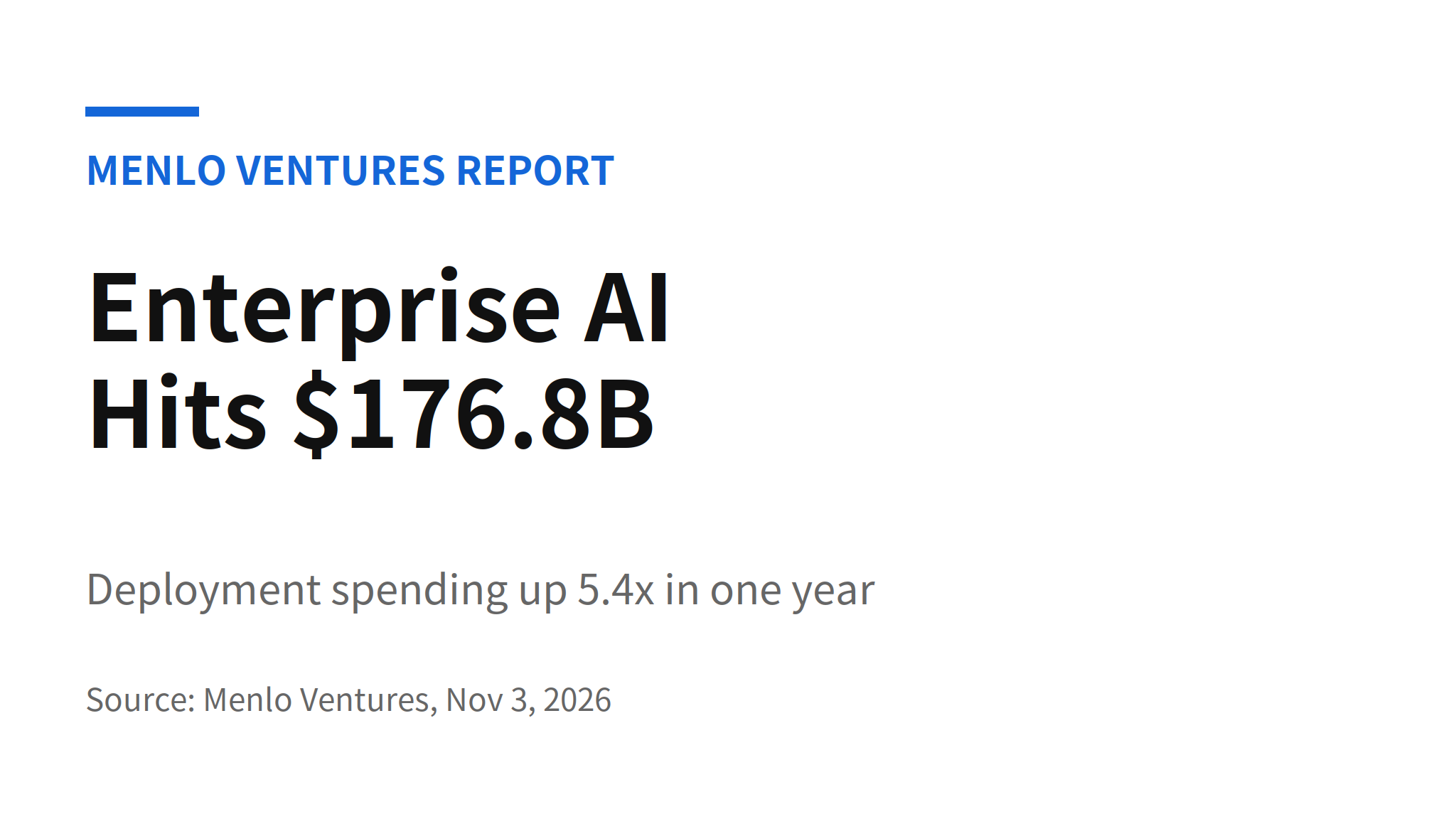
Enterprise spending on AI deployment reached $176.8 billion as of September 2026, according to Menlo Ventures. The figure comes from the firm's fourth annual report, 2026: The State of Enterprise AI, published on November 3, 2026. A year earlier the same measure stood at $33 billion, so spending grew 5.4 times in twelve months, faster than the 3.9 times growth recorded the year before.
The report names agents as the reason the curve steepened. On OpenRouter, agent traffic now accounts for 80 percent of all tokens, and the three largest model providers take a bigger share of the money than they did a year ago. Coding is where the spending concentrates: it is the largest application category by a wide margin, and two coding tools account for most of it.
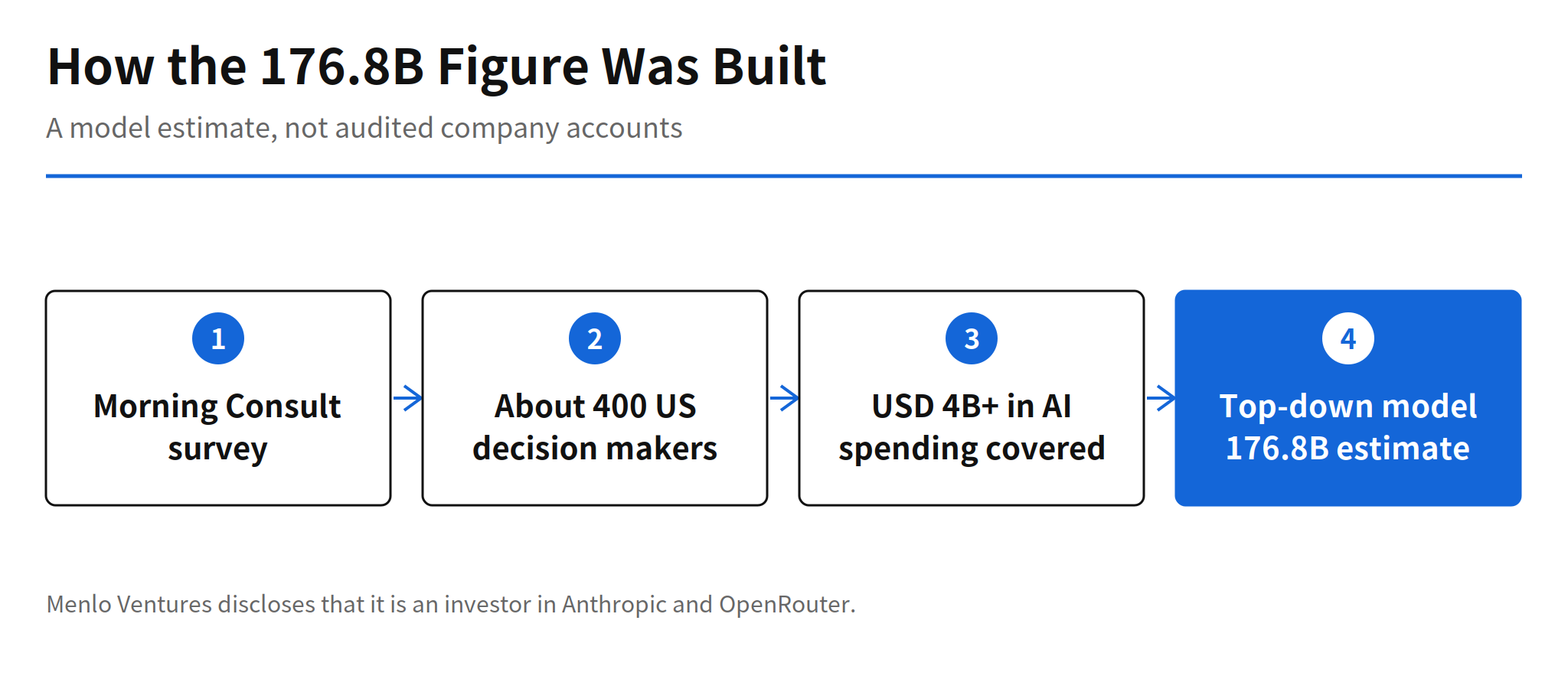
Those headline numbers need one qualification before anything else. The $176.8 billion total is a model estimate by Menlo Ventures, built from a survey of about 400 US decision makers and public data. It is not an audited total, and Menlo discloses in the report that it is an investor in both Anthropic and OpenRouter, the two companies at the center of its share and token statistics. The direction of the numbers is still informative, but the precision should be read with that context in mind.
Spending Growth Outpacing Adoption Growth
The most telling comparison in the report is not the total but the gap between adoption and spending. The share of companies using AI rose from 55 percent to 65 percent, a solid but gradual move. Average spending per company, by contrast, reached 4.7 times the previous year's level, well above the 1.9 times increase those companies had planned.
Menlo's explanation is that agents changed what spending is tied to. A chatbot seat costs the same whether an employee uses it twice a day or two hundred times. An agent that keeps working after the person leaves ties cost directly to workload, so budgets grow with usage instead of with headcount. If that reading is right, enterprise AI budgets have quietly shifted from a procurement line, set once a year, to something closer to a utility bill that rises with output.
Agents and the OpenRouter Token Split
OpenRouter gives the report its clearest agent statistic. Agent traffic is 80 percent of all tokens on the platform, roughly 7 times human usage. Agent traffic passed human traffic in February of this year and has grown 37 times since that crossover.
One caution applies here. OpenRouter is a routing platform, and its traffic mix reflects the developers and products that choose to route through it. It is a strong signal for how API driven workloads are changing, but it is not a census of all enterprise AI use, and Menlo's investment in OpenRouter is worth remembering when this particular statistic does the headline work.
Market Share Concentration Among Three Labs
Consolidation is the second big movement. Anthropic, OpenAI and Google together take 69 percent of deployment spending, or $122.7 billion, up from a 50 percent share last year. The money is concentrating even as total spending explodes, which means the long tail of smaller providers is growing in absolute terms while shrinking in relative ones.
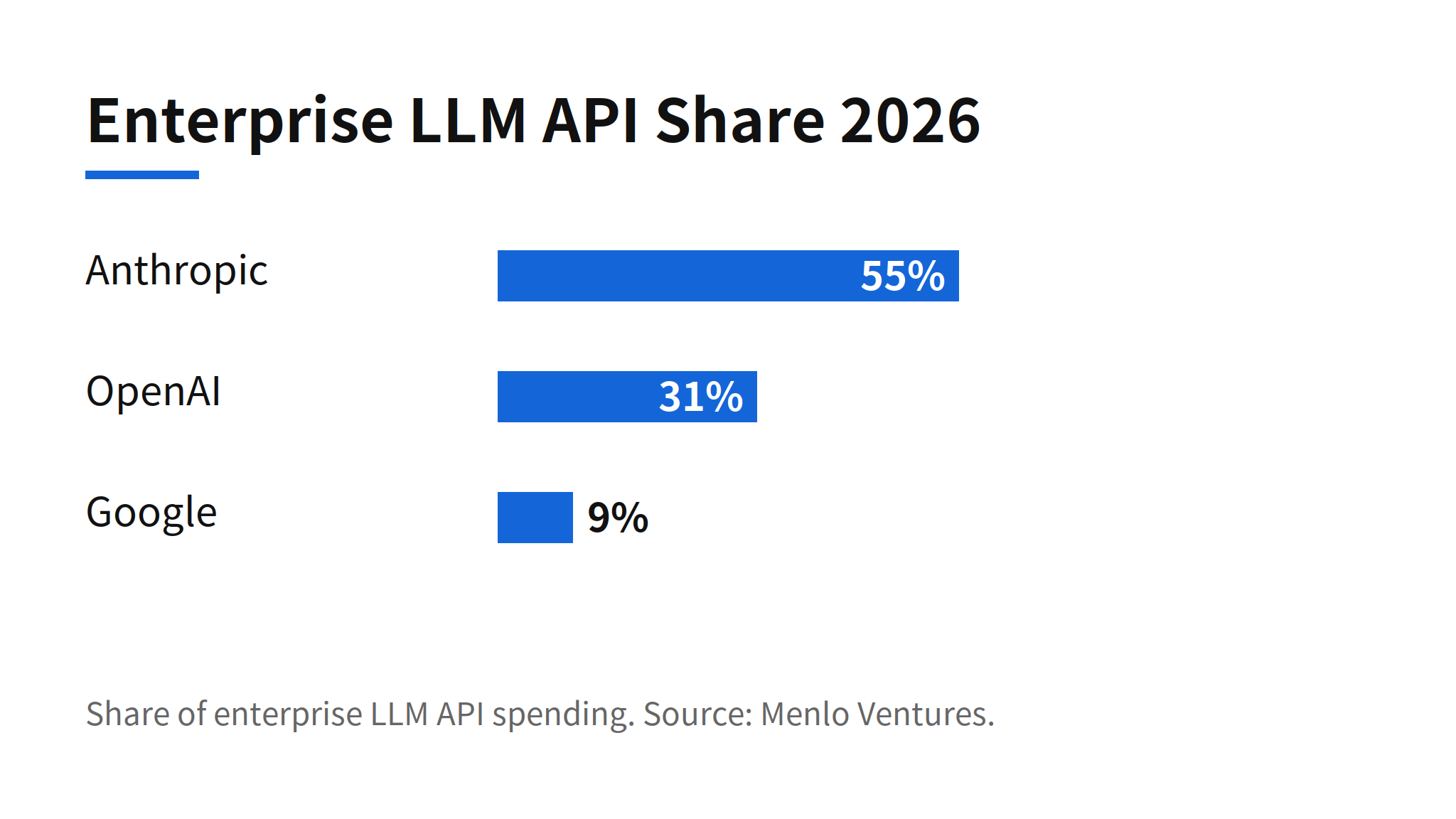
Inside enterprise LLM API spending, the shifts are sharper. Anthropic rose from 40 percent to 55 percent. OpenAI rose from 27 percent to 31 percent. Google fell from 21 percent to 9 percent. A drop of that size in one year, in a market growing 5.4 times, still leaves Google with far more revenue than before, but it signals that enterprise buyers are standardizing on fewer default providers.
Coding Dominance in the Application Layer
The application market totals $77.3 billion, and two categories take 76 percent of it. Coding accounts for $34 billion and chatbots for $25 billion. Within coding, Claude Code and Codex alone account for $24 billion, which is 70 percent of all coding spending.
The report's reasoning for the coding concentration is practical rather than promotional. Coding gives an agent an environment to act in, a codebase as context to learn from, and tests or build results to verify its work against. Most other knowledge work lacks at least one of those three. That framing also marks the next competitive question: whichever field builds the same closed loop of action, context and verification becomes the next place spending pools.
Model Choice and the Open Source Gap
Buyers are also paying up for capability. The token share of frontier models rose from 18 percent to 42 percent, while cheaper small models lost share. In a year when every provider cut prices somewhere, enterprise customers still moved toward the strongest models, which suggests performance, not price per token, is the deciding factor for workloads that produce revenue or replace labor.
Open source models show the opposite split between use and money. Their token share rose from 11 percent to 19 percent, but their share of spending fell from 6 percent to 4 percent. Usage and revenue are moving in different directions, and the report does not say when, or whether, that gap closes. For open model providers, the unresolved question is monetization, not adoption.
Survey Method and Estimate Limits
Morning Consult ran the underlying survey from September 8 to 26, 2026. The respondents were about 400 US enterprise decision makers who are collectively responsible for more than $4 billion in AI spending. Menlo Ventures then combined the survey results with public data in a top-down model to size the full market.
None of that makes the report useless. A consistent annual series, even a modeled one, is how shifts like the agent token crossover and the API share moves become visible at all. The right way to use it is as a map of where money is moving, with the sponsor's positions noted, rather than as a precise measurement of market size.
Related Reading
For what happens inside engineering organizations when coding agents scale, see the CI bottleneck report covering Anthropic and Linear, where agent generated code shifted the constraint to verification. For one of the tools in the spending lead, see Floorplan, which maps a codebase so Claude Code and Codex can navigate it.
FAQ
How much did enterprise AI spending reach in 2026?
Menlo Ventures put enterprise AI deployment spending at $176.8 billion as of September 2026, up from $33 billion in 2025. That is a 5.4x increase in one year, and the figure is a model estimate built from a survey and public data, not audited company accounts.
What share of OpenRouter tokens do agents use?
Agent traffic accounts for 80 percent of all tokens on OpenRouter, according to the report. That is about 7 times human usage, and agent traffic passed human traffic in February before growing 37 times after that point.
Which companies lead enterprise LLM API spending?
Anthropic holds 55 percent of enterprise LLM API spending, followed by OpenAI at 31 percent and Google at 9 percent. Together, Anthropic, OpenAI and Google take 69 percent of deployment spending, or $122.7 billion.
How was the $176.8 billion figure calculated?
Morning Consult surveyed about 400 US enterprise decision makers responsible for more than $4 billion in AI spending between September 8 and 26, 2026. Menlo Ventures combined the survey with public data in a top-down model to estimate total market size.
Why does coding take the largest share of application spending?
Coding accounts for $34 billion of the $77.3 billion application market, and Claude Code and Codex alone account for $24 billion of that. The report links the concentration to coding being a field where agents have an environment to act in, context to learn from, and results they can verify.