OpenAI Acquires Pierre Computer: Code Storage for Codex
OpenAI announced on November 4, 2026 that it will acquire Pierre Computer Company, Inc., the maker of the Trees and Diffs libraries and the Code Storage service. The headline product in the deal is Code Storage, a Git based service for storing code and its history, which OpenAI plans to fold into Codex. The acquisition price was not disclosed.
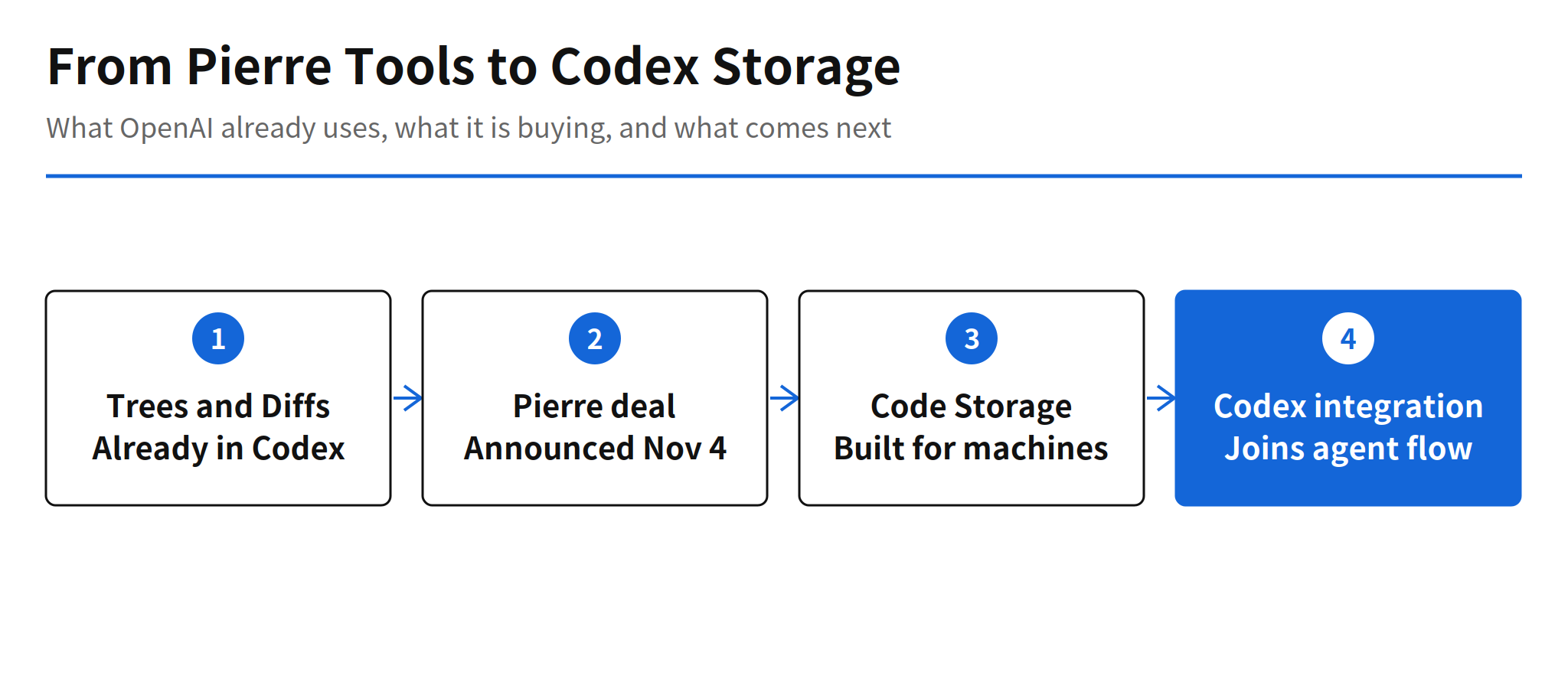
The deal is less surprising than it looks, because part of Pierre is already inside the product. Anyone who has browsed files or reviewed changes in the Codex app has used Pierre's Trees and Diffs libraries, according to OpenAI. OpenAI is buying a supplier whose interface code already ships in Codex, and adding the storage layer underneath it.
That storage layer is the strategic part. Code Storage was designed around APIs that are easy for machines to write to, which makes it a fit for a workflow where coding agents create branches and commits at a pace human oriented Git hosting was not built for. The rest of this article separates what Pierre already does in Codex, what Code Storage adds, and what the announcement leaves open.
What Pierre Already Does Inside Codex
Trees handles file browsing in large projects. Diffs handles review of changes, and its Edit mode lets a developer make a fix at the exact line where a problem appears, instead of leaving the review view to edit elsewhere. Those two libraries cover the two moments a Codex user spends outside code generation itself: finding the right file, and judging what the agent changed.
Pierre's newer tool, Highlights, works on syntax highlighting. OpenAI describes it as very fast, updating in real time while a developer types or an agent streams code in. Read together, the three tools share one trait: they were built for interfaces where code arrives continuously and often from a machine, so rendering and review have to keep up with a stream rather than a finished file.
Code Storage and the Machine-First Design
Code Storage stores code and history on Git. The design choice OpenAI highlights is the shape of the service itself: Pierre built it in a form that is easy for machines to use through its API, not only for people through a web interface. In an agent workflow that distinction matters, because the writer of the code, the creator of the branch, and often the first reviewer are all software.
The published specifications from Pierre's site put the scale in concrete terms: more than 30 concurrent writes, repositories up to 32TB, and Git LFS support. The named users are also telling. Lovable, Poke, Anything, Bolt, Amp and Parahelp are listed as Code Storage users, and several of them are agent driven building tools, exactly the kind of product that writes code continuously and needs storage that treats concurrent machine writes as the normal case.
The Pando Backdrop Inside OpenAI
OpenAI connected the acquisition to its own engineering work. Earlier in the same week it published Pando, a Git compatible backend for its own monorepo. As Codex increased parallel work by its engineers, fetches and pushes on the previous monorepo system slowed, merges failed, and reliability at times fell below 90%, according to OpenAI's engineering account.
After the move to Pando, median push latency fell by about 80%, and the system now moves close to 1 petabyte of Git data per day. Pando took 10 weeks from start to production and has handled production traffic since April 2026. Pierre is the external counterpart to that internal project: Pando rebuilds storage for OpenAI's own repository, while Code Storage brings a productised, machine oriented storage service into Codex for everyone else.
We wish to set the standard for modern software development: from the first branch an agent creates to that magic moment when code is deployed to the world. (OpenAI announcement, quoted in the original issue)
Deal Terms and Open Questions
- Price: not disclosed, in the announcement or in the Axios reporting cited by AI Weekly.
- Integration timeline: no specific schedule was given for folding Code Storage features into Codex.
- Existing customers: customers can keep using the service after closing, but how long it stays available once features move into Codex is unconfirmed.
- Open source: the announcement says Pierre's open source projects will remain open source and that OpenAI will keep contributing. Whether license terms change was not addressed.
- Closing date: not fixed, because regulatory approval is still pending.
Those gaps are normal for an announcement at signing, but two of them decide how much this deal matters to current Pierre users. If Code Storage continues as a standalone service, the acquisition mainly changes its owner. If its features migrate into Codex and the standalone service winds down, teams that built on its API will need a migration plan that has not been published yet.
Why Storage Is Becoming the Agent Bottleneck
The pattern across Pando and Pierre is consistent. Coding agents do not just write more code; they multiply the operations around code. More parallel agents mean more branches, more commits, more concurrent writes, and more diffs for a person to review. OpenAI's own numbers show where that pressure lands first: pushes, merges, and reliability, rather than code generation itself.
Owning the storage layer gives OpenAI a way to shape that pressure instead of adapting to hosting designed for human paced work. It also changes the competitive picture for Git based collaboration tools, because the pitch is no longer only a better editor or a smarter agent. The stated ambition in the announcement runs from the first branch an agent creates to deployment, which is a claim on the whole path code travels. Whether Codex can hold that path will depend on the integration details that are still missing, and on whether existing Code Storage customers stay through the transition.
Related Reading
For a tool that maps a codebase so coding agents can navigate it, see Floorplan, which builds codebase maps for Claude Code and Codex. For the layer above storage, see agent-autoloop, which supervises command line agents in the background. Pierre sits below both: it is the place the code those agents produce is stored and reviewed.
FAQ
What did OpenAI announce about Pierre Computer?
OpenAI announced on November 4, 2026 that it will acquire Pierre Computer Company, Inc. The deal brings Code Storage, Pierre's Git based code and history storage service, into Codex, and it remains subject to customary closing conditions including regulatory approval.
What are Trees, Diffs and Highlights?
Trees handles file browsing in large projects and Diffs handles review of changes, and both already run inside the Codex app. Diffs Edit mode lets a developer fix a problem at the line where it appears. Highlights is Pierre's newer syntax highlighting tool, which OpenAI describes as very fast and able to update in real time while code streams in.
What does Code Storage support?
Code Storage stores code and history on Git, and Pierre designed it around APIs that are easy for machines to write to. Its published specifications include more than 30 concurrent writes, repositories up to 32TB, and Git LFS support. Lovable, Poke, Anything, Bolt, Amp and Parahelp are listed as users.
How much did OpenAI pay for Pierre?
The price was not disclosed. OpenAI did not publish the acquisition price or the financial terms, and the closing date is not fixed because regulatory approval is still pending. Until closing, the two companies remain separate and independent.
Will Pierre's open source projects stay open source?
The announcement says the open source projects will remain open source and that OpenAI will keep contributing to them. It does not address whether license terms will change, and no specific timeline was given for integrating Code Storage features into Codex.
Sources
- Let's Data Science, OpenAI to Acquire Pierre, Maker of the Trees and Diffs Libraries (reprint of the OpenAI announcement)
- Unite.AI, OpenAI to Acquire Pierre Computer and Bring Code Storage to Codex
- AI Weekly, OpenAI Buys Pierre Computer, Folds Code Storage Into Codex
- Related issue #3733: OpenAI's Git backend Pando
- Original issue: ax-trend issue #3788