Claude Animated Shorts: Code-Rendered Videos with Remotion
claude-animated-shorts, a Claude skill published by mromidev, makes animated story shorts by rendering scenes in code. It uses three.js and Remotion and renders locally, so no AI video generator sits in the production path. The output is a vertical short of 55 to 70 seconds, with 2D characters placed inside 3D space, ink outlines, lens blur, and march style music and sound effects.
The repository was created on November 1, 2026, and at the time it was recorded it had 511 stars and 138 forks on GitHub. The license is MIT. Those counts describe a fast start for a single purpose skill, and the fork count is the more useful signal of the two. Forking a video pipeline usually means someone intends to run it, which is a stronger commitment than starring a tool to look at later.
The design choice behind the skill is easy to state. AI video generators vary from scene to scene, and keeping one character consistent across a minute of footage is hard to control. A scene built in code can be rendered again with the same character and the same look, and a production process fixed in skill files can be rerun with a new topic. The trade is also clear. Whatever the code pipeline cannot express has to be built by hand, and the skill answers that cost by shipping a finished piece as a working template.
Repository Response at Launch
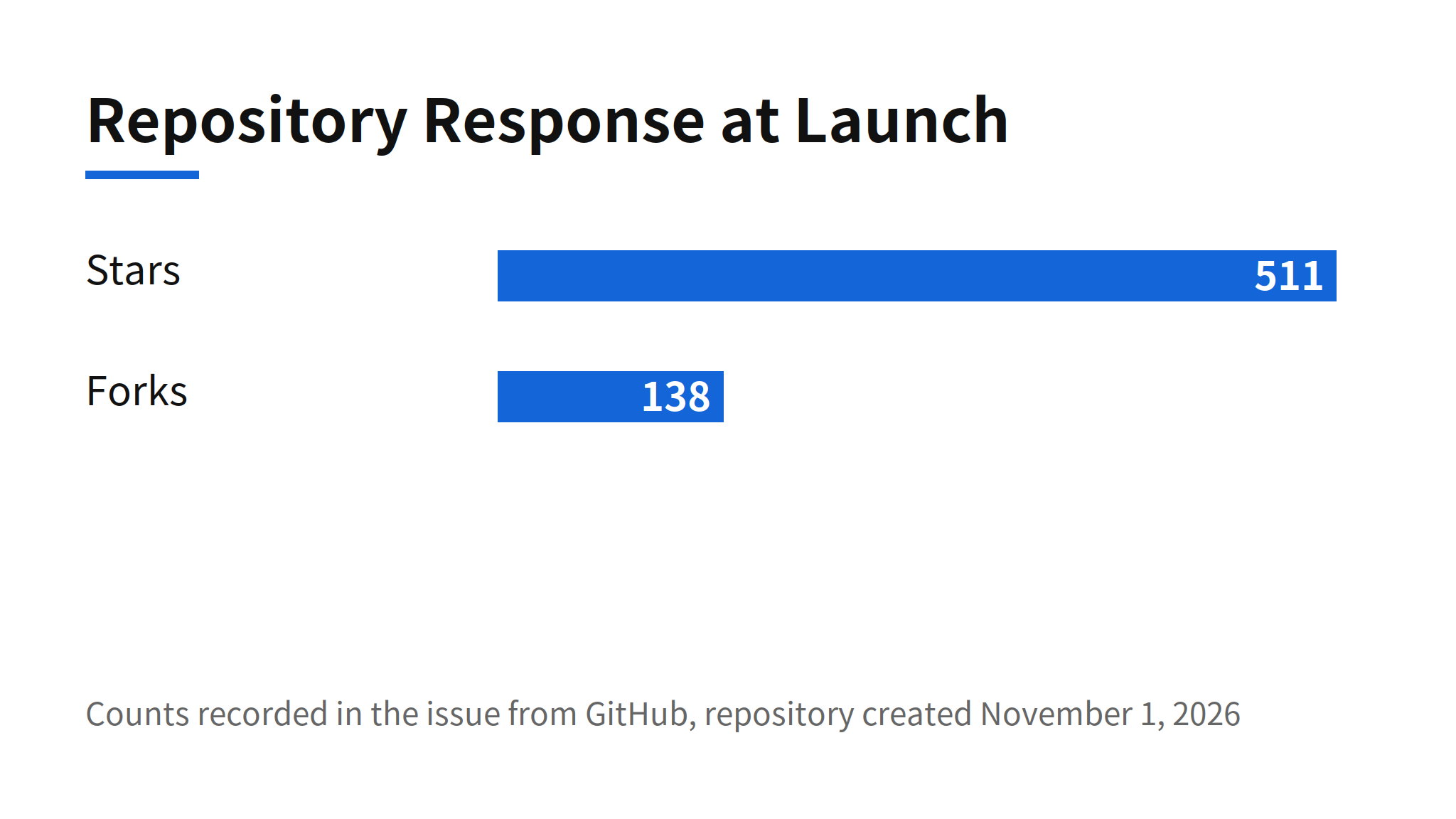
The ratio between the two counts is worth a look. At 138 forks against 511 stars, roughly one in four people who starred the repository also forked it. For a creative tool, that pattern fits a template people plan to adapt rather than a library they plan to depend on. It also matches how the repository is packaged. The skill carries its own reference research and a complete example, so a fork gives a maker the whole working setup in one copy.
A Finished Short Shipped as the Template
The verification piece is The Bridge That Fell for a Song, a 67 second short about the Broughton Bridge collapse of 1831. The full source of that short is included in the template folder inside the skill. Shipping a finished work matters more than a feature list here, because the obvious question for any shorts pipeline is what the output actually looks like at full length. A 67 second example sits inside the stated 55 to 70 second range, so the template also proves the format claim instead of only illustrating the style.
For a maker evaluating the skill, the template changes the starting point. The first project can begin from a working short with its scenes, timing and sound already assembled, and the work becomes adaptation rather than construction. That is a practical advantage over generator based workflows, where each new topic starts again from prompts and the results have to be reconciled shot by shot.
Style Measured From Twenty Reference Shorts
The visual style does not come from a single prompt. It comes from seven analysis reports produced by measuring 20 reference shorts, with the findings organized by movement, depth, texture, character, lighting, outline and color grading. The reference material bundled with that work is large: 38 full size reference frames and 20 contact sheets at 60 frames per short, for 1,200 frames in total.
That measurement step is the part other skill authors can copy. Instead of describing a look in adjectives, the author broke reference videos into frames and wrote down what the frames show, category by category. A coding agent can act on a report about outline weight or lens blur far more reliably than on a request for a cinematic feel. The 1,200 frames are evidence the style was studied at frame level, and they also explain why the output can hold together across a full minute.
How the Skill Builds a Short
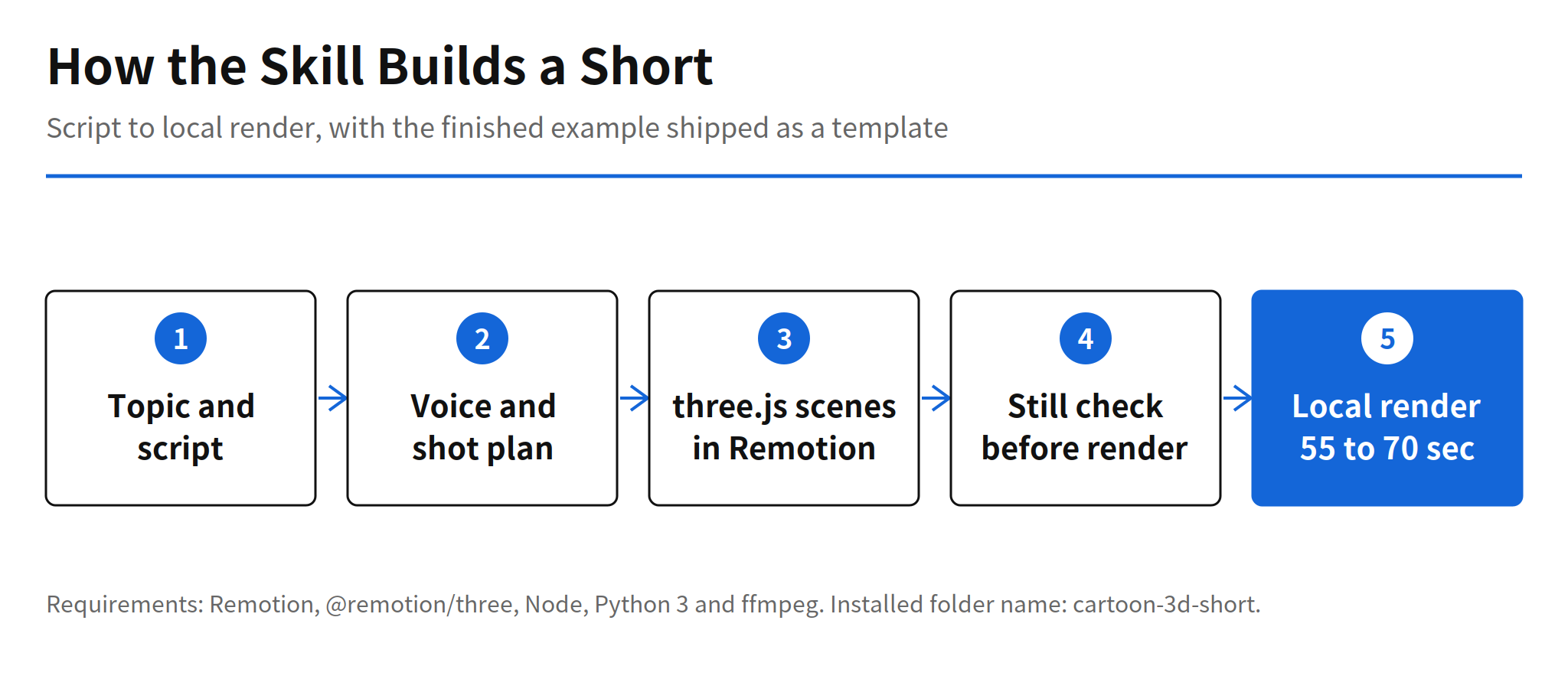
The pipeline inside the skill covers script, voice, shot design, still checks and rendering. Each stage is a place where a code based workflow behaves differently from a generator based one. A still check before rendering can catch a broken scene at the cost of one frame, and a shot plan written as data can be adjusted without regenerating footage that already works. By the time the render runs, most decisions have already been reviewed in cheaper forms.
Local rendering also changes the cost shape of repeat production. There are no generator credits consumed per scene, so the marginal cost of another episode is machine time and the maker's own revisions. For a channel publishing on a schedule, that predictability can matter as much as the visual style, because a format that costs the same on the tenth episode as on the first is easier to keep running.
Installation and Requirements
After installation, the skill folder is named cartoon-3d-short. The requirements listed in the repository are Remotion and @remotion/three, plus Node, Python 3 and ffmpeg. The stack is ordinary web video tooling, which keeps the skill inside an ecosystem many makers already have installed for Remotion work.
One operational warning is stated in the repository. The Remotion bundle copies about 1.3GB in the public/ folder into a temporary folder during the process. That figure is worth knowing before a first run on a small disk, and it hints at how much reference and asset material the pipeline carries with it.
License and Reference Frame Limits
The code is released under an MIT license. The reference frames carry a narrower condition. They may be used for style learning only, and the repository states that stories, characters and voices should be made by the user. That split is sensible for a template built from studying other people's shorts. The method is shared freely, while the studied material itself is not handed over as production assets.
Limits and Unconfirmed Details
- Audience results: the repository publishes no view counts or channel performance for the finished short. The word viral in the project description is the maker's own wording, and any performance claim remains unconfirmed.
- Render time and hardware: rendering time and required machine specifications are not stated. The only capacity figure given is the warning about the roughly 1.3GB copy during the Remotion bundle step.
- Reference frame rights: the copyright status of the reference frames is described only by the style learning scope. Using them directly in commercial production needs a separate check.
None of those gaps weakens the confirmed core, which is a complete and inspectable pipeline with its example source included. They do set the questions a serious adopter should answer with a first test render: how long it takes on their machine, and how much adaptation the template needs for a topic of their own.
Related Reading
Video production packaged as a coding agent skill is also the subject of an earlier post in this series on a launch video skill: huashu-motion: Coding-Agent Skill That Makes Launch Videos. The two skills take the same distribution route to different outputs, promotional launch videos in one case and narrative story shorts in the other.
Skills competing on output quality rather than generation itself is the theme of a recent post on a design skill for coding agents: Hallmark v2 Design Skill: 50 Themes for Coding Agents. Both cases show the skill format carrying studied reference material, not only instructions.
FAQ
What is claude-animated-shorts?
It is a Claude skill by mromidev for making animated story shorts. It renders scenes locally with three.js and Remotion instead of using an AI video generator, and it produces vertical shorts of 55 to 70 seconds.
What do you need to run it?
The requirements listed in the repository are Remotion and @remotion/three, Node, Python 3 and ffmpeg. After installation the skill folder is named cartoon-3d-short.
What example ships with the skill?
The verification piece is The Bridge That Fell for a Song, a 67 second short about the Broughton Bridge collapse of 1831. Its full source is included in the template folder inside the skill.
Can the reference frames be reused in commercial work?
The code is under an MIT license, but the reference frames are stated as being for style learning only. The repository also says stories, characters and voices should be your own, so using the frames directly in commercial production needs a separate check.