Superhuman Go Personal Assistant: SDK Release and Rollout
Superhuman announced on November 19, 2026 that Go, its proactive agent platform, now spans the whole Superhuman suite and gains a personal AI assistant. The suite in question is Docs, Grammarly, GPTZero, Fathom and Mail. The Go platform SDK is generally available to partners and customers, more than 20 partner agents will roll out over the coming weeks, agents can be shared and mentioned inside Superhuman Docs like human collaborators, and Mail gains an inbox agent that searches more than 100 connected tools. Almost none of this is available today. The rollout runs over the next few months, with Docs agents in open beta on December 1 and several Mail features reaching general availability only in early 2027.
The strategic move is easy to miss behind the feature list. Superhuman, the company formerly known as Grammarly, is no longer positioning Go as a feature inside one app. It is positioning Go as a shared agent layer underneath every product it owns, plus a distribution channel for third-party agents built on its SDK. That is the same app store shape other agent platforms are reaching for, except Superhuman starts from tools that office workers already open every day, which is exactly the adoption argument its CEO made at the launch.
A Personal Assistant That Manages Other Agents
The new personal assistant is the headline feature. Users can give it a name, customize its appearance, and let it learn how and where they like to work. It watches connected tools through the day, surfaces what needs attention first, prioritizes the list, and suggests next steps such as answering an important email or preparing for a last-minute meeting. It drafts content in the user's voice, refining writing in real time and learning from past responses, and new onboarding guides users to connect tools upfront so a personalized profile and a recommended set of agents exist from the start.
The more consequential role is coordination. The assistant manages the user's team of agents, whether those agents come from Superhuman, from partners, or from the user, and it gets more capable with every agent added. That makes the assistant a manager of agents rather than a single chatbot, and it also defines the control boundary Superhuman repeats throughout the announcement: the assistant works ahead and proposes, and the user always decides what actually gets done. What the announcement does not specify is where that boundary sits per integration, so which actions need approval every time and which run on a standing approval remains unconfirmed.
The SDK and the Partner Agent Wave
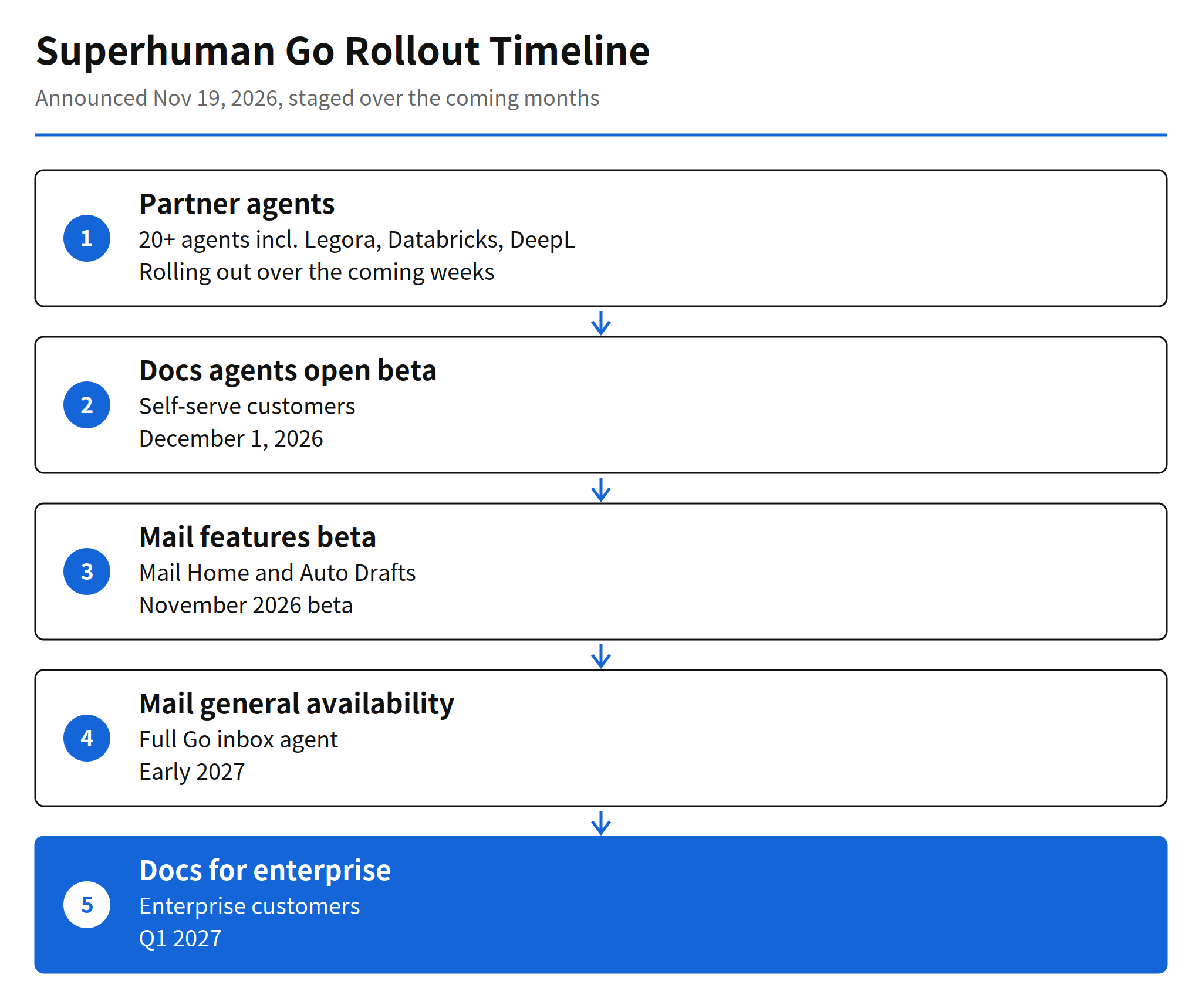
The Go platform SDK is now generally available and includes agent building blocks, so partners and customers can build agents that show up everywhere Go does. Superhuman named nine of the more than 20 incoming partner agents: Legora, Databricks, Amplitude, Saifr from Fidelity Labs, Blackboard, Apollo, Bitly, DeepL and Gamma. The examples show the intended breadth. Legora answers legal questions, the Databricks Live Metrics agent fills in missing metrics, Amplitude's Product Check agent verifies product usage claims, Blackboard's Assignment Coach helps students against course requirements, and DeepL's Brand Translator aims to keep a user's voice across languages.
Read as distribution, this is an early app store for agents inside a productivity suite. A partner agent built once inherits placement across mail, documents and meetings instead of negotiating each surface separately. The risk is the usual platform risk in reverse: partners are betting on Go's user base before most of the announced assistant features have shipped, and Superhuman has not published SDK pricing, review rules or revenue terms in the announcement, so the economics for builders are still unconfirmed.
Agents Inside Superhuman Docs
In Superhuman Docs, agents stop being a side panel. Users can share a document with an agent the way they would share it with a person, mention the agent to hand off work, and see it appear in the document like any other collaborator. Agents can also run on triggers whether or not anyone has the document open. Superhuman's examples are concrete: a product plan changes and an agent revises the rollout document that depends on it, customer feedback lands in a table and an agent pulls related tickets and writes findings into the row, and a briefing agent rewrites the top of a team document every morning from the previous day's pipeline changes.
The accountability design matters as much as the automation. Every action an agent performs in a document is logged, users can see when it last ran, and version history shows what it changed and who authorized it, with changes attributed to the agent. That attribution is what makes always-on document agents plausible in a team setting, because a wrong automatic edit can be found and reversed instead of silently absorbed into the text. Availability is staged: open beta on December 1, 2026 for self-serve customers, and the first quarter of 2027 for enterprise customers.
Go Inside Superhuman Mail and Fathom
In Superhuman Mail, Go becomes the inbox agent. It triages the inbox, searches across more than 100 connected tools, and handles cross-tool work that starts in email, such as creating a ticket, pulling metrics or updating a CRM record. Connecting a tool once to Go makes it usable across the whole suite, which removes the repeated per-app integration setup that usually fragments this kind of automation. Mail Home proactively shows the three things that need the most attention, tracks what the user promised others and what others promised the user, and Auto Drafts now pull context from sources such as Slack, meeting notes and internal documents. Superhuman says Auto Drafts already save an average of nine minutes per draft, which it frames as about three hours a week for someone replying to four emails a day. The new Email Assistant carries the core of that experience into Gmail and Outlook, splitting reply-needed mail from FYI mail, drafting replies, resurfacing conversations and archiving low-priority mail.
Fathom, now a Superhuman company, closes the meeting side of the loop. Its notetaker captures video, screen sharing and audio without a bot joining the call, with speaker attribution and live in-call notes. The next iteration adds one automatically shared collaborative note per meeting, and Go can act on action items from the conversation, for example drafting promised messaging before the meeting even ends. Meeting context then travels through a native Go connector and third-party MCP connections. The pattern across Mail, Docs and Fathom is consistent: capture context where work already happens, then let the same agent layer act on it in the other surfaces.
Adoption Numbers and the Last Mile Argument
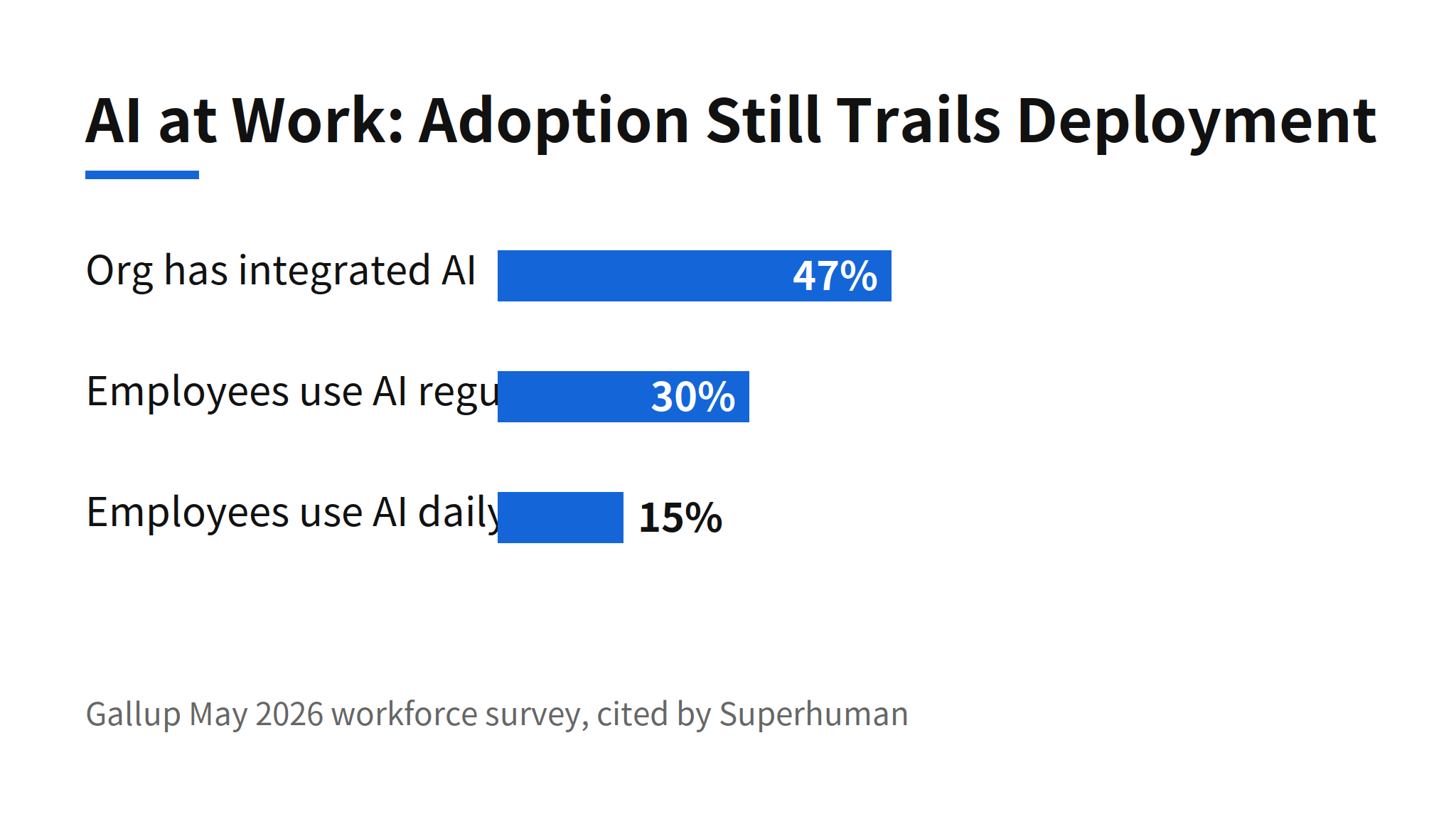
Superhuman frames the launch around an adoption gap. It cites Gallup's May 2026 workforce survey: 47 percent of U.S. employees say their organization has integrated AI technology or tools, but only 30 percent of employees use AI regularly and 15 percent use it daily. CEO Shishir Mehrotra called this the last mile of AI, the gap between deployment and adoption, and argued that AI embedded in existing tools reaches the whole team rather than only power users who go looking for it. As supporting scale, the company says it makes over 100 billion LLM calls a week, thousands per user per day, and that Go has passed 1 million monthly active users growing 20 percent month over month.
Those figures need their labels kept on. The Gallup numbers are a cited third-party survey. The 100 billion calls and the 1 million active users are Superhuman's own claims from its launch post and CEO remarks reported by TechCrunch, and the company has not published how monthly active users are counted. The direction of the argument is still testable: if embedding agents in mail and documents really closes the adoption gap, regular and daily use inside Superhuman's own base should show up in exactly the kind of usage growth the company is reporting, and future updates will either keep publishing those numbers or quietly stop.
Limits and Unconfirmed Points
- Most features are not available yet: the personal assistant and new features roll out over the next few months, partner agents over the coming weeks, Docs agents in open beta on December 1, 2026 for self-serve customers and in the first quarter of 2027 for enterprise, and Mail features in beta in November 2026 with general availability in early 2027. Early access runs through the Superhuman Community.
- Approval boundaries are unspecified: Superhuman says the user always decides what gets done, but the announcement does not state per integration which actions need approval each time and which run on a standing approval.
- Usage figures are company claims: the 1 million monthly active users, 20 percent monthly growth and 100 billion weekly LLM calls come from Superhuman itself, with no published counting method and no independent verification.
- Platform economics are unpublished: the announcement does not disclose SDK terms, partner review rules or any revenue arrangement for the more than 20 partner agents.
Even with those caveats, the release marks where agent competition is moving. The contested layer is shifting from standalone chatbots toward the default agent layer inside the mail, document and meeting tools people already use, with third-party agents distributed through an SDK on top. Superhuman's bet is that owning the everyday surfaces beats owning a destination app, and the staged dates above give a concrete schedule to check that bet against.
FAQ
What is the Superhuman Go personal AI assistant?
It is a personal assistant inside Superhuman Go that users can name and personalize. It flags what needs attention across connected tools, suggests next steps, drafts content in the user's voice and manages the user's team of agents, while the user decides what actually gets done.
What does the Go platform SDK release mean for partners?
The Go platform SDK is now generally available to partners and customers, with new agent building blocks. Over 20 partner agents, including Legora, Databricks, Amplitude, DeepL and Gamma, will roll out over the coming weeks and appear everywhere Go works.
When do Superhuman Docs agents become available?
Go agents in Superhuman Docs enter open beta on December 1, 2026 for self-serve customers. Enterprise customers follow in the first quarter of 2027.
When do the new Superhuman Mail features arrive?
The new Mail features, including Mail Home and Auto Drafts with cross-tool context, arrive in beta in November 2026 and become generally available in early 2027. The Email Assistant also brings core Mail help into Gmail and Outlook.
How many monthly active users does Go have?
Superhuman says Go has surpassed 1 million monthly active users and is growing 20 percent month over month. The company has not published how that figure is counted, so the number is a company claim rather than an independently verified metric.
Related Reading
- Mastra Factory Release: Issue to PR With Slack Agents, earlier coverage of agents moving into shared team work surfaces