Mastra Factory Release: Issue to PR With Slack Agents
Mastra announced a major update to Mastra Factory on November 18, 2026, turning its open-source software factory into a team work board where coding agents take work from intake to a merged pull request. Work now arrives from GitHub, GitLab, Linear, Jira and Incident.io incidents, every change carries a live preview link, and Slack becomes a first-class surface where a team can file work, answer agent questions and approve plans inside a thread. It is not a 1.0.0 release. Mastra says it will keep hardening stability and reliability before calling Factory 1.0, and it has not announced a date.
The shift matters because of where the work sits. A local coding agent ends inside one engineer's terminal, with its own worktrees and threads to manage. Factory lifts intake, workflow stages, approvals and previews onto a shared board, so the unit of automation is the team's queue rather than one person's session. Mastra built the tool to run its own repositories, used it internally under the name Shipyard, and now ships the same system as open source, which means the workflow is available to copy rather than just to read about.
How a Work Item Moves Through the Factory
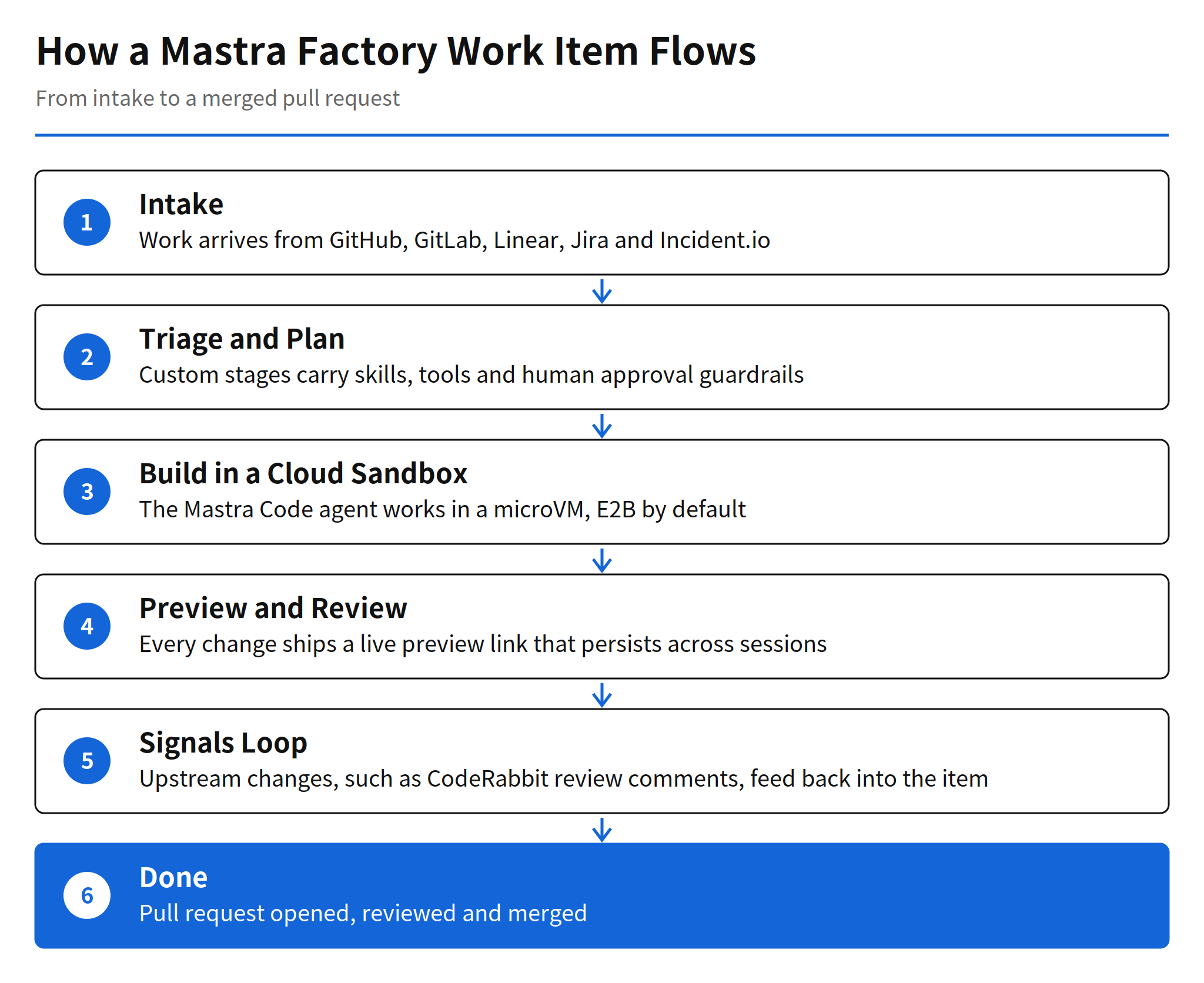
Work progresses through customizable workflow states such as Triage, Plan, Review and Done. Each stage can carry its own skills, tooling and guardrails, including human approvals where a team wants them. The coding agent is a cloud agent backed by Mastra Code, and it keeps observational memory that persists across work items on the board, so context from earlier items is available to later ones instead of being rebuilt per session.
Mastra also unified the session model in this update. The beta had several kinds of work streams, including a separate supervisor concept, and engineers reported that they did not want to learn a new interface. Any session now has the tools to interact with the board, start other sessions and thread context back, and UI sessions are private by default with optional sharing. Intake will widen further over time through Mastra Connect, which also supplies connections to team tools beyond issue tracking and version control.
Slack as a First-Class Work Surface
The Slack integration is the most concrete change in daily use. Tagging Factory in a thread files work, and the team can answer its questions and approve plans without switching to the web UI. In ambient mode, a tagged Factory instance judges whether a thread message calls for a reply at all, behaving more like a team member than a command bot. It can share screenshots, full app previews and files in the thread, and an opt-in generative UI mode lets it answer with rich Slack-native structures such as bar and pie charts.
The primitive underneath is Signals. A work item can subscribe to an upstream state change and steer itself when that change happens. Mastra's own example is code review: the team uses CodeRabbit for PR reviews, and with no extra configuration the work item subscribes to those reviews and automatically addresses the comments. That closes a loop most agent setups leave open, where a review comment waits for a human to notice it, restate it and restart the agent.
Cloud Workspaces, Previews and Model Choice
Every session runs in a cloud workspace with its own microVM sandbox, E2B by default on the Mastra platform. Teams can customize the Docker image plus memory and CPU, run sessions in parallel without touching a local machine, and get persistent, stable URLs for each workspace. App previews build on that: each change ships with a live preview link to an ephemeral environment that persists across sessions, so a reviewer clicks through the real app before opening the diff. Mastra's launch post is explicit about why, arguing that screenshots and code are a weaker substitute as more code is written by people further away from the running product.
Model choice follows the same control-first pattern. Factory supports any provider or gateway, including OpenAI-compatible inference providers such as OpenRouter and Ramp Router, frontier lab models, open-weight models and Mastra Gateway, plus custom gateways where data privacy or compliance rules require them. Defaults come in three modes: Personal, where runs follow the originating user's preferences; Hybrid, where board work uses org-level models and user sessions stay personal; and Org, where the organization enforces its chosen model families.
Measured Results From Mastra's Own Factory
Mastra published its internal numbers with an explicit caveat that factory claims deserve skepticism, and the figures are worth reading with that caveat attached. Before Factory, a Mastra engineer merged 9.5 PRs a week. Over the last four complete weeks that rose to 16.9, a 78 percent increase, split into 12.4 human-authored and 4.5 Factory-authored. The split is the honest part of the claim: most of the gain shows up as humans merging more, with the agent contributing a minority share directly.
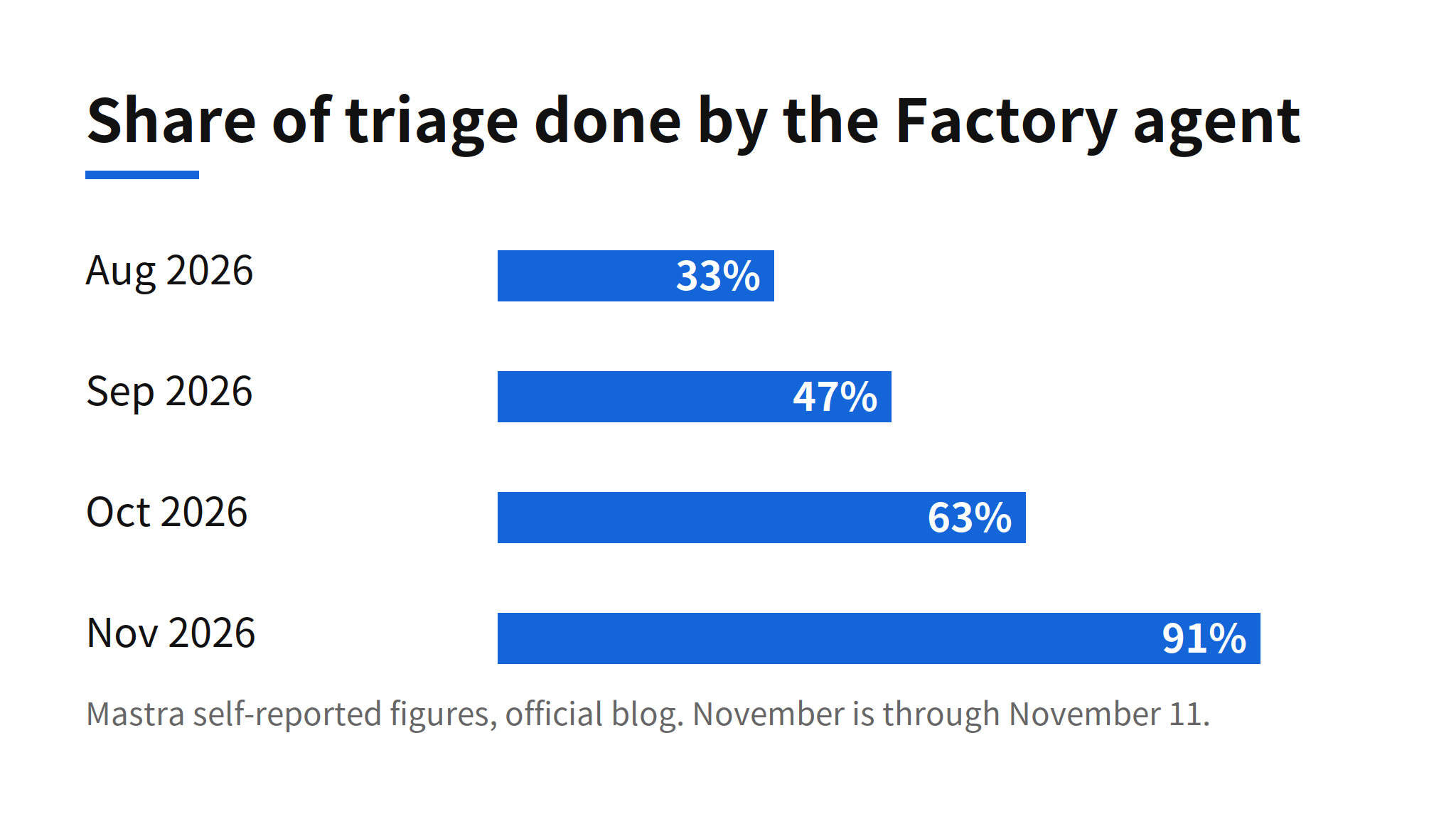
Triage changed the most. The median time a new work item sat in triage fell from 6.9 hours in August to 11 minutes in November, and the Factory agent now performs 91 percent of triage, up from 33 percent in August as item volume grew from 9 items in August to 131 in November through the 11th. End to end, the median time from issue to merged fix for Factory work was 28.2 hours across 290 PRs, against 56.4 hours before Factory, and once a work item is kicked off the median time to an open PR is 76 minutes. Adoption moved with the results: through early October no more than three engineers ran Factory sessions in a given week, and in each of the last three complete weeks 19 to 24 engineers did. Mastra also says it merged nearly 1,000 PRs improving Factory itself since the July alpha and September beta, after hundreds of customer conversations.
Getting Started With One Prompt
Setup is a single prompt to a coding agent, and Mastra says a factory can be set up and doing real work in under five minutes. The documented prompt asks the agent to name the factory, scaffold it and start the dev server:
Set up Mastra Factory for me. Ask me what to name my factory,
then run npx create-factory <factory-name>. Next, run
cd <factory-name> && npm run dev and open http://localhost:4111.
Documentation lives at factory.mastra.ai. For a first trial, the lowest-risk shape follows Mastra's own adoption path: connect one repository, keep human approval on the Plan stage, and let the agent take triage first, since triage is where its measured gains are largest and where a wrong call is cheapest to reverse. The launch post does not disclose Factory pricing, so cost for the hosted platform beyond the open-source core is a point to confirm before planning a rollout.
Limits and Unconfirmed Points
- All performance figures are self-reported: the 78 percent PR gain, the 11-minute triage median and the 91 percent agent triage share come from Mastra's own blog about its own team, with no third-party verification.
- Not a 1.0.0 release: Mastra states plainly that Factory is not launching as 1.0.0 and gives no date, only a commitment to keep improving stability and reliability.
- Pricing not disclosed: the launch post does not state pricing for the hosted platform, sandboxes or gateway usage.
- Claude Code and Codex support unconfirmed: secondary coverage described support for those tools as in progress, but the official blog text does not confirm it.
Read with those limits, the release still marks a clear direction. Vercel launched Board, its own agent collaboration surface, in the same week, and the overlap is not a coincidence: the contested layer is moving from raw model capability to the work management structure around agents, who files work, who approves it, where it runs and how review feedback gets back into the loop. Factory's bet is that this structure should be open source and customizable per team, and its internal numbers, self-reported as they are, are at least specific enough to test against.
FAQ
What is Mastra Factory?
Mastra Factory is an open-source software factory from the Mastra team. Work items from GitHub, GitLab, Linear, Jira and Incident.io land on a team board, and a cloud coding agent moves them through customizable stages from triage to a merged pull request.
What is new in the November 18, 2026 Factory update?
The update adds live app previews that persist across sessions, a Slack-native work surface with ambient mode and generative UI, Signals that react to upstream changes such as review comments, and broader intake and model support. It is not a 1.0.0 release, and Mastra has not announced a 1.0 date.
How do you set up Mastra Factory?
Mastra documents a one-prompt setup: ask a coding agent to run npx create-factory with a factory name, then run npm run dev and open http://localhost:4111. Mastra says a factory can be set up and doing real work in under five minutes.
Which models does Mastra Factory support?
Factory supports any model provider or gateway, including OpenAI-compatible providers such as OpenRouter, frontier lab models, open-weight models and Mastra Gateway. Model defaults can follow personal, hybrid or org-wide modes, and custom gateways are supported for privacy and compliance needs.
Are the Factory performance numbers independently verified?
No. The figures in the launch post, including merged PRs per engineer rising from 9.5 to 16.9 a week and median triage time falling from 6.9 hours to 11 minutes, are Mastra's own measurements from its internal factory, which it calls Shipyard. No third-party verification has been published.
Related Reading
- Eclipse Enclave 1.0 Release: Sandbox for Coding Agents, earlier coverage of the sandbox layer coding agents run in