DaisyRose-27B Release: Benchmarks, Training and Limits
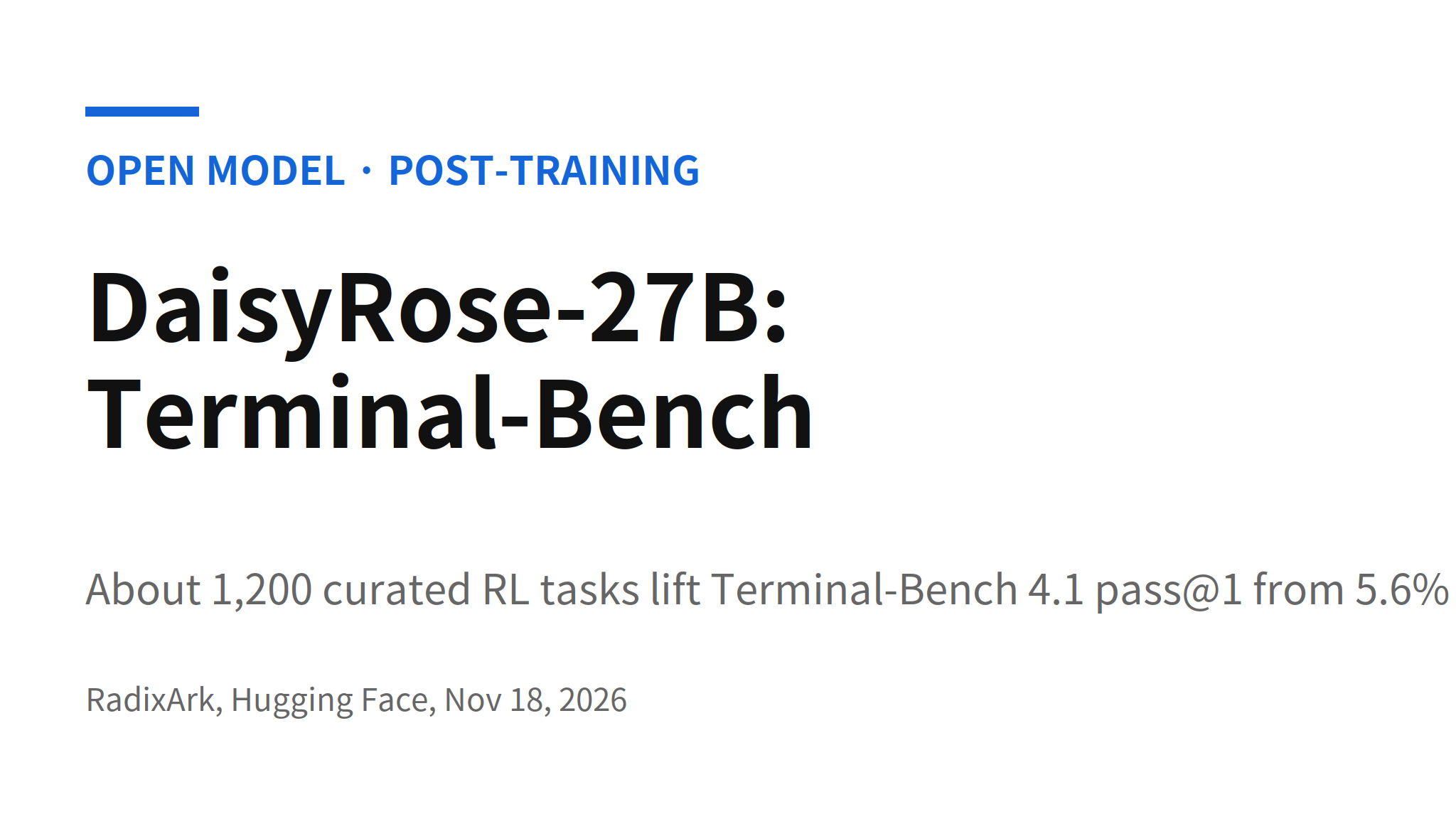
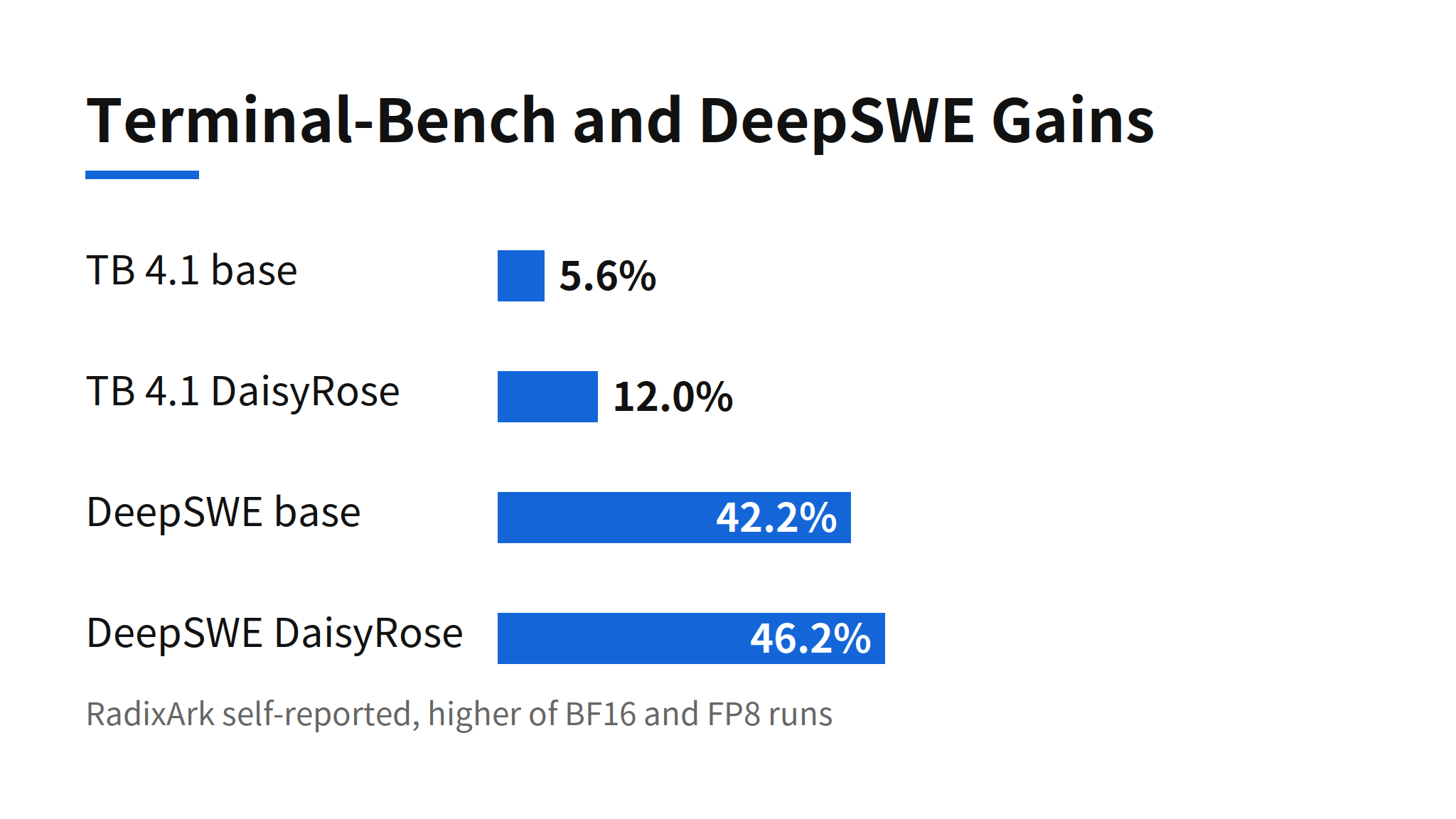
RadixArk released DaisyRose-27B on November 18, 2026, its first model, and the headline result is a doubling on the hardest benchmark it reports: Terminal-Bench 4.1 pass@1 rose from 5.6% for the base model Qwen3.8-27B to 12.0%. The striking part is the size of the training set. RadixArk and Eigent AI built thousands of candidate tasks, then kept only about 1,200 tasks, each redesigned around a mistake the base model actually makes. Training ran for 18 days on 144 H200 GPUs, and the checkpoints are public in BF16, FP8 and NVFP4 formats under the Apache 2.0 license.
That combination matters because it challenges a common budgeting assumption. Teams improving a coding agent usually wait for a larger base model or tune the agent harness around the model they have. DaisyRose-27B is evidence for a third route: keep the base model, spend the budget on task design, and post-train only on failures that were observed in practice. Whether the route generalizes is a separate question, and the limits section below covers why the published numbers should be read with care.
Benchmark Results Across Seven Tests
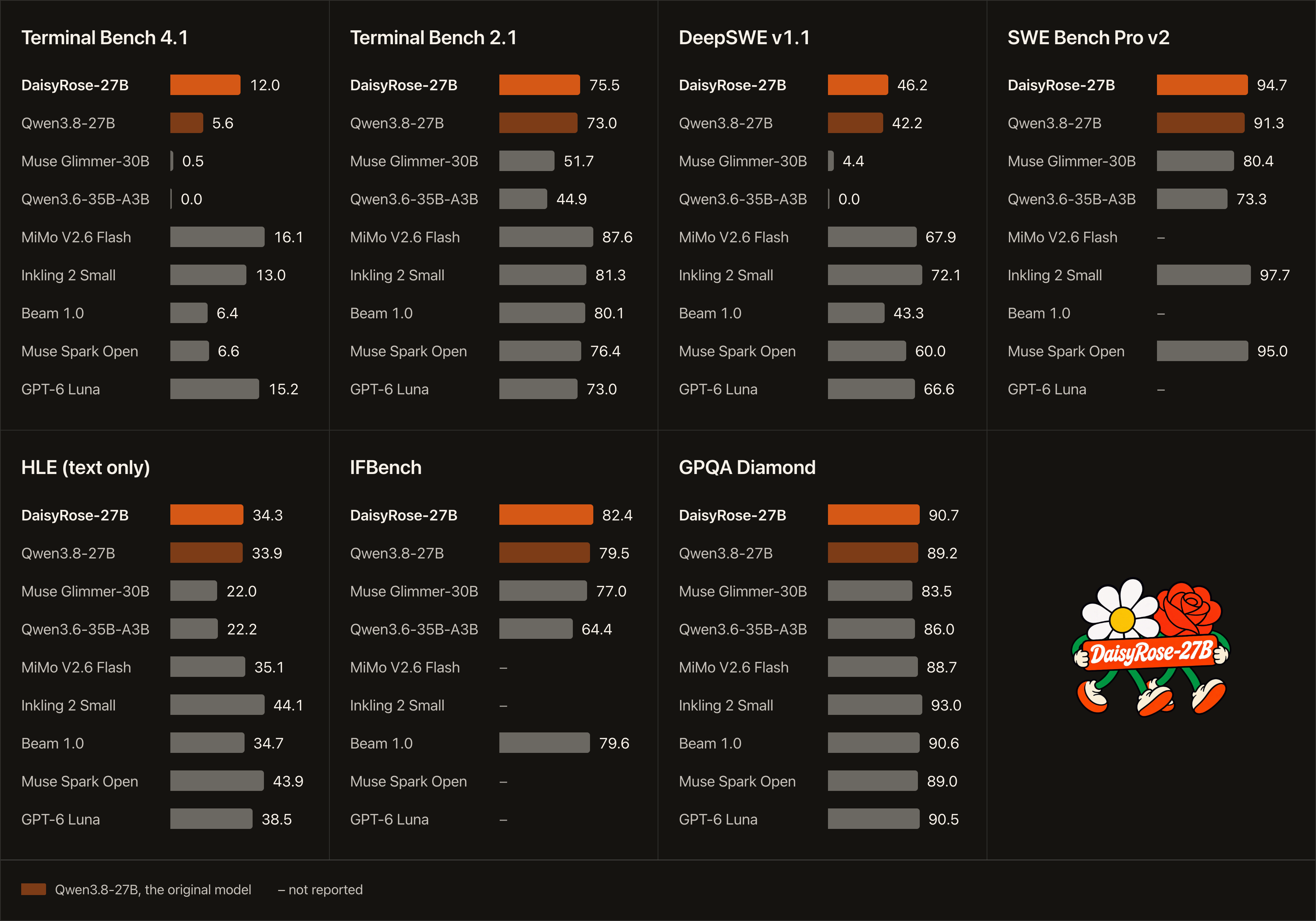
RadixArk reports gains on all seven benchmarks it published. Terminal-Bench 2.1 moved from 73.0 to 75.5, DeepSWE v1.1 from 42.2 to 46.2, and SWE Bench Pro v2 from 91.3 to 94.7. The reasoning and instruction tests moved less: HLE text only from 33.9 to 34.3, IFBench from 79.5 to 82.4, and GPQA Diamond from 89.2 to 90.7. The pattern fits the training design. The tasks were long horizon agent jobs, so the largest gain landed on the terminal agent benchmark and the smallest gains landed on static question answering.
Two measurement details belong next to those numbers. First, every score is RadixArk self-reported, and each benchmark score uses the higher of the BF16 and FP8 runs, although RadixArk says the two differ by less than one point wherever both were evaluated. Second, the absolute Terminal-Bench 4.1 score is still 12.0%. A doubling from a low base means the model still fails most of those tasks, so the result is best read as evidence about training efficiency rather than as a claim that terminal agents are solved.
Task Design From Observed Failures
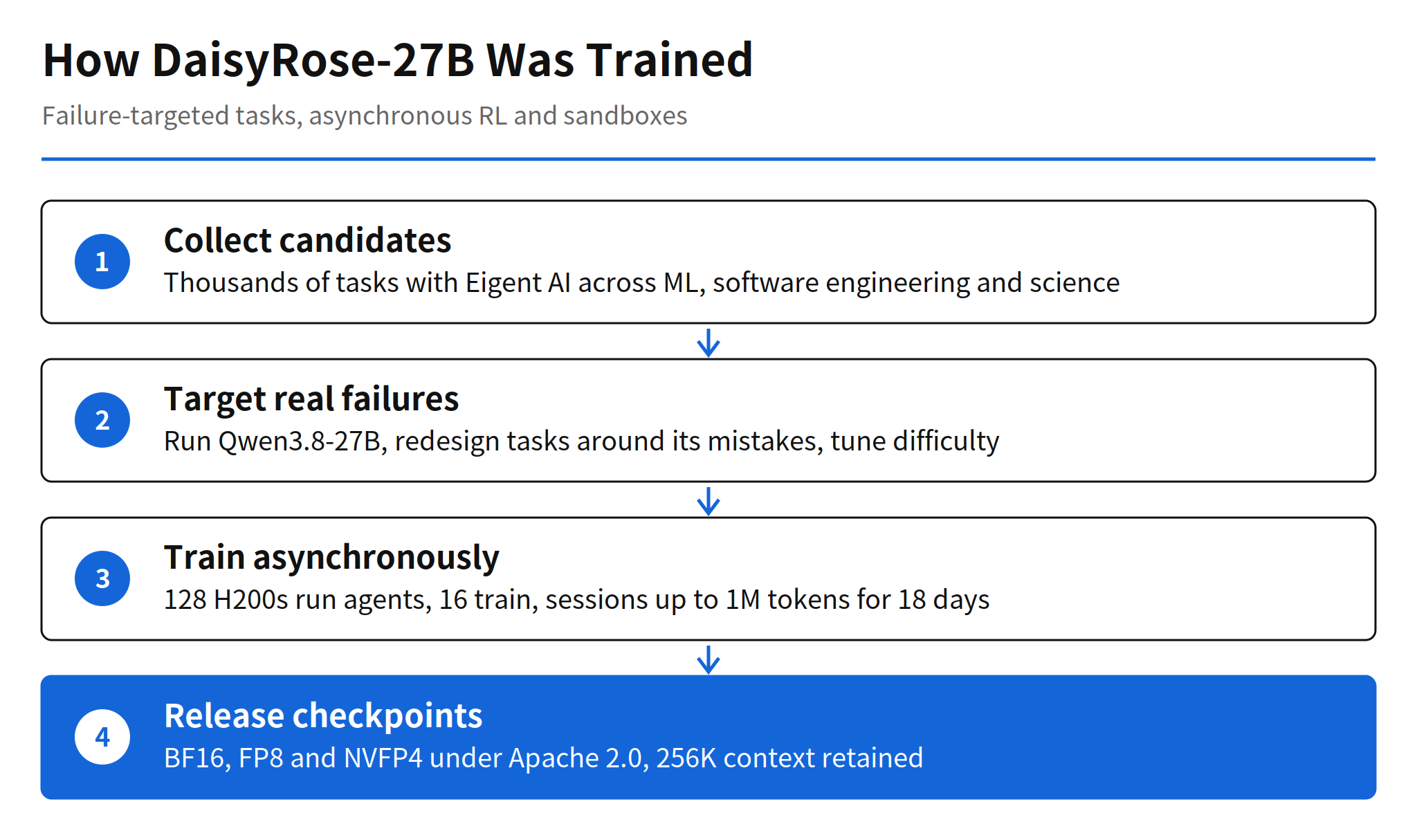
The task pipeline started from Eigent AI large pool of tasks in machine learning, software engineering, science and other fields. RadixArk ran Qwen3.8-27B on every candidate, redesigned each task around the mistakes it wanted the model to stop making, and adjusted difficulty until the solve rate fell within a range where learning could happen. Tasks that could be passed without solving the intended problem, or that contained a design flaw, were fixed or removed after review alongside the model attempts.
The surviving tasks are long by design. Each one requires several interdependent steps, and each attempt gets up to 1.5 hours in a sandbox, more than 100 tool calls and more than 256K output tokens. Training sessions could reach 1M tokens, using harness summarization to span multiple trajectories. That profile is far from short prompt reinforcement learning, and it explains why the sandbox and backend work below took as much engineering as the training itself.
Training Backend, Cost and Sandbox Scale
DaisyRose-27B was trained with Miles, RadixArk open source reinforcement learning framework, in fully asynchronous mode. While 128 H200 GPUs ran inference on agent tasks, 16 more ran the trainer and learned from the trajectories, with the updated model sent back to the inference GPUs after every step. The internal backend reached 37% model FLOPs utilization, compared with 16% for a comparable run on the Megatron based open source trainer, which RadixArk translates into 57% less GPU time for the same training. End to end throughput was about 16,800 tokens per second across the 144 GPUs, against about 8,300 for the open source trainer.
The sandbox service carries its own scale numbers. Built on the open source AgentENV project, it ran about 944,000 sandboxes between mid September and mid November, with up to 1,566 running concurrently, and 99% of sandbox creations succeeded across the nine weeks, rising above 99.95% since late October. RadixArk also says cloud infrastructure costs for its sandboxes were about 80% lower than popular cloud sandbox providers, helped by memory allocations that grow and shrink with actual usage. The total training bill in compute terms was 63,000 GPU hours. No dollar pricing for the model or the training run was published, and the internal backend itself is not public. Miles is the part other teams can actually download and reuse.
Running the Model With SGLang
The release keeps the base model shape intact: architecture, tokenizer, chat template and image understanding are unchanged, and the context window stays at 256K tokens. RadixArk recommends serving DaisyRose-27B with SGLang and DSpark speculative decoding, with launch configurations in the SGLang cookbook for different GPUs and checkpoint formats. After starting the server with the served model name DaisyRose-27B on port 30000, requests go through the standard OpenAI Python client against the local endpoint. The model thinks before answering by default, returning reasoning in reasoning_content and the final answer in content, with the model card settings of temperature 1.0, top_p 0.95, top_k 20 and min_p 0.0.
For a team evaluating the model, the practical sequence is narrow: download one of the three checkpoint formats, serve it with the cookbook configuration that matches the available GPU, and test it on the team own terminal tasks rather than on the published suite. The published suite was, by construction, close to the training distribution, since the training tasks were selected from similar long horizon agent work. Performance on a different task mix is unconfirmed.
Limits and Unconfirmed Points
- Self-reported benchmarks: all scores come from RadixArk, use the higher of BF16 and FP8 runs, and have no published independent remeasurement yet.
- Low absolute score: Terminal-Bench 4.1 at 12.0% means most tasks in that suite remain unsolved, despite the doubling against the base model.
- Closed backend: the 57% GPU time saving compares RadixArk internal backend with an open source trainer. The internal backend is not released, so that saving is not directly reproducible. Miles, the training framework, is open source.
- Task list not fully public: the full list of about 1,200 tasks and the detailed difficulty adjustment criteria have not been confirmed as public.
- No pricing: the checkpoints are free under Apache 2.0, but RadixArk published no hosted API pricing for DaisyRose-27B in the release post.
Read with those limits, the release still gives post-training teams a concrete reference point. A 27B open weight model doubled its terminal agent score with a training set small enough to audit by hand, provided the tasks were built from observed failures and the infrastructure could sustain very long sessions. The transferable lesson is the ordering: collect the failures of the model you already have before paying for more data or a larger model.
FAQ
What is DaisyRose-27B?
DaisyRose-27B is RadixArk first model, released on November 18, 2026. It is Qwen3.8-27B post-trained with reinforcement learning on about 1,200 curated long horizon agent tasks using the open source Miles framework.
How much did Terminal-Bench improve?
Terminal-Bench 4.1 pass@1 rose from 5.6% for Qwen3.8-27B to 12.0% for DaisyRose-27B in RadixArk self-reported results. The scores use the higher of the BF16 and FP8 runs, and no independent remeasurement has been published yet.
How can DaisyRose-27B be run?
RadixArk recommends serving the model with SGLang and DSpark speculative decoding. Checkpoints are available in BF16, FP8 and NVFP4 formats under the Apache 2.0 license, and the model keeps the 256K token context window of the base model.
What did the training run cost in compute?
Training ran for 18 days on 144 H200 GPUs and used 63,000 GPU hours in total. RadixArk reports 37% model FLOPs utilization on its internal backend, compared with 16% for a comparable Megatron based open source trainer run.
Related Reading
- OpenAI Jagged Frontier: Coding Agent Success Rates and Costs, a wider look at how uneven coding agent performance is across task types
- Transformers MoE Streaming: 180B on 32GB, 13.9 tok/s, another efficiency story, this time at inference time instead of training time