OpenAI Jagged Frontier: Coding Agent Success Rates and Costs
OpenAI published "Research acceleration: The jagged frontier" on November 18, 2026, a follow-up to its September report on how coding agents are changing development cycles inside its own research organization. The headline number is the share of tasks agents finished with no human intervention. For research tasks estimated at 2 to 4 hours of human work, that share rose from 23% in March to 46% in October. For 4 to 8 hour tasks, it rose from 13% to 35%.
The average hides the point of the report, which is in its title. Performance is jagged. Measured from August 1 to October 18, agents completed 79% of training run monitoring tasks unattended, but only 25% of inference and serving stack code tasks. A team deciding what to delegate should read the spread, not the mean. Narrow, well bounded work such as watching a training run is already close to hands off. Code that touches a whole production system is not, and the gap between those two numbers is the most useful planning figure in the release.
Success Rates by Task Type
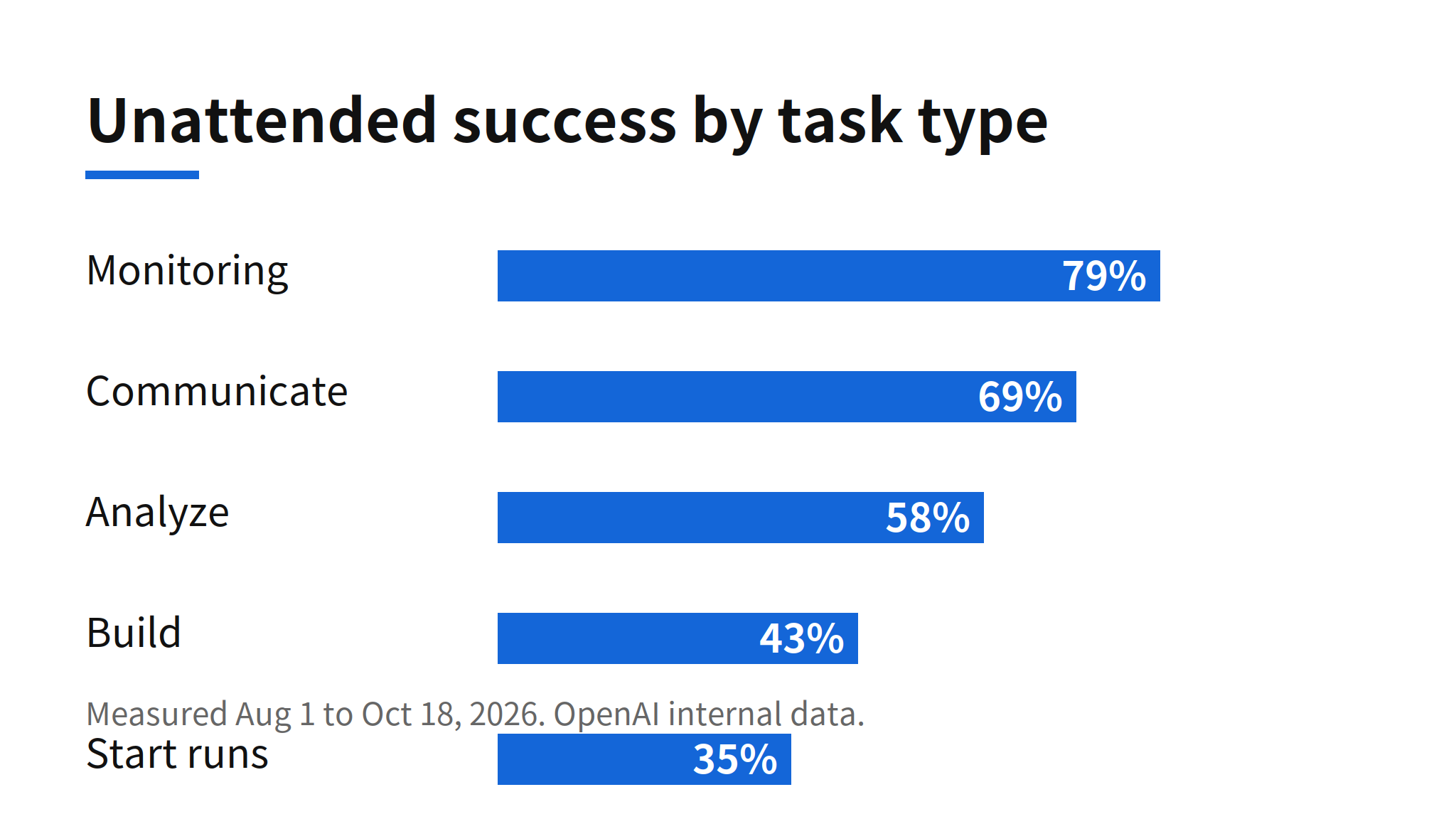
The breakdown runs in a consistent direction. Monitoring training runs reached 79% and starting training runs reached 35%, while writing inference and serving stack code reached 25%. Grouped by activity, Communicate scored 69%, Analyze 58% and Build 43%. Tasks that observe, summarize or report on a bounded system do far better than tasks that change a shared system, where a mistake propagates and where the correct change depends on context outside the immediate file.
That pattern matches what the September report started and what external measurements have suggested. It also explains why the improvement curve differs by task length. Doubling unattended success on 2 to 4 hour tasks in about seven months is a real capability gain, but the 4 to 8 hour band still sits at 35%, so longer tasks remain the binding constraint. For practitioners, the practical rule the data supports is to split work along the jagged edge: hand agents the monitoring, analysis and communication load first, keep humans on serving infrastructure and other system wide changes, and recheck the boundary every few months because it is moving.
Usage, Spend and Concurrent Agents
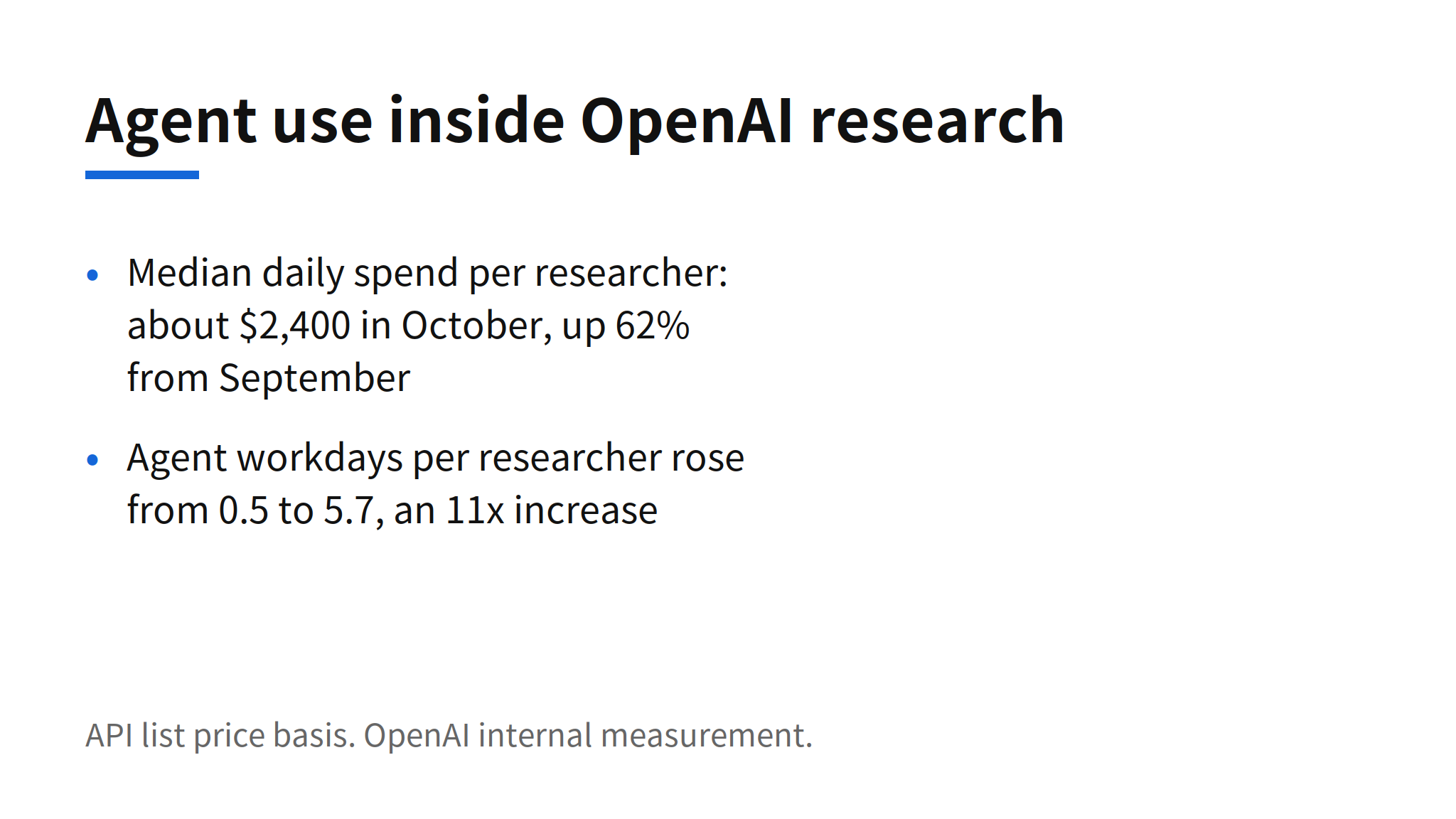
Usage grew as fast as success rates. At API list prices, the median daily agent spend per researcher reached about $2,400 in October, up 62% from September, and the top 10% of researchers reached about $23,000, up 105%. Agent workdays per researcher, where eight hours of agent use counts as one day, rose from 0.5 to 5.7, an 11x increase. By mid October, more than two thirds of researchers averaged at least 4 concurrently running agents per day, and more than 10% averaged at least 16.
Those figures reframe the cost question. The relevant comparison is no longer a seat license against a salary. It is a per researcher compute budget in the thousands of dollars per day, spent because the researchers running the most agents are also the ones reporting the largest gains. OpenAI also reported that recorded research weeks in Safety and Alignment grew 77% from January to September, the largest absolute increase among major research areas, which suggests agent capacity is being directed at oversight work as well as at capability work.
A survey of 101 researchers put a value on that shift. Asked what they would give up to keep frontier coding agents for three months, the median answer was 40% of team headcount and 30% of team compute. That is a stated preference in a hypothetical trade, not a market price, and it should be read as a measure of how embedded the tools have become rather than as a staffing recommendation.
Where Key Ideas Came From
The report also asked researchers where the key ideas behind GPT-6 Astra and GPT-6.2 Astra came from. In post training and safety monitoring, respondents said every key idea they named came from humans. In pretraining, some respondents said a key insight emerged from a conversation with Codex during GPT-6.2 Astra work. The samples were small, between one and four people per field, so the result cannot support a general claim in either direction.
Read together with the success rates, the picture is consistent. Agents are absorbing execution volume at scale, including a large share of bounded implementation and monitoring work, while the originating ideas in this sample still came mostly from people. OpenAI repeated its earlier position that AI labs should track and publicly report recursive self improvement indicators. This report is itself an instance of that reporting, which is worth noting when weighing how the numbers are framed.
Limits and Unconfirmed Points
- Internal measurement only: every figure comes from OpenAI's own measurement and estimation, with no independent verification.
- Success depends on human time estimates: rates are defined against an estimate of how long a person would take, so changes in task assignment can move the numbers. OpenAI stated this caveat in the report itself.
- Activity is not the same as outcomes: more code changes and more experiments do not by themselves mean faster research progress. OpenAI drew that distinction too, and its capability index, OpenAI ECI, rose 16.4 points per year against the 14 point per year trend Epoch has observed, a difference the report does not present as dramatic.
- Small sample for idea origins: the idea source survey covered one to four researchers per field, too few to generalize.
None of that makes the report unusable. It makes it a vendor's internal telemetry, published with its caveats attached, and the caveats are part of the value. For a team building its own delegation policy, the durable takeaway is the shape of the frontier rather than any single percentage: bounded observation and communication tasks are delegable now at high success rates, system wide code is not, and the boundary moved measurably in seven months.
FAQ
What did OpenAI's jagged frontier report measure?
The report, published on November 18, 2026, measured how coding agents changed development cycles inside OpenAI's own research organization. It tracked the share of research tasks agents finished with no human intervention, broken down by estimated human task length and by task type.
How much did unattended agent success improve?
For tasks estimated at 2 to 4 hours of human work, the unattended completion rate rose from 23 percent in March to 46 percent in October. For 4 to 8 hour tasks it rose from 13 percent to 35 percent over the same period.
Which task types do agents handle best and worst?
Monitoring training runs scored highest at 79 percent, while writing inference and serving stack code scored lowest at 25 percent. Starting training runs reached 35 percent. By category, Communicate reached 69 percent, Analyze 58 percent and Build 43 percent.
How much are OpenAI researchers spending on agents?
At API list prices, median daily agent spend per researcher reached about $2,400 in October, up 62 percent from September, and the top 10 percent reached about $23,000, up 105 percent. Agent workdays per researcher rose from 0.5 to 5.7.
What are the limits of these numbers?
All figures are OpenAI's internal measurements and estimates, with no independent verification. Success rates depend on estimates of how long a human would take, so changes in how tasks are assigned can move the numbers. OpenAI itself noted that more code changes and experiments do not by themselves prove faster research outcomes.
Related Reading
- GPT-6.2 Astra and Sol release coverage, the model launch whose key ideas this report traced
- METR: Anthropic Model Improvement Is Running 2x Faster, an external measurement of research acceleration at a rival lab