OpenAI Chip Design: AMD GPU RTL Gains Up to 14% PPA
Headline Results
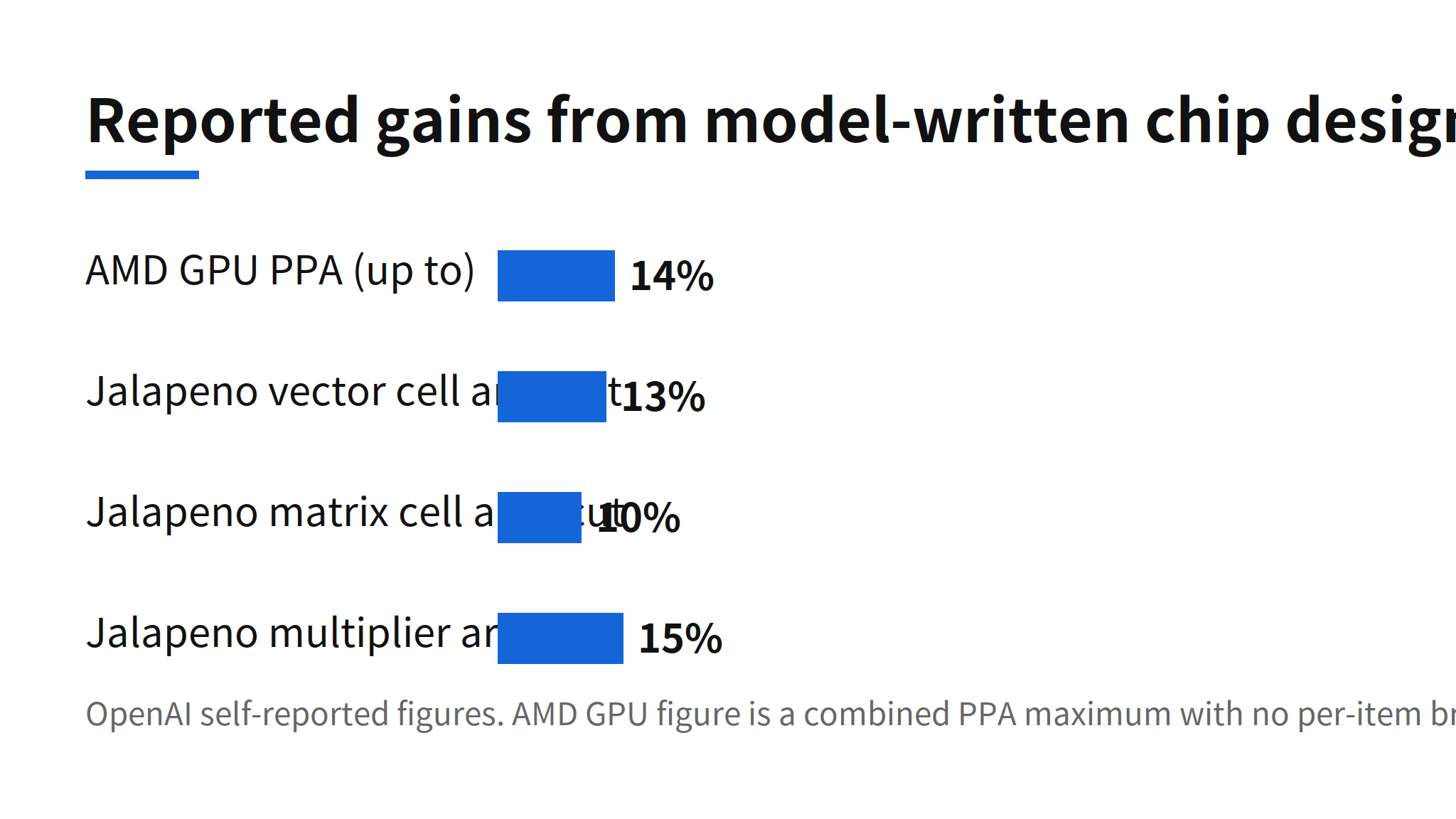
OpenAI published a technical report on 18 November 2026, titled Advancing chip design with OpenAI models, that moves the story from models writing software to models rewriting the circuits of production chips. Working with AMD, the models rewrote SystemVerilog RTL, the code that describes a chip's logic, for AMD's flagship GPU IP and delivered up to 14% better power, performance and area, a combined measure known as PPA, against baselines that were already heavily optimized. OpenAI frames that as roughly a year of design progress compressed into less than five months.
The result is not confined to a paper design. AMD has already included some of the model proposed changes in a recent design sent for manufacturing, and placed the rest in production design files for follow up products. OpenAI also says AMD verified single digit percentage PPA gains across key blocks of its next generation flagship CPU. That manufacturing step is what separates this report from earlier demonstrations of models helping with hardware tasks, because a change that reaches a tape out file has passed the verification flow that guards real silicon.
On OpenAI's own first inference chip, Jalapeno, the evidence is stronger still because it was checked in silicon. Model proposed changes cut standard cell area by about 13% in the vector unit and about 10% in the matrix unit, and those reductions were confirmed during silicon bring-up. One multiplier redesign in the matrix unit cut cell area by about 15% while also reducing latency from two clock cycles to one.
How the Rewrites Were Checked
Every rewrite was checked with Synopsys tools to confirm that the rewritten block preserved the original behaviour, and the same tools were used to weigh the power, performance and area trade offs. That verification loop matters for interpreting the claim. RTL optimization is a closed loop task in the same sense as software optimization with a test suite: a candidate change can be scored automatically, rejected if behaviour changes, and kept only when the measured trade off improves. It is a setting where an agent can iterate many times without a human reviewing each attempt.
The work has a longer history than the headline suggests. Engineers began using GPT-4o on Jalapeno in early 2025, and OpenAI says even that early model found nontrivial improvements. The November report is a follow up to the August update on Jalapeno itself, shifting the focus from the chip's existence to the process that produced it. OpenAI is also training GPT-Synopsys with Synopsys, a model intended to use electronic design automation tools the way expert engineers do. That partnership was announced on 30 September 2026, so it is an existing program rather than a new announcement inside this report.
Generational Evaluation on RISC-V Cores
To show that the capability tracks model generations rather than one favourable prompt, OpenAI evaluated models on two open source 32-bit RISC-V cores, PicoRV32 and Ibex, across 9,881 scored runs. The tasks covered improving an existing design and designing a core from a written specification. At a comparable budget of about 112,000 tokens per run, GPT-6.2 Astra had the highest average score on both cores.
OpenAI includes a caveat that limits how far those scores should be read. When a model designs from a specification, it can omit features such as performance counters that the scoring does not reward, which can inflate the result relative to improving a complete production design. The evaluation therefore supports a claim about direction and generational progress, not a direct estimate of how much of a production chip a model could design unaided.
Limits and Unconfirmed Points
- No breakdown of the 14%: OpenAI does not split the maximum between power, performance and area, and does not report it block by block. The figure does not mean the GPU runs 14% faster.
- No product named: the AMD GPU IP and the CPU blocks are not identified, so the result cannot be tied to a specific shipping product or schedule.
- No finished silicon measurement for AMD: the AMD changes sit in a design sent for manufacturing and in production design files. That is a production commitment, but it is not a measurement from completed AMD chips.
- Self reported figures: every number in the report comes from OpenAI. AMD has not published the same figures on its own channels, so the verification described here is second hand.
- The one year framing is an estimate: OpenAI gives no baseline definition for what a year of PPA progress normally means inside AMD, and no count of candidate rewrites that were rejected along the way.
For readers tracking AI hardware, the durable point is narrower than the headline and more useful. A model has now produced circuit changes that a major chip vendor accepted into a manufacturing bound design, and the same approach produced area cuts on OpenAI's own chip that survived bring-up. Whether the pace generalizes beyond RTL blocks with strong automated verification is the open question, and it is exactly the question the GPT-Synopsys program is set up to answer.
FAQ
What did OpenAI report on chip design on 18 November 2026?
OpenAI published a technical report saying its models rewrote SystemVerilog RTL for AMD flagship GPU IP and delivered up to 14% better power, performance and area against heavily optimized baselines. AMD has already included some changes in a design sent for manufacturing.
What gains were reported on OpenAI's own Jalapeno chip?
Model proposed changes cut standard cell area by about 13% in the vector unit and about 10% in the matrix unit. One multiplier redesign cut cell area by about 15% while reducing latency from two clock cycles to one, and the reductions were verified during silicon bring-up.
How was generational progress measured?
OpenAI ran 9,881 scored runs on the open source 32-bit RISC-V cores PicoRV32 and Ibex. At a budget of about 112,000 tokens per run, GPT-6.2 Astra had the highest average score on both cores.
What are the main caveats on the 14% figure?
OpenAI gave no breakdown of the 14% between power, performance and area, did not name the AMD product, and reported no measurements from finished AMD silicon. All figures are OpenAI self reported, and AMD has not published the same numbers on its own channels.
What is GPT-Synopsys?
GPT-Synopsys is a model OpenAI is training with Synopsys to use electronic design automation tools the way expert chip designers do. The partnership itself was announced earlier, on 30 September 2026.
Related Reading
- AMD MI450X Release: 288GB HBM4, Helios Specs and Claims, the AMD chip lineup this collaboration sits beside
- GPT-6.2 Astra and Sol: Release, Benchmarks and API Pricing, the model that led the RISC-V evaluation