Traces Joins Vercel: Coding Agent Sessions and Sharing
Traces, a service for sharing coding agent sessions across a team, is joining Vercel. The announcement, published on the Traces blog on November 17, 2026, says the entire team is moving to Vercel and will keep working on how teams build software with agents. For existing users, nothing changes on day one.
That continuity matters because Traces had become a shared record layer for agent work. It started in February 2026 as a simple way to share work across different agents, and in nine months it shipped adapters for 16 coding agents. Thousands of teams joined, and nearly 500,000 sessions were shared, according to Traces itself. Those are company published figures, not independently verified numbers, and they should be read that way.
What Traces shipped in nine months
The product list in the announcement shows what the team built beyond basic session sharing. Alongside the 16 adapters, Traces shipped Traces for Teams, Git integrations, Handoffs, Traces MCP and Surfaces. Read together, those names describe a progression. Adapters solve the input problem, because each coding agent stores its session in a different format. Git integration and handoffs solve the continuation problem, because another person or another agent needs to pick up where a session stopped. The MCP surface and Surfaces point at the next problem, which is making the shared record usable by tools, not only readable by people.
Traces describes the result in its own announcement as a hub for collaboration across agent ecosystems, an evolving team memory, and a core building block for teams taking ownership of their intelligence stack. That framing is broader than a viewer for transcripts. A session record holds what was asked, what the agent tried, and where it got stuck. For a team, that record is closer to a pull request discussion or a design document than to a log file, except it is produced as a side effect of doing the work.
What changes and what stays the same
Existing users can keep publishing and using Traces, keep sharing sessions, and keep using the Traces CLI. They can also keep adding users to organizations they already have, and Traces says support channels will remain open and that user data will be handled thoughtfully. The one concrete restriction in the announcement is that new organization creation has been paused as part of the transition.
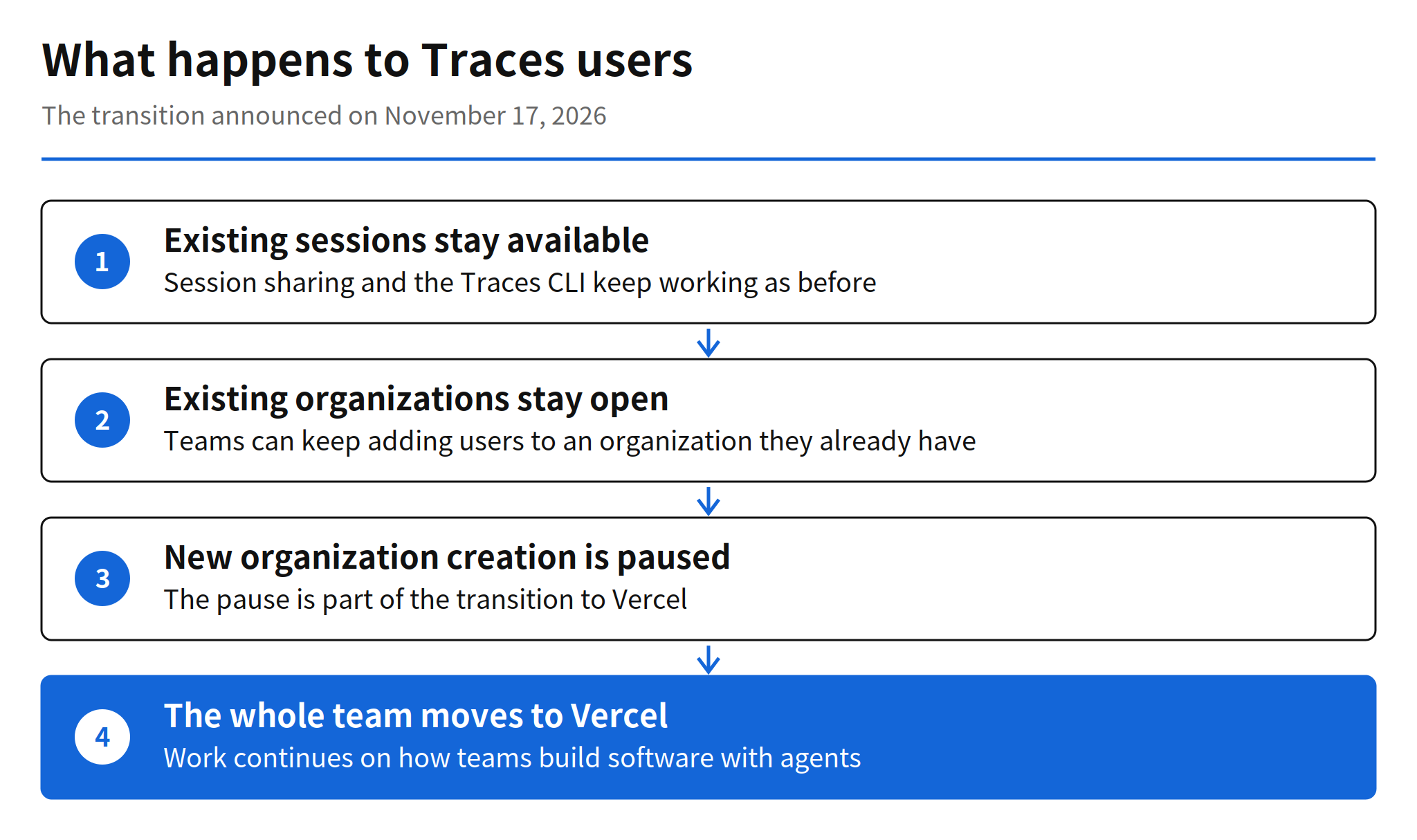
The pause is the detail to watch. Pausing new organizations is a normal step in an acquisition transition, but the announcement gives no date for reopening it and no statement about how long Traces will remain a standalone service. Teams evaluating Traces today therefore face a different question from teams already on it. Existing users have a stated continuity promise. New teams have no stated start date.
Why Vercel wants the session layer
Vercel chief executive Guillermo Rauch called Traces an essential new primitive for software development that sits earlier than the git diff. That comparison explains the fit. Vercel already owns a large part of what happens after code exists, including preview, deployment and delivery. The agent session sits before the diff. It holds the intent, the alternatives the agent explored, and the dead ends, none of which survive into the final commit.
If that earlier layer becomes part of a deployment platform, the practical effect is not only a nicer archive. A platform that sees both the session and the resulting deployment can connect them. It can show which session produced a change, make review start from the reasoning instead of only the diff, and give the next agent the context of the previous one. None of that integration is announced yet, so it remains a direction implied by the acquisition and by Rauch's framing, not a shipped product. Keeping that distinction clear matters, because the announcement itself promises continuity, not new Vercel features.
The timing also fits a wider pattern in the same period. Vercel has been adding agent facing pieces around its gateway and evaluation work, treating agents as users of the platform in their own right. An agent that is a platform user needs an identity, a record, and a way to hand work to a person or to another agent. Traces had already built the record and handoff parts for 16 different agents, which is hard to reproduce quickly because each adapter depends on the details of one agent's session format.
Limits and undisclosed terms
The announcement does not disclose the acquisition price or terms. It does not say when new organization creation will reopen, how long Traces will stay independent, or what name and form it will take inside the Vercel product line. The scale figures, thousands of teams and nearly 500,000 sessions, come from Traces alone, with no independent confirmation published alongside them.
There is also a practical limit in the model itself. A shared session is only as useful as what a team does with it. If sessions are shared but never reviewed, searched or handed off, the archive grows without changing how work is done. The value Traces demonstrated was in teams that treated sessions as a working record. Moving that record into a larger platform lowers the cost of keeping it, but it does not by itself create the review habit that makes the record valuable. That is the part new and existing users should judge in the months after the move, alongside the concrete questions about naming, pricing and standalone availability that the announcement leaves open.
Related articles
FAQ
What did Traces announce on November 17, 2026?
Traces announced that it is joining Vercel and that its entire team will move to Vercel. The team will continue working on how teams build software with agents.
What changes for existing Traces users?
Nothing changes on day one. Existing users can keep sharing sessions and using the Traces CLI, and they can keep adding users to organizations they already have. New organization creation has been paused as part of the transition.
How large had Traces become before joining Vercel?
Traces said thousands of teams had joined and nearly 500,000 sessions had been shared. Those figures are the company's own published numbers and have not been independently verified.
Were the acquisition terms disclosed?
No. The announcement did not disclose the acquisition price or terms, when new organization creation will reopen, or what name and form Traces will take inside the Vercel product line.