OpenAI Healthcare Agents: 99% Safe, 94.3% Bench Score
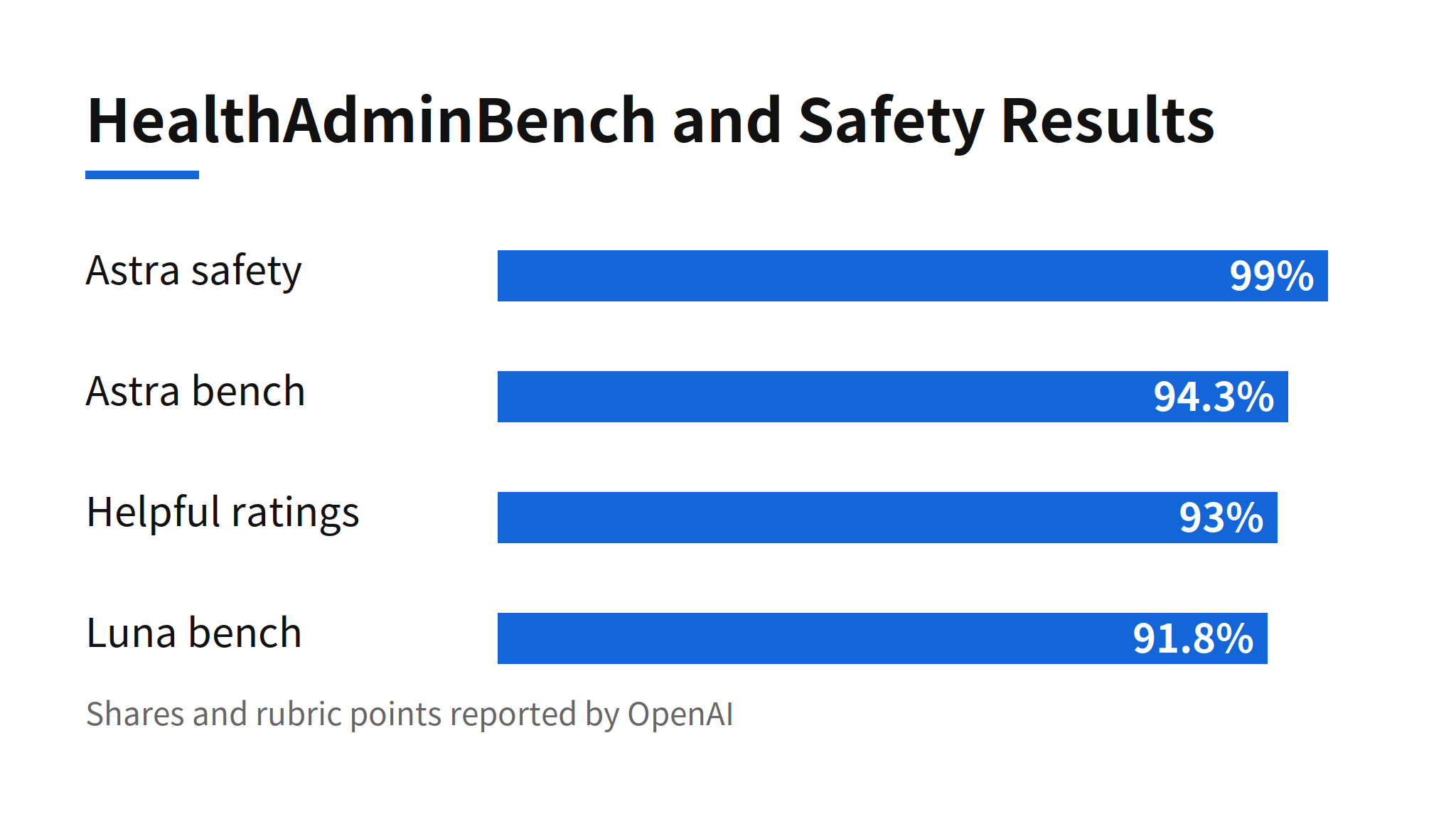
OpenAI published performance, safety and cost results for computer-use agents built for healthcare teams on November 16, 2026. The headline numbers are specific. Physician reviewers rated 99% of 325 reviewed GPT-6 Astra tasks from clinician EHR inboxes as clinically safe. On HealthAdminBench, an independent benchmark built by Stanford researchers, Astra earned 94.3% of the rubric points, while GPT-6 Luna earned 91.8% at 8.5 cents per task, a cost 98% below Astra. Healthcare teams, developers and individual clinicians can use the capability from that day through the OpenAI API, ChatGPT for Healthcare and ChatGPT for Clinicians.
The work these agents take on is the screen work between systems. A patient record sits in one system, the inputs for an insurance approval sit in another portal, and a team member copies data across by hand before care can move. A computer-use agent clicks and types its way through those applications, so it can finish multistep work that APIs do not fully reach. The partner organizations named in the release are Abridge, Ambience, Cigna Healthcare and CVS Health, and the task range covers authorization requests, referrals, discharge planning and contact between visits.
Safety and Helpfulness Numbers
The safety assessment looked at the agent's interface actions together with the notes, orders and patient messages it produced, and asked whether inaccuracies, omissions or actions in that work could plausibly lead to patient harm. That is a reviewer judgment about the work product, applied task by task. It is a stronger form of evidence than a demo, because the sample is counted and the judgment standard is stated. It is still not an outcome measure. The release does not show that patient harm fell in live care, and reading 99% as a clinical outcome would go past what OpenAI reported.
Helpfulness was measured on a five-point scale. In 93% of 646 assessments, physicians chose one of the two highest categories, "very helpful" or "extremely helpful". Taken together, the two figures answer different questions. The safety review asks whether the work could hurt someone. The helpfulness ratings ask whether clinicians found the output worth having. An agent can pass one test and fail the other, so publishing both counts, with their denominators, is what makes this release more useful than a launch post with adjectives instead of numbers.
HealthAdminBench and the Cost Gap
HealthAdminBench is the independent part of the evidence. Stanford researchers built the benchmark, and it contains 135 tasks and 1,698 subtasks spanning prior authorization, durable medical equipment orders and appeals. Agents observe live web portals through screenshots, accessibility trees or both, then navigate forms, review clinical documentation, check coverage criteria and submit decisions through standard browser interactions. Astra earned 94.3% of the available rubric points and Luna earned 91.8%, with both models evaluated at maximum reasoning effort.
The 2.5 point gap between the two models is small next to the cost gap. Luna ran at 8.5 cents per task, which OpenAI puts at 98% below Astra's cost per task. For a team processing tens of thousands of referrals a day, that difference decides which model handles the routine volume and which one is reserved for harder cases. One caveat applies to the whole benchmark section. These scores reach the public through OpenAI's own post, and how the per-task failures are distributed across the benchmark has not been confirmed from the benchmark's raw data. The scores are citable. The failure profile behind them is not yet public in the same detail.
Production Work at CVS Health and Cigna Healthcare
The strongest claim in the release is not a benchmark score. OpenAI reports that one CVS Health operational workflow cleared a months-long document-sending backlog over a single weekend, and that another agent handles the system steps behind tens of thousands of specialist referrals each day. Those are production volumes, not pilot counts. CVS Health runs its agents with validation checks, human oversight, screenshots and action records to verify what the agent did and what state the application is in, and its data stays inside its own enterprise-controlled infrastructure. Production data is not used to train foundation models.
CVS Health is also open-sourcing the tooling. Its CUA Agent Kit, built on the OpenAI Agents SDK, uses a computer-use agent to discover a browser or Windows workflow, then converts a successful run into inspectable Playwright or pywinauto code that runs without model calls. That design removes repeated model reasoning from stable workflows, which lowers cost and makes behavior reviewable as ordinary code. The repository carries a warning worth repeating. Run artifacts are not sanitized exports. Traces can contain credentials, cookies and session tokens, and screenshots capture whatever was visible on screen, so the kit's credential replacement and redaction markers are best-effort protections rather than comprehensive redaction.
At Cigna Healthcare, the problem the agent addresses is context gathering. Case managers previously moved across more than 10 clinical and administrative systems to assemble benefits, provider, appointment and prior-interaction information for a single member. The deployment assembles that context for member outreach, and Cigna reports it moved from concept to deployment in under eight weeks. The value there is not a clever model output. It is the removal of a manual relay that ran before every conversation.
How a Healthcare Computer-Use Task Runs
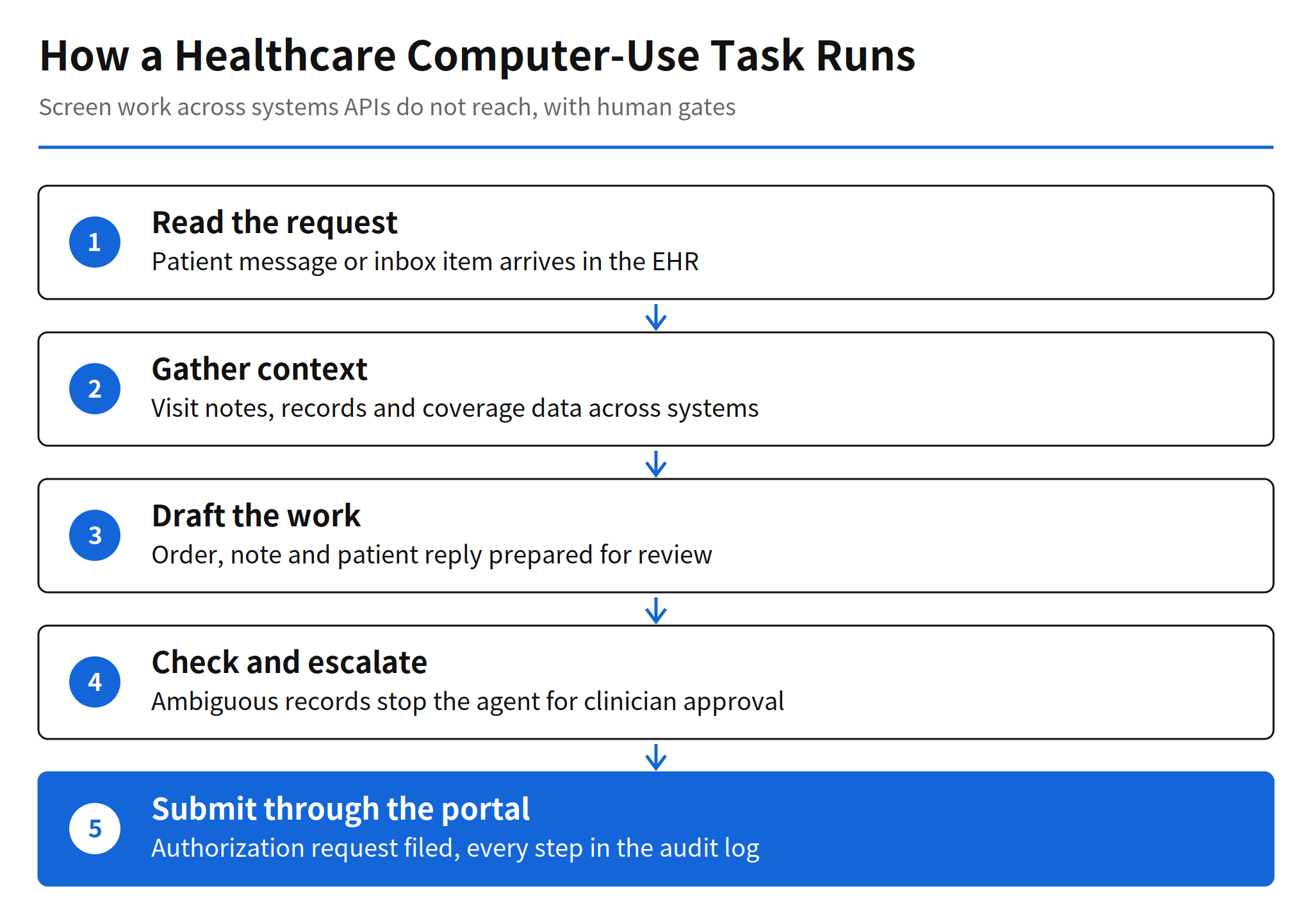
In the synthetic-patient demonstration OpenAI describes, a message about lower back pain starts the chain. The agent reviews visit notes, physical-therapy records and prior imaging, then drafts an MRI order, an encounter note and a patient reply for clinician review. After that it prepares an insurer-portal authorization request for an authorization specialist to review. Each consequential step lands in front of a person before it takes effect, which is the pattern the partner deployments repeat.
Abridge is building a cross-system assistant for discharge work across medication access and home health, running concurrent agents with escalation for clinical judgment. Its early environments are live with a few select partners, and its stated oversight requirements are concrete: show what information was used, whether each step completed, when the assistant escalated, and whether a payer received a submission. Ambience applies the same logic to prior authorization. The agent prepares a request from chart evidence, and when the record is ambiguous it stops and waits for clinician approval before submitting.
Oversight, Audit Logs and HIPAA Conditions
Health systems can restrict the actions an agent is permitted to take, pause the agent, and inspect a step-by-step audit log. ChatGPT for Healthcare provides role-based access controls and audit logs, and organizations can add approval steps and limit agents to the applications, records and actions each task needs. The point where an agent stops and hands work to a person is set by each organization. The Ambience pattern, stop on ambiguity and wait for approval, is one organization's choice, not a common standard across all deployments.
For workflows involving protected health information, organizations must use eligible services covered by an OpenAI Business Associate Agreement, with the required security and retention settings in place. OpenAI states that organization data is not used to train its foundation models. What the announcement does not publish is each organization's default configuration, so a team evaluating this for HIPAA-covered work still has to verify its own service eligibility and settings rather than rely on the launch post.
My read: the release is best understood as an evaluation template as much as a product launch. Safety judged on a counted task sample, helpfulness rated separately, an independent benchmark with a per-task cost, and production backlogs cleared at stated volumes. Teams building screen automation in any high-cost-of-error field can copy that reporting shape even if they never use these models. The open part is whether the oversight machinery, audit logs, action limits and escalation points, stays as rigorous when the agents move from administrative volume into broader clinical coordination, where Abridge's deployment is still in early environments.
Limits and Unconfirmed Points
- Safety is a judgment, not an outcome: the 99% figure is physician reviewers rating the model's work. Whether patient harm decreased in live care is not shown in this release.
- Benchmark detail is secondhand: the HealthAdminBench scores are quoted in OpenAI's post. The distribution of per-task failures in the benchmark's raw data is unconfirmed.
- Escalation rules are local: each organization sets when the agent stops and asks a person. There is no shared threshold across deployments.
- HIPAA defaults are unpublished: HIPAA-covered workflows require Business Associate Agreement eligible services and specific security and retention settings. Per-organization defaults are not in the announcement.
- Artifacts can leak: the CVS Health kit warns that traces may contain credentials, cookies and session tokens, and that redaction is best-effort. Teams adopting the kit need their own artifact handling rules.
FAQ
What did OpenAI release for healthcare teams?
OpenAI published performance, safety and cost results for computer-use agents built for healthcare teams on November 16, 2026. Healthcare teams, developers and individual clinicians can use the capability from that day through the OpenAI API, ChatGPT for Healthcare and ChatGPT for Clinicians.
What does the 99% safety figure mean?
Physician reviewers judged 99% of 325 reviewed GPT-6 Astra tasks from clinician EHR inboxes to be clinically safe. The figure describes reviewer judgments about the model's work, including whether inaccuracies or omissions could plausibly lead to patient harm. It is not a measured reduction in patient harm.
How did Astra and Luna compare on HealthAdminBench?
On HealthAdminBench, an independent benchmark built by Stanford researchers, GPT-6 Astra earned 94.3% of the rubric points and GPT-6 Luna earned 91.8%. Luna cost 8.5 cents per task, 98% less than Astra, and both models ran at maximum reasoning effort.
What production work is already running?
OpenAI reports that one CVS Health workflow cleared a months-long document-sending backlog over a weekend, and another agent handles system steps behind tens of thousands of specialist referrals each day. Cigna Healthcare case managers previously moved across more than 10 clinical and administrative systems to gather context for one case.
What do organizations need for HIPAA-covered workflows?
Workflows involving protected health information must use eligible services covered by an OpenAI Business Associate Agreement, with the required security and retention settings. OpenAI does not publish each organization's default settings in the announcement, and escalation thresholds are set by each organization.
Related Reading
- Ask AdMob Release: Agent Skills, MCP Server and How It Works, another agent release built around a human approval step before anything applies