Browser Use 1.0.6 Release: Default Model, 15x Pricing
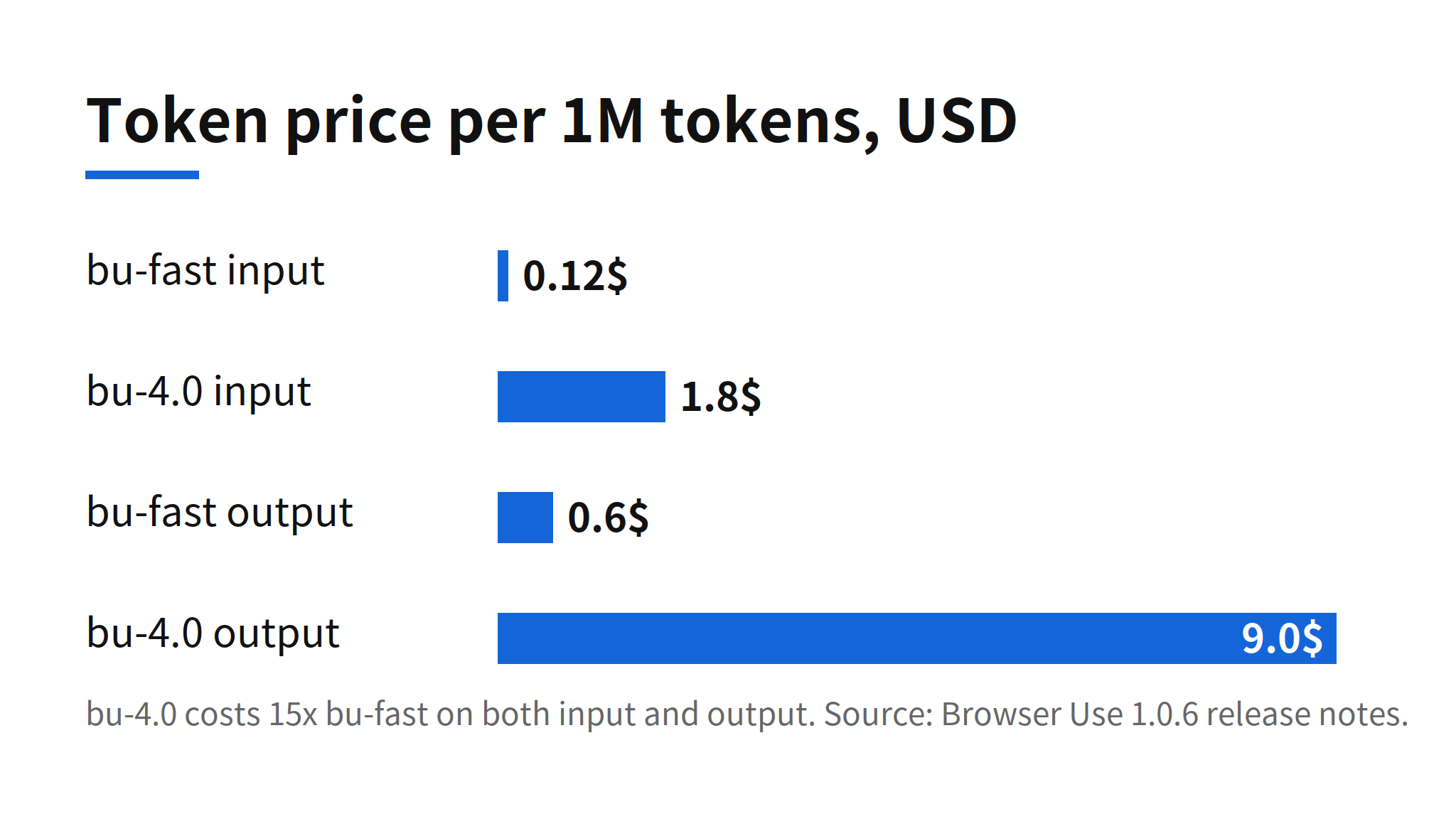
Browser Use 1.0.6, released on November 16, 2026 at 00:51 UTC, changes what an upgrade alone does to your bill. Code that creates an agent without naming a model now runs bu-4.0 on the Browser Use gateway instead of bu-fast, at $1.80 per 1M input tokens and $9.00 per 1M output tokens, which is 15 times the bu-fast price of $0.12 and $0.60. The default reasoning effort also rose from medium to high. Install it with pip install 'browser-use==1.0.6'.
The practical point comes first. If a pipeline calls Agent(task) or ChatBrowserUse() and passes no llm, upgrading the package is enough to change both the model and the cost structure. No code change is required, and no warning appears in the code itself. Teams that run browser agents on a schedule will see the change in the invoice before they see it in a diff, unless they read the release notes first.
What Changed in the Default Path
The change is narrow and specific. Agent(task) and ChatBrowserUse() now run bu-4.0 on the Browser Use gateway instead of bu-fast when the caller does not specify a model. The release notes frame this as a default change, not a removal. bu-fast remains available, and the newer model family adds two more named options on the same gateway.
Reasoning effort moved with the model. The default mode now runs at high instead of medium, which compounds the price effect in a way a token price table alone understates. A higher reasoning setting can consume more tokens on the same task, so the total cost of a run can rise by more than the 15x token price ratio. The one concrete run the release gives, a short test task, cost $0.022 instead of $0.0014, a ratio of about 15.7x, which is close to the token ratio for that task. Longer tasks with more reasoning steps may not track that ratio, and the release does not publish a per task type breakdown.
Pricing and the Missing Performance Number
The price table is the whole documented case for the change, and it is one sided. bu-4.0 costs 15 times as much on input and on output. What the release notes do not give is a completion rate, a success rate on a benchmark suite, or any measured gain that would let a reader judge whether the higher price buys a proportional result. That absence is the central fact for an upgrade decision. A default that costs 15 times more needs evidence about outcomes, and the release supplies evidence about price only.
My read: treat the new default as unproven until you measure it on your own tasks. Browser agent costs are driven by task length, page complexity and retry behaviour, all of which differ between teams. Run the same set of tasks on bu-fast and bu-4.0, record completion and total cost per completed task, and compare cost per success rather than cost per token. If bu-4.0 finishes tasks that bu-fast fails, its higher token price may still be the cheaper option per result. If completion is similar, the default change is a pure cost increase for that workload.
Keeping the Old Price and Choosing a Model
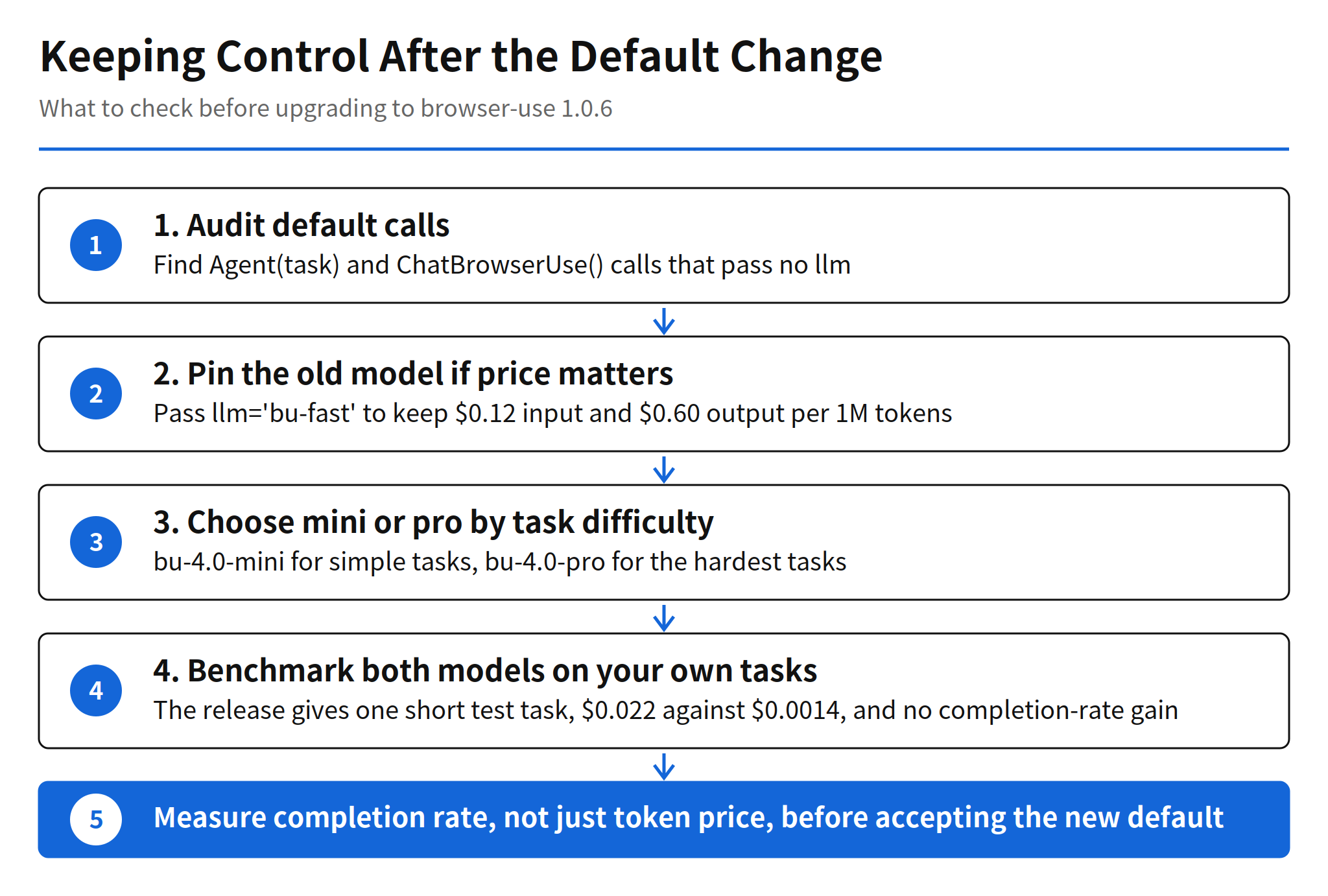
Keeping the previous behaviour takes one explicit argument. Pass llm='bu-fast' and the previous model and price apply. The release notes also name two alternatives inside the bu-4.0 family: pass llm='bu-4.0-mini' for simple tasks at the lowest cost, or llm='bu-4.0-pro' for the hardest tasks. The notes do not publish token prices for mini or pro. They point to the model and gateway pricing documentation instead, so the exact cost of those two options is unconfirmed in the release itself.
pip install 'browser-use==1.0.6'

# Keep the previous model and price
agent = Agent(task, llm='bu-fast')

# Simple tasks at the lowest cost in the new family
agent = Agent(task, llm='bu-4.0-mini')

# Hardest tasks
agent = Agent(task, llm='bu-4.0-pro')
Pinning the model explicitly is good practice beyond this release. A pipeline that names its model in code is insulated from default changes in either direction, and a future default change becomes a deliberate edit with a reviewable diff instead of a silent upgrade effect. The audit is small: search for Agent( and ChatBrowserUse( calls that pass no llm, then decide per call whether the task belongs on bu-fast, mini, the new default, or pro.
First Run Login and Judge Changes
Two smaller changes ship in the same release. On a first run without a key, Browser Use login opens and the run continues after approval, and cloud browsers print their live view link. That lowers the setup friction for a new user, since the authentication step happens inside the first run rather than as a separate configuration task.
The evaluator, called the Judge in the release, also changed how it presents cautions. Judge gotchas now stay grounded in what the run actually observed. For teams that read judge output as part of a review step, that grounding matters, because a caution invented beyond the observed run is harder to act on than one tied to a step the agent really took.
Context From the 1.0 Series
This default change lands on a very young major version. browser-use 1.0.0 arrived on November 10, and 1.0.6 followed six days later. The 1.0.0 release deleted about 80% of the code and moved the agent to driving CDP directly through a Python REPL. A default model change this early in the series means many users are still on their first 1.0 upgrade when the economics of the default path shift under them.
The scope also has a boundary that the release does not spell out. Users who pass their own model directly, rather than using the Browser Use gateway defaults, do not appear to be affected, since the change is described in terms of Agent(task) and ChatBrowserUse() on the gateway. The release notes do not state that boundary explicitly, so it is best read as unconfirmed and checked against your own configuration before assuming you are outside the change.
Limits and Unconfirmed Points
- No completion gain published: the release gives no figure for how much bu-4.0 improves task completion over bu-fast, so the value case for the 15x price is unmeasured in the source.
- One cost example only: the $0.022 against $0.0014 comparison is a single short test task from the release notes. Cost differences by task type are not published.
- Mini and pro prices not in the release: token prices for bu-4.0-mini and bu-4.0-pro are not stated in the release notes, only a link to the pricing documentation.
- Direct model users, scope unclear: whether callers who specify their own model outside the gateway are fully outside this change is not stated explicitly in the release notes.
FAQ
What changed in Browser Use 1.0.6?
The default model changed. Agent(task) and ChatBrowserUse() now run bu-4.0 on the Browser Use gateway instead of bu-fast, and the default reasoning effort rose from medium to high.
How much more does bu-4.0 cost than bu-fast?
bu-4.0 costs $1.80 per 1M input tokens and $9.00 per 1M output tokens, against $0.12 and $0.60 for bu-fast. That is 15 times as much on both sides. In the single short test task in the release notes, the cost rose from $0.0014 to $0.022.
How do you keep the previous model and price?
Pass llm='bu-fast' explicitly. The release notes state that this keeps the previous model and price. For simple tasks the notes suggest llm='bu-4.0-mini' at the lowest cost, and for the hardest tasks llm='bu-4.0-pro'.
Does bu-4.0 complete more tasks than bu-fast?
The 1.0.6 release notes give no completion rate figure for bu-4.0 against bu-fast. They give prices and one short test task cost, so any gain in task completion has to be measured on your own tasks.
Related Reading
- browser-use 1.0 Release: CDP Direct, 80% Code Deleted, the major version this default change builds on