Qwen4-Max Release: Pricing, 1M Context and Task Costs
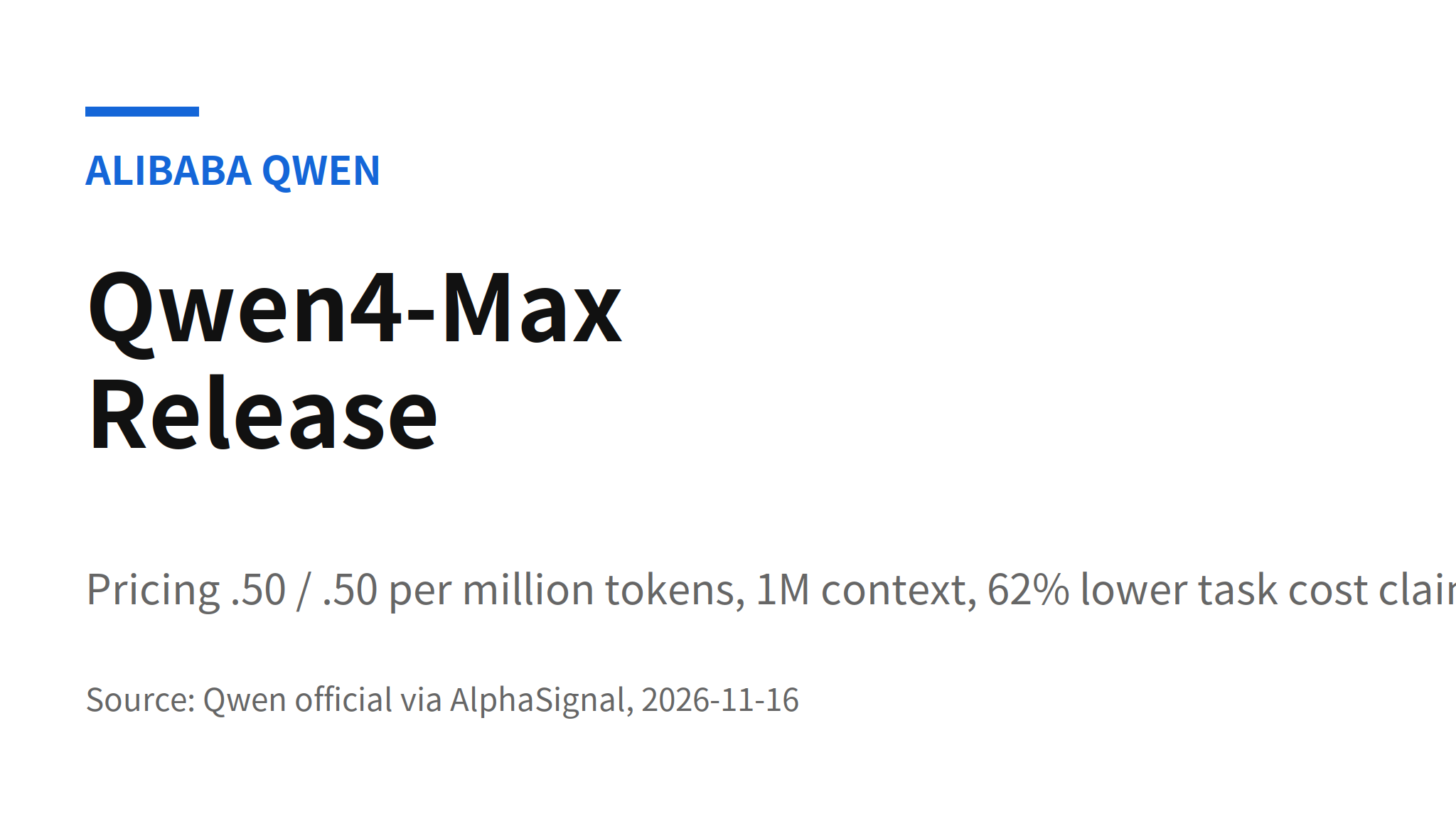
Alibaba's Qwen team released Qwen4-Max on November 16, 2026, turning a subscription only preview into a pay as you go API model. The listed price is $1.50 per million input tokens and $4.50 per million output tokens on QwenCloud, with implicit cached input at $0.075. The model accepts text, image and video, offers a 1 million token context window, and allows up to 393,216 output tokens.
The pitch is cost per completed task. Alibaba says its average Work360 task cost fell from $4.43 to $1.67, a drop of about 62%, while the Work360 score rose from 47.74 for Qwen3.8-Max to 52.69 for Qwen4-Max. Both numbers come from Alibaba's own evaluation, so they describe the direction the company wants to compete on more reliably than they settle how the model performs on someone else's workload.
The release also arrived early. The preview that opened on November 11 through the Token Plan was scheduled to end on November 25, and the full launch landed nine days ahead of that date with the pricing and cost figures the preview had left blank.
Pricing Against Qwen3.8-Max
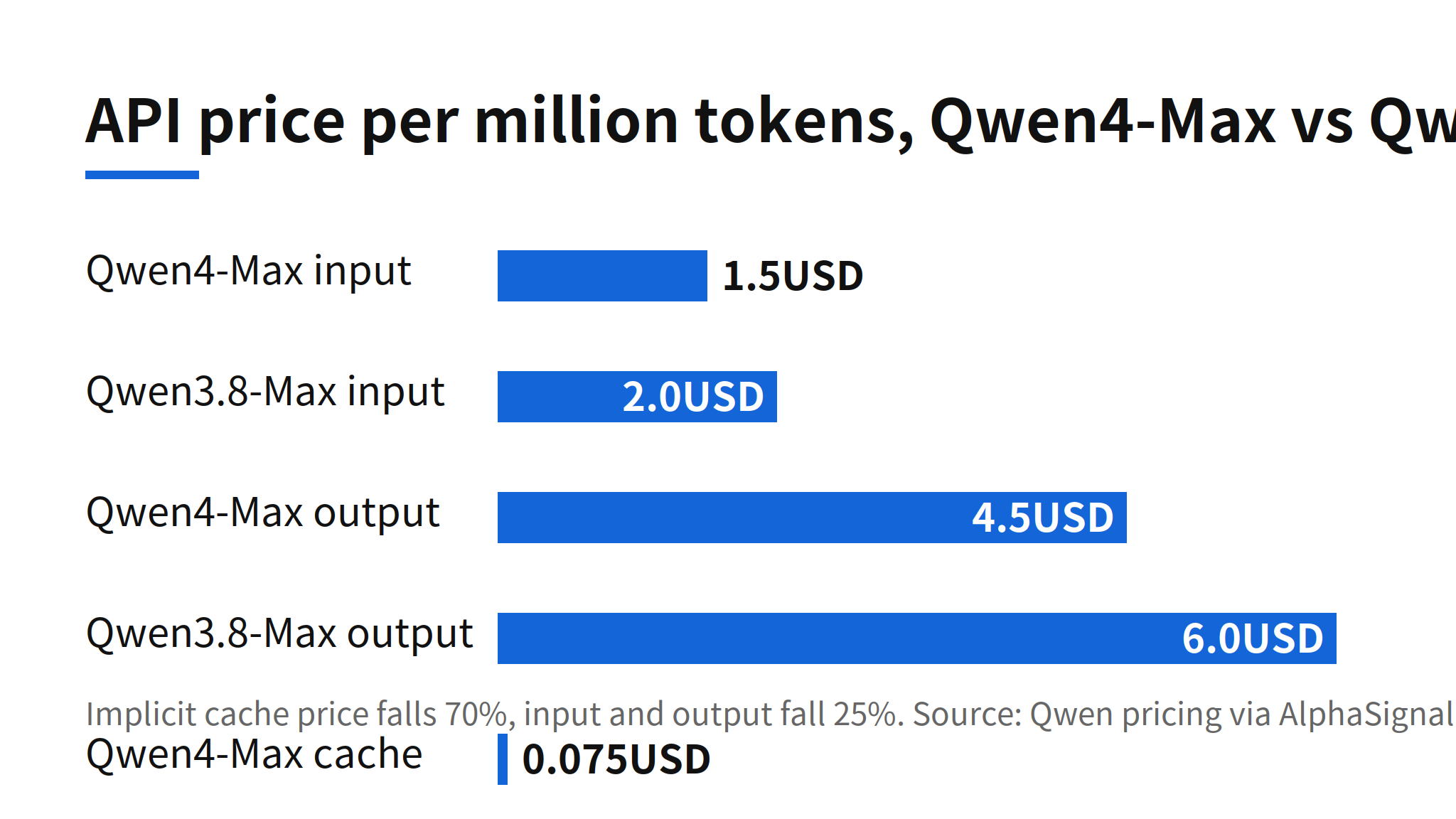
Input and output rates are both 25% lower than Qwen3.8-Max, which charged $2.00 for input and $6.00 for output per million tokens. The sharper cut is caching. Implicit cache input falls from $0.25 to $0.075, a 70% reduction that matters most for workloads that resend the same large prefix on every call, such as document review, retrieval systems and codebase agents. For those workloads the cache hit rate can move the real bill more than the headline input rate.
OpenRouter listed the same model on the same day as qwen/qwen4-max at the same $1.50 and $4.50 rates, so teams that already route through OpenRouter do not need a separate QwenCloud integration to test it. Access is also available through Qwen Studio, QwenWork and the Qoder coding environment.
Token Efficiency and the Work360 Claim
Price is only half of the cost argument. Alibaba reports that Qwen4-Max used about 24% fewer tokens at Xhigh reasoning and about 35% fewer at High reasoning on Work360, and about 48% to 49% fewer tokens on Terminal-Bench 4.0. In an agent loop, where a model may be called dozens of times for planning, tool calls, checks and retries, fewer tokens per step compound across the whole task. That compounding is how a 25% rate cut becomes a claimed 62% task cost cut.
Work360 itself needs context. It is Alibaba's own evaluation for tool use and long professional tasks, structured as 26 top level domains, 182 subdomains and 721 specialized fields. A first party benchmark can be well designed and still favor the tasks its maker chose to optimize for. No independent reproduction had been published at release time, and a circulating chart assigning Qwen4-Max a score of 53 on the Artificial Analysis index was flagged by AlphaSignal because the model was not listed in that index at publication time. The honest reading is that the efficiency claim is specific and testable, but not yet verified by a third party.
Access, Compatibility and Migration
QwenCloud exposes interfaces compatible with OpenAI Chat Completions, OpenAI Responses and Anthropic Messages, and the model supports tool calling, structured output and web search. That compatibility lowers the cost of a trial: an existing client can switch the API key, base URL and model identifier, then validate tool schemas, streaming behavior, error handling and token accounting before committing traffic.
from openai import OpenAI

client = OpenAI(
    api_key="<your QwenCloud key>",
    base_url="https://dashscope.aliyuncs.com/compatible-mode/v1",
)

response = client.chat.completions.create(
    model="qwen4-max",
    messages=[{"role": "user", "content": "Summarize this contract..."}],
)
print(response.choices[0].message.content)
Two operational details deserve attention in that trial. Output tokens are shared between reasoning and the final answer, so an explicit output limit and a deliberate reasoning effort setting are part of cost control, not optional tuning. Agent loops also need a stopping rule for stalled progress, because a cheaper token does not help if the loop runs twice as many steps.
Showcases and Architecture Gaps
Alibaba's announcement includes single showcase cases, including a manufacturing example where workpiece programming time reportedly fell from 475 minutes to 24 minutes, and a research run that screened 2.7 million candidate molecules over 48 hours of continuous execution. These are the maker's own examples, with no published reproduction conditions or failure rates, so they show intended use cases rather than expected results.
The architecture is similarly incomplete. Alibaba confirms a redesigned mixture of experts design, but it has not disclosed the total parameter count, the active parameter count or the expert configuration for Qwen4-Max. A secondary summary of the launch post described a 2.4 trillion parameter backbone with 71 billion active parameters and a 328 billion parameter n-gram embedding, while AlphaSignal reported that Alibaba did not disclose those figures. Until the official post confirms them directly, those numbers stay unconfirmed here. The predecessor, Qwen3.8-Max, was described with about 95 billion active parameters, which is not evidence about the new model.
Limits and Unconfirmed Points
- First party numbers: Work360 scores, token savings and the 62% task cost figure are Alibaba evaluations. Independent measurement is still missing.
- Parameters undisclosed: total and active parameter counts and the expert layout have not been confirmed by Alibaba for Qwen4-Max.
- Proprietary flagship: Qwen4-Max is not open source. Open weight releases were promised for smaller Qwen4 models, with no date and no license stated yet.
- Family schedule unknown: release timing for Qwen4-Flash, Qwen4-Plus and Qwen4-27B is unconfirmed, as are their parameter counts.
- Showcase evidence only: the manufacturing and molecule screening cases are single vendor examples without failure rates or reproduction details.
For teams running long agent jobs, the practical test is straightforward and does not require trusting Work360. Run the same tasks on Qwen4-Max and on the current model, and record completion without manual help, total tokens including reasoning and cached tokens, tool call failures and retries, wall clock time, and total spend per successful task including failed runs. Qwen4-Max makes a measurable claim, and that is its strength: if the savings survive real tool calls and real retries, the model earns its place on cost. If they do not, the price cut alone is a smaller story.
FAQ
How much does Qwen4-Max cost?
On QwenCloud, Qwen4-Max costs $1.50 per million input tokens and $4.50 per million output tokens. Implicit cached input costs $0.075 per million tokens. Those rates are 25% below Qwen3.8-Max for input and output, and 70% below for cached input.
What context and output limits does Qwen4-Max have?
Qwen4-Max accepts text, image and video input with a 1 million token context window. Maximum output is 393,216 tokens, shared between reasoning and the final response.
Is Qwen4-Max open source?
No. Qwen4-Max itself is proprietary and available through hosted services including QwenCloud, Qwen Studio, QwenWork and Qoder. Alibaba says smaller Qwen4 models will get open weight releases, but it has not published a date.
How was the 62% task cost reduction measured?
The figure comes from Alibaba's own Work360 evaluation, where average cost per task fell from $4.43 with Qwen3.8-Max to $1.67 with Qwen4-Max. Work360 is a first party benchmark covering 26 top level domains, and independent reproduction has not been published yet.
Related Reading
- Qwen4-Max-Preview Release: 1M Context, No Benchmarks Yet, the preview stage of this launch, published before pricing and benchmarks were disclosed