Sierra Poppy 1.0 Release: Personal Agent Protocol Guide
Sierra released version 1.0 of the Personal Agent Protocol, called Poppy, on November 13, 2026. Poppy is an open standard for the moment a personal agent arrives at a company and needs to work through that company business agent, website, or APIs. It defines how the agent finds the company, says who it is, and acts only inside the access the customer allowed.
The release matters less for the document itself than for the switch that was flipped with it. Shopify enabled Poppy for every merchant on its platform, and Poppy is now on for everyone who uses Muse, Meta AI agent, which automatically looks for Poppy first on every site it visits. A protocol that starts empty usually stays empty. This one starts with millions of storefronts on one side and a consumer agent that checks for it by default on the other.
What Poppy standardizes
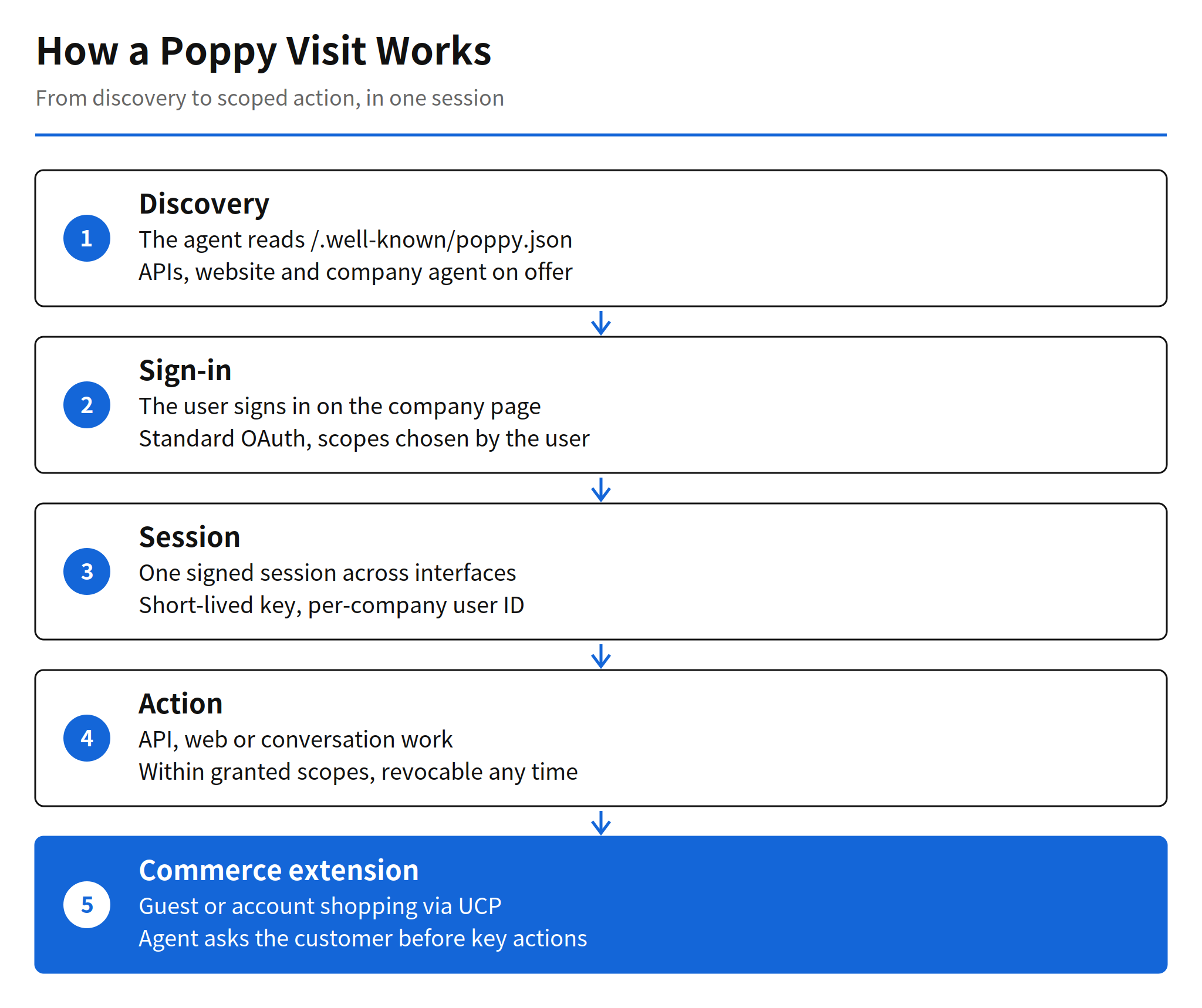
Today the choice at most companies is blunt. Either the company blocks agents, or an agent signs in as the person and can do anything that person can do. Poppy inserts the middle ground that the protocol site describes in plain terms. A company publishes a discovery document at /.well-known/poppy.json that identifies the organization and lists the APIs, website, and company agent it offers, along with the access agents can ask for. Standard OAuth metadata says where to sign in, and the user signs in on the company own page and chooses what the agent can see and do.
Once connected, one session covers API calls, conversations, and web browsing. The personal agent signs each API and conversation request with a short lived key, naming the session and a user ID that is different at each company. Sign in adds an access token and gives lasting access within the granted scopes, until it expires or the user or the company revokes it. Companies keep control of which agents they allow, how users sign in, and which scopes of account access an agent can request. That control is the product, in effect. Poppy sells companies a way to say yes in parts instead of yes to everything or no to everything.
How the protocol builds on existing standards
Poppy does not replace the stack agents already use. Sierra says the protocol was largely built with existing standards like MCP, OpenAPI, and UCP, and the protocol site says each API keeps its own schema. Authentication runs through OAuth, so customers control what personal agents can and cannot do and can manage that access over time. Since the first draft, the partners made adoption easier in stages, refined how the protocol uses those standards, expanded how a company can give guidance and collect feedback from an agent, and added extensions so industries can build on the core without changing it.
The clearest extension is the commerce extension co authored by Shopify. Shopify stores already support the Universal Commerce Protocol, UCP, by default, and Sierra draws a clean line between the two. UCP handles the shopping itself, such as finding products, filling a cart, and checking out. Poppy handles what happens before that, when an agent shows up, states its identity, and learns what it is allowed to do. The extension lets an agent shop as a guest or sign in with the customer account, makes the agent ask the customer before certain actions, and connects to UCP Ask so a shopper agent can talk directly to the store agent.
Live use at Mercury, Synchrony, and Turkish Airlines
Three named cases show what live means at this stage. At Mercury, people who use the service for business and personal banking can ask a personal agent to check balances, review recent transactions, categorize spending, or keep budgets and receipts up to date. A customer can also ask the agent to initiate a payment or transfer, with Mercury ensuring the request goes through the account approval policy before anything is sent. At Synchrony, the work explores how an agent could help a customer find a product while considering affordability and relevant offers and financing, across a network Sierra puts at more than 500,000 merchant locations. At Turkish Airlines, personal agents can check fares, flight status, and stopovers, pull up a booking with a reference number and surname, and find business class upgrades that customers approve before paying. Completing a purchase inside the conversation is still in progress there.
Read together, the three cases share a pattern that is more instructive than any single demo. Read only and low risk work is live now. Money movement and purchase completion pass through an approval policy or a customer confirmation, or are not finished yet. That is a sensible order of operations for a trust protocol, and it also marks the boundary of what version 1.0 actually delivers in production today.
Partner count and the limits of that number
Sierra says 60 new companies joined as design partners in this release, bringing the total to more than 100. The new list includes Cisco, Delta Air Lines, Intuit, Salesforce, Twilio, and Zoom, alongside the initial partners Meta, Genesys, Instinct, NiCE, Rocket, Shopify, Stripe, and Walmart. The initial announcement was last month, and drafts 0.1 through 0.4 were tested against real websites and APIs over five weeks before 1.0.
The partner count needs a careful reading, and the source material supports that caution. Joining as a design partner is not the same as publishing a Poppy file and receiving agents. The companies Sierra names as going live are Mercury, Synchrony, and Turkish Airlines, plus the platform level switches at Shopify and Muse. For the other names, the announcement confirms participation, not deployment. Teams evaluating Poppy should count live endpoints, not logos, and the protocol site validator and implementation kit Sierra mentions are the practical tools for checking a real implementation.
Limits and unverified points
Two limits should stay attached to the 1.0 label. First, the specification itself is marked draft 1.0, and the issue record notes that the spec says breaking changes may still arrive even though Sierra calls the release v1.0. Builders should pin their work to the current draft and expect revision, not treat 1.0 as a frozen contract. Second, payments are not in the protocol scope. An agent moving money depends on other standards such as UCP and on approval procedures at each company, as the Mercury case shows. Any claim that Poppy alone makes agent payments safe goes beyond what Sierra published.
For builders, the practical checklist from this release is short and concrete. If you run a service that personal agents will visit, publishing a poppy.json file and designing OAuth scopes are now first order tasks, because a default checking agent and the largest commerce platform in this story already look for them. If you build a personal agent, Poppy first discovery is the behavior Muse now ships, and matching it is becoming table stakes. The open question is conversion. How many of the more than 100 partners publish live endpoints, and how quickly, will decide whether Poppy becomes infrastructure or stays a well launched draft.
Related articles
- ChatGPT Wallet: How It Works, Pricing and Who Can Use It
- Perplexity Teammates Release: Persistent Agents, Pricing
FAQ
What is Poppy, the Personal Agent Protocol?
Poppy is an open standard from Sierra and partners that defines how a personal agent finds a company, identifies itself, signs a user in through OAuth, and works within scopes the user grants. It builds on MCP, OpenAPI and UCP.
What did Shopify enable for Poppy 1.0?
Shopify enabled Poppy for every merchant on its platform. Every Shopify store now automatically publishes a Poppy file, so merchants do not need to do extra implementation work.
How does Meta Muse use Poppy?
Sierra says Poppy is now on for everyone who uses Muse, Meta AI agent, and that Muse automatically looks for Poppy first on every site it visits.
Does Poppy handle payments?
No. Sierra and the issue record note that payments are not yet in the protocol scope. Moving money is left to other standards such as UCP and to approval procedures, for example Mercury routing a payment request through the account approval policy.