Amplitude Wave Product Agent: How It Works and Results
OpenAI published a customer story on November 12, 2026 about Wave, the product agent built by Amplitude. Wave decides what is worth building next. Given a product area and a goal metric, it collects Amplitude analytics, session replays, customer feedback and source code, ranks improvement opportunities, and turns the chosen one into a technical plan with acceptance criteria for a coding agent such as Codex. After the change ships, the same opportunity record is where the team measures what happened.
Amplitude says about 80% of Wave's intelligence comes from OpenAI models, with the rest from its own systems. The company also claims Wave can shorten a product improvement cycle from about a month to 1 to 2 days. Both numbers are Amplitude claims reported in the OpenAI story, not independent measurements, and the detail sections below keep that distinction visible. Pricing is not public, and customers are using Wave in beta.
The useful part of this case is not the headline speed. It is the handoff shape. Analytics tools usually stop at a dashboard or an insight, and a human still has to write the brief, scope the change and define how success will be judged. Wave produces that middle layer as a structured object, with the evidence attached, so a reviewer can reject the reasoning before any code is written.
Model Split by Job
The model assignment follows cost and depth rather than a single flagship for everything. GPT-6.1 Sol handles opportunity management and deep investigation across code and data, the work where a wrong conclusion is expensive. GPT-6 Luna handles high-frequency, lower-cost jobs such as code scans and small evaluation checks. GPT-Image-2.5 Flare creates mockups from session replay screenshots, so a proposed interface change can be shown rather than only described.
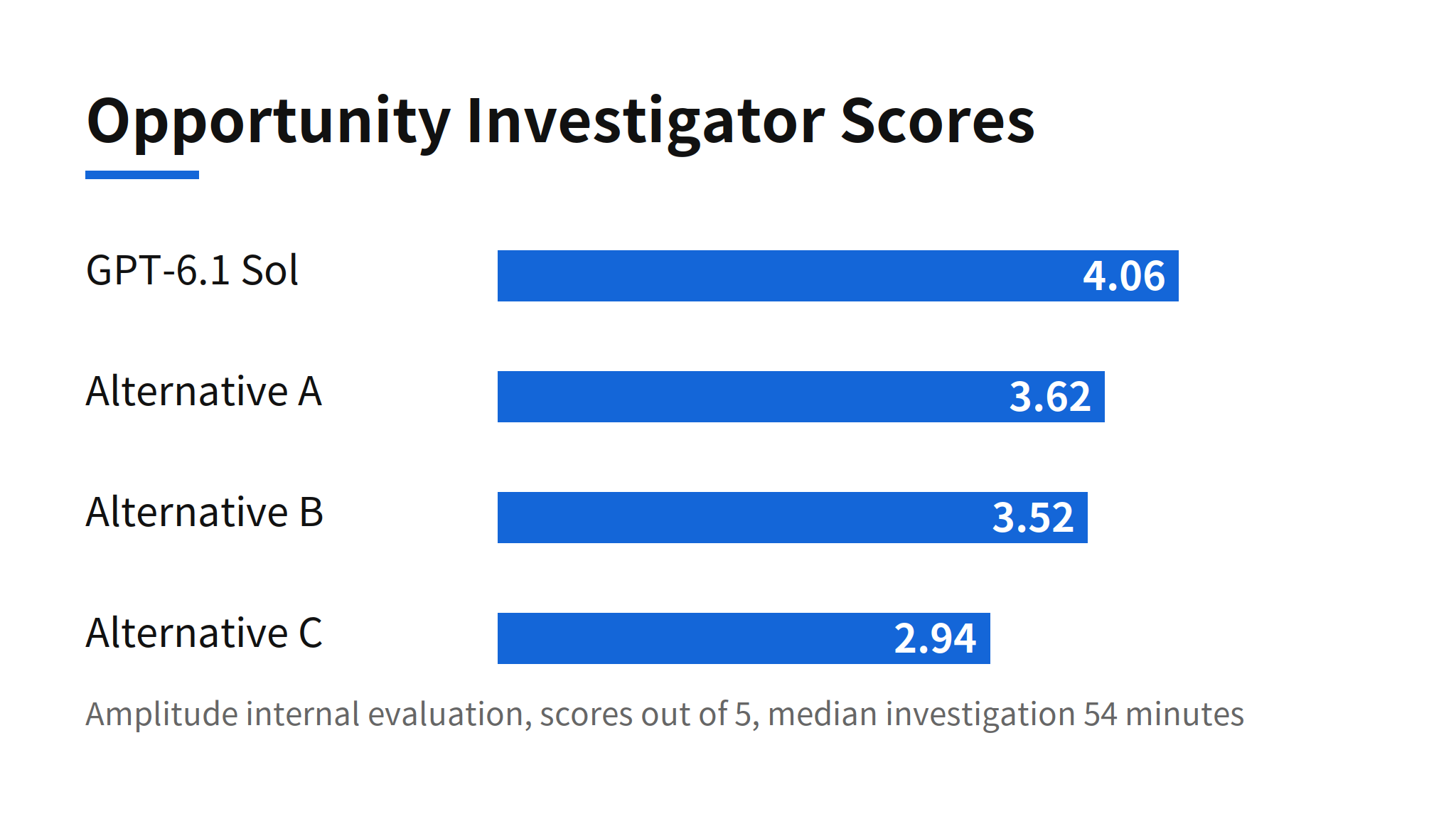
Amplitude tested the investigation step in its own evaluation, called Opportunity Investigator. GPT-6.1 Sol scored 4.06 out of 5, ahead of three alternative models at 3.62, 3.52 and 2.94, and the median investigation took 54 minutes. The story does not name the alternatives or publish the scoring rubric, so the gap is a reason to note Sol's placement, not a portable benchmark result. A team copying this design should expect to run the same comparison on its own opportunities, because investigation quality depends on how messy the underlying analytics and code are.
How a Wave Opportunity Moves
An opportunity starts with a goal, for example activation, conversion, agent quality or product friction, tied to a target metric. Wave then analyzes product data, watches session replays, reads feedback and surveys, and inspects the codebase. Its product page describes the loop as analyze, decide, build, experiment and learn, and each opportunity keeps the problem, the supporting evidence, a problem and solution view, a technical plan grounded in specific files, and the acceptance criteria in one place.
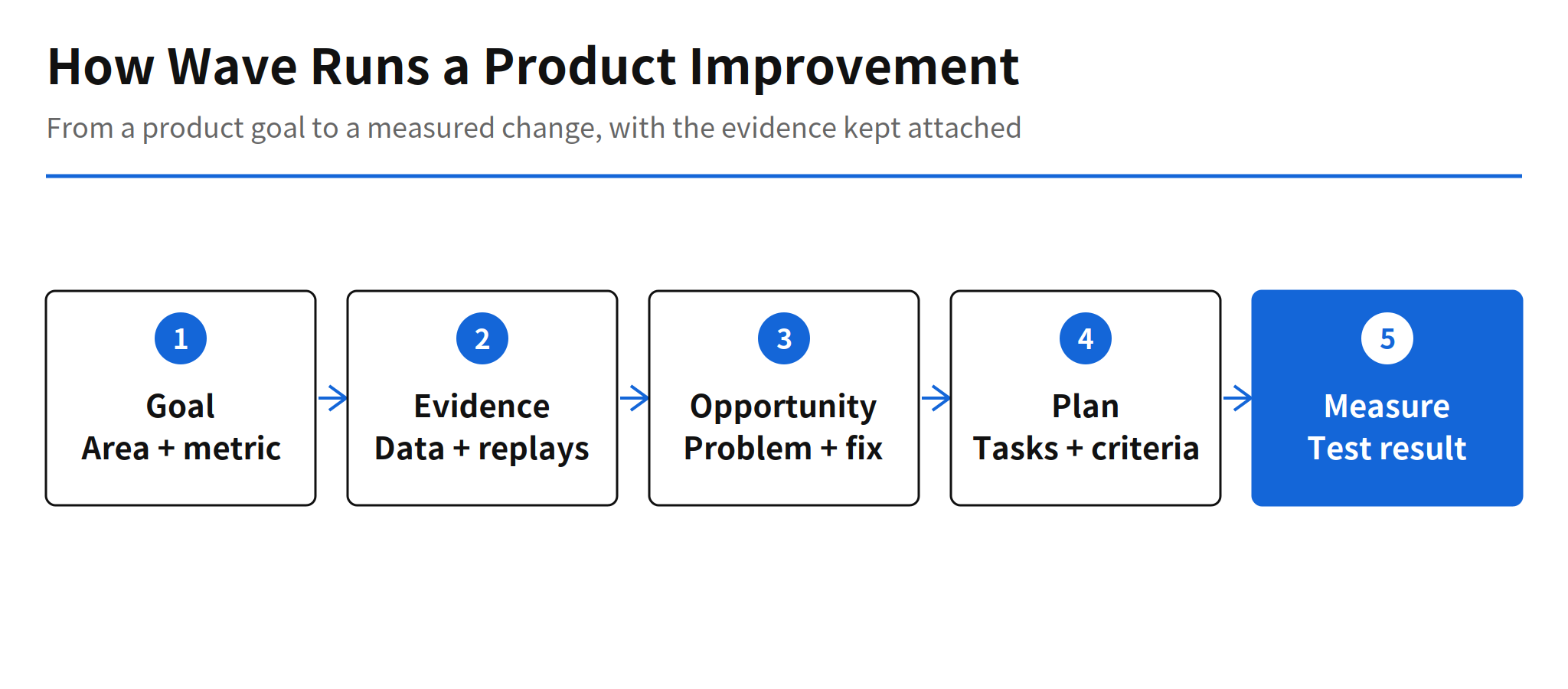
Execution is deliberately routed into tools teams already use. A reviewed opportunity can become a Linear, Jira or GitHub item, or go straight to a coding agent, and the evidence and plan travel with the work. The target metric from the original hypothesis stays attached through shipping, so the experiment readout answers the question the investigation started with. That continuity is also what makes the discard path important, and it is the part the public case does not quantify, as the limits section below notes.
Results on Amplitude's Own Product
Amplitude's own write-up, published November 9 and updated November 12, gives the most concrete evidence because it names the samples and calls out weak results as weak. The clearest case is the suggestion card study. In a review of 100 replays, users typed their question manually in 80 sessions and picked a suggestion card in only 12. The cards rendered correctly. They were just generic. Wave recommended generating suggestions from each user's recent chart and dashboard activity, and the team shipped personalized cards for users with that context while keeping generic cards for users without it.
In the original experiment from July, personalized cards recorded 2.43 suggestion sends per 100 exposed users, against 0.94 for generic cards. Amplitude reads that as a 160% increase and, in the same paragraph, labels it an initial test readout that still requires further validation. That pairing is the right way to read every number in this case: specific enough to check later, not yet a settled effect.
Other shipped changes show the range of what an opportunity can be. A contextual entry point into Custom Agent creation, added after Wave spotted that useful answers had no path into repeatable work, recorded about 70 unique users a week clicking through, roughly 8.3% of creation clicks over four weeks. A save-to-Notebook action for text answers recorded 152 save events over 30 days, and then exposed a measurement flaw: the team's Session Value Rate metric did not count the new save event, so the behavior could not be judged until the metric definition was updated. For AI Feedback onboarding, clearer setup guidance produced 121 users starting setup and 84 completing a source connection between June 30 and July 29, a completion rate of 69.4%.
Two cases keep the account honest. A recommendation label for HTTP API during developer onboarding measured 24.61% activation in the treatment against 17.75% in control, and Amplitude calls the result directional and statistically inconclusive, so the recommendation stays a hypothesis. A docs search fix was smaller and fully mechanical: search now waits for at least three characters and about 200 milliseconds of debounce, so incomplete queries no longer fire requests or pollute search telemetry. Wave also followed a bug that deleted sessions when a user clicked during an agent response, connected replay evidence to customer feedback, and turned the investigation into a coding agent pull request that the team reviewed and merged.
My read: the strongest claim in this case is not the 1 to 2 day cycle. It is that the investigation, the plan and the readout stay in one object. Most product teams lose the thread between an insight in a dashboard, a ticket written days later and an experiment reviewed weeks after that. If Wave's opportunity record really survives that whole path inside customer teams, and not only inside Amplitude, the product has a defensible shape even if the speed claim shrinks under outside measurement.
Limits and Unverified Claims
- Self-measured results: the cycle time, the model scores and the experiment readouts come from Amplitude's own use and evaluation. There is no third-party verification, and several readouts are labeled initial or inconclusive by Amplitude itself.
- Shipped changes only: the published results count changes that were actually shipped. The share of Wave proposals that teams reviewed and discarded is not disclosed, so precision cannot be judged from this case.
- Pricing and access: pricing, beta selection criteria and a general release date are unconfirmed. The product page offers access by request and an expert call, which suggests a sales-led rollout rather than self-serve signup.
- Data dependence: Wave's evidence quality rests on Amplitude analytics, replay coverage and a connected codebase. Teams without that instrumentation in one place should not expect the same investigation depth from the same models.
FAQ
What does Amplitude Wave do?
Wave takes a product area and a goal metric, gathers Amplitude analytics, session replays, customer feedback and source code, then ranks improvement opportunities. Each opportunity carries a proposed change, a technical plan and acceptance criteria that can go to a teammate or a coding agent such as Codex, and the result is measured in the same context after shipping.
Which models power Amplitude Wave?
Amplitude says about 80% of Wave intelligence comes from OpenAI models. GPT-6.1 Sol handles opportunity management and deep code and data investigation, GPT-6 Luna handles high-frequency, lower-cost work such as code scans and small evaluation checks, and GPT-Image-2.5 Flare builds mockups from session replay screenshots.
How fast does Wave make product improvements?
Amplitude claims Wave can cut a product improvement cycle from about a month to 1 to 2 days. That figure is Amplitude's own measurement from its internal use, with no third-party verification, and the published results count changes customers actually shipped.
What does Amplitude Wave cost and who can use it?
Pricing has not been published. According to the OpenAI customer story, customers are using Wave in beta, and Amplitude's product page offers access by request. Beta selection criteria and a general release date have not been confirmed.
Related Reading
- Perplexity Teammates Release: Persistent Agents, Pricing, another agent product built around ongoing work rather than single prompts
- Kiro Bots Release: Persistent Agents, Pricing and Memory, persistent coding agents on the implementation side of the same loop