Plurai Simulation Release: Agent Digital Twins, $13M Seed
Plurai launched Plurai Simulation on November 11, 2026, taking its agent simulation platform to general availability with a free starting tier for any agent developer. The company announced a $13M seed round on the same day, led by Team8 with participation from U&I, Velocity, Mercer and more than 20 angel investors and industry leaders. The product builds a digital twin of an agent and its operating environment, then runs simulated users against it so that failures surface before real customers reach the agent.
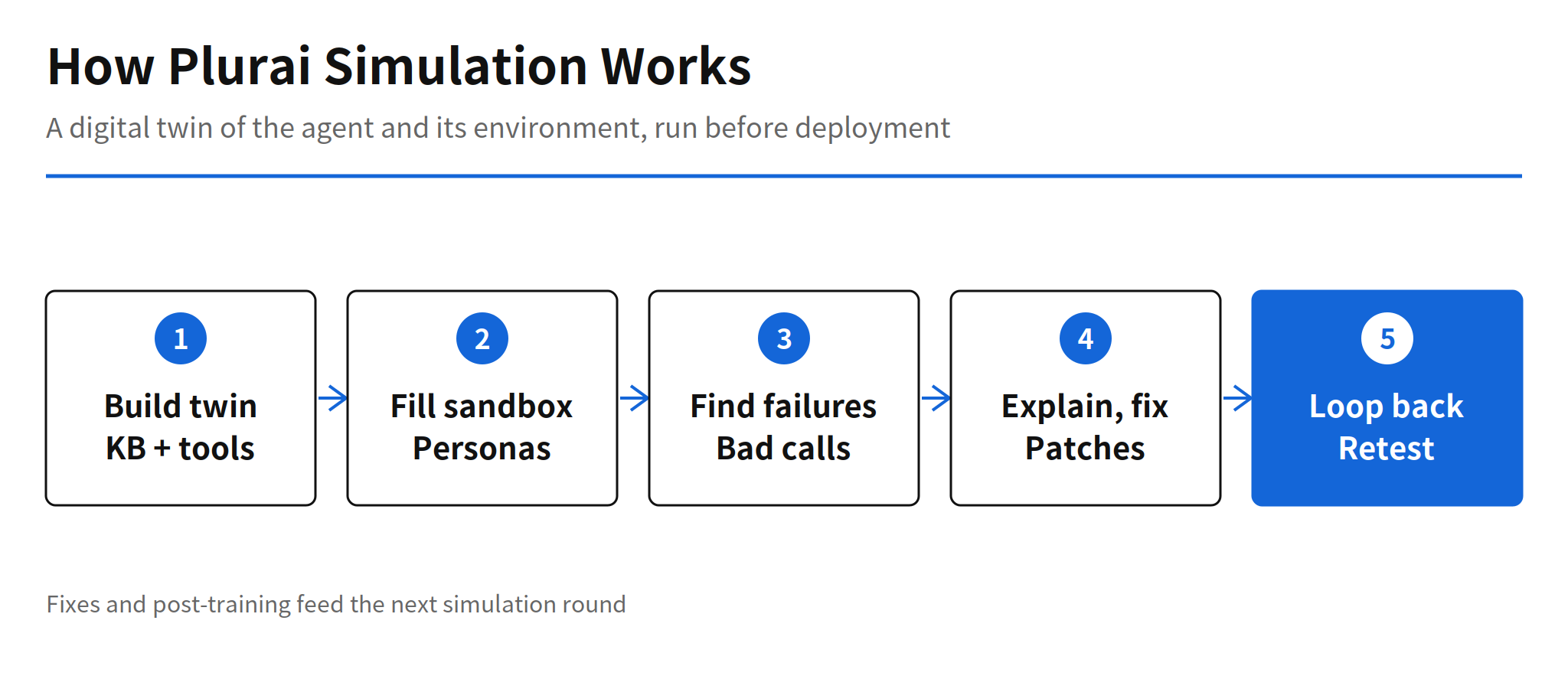
The gap Plurai targets is easy to recognise in practice. Agent demos usually work, and then real users arrive with requests, data and habits the demo never covered. Policy violations, hallucinations, wrong behaviour, broken tool calls, failed tasks and sensitive data leaks tend to appear at that point, in production, where each one costs support time and trust. Plurai moves that discovery into a sandbox built from the company own knowledge base, tools and policies, filled with personas modelled on real users plus deliberate edge cases.
How the Digital Twin Works
The twin is the organising idea. Instead of testing an agent against a fixed list of prompts, Plurai reconstructs the setting the agent will work in: the knowledge base it reads, the tools it can call and the policies it must follow. Simulated users then behave inside that setting, including the awkward cases a test writer would not think to script. A failure in the sandbox is useful precisely because the environment is close enough to production for the failure to mean something, and cheap enough to rerun after every fix.
That closeness is also the open technical question. A twin is only as good as its match with the real environment, and that match will vary by company, by data quality and by how often tools and policies change. Plurai has not published a method for measuring twin fidelity, and the failure types a simulation cannot reproduce are, by construction, the ones a team will still meet in production. The product reduces a known class of surprises; it does not remove the need to watch the live agent.
Fixes and Post-Training, Not Just Detection
Detection alone would make Plurai another evaluation dashboard. The launch describes a longer loop. The simulation explains why a failure happened and generates a fix, and the same simulation data is then used to post-train a model fitted to that specific agent. Failures found later in production flow back into the simulation set, so the tests a team runs next month include the incidents it actually suffered this month.
This loop is the meaningful design choice. Evaluation tools usually stop at a score, leaving the repair work to the team and the next prompt revision. A system that proposes the fix and retrains on the failure data is competing on repair speed instead, which matches how agent teams actually spend their time. The risk sits in the same place: a fix generated from simulation data can overfit to the twin, and a post-trained model tuned on synthetic failures still needs its own round of checking against real traffic before it earns trust.
Entry Points Inside Existing Tools
Distribution follows the workflow developers already have. Plurai can be started from Claude Code, Codex and GitHub Copilot, and agents built with Salesforce Agentforce can be imported. That choice lowers the trial cost to near zero for a team already shipping agents from a coding tool, and it puts the simulation step inside the build loop rather than in a separate QA phase that busy teams skip.
The company also added enterprise credibility signals around the launch. Dr. Eyal Carmi, CTO of Microsoft 365 Copilot, joined the advisory board. An adviser does not validate a product, but the appointment tells buyers which market Plurai wants: organisations running agents inside large productivity and CRM stacks, where a leaked document or a policy breach carries real consequences and where a pre-deployment gate is easiest to justify.
Background From Autonomous Driving
Founders Ilan Kadar and Elad Levi previously worked at Nexar, an autonomous driving company, and the product borrows that industry central lesson directly. Self-driving earned public trust through simulation at a scale far beyond road testing. Plurai cites Waymo as the reference point, with more than 20 billion simulated miles, roughly 100 times its real world driving. The founders say they saw the same pattern in agent development that driving teams saw on the road: the demo works, and the long tail of real usage is where the failures live.
The analogy is strong in one direction and weaker in another. Driving simulation benefits from physics that stay fixed, while an agent environment is made of changing documents, APIs and human expectations, so the twin needs constant rebuilding rather than a one time construction. Even with that caveat, the transfer is credible as a workflow: reproduce failures cheaply, fix them against the reproduction, and let production incidents expand the test set.
Performance Claims and Their Limits
Every performance number in this launch is a Plurai self-report, and the company has not disclosed sample sizes, measurement periods or comparison conditions. Design partners reportedly cut their agent development cycles from months to hours. Failures reaching real users fell by 82%, and the cost of operating a reliable agent fell by 97%. Joint work with NVIDIA and Nebius is presented with a stronger claim still: models post-trained by Plurai beat OpenAI and Anthropic frontier models on accuracy while costing 40 times and 44 times less.
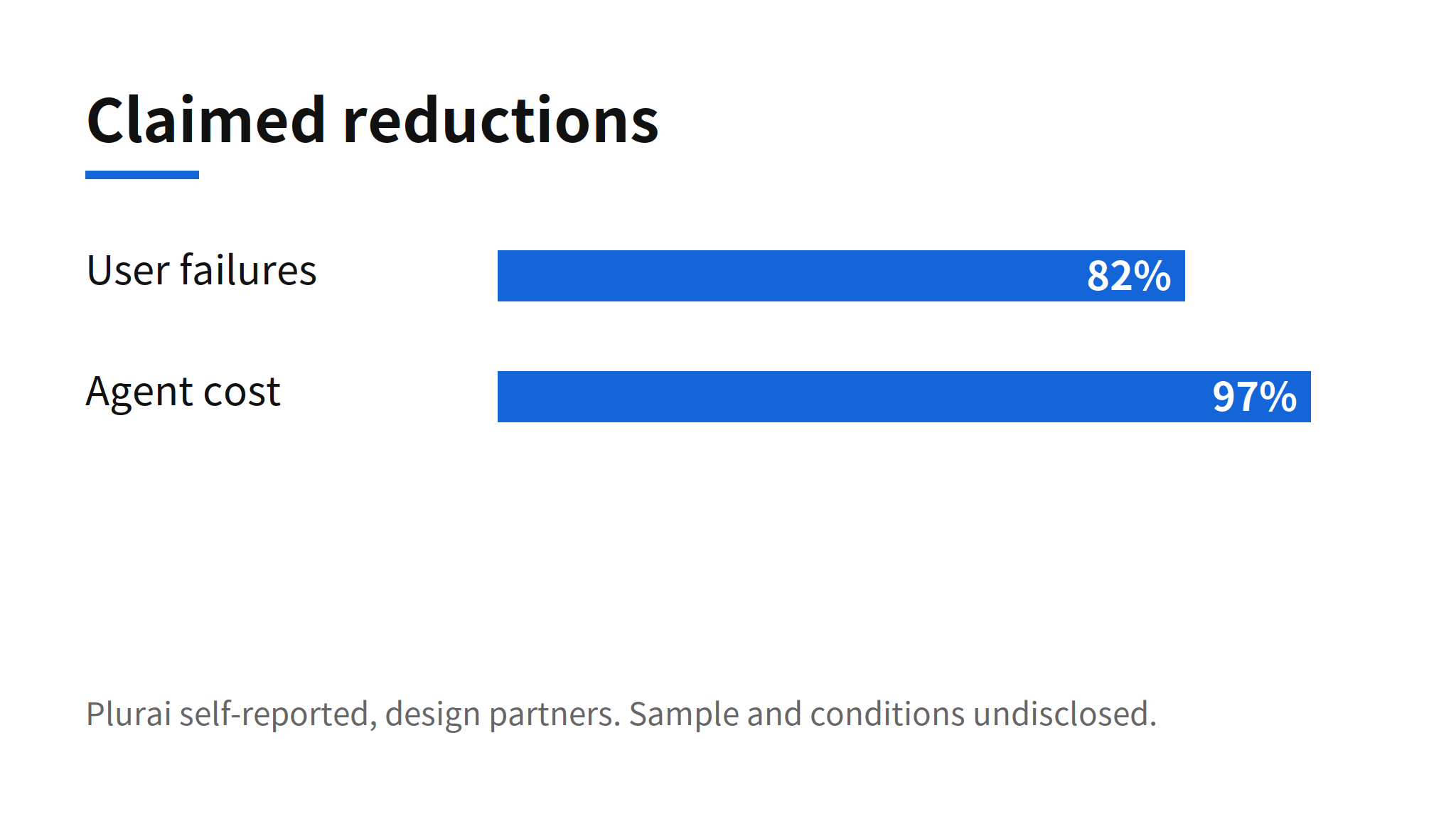
None of these figures has independent verification. The frontier model comparison names no benchmark, task set or evaluation date in the material summarised here, and the reduction percentages come from design partners selected by the company. Treat the numbers as a reason to run a pilot on your own agent, not as a measured ranking of Plurai against alternatives.
Two commercial details are also missing. The free tier has no published usage limits, and the conditions that move a team onto paid plans are not stated, so a budget decision cannot be made from the launch material alone. Pricing opacity is common at seed stage launches, but it matters here because simulation volume is the product: a team that simulates heavily needs to know what a run costs before it builds the habit.
Why Plurai Simulation Matters
Tools for building agents have multiplied quickly, while tools for reproducing agent failures before deployment stayed thin. Plurai is an attempt to claim that empty layer with a free entry point inside the coding tools developers already use, funded by a $13M seed and advised from inside the enterprise copilot world. Whether its headline numbers survive outside design partners is unproven. The category signal is clearer: agent evaluation and simulation are separating into their own product layer, and teams choosing agent tooling now have to budget for the testing layer as deliberately as they budget for the model itself.
FAQ
What is Plurai Simulation?
Plurai Simulation is an agent simulation platform that reached general availability on November 11, 2026. It builds a digital twin of an AI agent and its operating environment from a company knowledge base, tools and policies, then fills a sandbox with personas and edge cases so failures surface before real users reach the agent.
How much does Plurai Simulation cost?
Any agent developer can start for free, according to the launch post. The free tier usage limits and the conditions for moving to paid plans were not confirmed in the announcement.
How does Plurai Simulation fix failures, not just find them?
The platform explains why a failure happened, generates a fix, and post-trains a model fitted to the agent using the same simulation data. Failures that appear later in production flow back into the simulation, so the test set grows from real incidents.
Which tools does Plurai Simulation work with?
Developers can start from Claude Code, Codex and GitHub Copilot, and agents built with Salesforce Agentforce can also be imported. The entry point is the tool the developer already uses rather than a separate console.
Are the Plurai performance numbers verified?
No. The headline figures, including 82% fewer failures reaching users and a 97% lower cost of running reliable agents, are Plurai self-reported results from design partners. Sample size, measurement period and comparison conditions have not been disclosed, and no independent verification exists yet.
Related Reading
- StateBench: Frontier Models Fall to 13% on State Tracking (agent evaluation from the benchmark side)
- Kiro Bots Release: Persistent Agents, Pricing and Memory